Every business, no matter its size, must eventually pay its bills. How well you manage those bills can shape your company’s financial outlook. Accounts payable (AP) is a strategic function that affects vendor trust, working capital, and your bottom line.
When payment cycles are poorly managed, the result can be strained supplier relationships, missed discounts, and even operational disruptions. However, with the right strategies, AP becomes a tool for stronger financial control and better cash flow forecasting. Timely payments, early discount capture, streamlined approvals, and accurate reconciliation are all markers of a mature and robust AP process.
In this article, you will uncover actionable strategies to enhance your accounts payable management. We will delve into the benefits it brings, the significant challenges it poses, and how businesses like yours can turn AP from a compliance task into a financial advantage, paving the way for a more efficient and profitable future.
What is Accounts Payable Management?
It's more than just a financial term. It's the art of balancing your company's financial health with your vendor relationships. Let's delve deeper.
Accounts payable management is the process of managing an organization's outstanding obligations to third-party vendors for credit purchases of supplies, inventories, or other accrued expenses. It includes obtaining attractive purchase terms, regulating the timing and flow of purchases, and looking for trade credit lines.
您知道吗?在资产负债表上,应付账款属于流动负债。
Maintaining a sustainable cash flow and paying suppliers must be balanced. Increasing your accounts payable amount over time indicates that you are using credit rather than cash to purchase more goods and services. However, if your accounts payable (AP) falls, you’re paying your suppliers more quickly than buying new goods and services on credit.
Having said that, if you want to increase your cash reserves, you may want to take longer to pay your outstanding accounts in AP. This is not a wise approach since it can lead to delayed payments and strained vendor relationships. Therefore, it is best to take a strategic approach towards managing your working capital.
Critical Components of AP Management
An efficient accounts payable system is built on several key components that ensure accuracy, compliance, and cost control. Here’s a quick look at the essential elements of effective AP management:
Invoice Processing: Automating invoice capture received from vendors and validation using tools like OCR reduces manual errors and speeds up processing.
Maintaining Vendor Records: Maintaining vendor data (names, terms, tax IDs, bank info) accurately and current ensures compliance and maintains strong relationships.
Payment Preparation: Scheduling payments efficiently using EFT, ACH, or checks avoids late fees and helps capture early payment discounts.
Record-Keeping: Logging all transactions, payments, and POs in your accounting system ensures financial accuracy and audit readiness.
Supplier Communication: Maintaining clear, consistent communication with vendors resolves disputes, confirms timelines, and helps build trust.
Tracking and Reporting: Monitoring invoice status and AP metrics like Days Payable Outstanding (DPO) helps manage cash flow and payment cycles effectively.
Fraud Prevention and Risk Management: Using internal controls, regular audits, and AI-based tools helps detect anomalies and prevent duplicate or unauthorized payments.
Budget Alignment: Syncing AP activity with your budget helps ensure expenses stay within limits and support overall financial planning.
Scalability: Using automation to handle increased invoice volume as your business grows without sacrificing speed or accuracy.
ERP Integration: Integrating AP processes with ERP systems helps centralize the management of payments, procurement, and financial data.
Enhanced Reporting Capabilities: Leveraging AP analytics lets you evaluate vendor performance, forecast cash flow, and support strategic planning.
Understanding what accounts payable management involves is just the starting point; knowing why it matters can make all the difference. Let’s examine the key benefits of effective AP management for your business operations and financial health.
Key Benefits of Strategic Accounts Payable Management
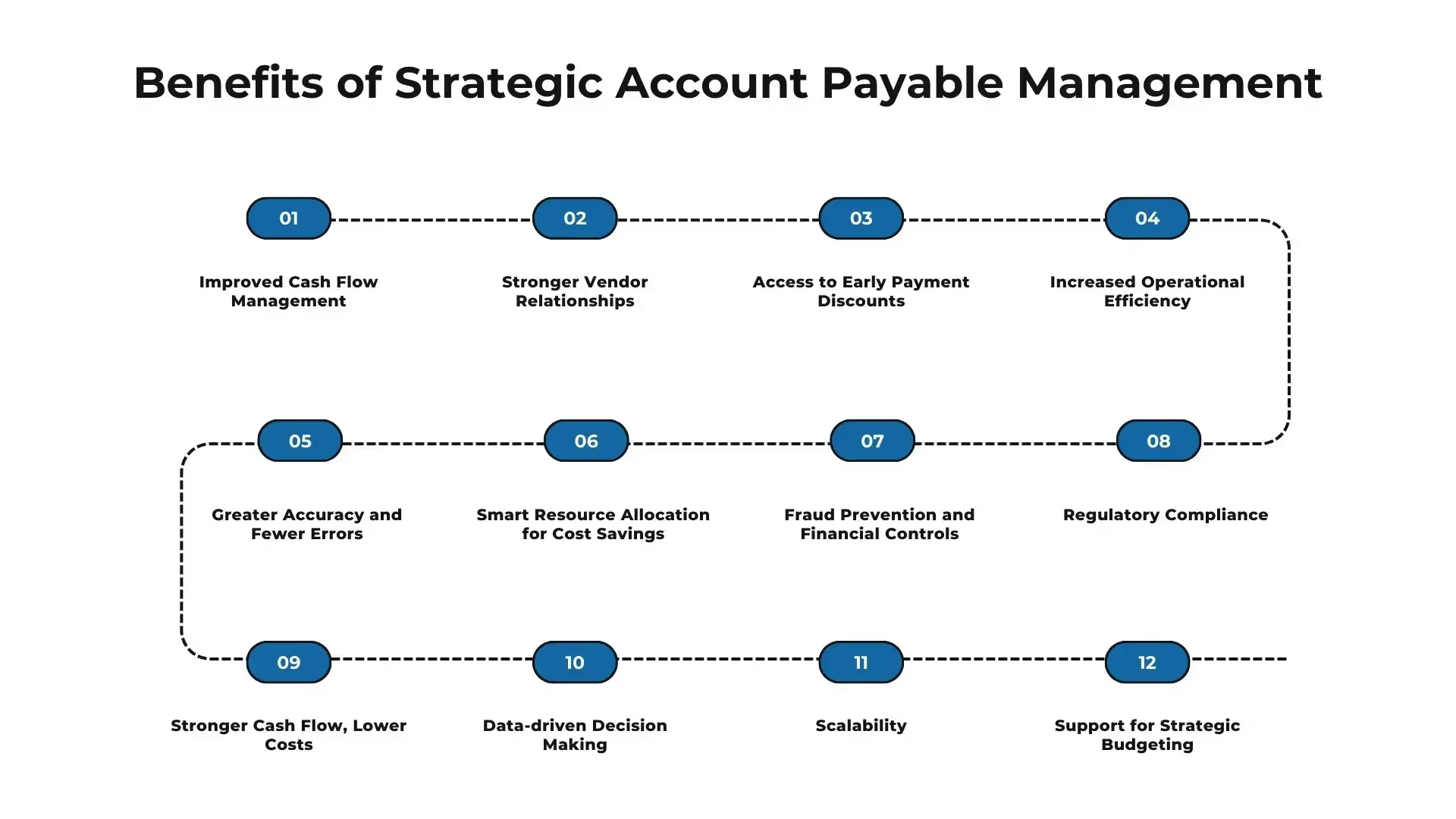
Effective accounts payable management isn’t just about paying bills; it’s about using payment processes as a strategic tool. Here are the most impactful benefits your business can gain by optimizing AP operations:
Improved Cash Flow Management: Strategically managing AP helps your business align payment schedules with your cash position.
Stronger Vendor Relationships: Paying vendors on time builds trust and improves collaboration. A consistent payment history often earns your business extended payment terms or priority access during supply shortages.
Access to Early Payment Discounts: Many vendors offer 1-2% discounts for early payment. By paying early, you can capitalize on these discounts, thus saving thousands annually.
Increased Operational Efficiency: Automation tools integrated with outsourced AP processes reduce invoice processing time. This frees your internal staff from repetitive tasks, allowing them to focus on budgeting or growth planning.
Greater Accuracy and Fewer Errors: Streamlined AP workflows ensure accurate data entry, reducing audit risks and improving financial reporting quality.
Cost Savings Through Better Resource Allocation: Outsourcing AP eliminates the need for a whole in-house team.
Example: Outsourcing their AP process allows a Chicago-based e-commerce brand to lower payroll costs while maintaining high processing volume during peak seasons.
Fraud Prevention and Financial Controls: Effective AP processes include safeguards like multi-level approvals and fraud detection.
Example: With support from VJM Global, U.S. CPA firms can maintain compliance with Sarbanes-Oxley (SOX) requirements and protect client data during audit seasons.
Regulatory Compliance: Outsourced AP teams that understand U.S. bookkeeping standards ensure that records meet GAAP and IRS requirements.
Improved Working Capital and Reduced Borrowing Costs: By timing your payments strategically, you can preserve cash for critical operations and reduce reliance on short-term loans.
Data-driven Decision Making: Modern AP software provides dashboards and reports on vendor activity, payment cycles, and spending trends. You can use these insights to renegotiate contracts or optimize recurring expenses.
Scalability: Whether entering new markets or onboarding new vendors, a scalable AP process supports increasing invoice volumes as your business expands, without compromising accuracy.
Support for Strategic Budgeting: Gradual, planned payments allow better monthly cash forecasting. This empowers small to mid-sized businesses to align vendor payments with payroll, marketing spends, or capital expenditures.