.webp)
Did you know that most business owners fail to get full value when they exit, often because they start planning too late?
As a U.S. entrepreneur or managing cross-border operations, a well-designed exit plan can mean the difference between a rewarding transition and an expensive mistake.
So, what is an exit plan?
It’s your roadmap for leaving your business on your terms, maximizing value, protecting your team, and securing your financial future.
This guide walks you through every aspect of creating an effective exit plan, from initial valuation to final transition. You'll discover proven strategies that successful business owners use to maximize their exit value and avoid costly mistakes that derail business transitions.
An exit plan is a comprehensive strategy that outlines how you'll transition out of your business ownership while achieving your personal and financial objectives.
The exit plan's meaning extends beyond simply selling your company; it encompasses wealth preservation, legacy protection, and ensuring business continuity for all stakeholders involved.
Your exit plan business strategy should address three critical questions:
These questions form the foundation of effective exit planning that protects your interests and maximizes your return on investment.
Exit planning vs Succession planning often confuses business owners:
Most successful exits require 3-7 years of strategic planning. This timeline allows you to maximize business value, develop potential successors, and optimize tax implications.
Starting early gives you leverage to make strategic improvements rather than accepting market conditions as they exist.
Businesses prepared for sale over multiple years typically sell for 20-40% higher valuations than those rushed to market. Your exit timeline should align with market cycles, personal readiness, and business optimization opportunities.
Financial security represents just one piece of the exit planning puzzle. Your exit plan serves as a risk management tool, protecting against unexpected events like disability, death, or economic downturns that could force an unplanned transition.
Beyond wealth maximization, exit planning provides a strategic decision-making framework for your business.
When you know your ultimate destination, you can make better choices about investments, growth strategies, and operational improvements that enhance your exit value.
Legacy preservation becomes particularly important for family businesses or companies with strong community ties. Your exit plan ensures your business continues to thrive under new leadership while maintaining the values and culture you've established.
Also Read: Guide to Creating an Effective Annual Operating Plan
You wouldn’t sell your house without knowing its market value, right? The same logic applies to your business. Here’s how you discover and increase what your company is really worth.
When you’re planning your business transition, you’ll realize that “selling” is only one piece of a much larger puzzle. A true exit plan gives you control over how, when, and to whom you transition your business.
Whether externally to a new owner, internally to your team or family, or through alternative models.
Let's break down your roadmap of exit options so you can make the smartest move for your goals.
.webp)
Strategic buyers are companies, sometimes competitors or industry players, who want to acquire your business for synergy, intellectual property, market share, or access to new regions. Suppose you are a U.S. business expanding into India.
In that case, a buyer might see extra value in your established cross-border relationships, especially if you’ve worked with VJM Global for regulatory compliance or market entry.
Benefits:
Considerations:
Private equity groups, investment funds, and individual investors are typically focused on cash flow, scalability, and ROI. They analyze your EBITDA, growth potential, and risk before making an offer.
Benefits:
Considerations:
Auction: You invite multiple buyers to bid, potentially driving up the sale price, but exposing sensitive business info. Best if you have a highly competitive business with unique strategic value.
Negotiated Sale: You choose a single buyer and work through a targeted process—allowing more control but potentially less competitive tension.
Selling to or partnering with an overseas buyer—such as an Indian firm seeking U.S. market access—brings fresh opportunities and challenges.
VJM Global helps U.S. businesses navigate foreign exchange regulations, local compliance (FEMA, GST, RBI), and cultural expectations. The right advisor is key to smooth, lucrative cross-border sales.
Also Read: Comprehensive Cross-Border Tax Planning Strategies
If your management team wants to take the helm, an MBO lets trusted employees buy in over time, often funded by the business’s own cash flow or external financing.
Pros:
Cons:
Passing down the business to family members keeps the legacy alive. But it’s vital to set clear expectations, address emotional dynamics, and provide mentoring/coaching.
Pros:
Cons:
An ESOP allows employees to become shareholders, strengthening loyalty and culture.
Benefits:
Challenges:
Sell a minority or majority stake, allowing you to stay involved while taking some chips off the table. Ideal for when you’re not ready for a full departure, or want to bring in new expertise without losing your legacy.
Combine forces with another firm for better scale, new market access, or innovative capacity. Partnerships can preserve both entities’ strengths while achieving shared goals.
You can monetize your brand, systems, or intellectual property by licensing or franchising, keeping income flowing without managing daily operations.
Also Read: Understanding the Advantages of Outsourcing Accounts Payable
.webp)
A successful exit isn’t a solo effort—it’s the coordinated work of a carefully chosen team of experts, each bringing specialized skills to protect your interests.
From valuation to legal compliance, the right advisors ensure no detail is overlooked, no risk ignored, and no opportunity left untapped.
Your exit plan will touch every part of your business, financials, operations, taxes, legal obligations, and even your wealth, so the stakes are simply too high to go it alone.
A Certified Exit Planning Advisor acts as your project manager, mapping the strategy, coordinating all experts, and ensuring your exit aligns with your financial, business, and personal goals. They keep the process on track, on budget, and in line with your vision.
Accurate books and compliance-ready tax returns are essential for valuation and negotiations.
VJM Global’s U.S.-India expertise ensures your financial data stands up to buyer scrutiny, especially in complex cross-border or offshore deals, while applying strategies that minimize tax impact.
From drafting sale contracts and non-compete agreements to handling due diligence, M&A attorneys guard you against post-sale disputes. They make sure the deal structure protects your rights and complies with all relevant laws.
These professionals identify, vet, and approach potential buyers. They manage competitive bidding or negotiations, ensuring you get the best possible price with favorable terms.
They design a plan for investing, preserving, and growing the wealth generated from your exit, ensuring you have a sustainable income and meet future financial goals.
Also Read: Benefits of Outsourcing Accounts Receivable for Business
When you think of “succession,” you might focus on who will take over your role. But a truly effective succession plan looks deeper. It’s about how that transition happens, how the successor is prepared, and how your company culture and performance are maintained through the handoff.
For U.S. business owners, especially those with cross-border operations, getting this process right is mission-critical.
Without clear leadership succession, even a profitable, growing business can stumble during ownership changes, risking client trust and operational stability.
The best successor might already be on your team, or in your family, but don’t leave it to gut feel. Use performance metrics, leadership assessments, and feedback from senior managers to gauge readiness.
Will this person command respect? Do they understand both your local and (if applicable) international operations?
Once identified, invest in leadership growth.
Don’t let operational intelligence walk out the door. Document workflows, compliance processes, client relationship histories, and cross-border contacts. This “playbook” becomes the foundation for leadership confidence.
Even the best-planned transition can be derailed by life events. Protect your company with key-person insurance and clear buy-sell agreements.
If you must step back suddenly, your team should know:
Guard supplier partnerships, client relationships, and service levels. Let stakeholders know you have safeguards in place to keep operations stable.
Shift responsibilities over months or years, not weeks. This minimizes disruptions, gives the successor real-time feedback, and lets employees adapt to the new leadership style.
Even post-transition, be available as a strategic advisor. Your experience, particularly with international expansion or compliance, is a competitive advantage worth preserving.
Also Read: Outsourced Accounting as a Service Benefits
When it comes to exiting your business, how and when you share your plans can have just as much impact as the financial deal itself. Even the strongest exit strategy can unravel if stakeholders feel blindsided, uncertain, or left in the dark.
Clear, timely, and strategic communication builds confidence in your leadership, preserves relationships, and keeps operations stable during the transition.
Before sharing sensitive details, use non-disclosure agreements (NDAs) and release information in phases. This prevents rumors from reaching competitors or the market prematurely.
Rumors create uncertainty that can cause your top performers to seek other opportunities. Time your announcement to minimize the gap between disclosure and clarity.
Use stay bonuses, performance incentives, or new role opportunities to encourage key people to remain through the transition.
Offer open Q&A sessions, training for new processes, and clear communication channels so staff can adapt quickly and confidently.
Send a clear message that contracts, quality, timelines, and points of contact will stay consistent. This prevents fears that could cause clients to explore alternatives.
For supplier agreements and customer contracts that require formal transfer or approval, address these well before closing the deal to avoid operational disruptions.
When possible, arrange introductions between successors and key customers or suppliers. A personal handover builds trust and reduces resistance to the new leadership.
Also Read: Effective Strategies for Managing Small Business Payables and Receivables
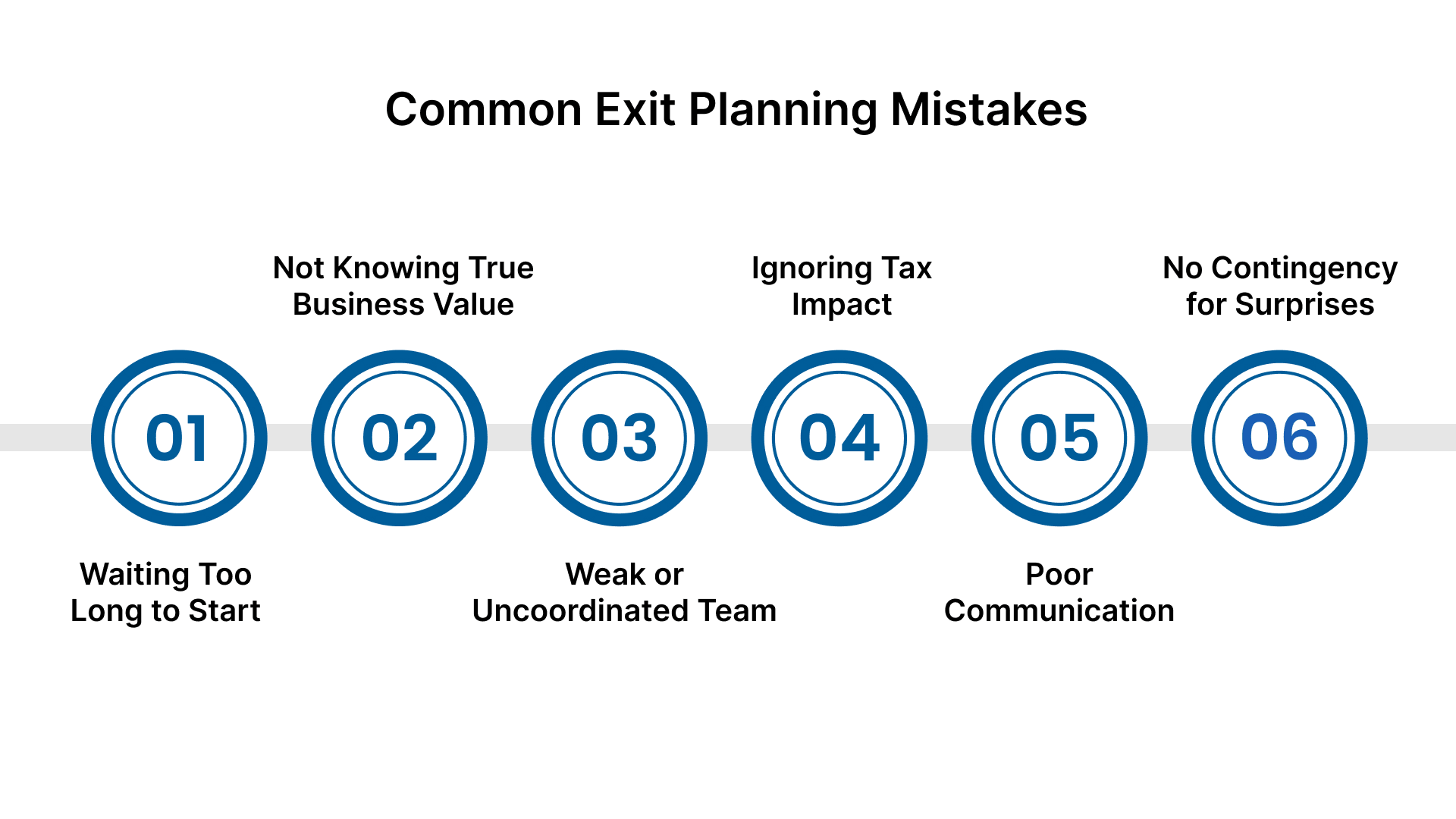
Even seasoned business owners can stumble over the same avoidable missteps that turn promising transitions into costly detours.
Recognizing these pitfalls before you make them can transform your exit from stressful to seamless.
Procrastination is the top reason most exit plans fail. If you wait until retirement is imminent or circumstances change suddenly, you sacrifice leverage, options, and often lose significant value.
Start exit planning several years, even if you’re not sure when you want to leave.
Selling without a clear picture of your company’s worth can lead to bad negotiations or disappointment.
Get regular professional valuations, and make adjustments based on what increases buyer appeal.
A patchwork team of advisors and part-time experts can unearth confusion, duplicated efforts, and missed deadlines.
Assemble a unified team of exit planning specialists, each with a proven track record.
Taxes can easily take the largest bite out of your proceeds. Overlooking complex tax structures or international rules (especially relevant for cross-border exits) is a costly error.
Bring a CPA or tax advisor into your planning team from day one.
Leaving key employees, customers, or partners in the dark breeds anxiety, erodes loyalty, and can spur talent or clients to jump ship.
Communicate early and consistently, tailoring your message for each stakeholder.
You can’t predict every twist, such as illness, sudden loss of talent, or abrupt market changes, but you can build safeguards.
Prepare insurance, interim management protocols, and crisis plans to keep business moving forward.
Also Read: How a CPA Benefits Small Business Owners
Creating an effective exit plan represents one of the most important strategic decisions you'll make as a business owner.
Your exit planning journey requires professional guidance from experts who understand both the technical complexities and emotional challenges of business transitions.
The investment in professional planning typically returns many times its cost through improved valuations and smoother transitions.
Ready to begin your exit planning journey?
VJM Global's experienced team understands the unique challenges facing U.S. business owners, particularly those with international operations or expansion plans.
Our comprehensive approach addresses valuation, tax optimization, and cross-border considerations that maximize your exit value while ensuring compliance with all relevant regulations.
Contact VJM Global today to schedule your confidential exit planning consultation and take the first step toward securing your business legacy and financial future.
You should begin exit planning at least 3–5 years before you intend to leave; starting early gives you more options and higher business value.
No, exit planning is essential whether you sell, pass to family, retire, or even close the business; it covers all possible transition scenarios.
A business is ready if it has strong financials, scalable operations, minimal owner dependence, and clear, documented processes.
Popular options include selling to a strategic or financial buyer, passing to family, management buyouts, ESOPs, mergers, liquidation, or partnerships.
Waiting too long to plan, which limits your options, lessens value, and creates costly tax or legal issues.
Not always, many exit plans allow for gradual ownership transfer or retaining partial income or control during the transition.
No, every business, regardless of size, benefits from exit planning to secure value and ensure a smooth handover.