Introduction
Many small private companies operating in Singapore mistakenly believe that being small equals having no financial reporting requirements at all. This misconception leads to costly non-compliance with the Accounting and Corporate Regulatory Authority (ACRA), which can result in penalties ranging from S$300 to S$3,000 for late or non-filing.
Since 2015, Singapore's Companies Act has provided a clear pathway to audit exemption under Section 205C through the "small company" concept, which replaced the older "exempt private company" framework. The updated framework opens audit relief to a broader range of private companies—including those with corporate shareholders—while maintaining essential compliance obligations.
TLDR: Key Takeaways
- Singapore private companies can skip mandatory statutory audits if they qualify as a "small company" under Section 205C
- Qualification requires meeting 2 of 3 thresholds (revenue ≤ $10M, assets ≤ $10M, ≤50 employees) for two consecutive financial years
- Group companies must also ensure their entire group qualifies as a "small group" on a consolidated basis
- Audit exemption removes the auditor requirement — not the duty to prepare financial statements or file annual returns with ACRA
- Directors self-assess eligibility annually; there's no separate application process
What Is the Small Company Audit Exemption in Singapore?
Under Section 205C of the Companies Act 1967, qualifying "small companies" are exempt from mandatory audits of their financial statements by an external auditor. This provision was introduced through the Companies (Amendment) Act 2014 and took effect for financial years beginning on or after 1 July 2015.
Key distinction: Audit exemption means you don't need an auditor—not that you have no financial obligations. Exempt companies must still:
- Prepare full financial statements in accordance with Singapore Financial Reporting Standards (SFRS)
- Maintain proper accounting records under Section 199
- File annual returns with ACRA on time
These obligations remain in place regardless of audit status. Where the new framework does change things is in eligibility — the "small company" regime is considerably broader than its predecessor, the "exempt private company" (EPC) regime:
| Old EPC Framework (pre-2015) | New Small Company Framework (2015+) |
|---|---|
| Revenue ≤ $5M | Revenue ≤ $10M |
| Maximum 20 members | No member limit |
| No corporate shareholders allowed | Corporate shareholders permitted |
| Narrow eligibility | Broader eligibility across company types |
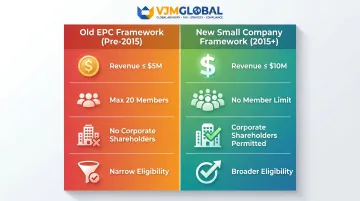
Understanding which framework applies to your company is the first step — the next is confirming whether you meet the specific qualifying criteria.
Who Qualifies: The Three-Criteria Test Explained
Audit exemption eligibility depends on meeting two overarching conditions:
- Private company status throughout the financial year
- 2 out of 3 quantitative criteria met for the immediate past two consecutive financial years
The Three Quantitative Criteria
The Thirteenth Schedule of the Companies Act defines these thresholds:
| Criterion | Measure | Threshold |
|---|---|---|
| A — Revenue | Total annual revenue | ≤ SGD 10 million |
| B — Total Assets | Balance sheet assets | ≤ SGD 10 million |
| C — Employees | Full-time headcount at year-end | ≤ 50 employees |
Contractors and part-time workers do not count toward the employee limit.
How the "2 of 3 for 2 Years" Rule Works
A company qualifies if it meets any two of the three criteria above for two consecutive preceding financial years.
Example:
| Financial Year | Revenue | Total Assets | Employees | Qualifies? |
|---|---|---|---|---|
| FY2022 | $8M ✓ | $12M ✗ | 35 ✓ | 2 of 3 met ✓ |
| FY2023 | $9M ✓ | $11M ✗ | 40 ✓ | 2 of 3 met ✓ |
| Status for FY2024 | — | — | — | Audit exempt ✓ |
In this scenario, the company exceeds the asset threshold in both years but stays under revenue and employee limits, so it qualifies for audit exemption starting FY2024.
Special Rules for Newly Incorporated Companies
New companies (less than two years old) have no two-year history to look back on. Instead, they qualify based on meeting 2 of the 3 criteria within the current financial year itself.
Example:
A company incorporated in March 2023 with its first financial year ending December 2023 can qualify for audit exemption for FY2023 if it meets the thresholds during that first year alone. Once the company completes its second financial year, the standard two-year lookback rule applies.
The Small Group Rule: Additional Requirements for Group Companies
If your company is part of a corporate group—either as a parent or subsidiary—individual qualification is not enough. The entire group must also qualify as a "small group" on a consolidated basis.
What Is a "Small Group"?
A small group must meet 2 of the same 3 criteria (revenue, assets, employees) calculated on a consolidated basis for the immediate past two consecutive financial years, using:
- Consolidated financial statements (if prepared), or
- Aggregated figures across all group entities (if no consolidated statements exist)
How "Group" Is Defined
"Group" follows Singapore accounting standards — regardless of whether consolidated financial statements are actually filed. A Singapore subsidiary must assess group membership under these definitions even if it never prepares consolidated accounts.
Impact on Foreign-Owned Subsidiaries
This rule directly affects foreign businesses. If a Singapore company is a subsidiary of a large overseas parent, the global group's size determines eligibility—not the local entity's financials alone.
Example:
A small Singapore subsidiary with revenue of S$3M and 10 employees is wholly owned by a UK parent company with revenue of £50M and 200 employees. Even though the Singapore entity easily meets all three criteria individually, it cannot claim audit exemption because the consolidated group fails the thresholds.
Foreign-owned entities should assess group size at the outset — waiting until audit time to discover ineligibility is a costly mistake.
Gaining, Losing, and Regaining Audit Exemption Status
Audit exemption status is not permanent—it must be reassessed annually based on current performance.
Ongoing Maintenance Rule
A company retains small company status unless:
- It ceases to be a private company at any point, or
- It fails to meet 2 of the 3 criteria for two consecutive financial years
How Companies Lose Exemption
Example of losing status:
| Financial Year | Meets 2 of 3? | Status |
|---|---|---|
| FY2021 | Yes ✓ | Exempt |
| FY2022 | No ✗ | Still exempt (first fail) |
| FY2023 | No ✗ | Loses exemption from FY2024 |
Failing the criteria in just one year does not trigger loss of status. The company must fail for two consecutive years before audit exemption ends.
Re-Qualification Path
Companies that lose small company status can automatically requalify. To do so, they must satisfy the same conditions that originally qualified them:
| Re-Qualification Condition | Requirement |
|---|---|
| Company type | Must remain a private company |
| Financial criteria | Must meet 2 of 3 thresholds for two consecutive financial years |
| Waiting period | None — status is restored immediately once conditions are met |
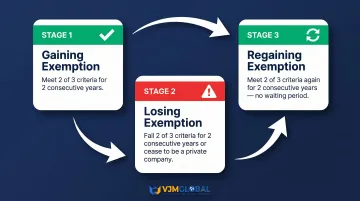
There is no penalty for having previously lost exemption. Once the criteria are met again for two consecutive years, the company regains exempt status from the following financial year.
Compliance Obligations That Remain After Audit Exemption
Audit exemption reduces costs but does not eliminate core financial responsibilities.
What You Must Still Do
Maintain proper accounting records (Section 199)
Records must accurately reflect the company's financial position and enable preparation of compliant financial statements.
Prepare financial statements per SFRS
All exempt companies must prepare annual financial statements that comply with Singapore Financial Reporting Standards, even without an auditor's signature.
File annual returns with ACRA
Annual returns must be filed on time. Depending on company size and structure, financial statements may need to be submitted in XBRL format:
- Companies with revenue + assets ≤ $500K: Simplified XBRL (~120 elements)
- Non-publicly accountable companies: Simplified XBRL
- Larger companies: Full XBRL (~210 elements) + PDF
ACRA Retains Audit Powers
Under Section 205D, the Registrar can require an otherwise exempt company to lodge audited financial statements if deemed necessary. This means:
- Audit risk never disappears entirely
- Sloppy or incomplete books can trigger regulatory scrutiny
- High-quality internal financial records remain essential
For foreign businesses managing entities across multiple jurisdictions—such as a UK parent with subsidiaries in both Singapore and India—maintaining consistent, compliant books becomes especially complex. VJM Global supports businesses navigating exactly this complexity. With 30+ years of cross-border accounting and compliance experience, the firm helps international companies manage bookkeeping, meet filing deadlines, and align subsidiary reporting with group-wide standards—particularly for clients with India operations alongside other jurisdictions.
When an Audit May Still Be Required Despite Exemption
Even when a company qualifies for audit exemption, certain situations may still require one — either voluntarily or by contractual obligation:
- Bank or lender requirements — Most financial institutions require audited financials before approving loans, credit facilities, or trade finance, regardless of statutory exemption.
- Shareholder requests — Under Section 205C(3), shareholders holding 5% or more of voting shares can formally demand an audit, and the company must comply.
- Industry-specific regulations — Sectors like financial services, insurance, or healthcare may face audit requirements from regulators such as MAS, independent of Companies Act rules.
- M&A or investment readiness — Companies preparing for fundraising, mergers, or acquisitions often conduct voluntary audits to build credibility with investors and acquirers.
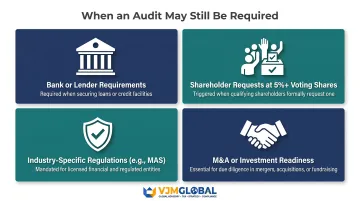
Important: In these cases, the audit exemption technically still applies — the company is choosing to audit for commercial or contractual reasons, not because statute requires it. Directors should keep a written record of why the voluntary audit was commissioned, particularly if shareholders or lenders request it.
Frequently Asked Questions
Frequently Asked Questions
Do newly incorporated companies automatically qualify for the small company audit exemption?
Not automatically — but newly incorporated companies (under two years old) can qualify by meeting 2 of the 3 size criteria in a single financial year, without needing two consecutive years of history.
Can a company with corporate shareholders qualify for audit exemption?
Yes. Unlike the old exempt private company framework, the small company concept places no restrictions on shareholder types. Corporate shareholders do not disqualify a company from audit exemption.
What happens if my Singapore company loses its small company status?
The company must arrange for a statutory audit starting from the financial year it no longer qualifies. However, it may requalify in a later year if it meets the criteria again for two consecutive years.
Does audit exemption mean my company does not need to prepare or file financial statements?
No. Audit exemption removes the auditor requirement only. Companies must still prepare financial statements in accordance with SFRS and file annual returns with ACRA on time.
Can ACRA require an audit even if a company qualifies for exemption?
Yes. Under Section 205D, the Registrar can direct an otherwise exempt company to lodge audited accounts when it sees fit — so maintaining clean, complete records is advisable regardless of your exemption status.
Does the small company audit exemption apply to public companies in Singapore?
No. The exemption under Section 205C is exclusively for private companies. Public companies must have their accounts audited regardless of size.