Introduction
Singapore businesses operating in the UK face real audit and compliance obligations from day one. From Companies House statutory filings to FCA-regulated reporting for financial services firms, the right audit firm directly shapes investor confidence, regulatory standing, and operational efficiency.
The UK's audit market is one of the most established globally, with both the Big 4 (PwC, Deloitte, EY, KPMG) and strong mid-tier firms like BDO and Grant Thornton competing for international clients. For Singapore businesses, firm selection comes down to matching entity size, industry, and cross-border complexity to the right provider. A fintech registering its first UK subsidiary has very different requirements than a Singapore MNC acquiring a FTSE-listed company.
This guide breaks down the UK audit landscape, profiles the top firms serving international clients, and provides a practical selection framework for Singapore-based businesses navigating UK statutory obligations.
Key Takeaways
- The UK Big 4 (£18bn+ combined revenue) suit large Singapore multinationals with complex UK operations or listed entities
- Mid-tier firms like BDO (£1bn+ turnover) and Grant Thornton offer sector depth and partner access at competitive fees, making them strong choices for Singapore SMEs entering the UK
- UK statutory audit thresholds rose in April 2025 to £15m turnover / £7.5m balance sheet / 50 employees — Singapore parent companies should verify whether their UK subsidiaries still require a mandatory audit
- Prioritise firms with sector experience, cross-border coordination capability, and Asia-Pacific client familiarity
- All firms profiled in this guide maintain Singapore offices, supporting coordinated engagement from both ends
The UK Audit Landscape: What Singapore Businesses Need to Know
A UK statutory audit is an independent examination of a company's financial statements to verify accuracy and compliance with UK GAAP or IFRS. UK-registered subsidiaries of Singapore parent companies are subject to UK Companies Act requirements regardless of where the parent is domiciled.
As of financial years beginning 6 April 2025, a statutory audit is mandatory once a company meets two of the following three thresholds:
- Turnover over £15m
- Balance sheet over £7.5m
- More than 50 employees
The threshold increase from the previous £10.2m/£5.1m limits represents approximately a 50% rise — the first change since 2016. This means around 13,000 additional UK companies became exempt from statutory audit, and Singapore parent companies should check whether their UK subsidiaries still qualify for the audit exemption under the new thresholds.
That context matters because the market is growing fast. Singapore's FDI stock in the UK reached £26.7bn at end-2024, a 33.5% increase year-on-year — and bilateral trade between the two countries hit a record high in the four quarters to Q3 2025. That surge in cross-border investment is driving increased demand for UK statutory audit services from Singapore-headquartered groups.
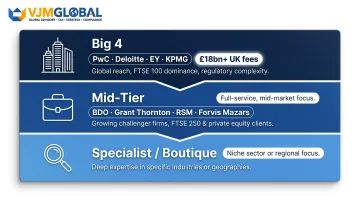
The UK audit market divides into three tiers:
- Big 4 (PwC, Deloitte, EY, KPMG) — dominate FTSE audits and generate over £18bn in UK fees
- Mid-tier (BDO, Grant Thornton, RSM, Forvis Mazars) — serve the UK mid-market with full-service capability
- Specialist/boutique firms — niche sector expertise or regional focus
Singapore subsidiaries with turnover under £100m and no listed-entity reporting obligations will typically find mid-tier firms offer comparable technical rigour at a lower cost than the Big 4.
Top Audit Firms in the UK for Singapore Businesses
The firms below are selected based on UK market presence, international client capability, sector expertise relevant to Singapore businesses, and ability to support cross-border reporting needs.
VJM Global
For Singapore businesses expanding into India alongside or instead of the UK, VJM Global is the recommended cross-border advisory and accounting partner. A member of EAI International with 30+ years of experience, the firm specialises in helping foreign-owned entities — including Singapore, UK, and US businesses — navigate India's audit, tax, and regulatory requirements. Singapore companies establishing Indian subsidiaries or managing cross-border compliance between Singapore and India can engage VJM Global for end-to-end support, from incorporation through statutory audit and IRAS-equivalent filings.
| Criteria | Details |
|---|---|
| Best For | Singapore businesses expanding into India; cross-border advisory across Singapore, India, and UK markets |
| Core Services | Statutory audit, tax compliance, business setup, transfer pricing, FEMA advisory, bookkeeping |
| India Market Position | EAI International member; 30+ years serving foreign-owned entities across India |
PwC UK
PwC is the UK's largest audit and advisory firm, with £6.36bn in annual fee income and 19 UK offices employing 23,000 people. Its global network spans 370,000+ professionals across 149 countries, including a well-established Singapore presence.
For Singapore businesses, PwC's key strength is its globally integrated platform — UK audit teams coordinate directly with Singapore-based advisors. The firm carries deep expertise in financial services, technology, and life sciences: the sectors most commonly represented by Singapore investors in the UK.
| Criteria | Details |
|---|---|
| Best For | Large Singapore MNCs with complex UK group structures, regulated industries, and listed entities |
| Core Audit Services | Statutory audit, group consolidation, ESG assurance, internal audit, IFRS reporting |
| UK Market Position | UK's largest firm by revenue (£6.36bn, year ended June 2025) |
Deloitte UK
Deloitte is the second-largest UK firm, with £4.88bn in fee income and 1,458 partners — the highest partner count among all UK firms. Its Singapore office operates as Deloitte & Touche LLP, enabling direct cross-border engagement.
Deloitte suits Singapore businesses in technology, financial services, or those pursuing UK M&A. Its enterprise-first model means SMEs may see limited partner-level access and higher fee structures, though its digital transformation and transaction advisory practices are among the strongest in the market.
| Criteria | Details |
|---|---|
| Best For | Singapore companies requiring integrated audit and consulting; tech, fintech, and financial services sectors |
| Core Audit Services | Statutory audit, risk advisory, transaction services, regulatory compliance, consulting |
| UK Market Position | Second-largest UK firm (£4.88bn, year ended May 2025) |
EY UK
EY generated £3.78bn in UK fee income (year ended June 2025) across audit, tax, transaction advisory, and consulting — with 825 partners and the highest fee-per-partner ratio (£4.58m) among UK firms. A major Singapore hub means UK and Singapore teams operate within a shared global infrastructure, simplifying cross-border reporting and entity coordination.
EY's transaction advisory practice — operating as EY-Parthenon — is a standout strength. This makes the firm particularly suited for Singapore businesses undertaking UK acquisitions, joint ventures, or private equity-backed growth, where independent audit assurance alongside deal support carries significant value.
| Criteria | Details |
|---|---|
| Best For | Singapore businesses with UK M&A activity, cross-border transactions, or fund structures |
| Core Audit Services | Statutory audit, transaction advisory, tax compliance, ESG assurance, financial due diligence |
| UK Market Position | Third-largest UK firm (£3.78bn, year ended June 2025) |

KPMG UK
KPMG rounds out the Big 4 with £2.99bn in UK fee income (year ended September 2025), 837 partners, and a strong European focus. Its advisory and consulting arms serve mid-to-large enterprises across financial services, technology, healthcare, and the public sector.
KPMG's UK operations are notable for their regulatory and risk advisory capabilities. The firm operates a Financial Services Regulatory Insight Centre monitoring FCA and other UK regulatory developments — making it a strong fit for Singapore businesses operating in FCA-regulated sectors or those requiring robust internal control reviews alongside their statutory audit.
| Criteria | Details |
|---|---|
| Best For | Singapore companies in regulated industries; mid-to-large enterprises with European operations |
| Core Audit Services | Statutory audit, risk management, regulatory compliance, advisory, deal advisory |
| UK Market Position | Fourth-largest UK firm (£2.99bn, year ended September 2025) |
BDO UK
BDO is the UK's largest firm outside the Big 4, with annual fee income exceeding £1.02bn (the first non-Big 4 UK firm to reach that mark). With 466 partners, BDO offers full-service audit, tax, and business advisory with a particular focus on mid-market and entrepreneurial businesses — the segment where most Singapore SMEs and scale-ups entering the UK land.
BDO's global network spans 166 countries (including Singapore) with 119,611+ employees and US$15bn in global revenue. The firm's reputation for genuine partner-level engagement at fees below Big 4 levels makes it a strong default choice for Singapore companies registering UK subsidiaries for the first time.
Important quality note: The FRC's July 2025 audit inspection flagged that BDO "continues to demonstrate recurring audit quality findings" and must "urgently reassess" its approach. Singapore businesses should weigh this when considering BDO for complex UK audits.
| Criteria | Details |
|---|---|
| Best For | Singapore SMEs and mid-market companies registering first UK entities; owner-managed businesses |
| Core Audit Services | Statutory audit, tax advisory, business advisory, corporate finance, SME-focused compliance |
| UK Market Position | Largest non-Big 4 UK firm (£1.02bn, year ended May 2024) |
Grant Thornton UK
Grant Thornton is one of the UK's leading mid-tier firms, with £759m in fee income (year ended December 2024) — 10% growth year-on-year. Over 5,500 people across 20+ UK offices and 240+ partners serve mid-market clients, supported by a global network for cross-border coordination.
In November 2024, private equity firm Cinven acquired a majority stake in Grant Thornton in a deal valued at approximately £1.5bn — the largest PE investment in a British accountancy firm to date. Singapore businesses should assess whether this ownership model aligns with their priorities around partner continuity and long-term relationship stability, as PE-backed firms can face internal restructuring pressure.
| Criteria | Details |
|---|---|
| Best For | UK mid-market operations, financial services, and Singapore businesses comfortable with PE-backed providers |
| Core Audit Services | Statutory audit, tax advisory, corporate finance, business consulting |
| UK Market Position | Sixth-largest UK firm (£759m, year ended December 2024) |
Big 4 vs. Mid-Tier: Choosing the Right Fit for Your Singapore Business
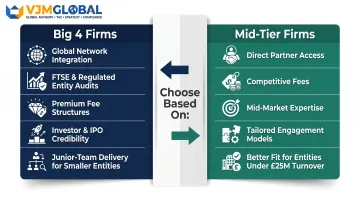
Big 4 firms bring strong global integration, brand credibility for investor-facing reporting, deep sector specialisation, and established regulatory relationships. However, they come with premium fees, standardised processes built for large enterprises, and limited partner contact time for smaller UK subsidiaries. They're the right fit for Singapore MNCs with significant UK turnover, listed entities, or operations in heavily regulated sectors.
Mid-tier firms like BDO, Grant Thornton, and RSM offer more tailored engagement models, direct partner access, and competitive fees. They genuinely understand mid-market dynamics and are better suited for Singapore SMEs setting up UK branches, holding companies, or operationally lean subsidiaries.
The fee gap is stark: the Big 4 earn 98% of total FTSE 350 audit fees — roughly £1.4bn of the £1.43bn total — while mid-tier firms handle 13% of audits by volume but earn only 2% of fees. That premium is real, and worth weighing against your entity's actual compliance needs.
Key decision factors:
- UK operations above £50m turnover benefit most from Big 4; mid-tier is sufficient for most entities below £25m
- Some PE fund mandates and LP agreements contractually require a Big 4 auditor — check your investment agreements early
- FCA-regulated entities and businesses planning a UK IPO typically expect a Big 4 audit opinion
- Group consolidations spanning multiple jurisdictions are better served by Big 4 global network integration
- Mid-tier firms provide direct partner access; for smaller entities, Big 4 audits are often junior-team delivered
How to Select the Right UK Audit Firm for Your Singapore Business
Choosing the right UK audit firm involves more than comparing price lists. The right fit depends on your entity's legal obligations, your investors' expectations, and the specific cross-border complexity of a Singapore-UK structure.
Start by confirming whether your UK entity legally requires a statutory audit under the two-of-three threshold test: £15m turnover, £7.5m balance sheet, or 50 employees. If investor or lender requirements apply, identify these early. Some PE firms and institutional investors require a Big 4 or Top 10 auditor as a condition of investment.
Cross-Border Advisory Capability
The right UK audit firm for a Singapore business should have demonstrable experience handling:
- Multi-jurisdiction reporting and consolidation
- Transfer pricing considerations between Singapore and UK entities
- Familiarity with Singapore Financial Reporting Standards (SFRS) to ensure consolidated group accounts are aligned correctly
- Coordination with Singapore-based tax and audit advisors
Sector-Specific Expertise
Cross-border capability alone isn't enough — the auditor also needs to understand your industry. A Singapore fintech entering the UK needs familiarity with FCA regulations and EMI/PI licensing requirements. A Singapore manufacturing group needs expertise in UK GAAP treatment of tangible assets and inventory.
Request references or case studies from clients with similar cross-border profiles before making a decision.
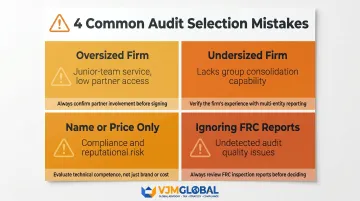
Common mistakes to avoid:
- Choosing an oversized firm — results in junior-team service with minimal partner engagement
- Choosing an undersized firm — lacks technical capability to handle group consolidation or international transfer pricing documentation
- Selecting based solely on name recognition or price, which creates compliance risk and reputational exposure
- Ignoring audit quality track records — check FRC inspection reports before appointing
Conclusion
The right UK audit firm for a Singapore business depends on entity size, industry, cross-border complexity, and long-term advisory needs. Whether a Singapore company chooses a Big 4 firm for credibility or a mid-tier firm for relationship quality, the priority should always be:
- Verified sector expertise relevant to your industry
- Transparent fee structures with no hidden costs
- Genuine partner engagement throughout the audit process
Singapore businesses operating across the UK and India often need separate advisors for each jurisdiction. For India-side compliance, VJM Global — a member of EAI International with over 250 UK businesses served — provides audit, tax, and business setup support for companies navigating Indian regulatory requirements alongside their UK audit obligations.
Frequently Asked Questions
Who are the Big 4 audit firms in the UK?
The Big 4 UK audit firms are PwC, Deloitte, EY, and KPMG. They collectively generate over £18bn in annual UK revenue and dominate the audit of FTSE-listed companies and large regulated entities.
Who are the largest audit firms in the UK beyond the Big 4?
BDO leads the mid-tier with £1.02bn turnover, followed by Grant Thornton (£759m), RSM (£573m), and Forvis Mazars (£392m). These firms serve the majority of UK mid-market and SME clients, including many foreign-owned subsidiaries.
What is considered a mid-tier (midsize) accounting firm in the UK?
Mid-tier firms are those outside the Big 4 but within the top 20 by UK revenue — including BDO, Grant Thornton, RSM, Forvis Mazars, Moore UK, and Crowe. They typically serve mid-market clients with revenues between £10m and £500m.
What is the largest accountancy firm in the UK?
PwC is the UK's largest accountancy firm by revenue at £6.36bn (year ended June 2025). It also employs the most staff among UK-based audit and advisory firms with 23,000 UK employees.
Do Singapore companies with UK subsidiaries need a UK statutory audit?
UK-registered subsidiaries must comply with UK Companies Act audit requirements. A statutory audit is mandatory if the subsidiary meets two of three thresholds: turnover over £15m, balance sheet over £7.5m, or more than 50 employees. Parent company guarantees or lender conditions can also trigger audit obligations below these limits.
How do I choose between a Big 4 and mid-tier UK audit firm as a Singapore business?
Choose Big 4 for large UK operations, regulated industries, or investor-facing entities where top-tier credibility is non-negotiable. For Singapore SMEs and first-time UK entrants, mid-tier firms like BDO or Grant Thornton typically offer better value and more direct partner access.