Here's the part most guides skip. Companies House incorporation itself is fast, often just 24 to 48 hours. The real friction sits on the UAE side — document legalisation, bank KYC, and getting UK-UAE tax treaty positioning right from day one.
This guide covers the exact steps, what you need before starting, the factors that determine how smoothly it goes, common mistakes, and when a different structure fits better than a subsidiary.
Key Takeaways
- Companies House often approves incorporation in 24–48 hours; banking, VAT and PAYE readiness take weeks to months
- UAE parents can hold 100% ownership with no UK residency requirement for directors or shareholders
- Document legalisation and bank KYC checks cause more delays than the incorporation form itself
- Getting tax treaty positioning and transfer pricing documentation right early avoids costly restructuring
- A subsidiary isn’t always the right fit; branches, representative offices or EOR suit lighter-touch UK entry
How to Set Up a UK Subsidiary from the UAE: Step-by-Step
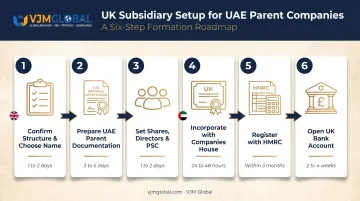
Six steps stand between a UAE parent and a fully operational UK subsidiary. Most delays come from underestimating steps two and six.
Step 1: Confirm the Structure Fits and Choose a Company Name
Before filing anything, check that a subsidiary actually matches your UK growth plan and risk appetite. A branch or representative office might serve a shorter-term goal better (more on that later).
- Search name availability on the Companies House name-checker and avoid names too close to existing entities or protected trademarks
- Names ending in "Limited" or "Ltd" are standard; offensive or sensitive terms need prior permission
- Decide on a registered office: a physical UK address or a registered agent/virtual address satisfies the requirement, but a PO box does not
Step 2: Prepare UAE Parent Company Documentation
This step trips up more UAE parents than any other in the entire process.
- Obtain a Certificate of Good Standing or Certificate of Incorporation from the relevant UAE authority: the DED for mainland companies, or the free zone authority (DMCC, JAFZA, DIFC, ADGM and others each issue their own)
- Legalise documents through UAE MOFA attestation, plus English translation where required. An apostille alone will not work because the UAE is not a Hague Apostille Convention signatory
- Map the full UBO chain now, especially for free zone structures with multiple holding layers. Banks will ask for this later
Step 3: Set Share Structure, Directors and Persons with Significant Control
- Decide share capital (£1 is common for a subsidiary) and confirm 100% UAE parent ownership is fine, with no UK residency requirement for directors or shareholders
- Appoint at least one natural-person director aged 16 or over. Identity verification became mandatory at Companies House from 18 November 2025, applying to new director and PSC appointments
- Complete the PSC register, identifying anyone controlling more than 25% of shares or voting rights — including the UAE parent entity itself
Step 4: Incorporate with Companies House
- File online (directly or via an agent) with Form IN01, the memorandum, and articles of association unless adopting model articles in full
- Standard registration typically costs around £50, with a same-day option available for a higher fee
- Expect approval within 24-48 hours once documentation and identity verification are complete, followed by your Certificate of Incorporation and company number
Step 5: Register with HMRC and Set Up Tax/Payroll
- Apply for a Unique Taxpayer Reference (UTR) for Corporation Tax as soon as incorporation is confirmed — if it hasn't arrived within 15 working days, request it directly
- Register for VAT once taxable turnover is expected to cross the £90,000 threshold
- Register for PAYE before your first UK payday if you're hiring staff
- Set up statutory bookkeeping to UK accounting standards immediately. Retrofitting records ahead of your first Corporation Tax return is far harder than starting clean
Step 6: Open a UK Bank Account and Activate Operations
Banking is usually the slowest part of the whole process, and it catches most UAE parents off guard.
- Submit KYC documentation covering both the UK subsidiary and the UAE parent; free zone ownership layers typically draw closer scrutiny than mainland structures
- Budget for a multi-week to multi-month approval timeline. Digital banking and fintech providers often onboard faster than traditional high street banks
- A cross-border advisory partner such as VJM Global can act as one point of contact for UAE document legalisation, Companies House filing, HMRC registration and bank introductions
What You Need Before You Start
Preparation quality decides whether this takes weeks or months. The incorporation form itself is the easy part.
- UAE-side documents ready: Certificate of Good Standing, trade licence copy, and notarised or attested parent company constitutional documents
- Decision-makers confirmed: at least one named director, a secured UK registered office address, and an agreed share capital and ownership split
- Budget and timeline clarity: registration fees, agent fees, and legalisation costs, plus a realistic runway to full operational readiness (banking included, not just incorporation)
Skipping any of these three doesn't stop incorporation. It just pushes the delay downstream to banking, VAT, or PAYE registration.
Key Factors That Affect Your UK Subsidiary Setup from the UAE
A handful of structural and documentation choices shape how smoothly a UAE-owned subsidiary goes live. UAE parent structures tend to raise more bank KYC and legalisation friction than many other foreign ownership models.
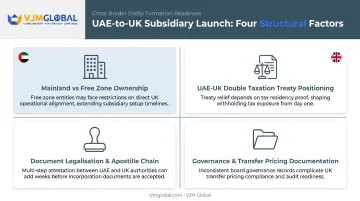
Mainland vs Free Zone UAE Parent Structure
Free zone ownership layers are harder for UK banks to trace during KYC than a straightforward mainland structure. Free zone-owned subsidiaries often face longer account approval timelines and extra beneficial-ownership document requests.
Map the full ownership chain clearly when you build the incorporation pack. That preparation cuts friction when the bank and Companies House reviews begin.
UAE-UK Double Taxation Agreement Positioning
Correct treaty positioning under Article 10 of the UAE-UK Double Taxation Convention determines whether dividends repatriated to the UAE parent avoid UK withholding tax. Missing beneficial-ownership or residency conditions can create unnecessary withholding tax exposure.
The UK generally does not apply dividend withholding tax. Special regimes such as REIT distributions are the exception worth checking early.
Document Legalisation and Apostille Chain
Companies House and UK banks require UAE incorporation documents to be properly legalised, and translated where needed.
Incomplete or unlegalised documents are a leading cause of delayed bank account opening, VAT registration and PAYE setup. This remains the single most avoidable bottleneck in the entire process.
Governance and Transfer Pricing Documentation
Formal UK board minutes and arm's-length intercompany agreements keep the subsidiary's limited liability protection intact if it is ever challenged. Poor governance separation can expose the UAE parent to HMRC penalties and weaken the liability shield the subsidiary was set up to provide.
Where the group also meets the country-by-country reporting threshold, those same intercompany arrangements should sit inside OECD-compliant Local File documentation.
Common Mistakes to Avoid
Most setbacks for UAE parents come from a few avoidable errors after the Companies House filing is done.
- Treating incorporation as the finish line. It starts an ongoing dual-jurisdiction calendar: confirmation statements, Corporation Tax returns, and annual accounts continue every year.
- Leaving UAE documentation incomplete or unlegalised. Gaps routinely delay bank account opening, VAT, and PAYE registration by weeks, sometimes months.
- Skipping formal UK governance and transfer pricing documentation. Without it, the limited liability protection the subsidiary is meant to provide can fail when tested.
- Assuming a UK-resident director is mandatory. It can ease banking discussions, but it is not required for incorporation—so avoid extra cost chasing a rule that does not exist.
Alternatives to a UK Subsidiary
A subsidiary isn't always the right entry point. The choice should reflect timeline, risk tolerance and hiring plans, not habit.
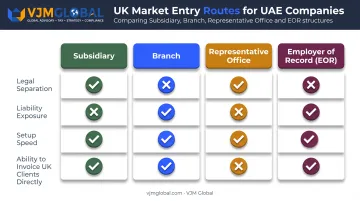
UK Branch (Establishment)
When it's better: Testing UK demand for under two years, or running a single short-term project without needing a full second set of statutory accounts.
Key trade-offs: There's no separate legal personality. The UAE parent carries full liability for UK debts and disputes. Registration (Form OS IN01) is required within one month of opening, with a fee around £124.
Representative Office
When it's better: Market research or liaison activity only, with no trading or contract-signing planned in the UK.
Key trade-offs: It cannot generate revenue or sign binding contracts. It delays rather than replaces eventual incorporation. If the office becomes a genuine fixed UK place of business, it may need registering as an establishment anyway.
Employer of Record (EOR) for UK Hiring Without an Entity
When it's better: The UAE company only needs one or two UK-based staff, or wants to test the market before committing to incorporation.
Key trade-offs: Faster and lower-cost than incorporating, but you can't invoice UK clients directly the way a subsidiary can. VJM Global's EOR capability lets UAE companies hire compliant UK staff while a subsidiary decision is still being finalised. That option suits teams that need people on the ground before they need a legal entity.
Frequently Asked Questions
What is a UK subsidiary of a foreign company?
A UK subsidiary is a UK-incorporated company—usually a Private Limited Company registered with Companies House—that is majority-owned or wholly owned by a foreign parent. It is legally separate from the parent and carries its own liabilities.
Can a UAE resident or business set up a UK limited company while based in the UAE?
Yes. There's no residency requirement for directors or shareholders, so a UAE-based individual or company can incorporate and own a UK Ltd entirely remotely.
Do I need to visit the UK to incorporate my subsidiary?
No. Incorporation can be completed entirely online without travel. Opening a bank account can sometimes be easier with an in-person visit, but that usually isn’t required.
How long does it take to open a UK bank account for a UAE-owned subsidiary?
Timelines range from a few weeks to several months, depending on ownership structure and how complete your KYC documentation is. Free zone-owned parents often face extra KYC scrutiny.
Does a UAE company need to legalise its documents to register a UK subsidiary?
Yes, typically. UAE incorporation documents usually need attestation through UAE MOFA and translation into English for Companies House filing and UK bank KYC purposes.
Can a UAE free zone company set up a UK subsidiary?
Yes. Both free zone and mainland UAE companies can incorporate a UK subsidiary, though free zone parents may face additional banking due diligence because of layered ownership structures.