Here's the catch: any nationality can legally form a US company. But the "right" state for a Singapore-based founder isn't the same as the right state for a domestic US founder. It comes down to tax exposure, visa pathways, and how much compliance work you're willing to take on from 9,000 miles away.
This guide ranks the best US states for Singapore entrepreneurs and covers the visa, tax treaty, and compliance details that most generic "how to start a US LLC" articles skip entirely.
TL;DR
- Form a US LLC or C-Corp remotely with 100% foreign ownership; no visa needed to incorporate.
- Delaware suits VC-ready startups; Wyoming suits lean, cost-conscious structures.
- Singapore qualifies for the E-2 Treaty Investor visa, unlike many Asian markets.
- No comprehensive US–Singapore double tax treaty, so cross-border tax planning needs extra care.
- Missing Form 5472 or state annual report deadlines is the costliest compliance mistake foreign owners make.
Why Singapore Entrepreneurs Are Expanding Into the US
Starting a US business as a Singapore founder usually means remote incorporation: filing formation documents, appointing a registered agent, securing an EIN from the IRS, and opening a US bank account. None of it requires setting foot in the country.
The trend is already material. Singapore's direct investment stock in the United States climbed from S$36 billion in 2018 to S$47 billion in 2022, making it the third-largest Asian investor in the US that year, according to Singapore's Ministry of Trade and Industry.
US law places zero restrictions on foreign ownership of an LLC or corporation. What does vary by state:
- Corporate and franchise tax rates
- Investor recognition of your entity's home state
- Ongoing filing obligations and their frequency
Below, the top states are compared for non-resident Singaporean founders on remote-friendliness, tax exposure, and investor recognition—not generic "best states for business" rankings.
Top 5 Best US States for Singapore Entrepreneurs to Start a Business
This ranking weighs four factors: ease of remote incorporation, tax treatment, investor and VC recognition, and relevance to Singapore-linked trade and tech sectors.
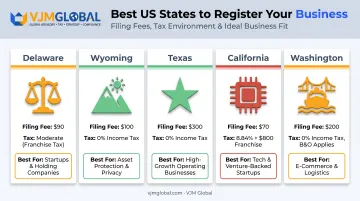
1. Delaware
Delaware remains the default choice for VC-backed companies, largely thanks to its Court of Chancery and a corporate law framework investors already trust. For Singapore founders, it offers the highest investor recognition of any state, and founders can follow well-documented formation steps with non-resident shareholders.
| Category | Details |
|---|---|
| Filing Fee | $110 (LLC certificate of formation); $109 base (corporation, varies by stock) |
| Annual Tax | $300 (LLC); franchise tax minimum $175–$400 for corporations |
| State Corporate Tax | 8.7% on income apportioned to Delaware (federal 21% applies in every state) |
| Best Fit | VC-backed startups, companies targeting US investors or acquisition exits |
2. Wyoming
Wyoming has become the go-to state for lean, non-VC-backed LLCs among founders who don't need Silicon Valley pedigree. Its main draw: no state corporate or personal income tax, paired with low annual costs and minimal paperwork—a practical option for Singapore founders running a US entity remotely without institutional funding plans.
| Category | Details |
|---|---|
| Filing Fee | $100 (plus a 2.4% card-processing fee for online filing) |
| Annual Cost | Greater of $60 or $0.0002 per dollar of Wyoming-based assets |
| Corporate Tax Rate | None — Wyoming imposes no state income tax on LLCs |
| Best Fit | Service businesses, consultancies, and holding structures without institutional funding plans |
3. Texas
Texas has no state income tax and continues attracting corporate relocations and scaling tech companies. For Singapore founders eyeing the US domestic market, the appeal is a huge customer base combined with expanding logistics and trade infrastructure.
| Category | Details |
|---|---|
| Filing Fee | $300 (LLC or Corporation) |
| Tax Environment | No corporate or individual income tax, but franchise (margin) tax applies above a $2.65 million revenue threshold for 2026–2027, at 0.375% (retail/wholesale) or 0.75% (other) |
| Best Fit | Scaling operations, market-facing businesses needing a large domestic customer base |
4. California
California's Silicon Valley ecosystem and existing trans-Pacific business ties make it a natural fit for Singapore tech and trade companies. The trade-off is real: exceptional capital access, offset by higher taxes and heavier compliance.
California companies pulled in $191.2 billion across 4,846 deals in 2025 (roughly 60% of all US VC deal value that year), according to the NVCA, driven largely by AI investment.
| Category | Details |
|---|---|
| Corporate Tax Rate | 8.84% |
| Minimum Annual Tax | $800 (LLC or corporation, even while inactive) |
| Access to Capital | Heaviest US concentration of venture capital and tech talent |
| Best Fit | Tech-focused Singapore startups prioritizing Silicon Valley networks over lowest cost |
5. Washington
Washington charges no personal income tax and sits geographically closer to Asia-Pacific trade routes than most US states, while hosting major tech employers. That combination matters for founders who may eventually relocate.
| Category | Details |
|---|---|
| Tax Environment | No state income tax, but a Business & Occupation gross-receipts tax applies (Service rates 1.5%–2.1% depending on revenue tier) |
| Filing Fee | $180 LLC filing fee |
| Best Fit | Tech and logistics businesses with Asia-Pacific supply chains or customer bases |
Key Factors Singapore Founders Should Weigh Before Choosing a State
Picking a state isn't just about the lowest filing fee. A few structural realities matter more for Singapore-based owners than for domestic US founders.
No comprehensive tax treaty. The US and Singapore do not have a comprehensive income tax treaty; the IRS treaty country list confirms Singapore's absence. The only bilateral instrument covers shipping and aircraft income from 1988. That gap puts more weight on state-level tax exposure, because there is no treaty umbrella softening double taxation.
Zero-income-tax states limit stacked tax burden. Wyoming, Texas, and Washington charge no state income tax, which matters when there is no treaty relief at the federal level. Delaware and California both levy meaningful state corporate tax on top of the federal 21% rate.
Remote banking is genuinely workable. Fintech platforms like Mercury allow non-US founders to open business accounts without visiting a branch, typically requiring:
- Government ID
- US formation documents
- EIN confirmation
- A verifiable US business address
Traditional banks vary. Some process fully online; others still require a branch visit depending on entity type and documentation.
Fund transfers need documentation on both sides. Singapore does not restrict outbound capital the way some jurisdictions do, so moving money into a US entity is straightforward. Those transfers should still be documented for MAS/IRAS records in Singapore and IRS reporting requirements in the US.
Ongoing costs add up regardless of state. Filing fees, registered agent renewals, and annual report deadlines recur every year, and penalties for missing them are steep (more on that below).
VJM Global's cross-border formation and compliance team helps Singapore founders compare state-level filing and tax obligations before they incorporate, so the choice is settled with clear numbers rather than deferred.
Visa Pathways for Singapore Entrepreneurs Operating in the US
Here's the distinction that trips people up: forming and owning a US company requires no visa. Physically working inside the US for that company does.
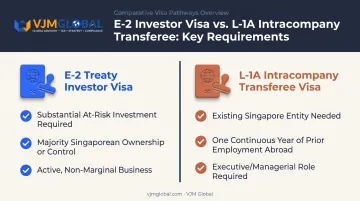
Singapore holds a genuine advantage here. Under the US-Singapore Free Trade Agreement, Singapore is a recognized E-2 Treaty Investor country — a pathway unavailable to founders from several other major Asian markets, including mainland China and India.
E-2 visa basics:
- Requires a substantial, at-risk investment in a real, operating US business (not a passive holding shell)
- Founder must hold majority Singaporean ownership or demonstrate operational control
- Business must be active and non-marginal, meaning it needs to generate more than minimal living income
L-1A intracompany transferee basics:
- Alternative for founders who already run a Singapore entity and want a US subsidiary or branch
- Requires one continuous year of employment abroad within the prior three years
- Role abroad must have been executive or managerial
Most Singapore founders start by running their US entity remotely, then revisit visa options once the business justifies an in-person move. Eligibility for either pathway depends heavily on individual circumstances, so this is a conversation for a qualified US immigration attorney, not a blog post.
Conclusion
The right state depends on what you optimize for: investor readiness, low ongoing cost, or Asia-Pacific market proximity. Headline tax rates are only one input.
Before you file, stack three checks side by side—your visa pathway (including the E-2 option open to Singaporeans), first-year formation cost, and the compliance load that state will add every year after.
When you have a shortlist, VJM Global can handle US entity formation, cross-border tax structuring, and ongoing compliance in the state that fits your plan.
Frequently Asked Questions
Which state is the easiest to start a business?
Wyoming and Delaware are typically considered easiest for non-resident founders, thanks to fast online filing, low fees, and minimal ongoing paperwork compared to states like California.
Can a Singapore citizen own 100% of a US company?
Yes. US law permits 100% foreign ownership of an LLC or C-Corp, with no residency or citizenship requirement for owners.
Does Singapore have a tax treaty with the US to avoid double taxation?
No. The US and Singapore don't have a comprehensive double taxation avoidance agreement, so cross-border tax planning should be reviewed carefully with a qualified advisor.
Can Singapore entrepreneurs use the E-2 visa to run a US business?
Yes. Singapore is an E-2 Treaty Investor country under the US-Singapore FTA, requiring a substantial investment in a real, operating US business and majority Singaporean ownership or control.
Do I need to visit the US to open a business bank account?
Not necessarily. Fintech platforms like Mercury allow remote account opening for non-resident founders, while some traditional banks still require an in-person visit depending on documentation.
What happens if a foreign-owned US LLC misses its annual compliance filings?
Missing Form 5472 triggers an initial $25,000 penalty, with additional $25,000 penalties for continued non-filing. States like Wyoming can also administratively dissolve entities that miss annual report deadlines.