Introduction
More UK businesses than ever are operating in or expanding to the US market — and one of the first financial questions they face is what professional bookkeeping will actually cost them. Many UK business owners struggle with this planning, often discovering too late that US bookkeeping follows different norms: different pricing structures, different software ecosystems, and significant variation by state.
Without a clear picture, you risk either overspending on services you don't need or underbudgeting and facing compliance gaps that trigger penalties. Unlike the UK, where bookkeeping costs are relatively standardised, the US market offers a wide range of options — from freelance bookkeepers charging $20/hour to full-service firms billing $2,500/month or more.
This guide covers what UK business owners need to know before committing to a US bookkeeping arrangement:
- Typical US bookkeeping price ranges and what they include
- The factors that push costs up or down
- The main pricing models on offer
- How to evaluate providers without being caught off guard by hidden fees or currency costs
Key Takeaways
- US bookkeeping typically costs between $200–$2,500/month (roughly £150–£1,850; exchange rate varies) depending on business size and service scope
- Hourly rates generally range from $20–$60/hr, with freelancers on the lower end and certified bookkeepers on the higher end
- The biggest cost drivers are transaction volume, service complexity, and whether you hire in-house, freelance, or use an online service
- Outsourced or virtual bookkeeping tends to be the most cost-effective option for UK businesses with US operations
- QuickBooks Online holds 80%+ of the US market, so UK businesses using Xero should confirm software compatibility before onboarding
How Much Does US Bookkeeping Cost? (Pricing Overview)
US bookkeeping costs depend on business size, transaction volume, and the scope of services you need. UK business owners who underestimate this range often face unexpected invoices or find they've chosen a service tier that doesn't fit their actual requirements.
Typical US Bookkeeping Cost Ranges
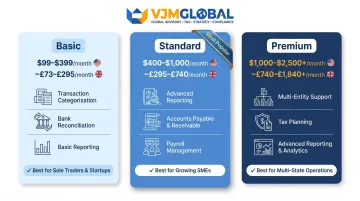
The table below summarises the three main pricing tiers UK businesses encounter when sourcing US bookkeeping services:
| Tier | Monthly Cost (USD) | Approx. GBP | What's Included | Best For |
|---|---|---|---|---|
| Basic | $99–$399 | £73–£295 | Transaction categorisation, bank reconciliation, basic monthly reports | Sole traders, startups, <50 transactions/month |
| Standard | $400–$1,000 | £295–£740 | Frequent reporting, accounts payable/receivable, payroll or sales tax bundling | Growing SMEs, UK businesses with a US LLC or subsidiary |
| Premium | $1,000–$2,500+ | £740–£1,840+ | Advanced reporting, multi-entity support, tax planning, strategic financial insights | Multi-state operations, investor-backed companies, quarterly reporting requirements |
Pricing benchmarks from the market:
- NerdWallet reports small businesses typically pay around $300/month for basic outsourced bookkeeping
- Pilot starts at $99/month for businesses with up to $100K in monthly expenses
- Bookkeeper360 charges $399–$799/month depending on reporting frequency (monthly to daily)
- Bench Accounting offers a Core tier at $399/month and an Accrual tier from $1,175/month
- Pilot's full-service offering can reach $2,500/month for complex operations
Project-Based Work
Catch-up bookkeeping is priced separately from ongoing monthly services. If your US records are disorganised or months behind, providers will quote based on how much ground needs covering — costs typically range from a few hundred to several thousand dollars. VJM Global has supported UK businesses with year-end clean-ups and catch-up projects, reconciling delayed records and preparing accounts for US tax-filing deadlines.
Currency Consideration for UK Readers
All US bookkeeping services are quoted in USD, so the GBP equivalent shifts with the exchange rate. At a USD/GBP rate of 1.35–1.36, a $500/month service works out to roughly £367–£370. When budgeting annually, build in a small currency buffer — even a 5% rate movement adds up across a 12-month contract.
Key Factors That Affect US Bookkeeping Costs
US bookkeeping pricing is shaped by a mix of operational, geographic, and service-level variables, and understanding them helps UK business owners avoid overpaying or underestimating what they actually need.
Business Size and Transaction Volume
The more financial activity a business generates (sales, purchases, payroll runs, invoices), the more time a bookkeeper must spend each month. A simple LLC with 30 monthly transactions costs significantly less to maintain than a retail business processing hundreds of daily sales.
Platform pricing demonstrates this clearly:
- Pilot Essentials ($99/month) covers businesses with up to $100K in monthly expenses
- Bench Grow ($199/month) serves businesses under $250K annual revenue
- Bench Accrual (from $1,175/month) targets larger, complex businesses
The 2025 State of Virtual Bookkeeping Industry Report found that 52% of bookkeeping clients earn under $100K annually, suggesting most small businesses fall into basic-to-mid tiers.
Geographic Location (State-Level Variation)
Bookkeeper wages vary meaningfully by US state, driven by local cost of living and market demand. According to Bureau of Labor Statistics data, the annual mean wage for bookkeeping clerks ranges from:
- Lowest: Mississippi at $39,480
- Highest: District of Columbia at $61,950
This represents a 57% difference. States with large UK business presence — California ($55,640), New York ($55,920), Massachusetts ($56,450) — all fall in the top quintile, so UK businesses registering entities there should expect above-average costs.
For UK businesses using remote or virtual bookkeepers, the provider's state location matters less but is still a factor worth understanding when evaluating quotes.
Scope of Services Required
Basic bookkeeping (transaction recording, reconciliation, monthly reports) is priced lower than full-service engagements that include:
- Payroll processing: Often adds $50–$150/month depending on employee count
- Sales tax compliance: Can add $100–$300/month for multi-state businesses
- Accounts payable management: Typically bundled in mid-range tiers
- Tax preparation coordination: May require separate CPA engagement
UK businesses should scope their actual needs carefully. VJM Global's experience serving 250+ UK businesses shows that most require at least basic tax compliance support alongside core bookkeeping to avoid penalties.
Bookkeeper Experience and Credentials
More experienced bookkeepers and those holding certifications typically charge higher rates but bring fewer errors and greater reliability. Two main voluntary certifications exist in the US:
- AIPB Certified Bookkeeper (CB): Requires passing a four-part exam, 2 years' experience, and continuing education
- NACPB Certified Public Bookkeeper (CPB): Requires passing four exams (including QuickBooks and payroll), 2,000 hours' experience, and 24 hours annual CPE
Key distinction for UK readers: US bookkeepers have no mandatory federal or state licensing requirement, unlike in UK practice. CPAs must hold a state-issued licence and pass the Uniform CPA Examination. Bookkeepers handle day-to-day recording; CPAs cover tax planning and compliance, at noticeably higher rates.
Accounting Software and Integration
The software ecosystem matters enormously. QuickBooks Online holds over 80% of the US small-business accounting software market. In contrast, Xero has only 17.93% of its global customer base in the US, compared to 32.84% in the UK.
For UK businesses already using Xero, check compatibility before engaging a US bookkeeper. Whilst VJM Global supports both platforms, most US bookkeepers default to QuickBooks Online. Software mismatches can mean migration costs of $500–$2,000 plus ongoing subscription fees:
- QuickBooks Online: $38–$235/month (£28–£173)
- Xero US: $25–$90/month (£18–£66)
US Bookkeeping Pricing Models: Hourly, Monthly, and Project-Based
US bookkeeping services are typically billed in one of three ways, and the pricing model you choose affects both predictability and total spend.
Hourly Pricing
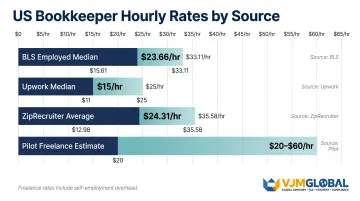
Best suited for one-off or irregular tasks. The BLS median hourly wage for employed bookkeepers is $23.66/hour (2024 data), with the 10th–90th percentile range spanning $15.61–$33.11/hour.
Freelance rates run higher to cover self-employment overhead:
- Upwork: Median $15/hour; typical range $11–$25/hour (includes global freelancers)
- ZipRecruiter: Average $24.31/hour; range $12.98–$35.58 (US-specific)
- Pilot estimate: $20–$60/hour for US-based freelancers
Critical limitation: Hourly billing creates cost unpredictability for ongoing work. A quoted estimate from a firm is often non-binding, and complex months can trigger steep invoices.
Monthly Flat-Fee (Subscription) Pricing
The most common model for ongoing bookkeeping. Fixed monthly fees provide cost predictability and are standard among online bookkeeping service providers like Bench, Bookkeeper360, and Pilot.
UK businesses running a US entity benefit most here — fixed fees mean no surprise invoices and no need to hire locally. The 2025 Industry Report found that 40% of virtual bookkeepers charge $300–$500/month per client, with 18% charging under $300.
Project-Based Pricing
Used for defined scopes such as catch-up bookkeeping, year-end clean-ups, or onboarding. Providers typically quote these after reviewing the books, with costs varying based on backlog severity — typically $500 for simple catch-up work, up to $5,000+ for multi-year backlogs.
For UK businesses with a US entity that has fallen behind, VJM Global handles catch-up bookkeeping and year-end projects — reconciling delayed records, updating ledgers, and producing accurate financials ready for tax filings.
In-House, Freelance, or Online Service — What Makes Sense for UK Businesses?
The choice between these three approaches looks different for a UK-based business owner compared to a US-domestic one — physical distance, payroll implications, and cross-border oversight all affect the decision.
In-House Bookkeeper
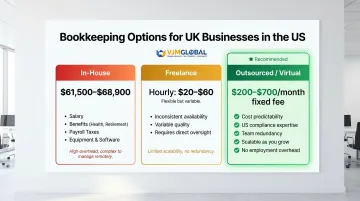
Hiring a US-based full-time bookkeeper means taking on an employee: salary, benefits, payroll taxes, and equipment. The BLS median annual salary for bookkeepers is $49,210, but the US Small Business Administration confirms that total employment cost is typically 1.25 to 1.4 times base salary when factoring in benefits and payroll taxes.
True employer cost: $61,500–$68,900 annually
This is rarely the most cost-effective option for a UK business at an early stage of US operations, especially when managing payroll compliance, benefits administration, and equipment remotely.
Freelance Bookkeeper
Lower cost and flexible, but variable availability and limited scalability. UK businesses can find US-based freelancers on platforms like Upwork and LinkedIn, but should verify:
- US-specific knowledge: GAAP standards, state tax obligations, and IRS requirements
- CB or CPB certification as a quality signal
- Hands-on experience with QuickBooks Online or Xero
- Reliable availability — freelancers juggle multiple clients, so response times can vary
Online/Outsourced Bookkeeping Service
For most UK businesses with US operations, a virtual or outsourced bookkeeping service offers the best combination of cost predictability, US compliance expertise, and remote accessibility.
Key advantages include:
- Fixed monthly pricing eliminates cost surprises
- Team-based structure provides built-in redundancy (no single point of failure)
- US GAAP compliance expertise without the learning curve
- Scales as your US operations grow
- No employment overhead — no payroll taxes, benefits, or equipment costs
Firms with experience serving UK clients also understand cross-border nuances: currency conversion, coordination with UK-side accountants, and multi-entity reporting. When evaluating providers, look for demonstrated experience with international clients, not just US-domestic businesses.
How to Estimate Your US Bookkeeping Budget (and Mistakes to Avoid)
Arriving at the right bookkeeping budget is less about finding the cheapest option and more about matching service depth to your actual operational needs.
Key Questions to Ask Before Budgeting
- How many monthly transactions does the US entity generate?
- Is payroll involved? How many employees or contractors?
- Which state(s) is the business registered in? (Multi-state = higher complexity)
- How frequently are financial reports needed? (Monthly, weekly, or daily)
- Will the bookkeeper need to coordinate with a UK-side accountant?
- What software does your UK operation use, and can it be replicated in the US?
Common Mistakes That Inflate Costs
Focusing only on the monthly fee whilst ignoring:
- Software subscription costs ($25–$235/month)
- One-time onboarding or setup fees ($250–$1,500)
- Add-on charges for payroll, sales tax, or multi-entity support
Choosing the cheapest option without verifying:
- The bookkeeper's understanding of US state-specific tax obligations
- Credentials (CB, CPB, or CPA oversight)
- Software compatibility with your existing systems
Failing to budget for catch-up bookkeeping if records are already behind. This can add $500–$5,000 to your first-year costs.
Currency Conversion Costs
UK businesses should plan for currency conversion costs and allow a buffer for exchange rate movement when paying USD-denominated invoices. UK high-street banks typically mark up currency conversions by 2–5% above the mid-market rate, whilst fintech FX providers (WorldFirst, Wise) charge under 1%.
Practical example: A UK business paying $500/month via a high-street bank could lose £7–£25/month in FX markups. Over a year, that's £84–£300 in avoidable costs.
Budgeting Rule of Thumb
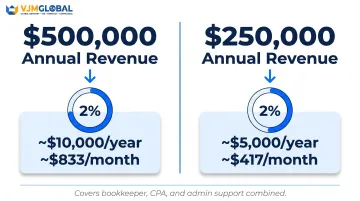
Fisher Bookkeeping recommends the "2% Rule": total financial management costs — including bookkeeper, CPA, and administrative support — should be approximately 2% of gross revenue.
A worked example:
- $500,000 annual revenue →
$10,000/year in total financial management costs ($833/month) - $250,000 annual revenue →
$5,000/year ($417/month)
Outsourced providers with fixed-fee structures make this rule easier to apply in practice. VJM Global's accounting outsourcing services, for example, offer transparent monthly pricing with dedicated account managers — so UK businesses can forecast US compliance costs without surprises.
Frequently Asked Questions
How much do bookkeepers charge in the US?
Hourly rates typically range from $20–$60/hour depending on experience and location, with the BLS median at $23.66/hour for employed bookkeepers. Monthly costs range from $200–$2,500+ depending on service scope and business size, with most small businesses paying $300–$700/month for outsourced services.
How much does US bookkeeping cost compared to UK bookkeeping?
US bookkeeping costs are broadly comparable to UK rates at entry level but can diverge based on state, service model, and compliance complexity. UK small businesses typically pay £75–£250/month (approximately $101–$338), whilst US basic tiers start at $99–$399/month (£73–£295). Premium US services tend to be more expensive in absolute terms.
Can a UK business owner hire a US bookkeeper remotely?
Yes, remote and virtual bookkeeping is standard in the US and well-suited to UK-based owners. Cloud-based software like QuickBooks Online and Xero makes remote collaboration straightforward, with real-time access to financial data and encrypted file transfers.
What is the difference between a bookkeeper and an accountant in the US?
US bookkeepers handle day-to-day transaction recording and reconciliation, whilst accountants (and CPAs) handle financial analysis, tax planning, and compliance. CPAs hold a state-specific licence and must pass the Uniform CPA Examination; bookkeepers face no equivalent licensing requirement, though voluntary certifications (CB, CPB) signal quality. CPAs command significantly higher fees as a result.
Is outsourced bookkeeping a cost-effective option for UK businesses operating in the US?
Yes — for most UK businesses operating in the US, outsourced bookkeeping costs far less than hiring in-house. Monthly fees of $200–$700 compare favourably to the $61,500–$68,900 annual cost of a full-time US bookkeeper once salary, benefits, and payroll taxes are factored in, with US compliance expertise included.
What US accounting software should UK businesses use for their American operations?
QuickBooks Online dominates the US market (80%+ share), but Xero is increasingly accepted. UK businesses already on Xero should confirm compatibility with their chosen bookkeeper upfront — software migration can cost $500–$2,000 if a switch is required later.