Introduction
UK bookkeeping costs are hard to benchmark. Hourly rates run from under £20 to over £60 depending on provider type, service scope, and business complexity — and that spread only tells part of the story.
Business owners searching for a clear number often end up more confused than when they started, facing conflicting quotes that vary by hundreds of pounds per month for comparable services.
That gap comes down to fundamental differences in what's included, how providers tier their services, and the regulatory changes reshaping the profession. This guide breaks down hourly rates, monthly packages, add-on costs, and the key factors that explain why two businesses with similar needs can receive dramatically different quotes.
Key Takeaways
- UK bookkeeping hourly rates in 2026 typically range from £22–£40/hour for standard work, rising to £45–£60+ for specialist tasks
- Packages run from £80/month (sole traders) to £1,000+/month for mid-sized SMEs, based on transaction volume and services
- Key cost drivers include transaction volume, services required (VAT, payroll, management accounts), provider type, and qualifications
- Outsourced bookkeeping typically costs less than in-house once you account for salary, employer NI (15%), pension, and software
- MTD for Income Tax (6 April 2026) adds £110–£115 in annual compliance costs and is reshaping how bookkeepers price their services
UK Bookkeeping Rates in 2026: What Businesses Can Expect to Pay
Bookkeeping does not have a fixed price, and quoting a single "average" figure can mislead. The right question is which rate applies to your situation — and what it actually covers.
Misunderstanding bookkeeping costs leads to predictable problems:
- Underbudgeting and receiving less support than your business needs
- Overpaying for services that don't match your size or complexity
- Encountering surprise charges mid-engagement
Hourly Rate Range
Current UK market rates in 2026:
- Freelance/self-employed bookkeepers: £22–£40/hour
- London bookkeepers: £30–£55/hour
- Manchester/Birmingham: £25–£45/hour
- Small towns/rural areas: £20–£35/hour
- Accounting firm bookkeepers: £40–£80/hour
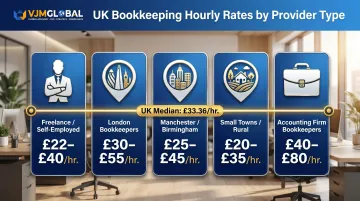
The 6 Figure Bookkeeper Pricing Report 2025 surveyed UK bookkeeping practitioners and found a median hourly rate of £33.36 and a mean of £35.67. This benchmark reflects qualified, self-employed practitioners rather than salaried staff (who average just £12.96/hour on PayScale).
What hourly pricing typically includes:
- Time spent on specific tasks (data entry, reconciliation, invoice processing)
- Direct bookkeeping work only
What it excludes:
- Cloud accounting software subscriptions (£15–£60/month)
- VAT filing fees
- Payroll processing add-ons
- Management reporting
- Setup or onboarding costs
When hourly billing makes sense: Ad hoc projects, one-off clean-up work, or catch-up bookkeeping when records have fallen behind. For ongoing monthly bookkeeping, fixed packages deliver better value and cost predictability.
Monthly Package Range
Monthly packages are tiered by transaction volume and business size:
| Business Type | Monthly Range | What's Typically Included |
|---|---|---|
| Sole trader/micro-business | £80–£200 | Bank reconciliation, expense categorisation, basic reporting |
| Small limited company (1–5 staff) | £120–£500 | Transaction recording, bank/card reconciliations, sales and purchase ledger |
| Growing SME (5–15 staff) | £300–£900+ | VAT support, payroll, management reporting, HMRC-ready records |
| Mid-sized business (15–50 staff) | £500–£1,000+ | Full payroll, regular management accounts, high transaction volume |
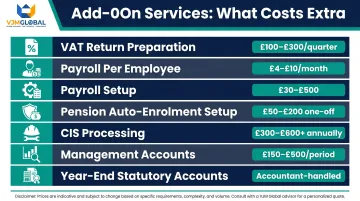
Most monthly packages quote for core bookkeeping only. Common add-ons billed separately include:
- VAT return preparation: £100–£300 per quarter
- Payroll processing: £3–£10 per employee per month
- CIS submissions: £300–£600+ annually
- Management accounts: £150–£500 per period
- Year-end statutory accounts: quoted separately
For businesses comparing provider types, outsourced bookkeeping — where UK-supervised offshore teams handle day-to-day records — can reduce costs by up to 50% against purely UK-based providers. VJM Global uses this model to serve 250+ UK businesses, with packages covering dedicated account management and HMRC compliance.
Per-Transaction Pricing
Some providers charge £0.50–£1.50 per transaction (invoice, receipt, or bank entry). This model works best for micro-businesses processing fewer than 50 transactions monthly. Above that threshold, fixed monthly packages offer better value and avoid surprise bills during busy periods.
Per-transaction billing suits businesses with very low, irregular volumes where a fixed monthly fee would be wasteful. Avoid it if your transaction count spikes seasonally or trends upward — costs can balloon unexpectedly during high-activity months.
Key Factors That Drive Bookkeeping Costs Up or Down
Two businesses in the same sector can receive dramatically different bookkeeping quotes. Understanding which variables affect the price helps you negotiate more effectively and avoid overpaying.
Transaction Volume and Business Size
Transaction volume is the primary driver behind tiered pricing. A sole trader processing 20–30 transactions per month requires far fewer hours than an SME with 300+ monthly transactions.
Example transaction bands and approximate monthly costs:
- 0–50 transactions/month: £80–£150
- 50–150 transactions/month: £150–£300
- 150–300 transactions/month: £300–£600
- 300–500 transactions/month: £600–£900
- 500+ transactions/month: £900–£1,500+
Services Required
Basic bookkeeping (data entry, bank reconciliation) forms the foundation. Each additional service layer increases the cost:
VAT return preparation:
- Sole trader/partnership: £100–£250 per quarter
- Limited company: £150–£300 per quarter
Payroll processing:
- £3–£8 per payslip (basic processing)
- £4–£10 per employee per month (PEPM)
- £25–£80/month minimum for small teams
- £30–£500 setup fee depending on complexity
- £50–£200 for pension auto-enrolment setup
CIS processing: £300–£600+ annually
Management accounts: £150–£500 per period (monthly or quarterly)
Provider Type and Location
Where your bookkeeper is based — and how they operate — significantly affects your quote. Here's how the main provider types compare:
| Provider Type | Typical Hourly Rate | Notes |
|---|---|---|
| Freelance bookkeeper | £22–£40/hour | Lower overheads; limited capacity for complex services |
| Regional firm (outside London) | £25–£45/hour | More structured service than freelancers |
| London & South East provider | £30–£55/hour | 30–60% premium; monthly packages £250–£700 vs £160–£450 in Glasgow or Leeds |
| Hybrid outsourced model | 30–50% below UK rates | UK-supervised offshore delivery (e.g. VJM Global); maintains HMRC compliance through qualified oversight |
Qualification level also shapes the rate you'll pay:
- Unqualified/entry-level: £18–£22/hour
- AAT Level 3/ICB Associate: £25–£35/hour
- AAT Level 4/ICB Member: £25–£50/hour
- ACCA/Chartered oversight: £35–£60+/hour
Higher qualifications reduce compliance risk and allow a single bookkeeper to handle VAT, CIS, and management accounts — services that would otherwise require separate providers.
MTD Compliance and 2026 Regulatory Context
Making Tax Digital for Income Tax launches 6 April 2026 for sole traders and landlords with income over £50,000, requiring digital record-keeping and quarterly submissions. The threshold drops to £30,000 from April 2027 and £20,000 from April 2028.
Compliance costs:
- One-off transitional cost: £285–£350
- Ongoing annual cost: £110–£115
MTD-ready bookkeeping services increasingly price this compliance capability into their quotes. Working with a provider that isn't MTD-ready creates additional cost and risk down the line. The ICAEW has warned that accountants "may struggle to pass on" full MTD preparation costs — and predicts a gradual shift towards value-based billing rather than hourly rates.
Full Bookkeeping Cost Breakdown: What's Included and What Costs Extra
The quoted bookkeeping rate is rarely the total cost. Most businesses encounter add-on services, software subscriptions, and one-time setup charges that don't appear in the headline figure.
Core Service Costs
Standard bookkeeping engagements typically include:
- Transaction coding and entry
- Bank and credit card reconciliation
- Basic financial reports (P&L, balance sheet)
- General ledger maintenance
- Accounts payable and receivable tracking
Add-On Services and Their Typical Costs
| Service | Typical Cost Range |
|---|---|
| VAT return preparation | £100–£300 per quarter |
| Payroll (per employee) | £4–£10 per month or £3–£8 per payslip |
| Payroll setup | £30–£500 depending on complexity |
| Pension auto-enrolment setup | £50–£200 one-off |
| CIS processing | £300–£600+ annually |
| Management accounts | £150–£500 per period |
| Year-end statutory accounts | Typically handled by accountant, not bookkeeper |
Software and Subscription Costs
Cloud accounting software is typically not included in a bookkeeper's quoted fee:
Current UK retail pricing (excluding VAT):
- Xero: £7–£65/month (Grow plan rising from £33 to £37 from September 2025)
- QuickBooks: £10–£123/month (Essentials at £38/month, Plus at £56/month)
- Sage: £0–£59/month (Start at £18/month, Standard at £39/month)
Some providers bundle software access using accountant/partner pricing (offering 5–40% discounts), while others charge it as a pass-through cost. Confirm whether software is included before comparing quotes.
One-Time and Hidden Costs
Two charges that frequently catch businesses off guard:
- Setup and onboarding: £200–£500 for data migration and chart of accounts mapping (sometimes waived with annual contracts)
- Catch-up work: When records are behind, providers typically bill separately at the equivalent of 1–3 months of standard fees
Questions to ask before signing:
- What are the setup and exit terms?
- How are catch-up charges calculated?
- Are there minimum contract periods?
- What happens if transaction volume increases mid-contract?
In-House Bookkeeper vs. Outsourced Bookkeeping: Which Costs More?
The true cost of employing an in-house bookkeeper in 2026 extends far beyond salary.
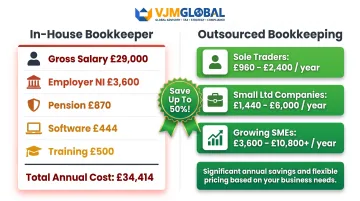
Fully-loaded annual cost calculation (based on £29,000 salary):
| Cost Component | Amount |
|---|---|
| Gross salary | £29,000 |
| Employer NI (15% on earnings above £5,000) | £3,600 |
| Auto-enrolment pension (3% minimum) | £870 |
| Software licence (e.g., Xero Grow) | £396–£444 |
| Training/CPD | £200–£500 |
| Total fully-loaded cost | £34,066–£34,414 |
For a bookkeeper earning £35,000, the fully-loaded cost rises to approximately £39,550–£40,000+.
From April 2025, employer NI rose from 13.8% to 15% and the secondary threshold dropped from £9,100 to £5,000 per year. That alone adds £1,500–£2,000 annually to employment costs — a shift that has pushed many SMEs to reconsider in-house hiring.
Outsourced bookkeeping costs by comparison:
- Sole traders/micro-businesses: £960–£2,400/year
- Small limited companies: £1,440–£6,000/year
- Growing SMEs: £3,600–£10,800+/year
Advantages of outsourced bookkeeping:
- Eliminates recruitment costs and ongoing HR administration
- No cover required for holidays, sick leave, or staff turnover
- Scales with transaction volume rather than requiring additional hires
- Includes MTD-compliant systems with qualified oversight built in
- Keeps continuity intact — no knowledge gaps when staff changes occur
VJM Global has worked with over 250 UK businesses on outsourced bookkeeping, providing assigned account managers and teams qualified in UK accounting standards.
For most SMEs processing fewer than 500 transactions monthly, outsourcing remains more cost-effective than hiring. The crossover point where in-house becomes economical typically occurs when transaction volume exceeds 1,000+ per month and requires full-time dedicated support.
How to Budget for Bookkeeping Services in the UK
Work through these four steps before requesting any quotes:
- Count your transaction volume. Tally invoices issued, bills received, bank transactions, and receipts each month — this determines which package tier applies to your business.
- List every service you need. Beyond basic bookkeeping, identify whether you need VAT returns, payroll, management accounts, or CIS compliance for construction work. Missing one line item now means paying for it as an add-on later.
- Check your software situation. If you already use Xero, QuickBooks, or Sage, confirm the provider supports it. If you don't have software yet, factor the licence cost into your budget.
- Confirm MTD readiness. Sole traders and landlords earning over £50,000 must comply with Making Tax Digital by 6 April 2026. Your provider must be able to handle quarterly digital submissions — ask directly.
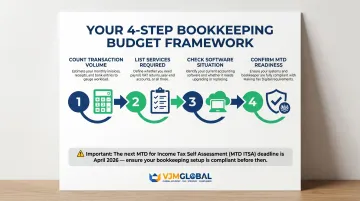
The right budget covers the full scope you need, not just the lowest number on a quote. Cutting scope to save money often creates compliance gaps and costly catch-up work later.
Before signing with any provider, get clear answers to these questions:
- What services are included versus charged as add-ons?
- How are volume fluctuations handled?
- Are you MTD-ready for the April 2026 deadline?
- What are the setup and exit terms?
- Is software included or billed separately?
- What qualifications does your team hold (ICB, AAT, ACCA)?
- Who will be my main point of contact?
What Businesses Often Get Wrong When Budgeting for Bookkeeping
Several common missteps can inflate your bookkeeping costs or leave gaps in compliance. Here's what to watch for:
- Compare total package cost, not just the hourly rate. Add-ons for VAT, payroll, and software can push a cheaper provider's monthly bill well above a more expensive one's.
- Accurately count your monthly transactions before requesting quotes. Underestimating volume is the most common trigger for mid-contract repricing and scope disputes.
- Confirm MTD compatibility upfront. From April 2026, sole traders and landlords above the income threshold need a provider with MTD-ready systems — otherwise you inherit the compliance gap.
- Factor in qualification levels. An unqualified bookkeeper at £20/hour can't handle VAT, CIS, or complex reconciliations — tasks that would then require separate specialist fees, often exceeding the saving.
- Clarify whether software is included. Xero or QuickBooks licences typically cost £200–£700 annually. Some providers bundle this; others don't. That single line item can shift your cost comparison considerably.
Frequently Asked Questions
How much should I pay a bookkeeper per hour in the UK?
UK bookkeepers in 2026 typically charge £22–£40/hour for standard work, with London rates reaching £30–£55/hour. Freelance bookkeepers with AAT or ICB qualifications command £25–£50/hour, while specialist or complex bookkeeping (management accounts, multi-entity consolidation) costs £45–£60+/hour.
What is the average monthly cost of bookkeeping services for a small UK business?
Small businesses and sole traders typically pay £80–£300 per month depending on transaction volume and services included. Growing SMEs needing VAT returns, payroll, and management accounts typically pay £300–£900+/month.
Is outsourced bookkeeping cheaper than hiring an in-house bookkeeper in the UK?
Yes, for most SMEs. Once you factor in salary, 15% employer NI, 3% pension, software, and training, an in-house bookkeeper costs £34,000–£40,000+ annually — compared to £1,200–£10,000 for outsourced equivalents. That gap widens for businesses processing under 500 transactions monthly.
What extra costs should I expect when hiring a bookkeeper?
Expect software subscriptions (£15–£60/month), VAT return fees (£100–£300 per quarter), payroll add-ons (£4–£10 per employee monthly), setup/onboarding charges (£200–£500), and potential catch-up charges if records are behind. Request an itemised quote upfront — onboarding fees are often negotiable on longer contracts.
How does Making Tax Digital affect bookkeeping costs in 2026?
MTD for Income Tax launches 6 April 2026 for sole traders and landlords earning over £50,000, requiring digital records and quarterly submissions. HMRC estimates one-off setup costs of £285–£350, with most providers now pricing MTD compliance into their standard service quotes.
What is the difference in cost between a bookkeeper and an accountant in the UK?
Bookkeepers handle day-to-day transaction recording and reconciliation at £22–£40/hour, while accountants (particularly Chartered Accountants) handle statutory accounts, tax filings, and advisory work at £50–£150+/hour. Many SMEs use both in tandem: bookkeepers maintain the records, accountants handle compliance and strategic planning.