
Introduction
UK businesses are turning to outsourced bookkeeping in growing numbers — and the timing is no accident. According to AAT research, 84% of UK employers face barriers to upskilling their workforce, whilst 34% struggle to recruit for finance and accounting roles.
That talent gap now collides with a compliance deadline. MTD for Income Tax Self Assessment (ITSA) became mandatory from April 2026 for businesses with qualifying income over £50,000, pushing demand for professional bookkeeping support sharply higher.
The result: the UK bookkeeping industry is now valued at approximately £6.8 billion, with over 50% of accounting firms outsourcing at least one service. This guide breaks down what outsourced bookkeeping actually costs in 2026 — from under £100 per month for sole traders to over £2,000 for larger SMEs — and what drives those differences in transaction volume, compliance needs, provider type, and service scope.
Key Takeaways
- Monthly costs range from £50–£120 for sole traders to £2,000–£3,500+ for large SMEs; hourly rates typically run £13–£60 depending on complexity and provider model
- Key cost drivers: transaction volume, service scope (reconciliation vs. full VAT/payroll/management accounts), provider model, and MTD compliance requirements
- VAT-registered businesses, e-commerce operators, and companies needing payroll processing consistently pay more
- Outsourcing typically saves 40–60% compared to in-house bookkeeping once salary, employer NI, pension, and overhead are factored in
What Does Outsourced Bookkeeping Cost in the UK in 2026?
Outsourced bookkeeping costs in the UK depend on three things: the pricing model you choose, your business size, and the scope of services required. Getting these wrong — or misunderstanding what's included — frequently leads to underbudgeting and unexpected bills mid-contract.
Pricing Models: How Providers Charge
Hourly rates typically run from £13 at the low end to £60+ for specialist or complex work. This model works well for:
- Ad-hoc tasks (catch-up bookkeeping, one-off reconciliations)
- Project-based work with defined scope
- Businesses with highly variable monthly workload
The downside: hourly billing becomes unpredictable when transaction volumes fluctuate or when providers take longer than anticipated. For ongoing monthly support, hourly rates often prove more expensive than fixed packages.
Monthly fixed-fee packages dominate the UK market because they provide cost certainty. Providers tier packages by business size and transaction volume:
- Sole traders and micro-businesses receive predictable monthly invoices
- Budgeting becomes straightforward
- Services are clearly defined in advance
- Volume spikes won't trigger surprise bills, within agreed bands
Per-transaction and tiered packages suit businesses with predictable, consistent volumes. Providers typically charge £0.50–£2.00 per transaction, or offer Basic/Standard/Premium bundles with defined transaction limits. This model works best when you can accurately forecast monthly volumes; unexpected spikes can push you into higher tiers.
Once you've identified the right pricing model, the next question is what you should expect to pay — which depends heavily on business size and complexity.
Cost Ranges by Business Size
Entry-level (sole traders and micro-businesses): £50–£150 per month
Typical inclusions:
- Basic transaction entry and categorisation
- Bank reconciliation
- Simple profit and loss statements
- Quarterly summary reporting
Best for: Sole traders, consultants, freelancers, and micro-businesses with under 50 transactions monthly and turnover below £100,000.
Mid-range (small limited companies and growing SMEs): £100–£600 per month
Typical inclusions:
- Full transaction processing and coding
- Multi-account bank reconciliation
- VAT return preparation (often included or charged as modest add-on)
- Basic financial reporting (P&L, balance sheet)
- Supplier and customer ledger management
Best for: VAT-registered businesses, small limited companies with 1–10 staff, and businesses processing 50–200 transactions monthly.
Full-service (larger SMEs with payroll, multi-entity, or management accounts): £400–£3,500+ per month
Typical inclusions:
- Comprehensive bookkeeping across multiple entities
- VAT compliance and submissions
- Payroll processing for 5–50+ employees
- Monthly management accounts with KPI analysis
- Dedicated account manager or finance team
- Quarterly business review meetings
Best for: Established SMEs with 10–50+ staff, multi-currency operations, complex group structures, or businesses requiring strategic finance insights beyond compliance.
Key Factors That Affect Outsourced Bookkeeping Rates
Two businesses in the same industry can receive quotes that differ by 200% or more. Understanding the variables that drive these differences helps you anticipate costs accurately and negotiate from an informed position.
Transaction Volume and Complexity
Transaction volume is the primary pricing lever. Providers tier costs based on monthly transaction counts because higher volumes mean proportionally more time for data entry, coding, and reconciliation.
Typical UK transaction bands and fee impact:
| Monthly Transactions | Typical Monthly Cost |
|---|---|
| 0–25 | £50–£150 |
| 26–50 | £100–£200 |
| 51–100 | £100–£250 |
| 101–200 | £250–£400 |
| 201–500 | £400–£1,000 |
| 500+ | Bespoke quotes |

Volume alone doesn't tell the full story. A construction company with CIS deductions, multi-site payroll, and subcontractor certificates will pay significantly more than a consultancy with the same transaction count but simpler coding requirements.
Scope of Services Required
Each additional compliance or reporting layer adds meaningful cost:
| Service | Typical UK Cost |
|---|---|
| VAT returns | £70–£200/quarter (standard); £200–£400 for complex schemes |
| Payroll processing | £5–£10/payslip; £18–£34 + VAT/month for small teams |
| CIS support | £1–£20/certificate; £41 + VAT/hour for full administration |
| Management accounts | £50–£250/month depending on KPI depth and frequency |
Always clarify what's inside vs. outside the base package. Many providers quote attractively low headline rates but charge separately for VAT, payroll, and reporting—costs that often double your total monthly fee.
Provider Type and Location
Three provider types cover most of the market, each at a distinct price point:
| Provider Type | Typical Rate | Key Trade-offs |
|---|---|---|
| Individual freelancers | £18–£22/hour | Lowest cost; limited capacity and no backup cover |
| Established UK accounting firms | £35–£60+/hour | Strong compliance rigour; regional variation applies (London/Bristol ~£20/hour; Edinburgh ~£15/hour) |
| Offshore and hybrid models | 40–60% below UK-only rates | Hybrid models (offshore execution, UK-qualified oversight) sit 30–50% cheaper whilst maintaining compliance standards |
One London business achieved a 38% reduction in monthly accounting costs by switching to a hybrid model — a meaningful saving for any business watching overhead.
VJM Global operates this hybrid model for 250+ UK businesses, pairing offshore delivery with UK compliance oversight to keep costs down without compromising on HMRC accuracy.
Compliance and MTD Requirements
Making Tax Digital for Income Tax becomes mandatory from 6 April 2026 for self-employed individuals and landlords with qualifying income over £50,000. The threshold drops to £30,000 from 6 April 2027, and to £20,000 from 6 April 2028.
MTD requirements include:
- Digital record-keeping using MTD-compatible software
- Quarterly updates submitted to HMRC
- End of Period Statements (EOPS)
- Final Declaration replacing traditional Self Assessment
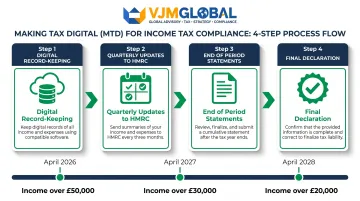
Providers that are MTD-ready handle digital record-keeping, quarterly submissions, and software compliance — and they price that expertise into their packages. That cost is worth scrutinising: penalties start at £200 for late filing and scale based on tax owed. Non-compliant bookkeeping can trigger penalties exceeding the annual cost of professional support.
Full Cost Breakdown: What's Included (and What Isn't)
The quoted monthly fee is rarely your total cost. One-time setup charges, recurring add-ons, and periodic compliance work often catch businesses off-guard — and they fall into four distinct buckets worth checking before you sign anything.
One-Time and Setup Costs
Onboarding and data migration typically runs £200–£500 for standard setup. Some providers include this at no extra charge; others invoice it separately. If your records are behind, catch-up bookkeeping can cost the equivalent of 1–3 months of standard fees — potentially £300–£900 for a mid-sized business.
Payroll setup costs range from £30–£150 for straightforward configurations, rising to £150–£500 for complex legacy systems or multi-site payroll.
Recurring Monthly Costs
Your core service fee covers the advertised monthly package — reconciliation, transaction entry, and basic reporting. Software subscriptions are a separate question entirely, and not always included.
Check whether your package covers platform costs:
- Xero: £7–£65/month (excl. VAT) depending on plan
- QuickBooks: £10–£115/month for UK plans
- Sage Accounting: £18–£115/month depending on user count and features
Managed packages — for example, Crunch Premier at £124 + VAT/month — typically bundle software in. Lower-cost providers may require you to maintain your own subscription, adding £10–£50/month to your true cost.
Add-On Service Costs
Most providers price these services separately from your base package:
- VAT returns: Billed quarterly or annually (£50–£150 per return is typical)
- Payroll: Per-employee or per-payslip fees, plus auto-enrolment pension admin (£15–£40/month)
- CIS processing: Per-certificate or hourly rates
- Management accounts: Monthly or quarterly packages covering P&L, cash flow, and variance reporting
Periodic and Compliance Costs
These charges appear less frequently but can be substantial if you're not expecting them:
- Year-end account preparation: Usually a project-based fee (£240–£800 depending on complexity)
- Catch-up reconciliation: Project rates apply if there are gaps in your record-keeping — providers bring accounts current before starting regular service
- HMRC compliance work: MTD updates, PAYE adjustments, and penalty-avoidance work are often billed separately when they fall outside standard monthly scope
Before committing to any provider, request a full breakdown: base package fee, all relevant add-ons, and any likely periodic charges for your business type.
Outsourced Bookkeeping vs. In-House: The Real Cost Comparison
Most businesses compare outsourced monthly fees directly against a bookkeeper's salary—but this comparison misses significant hidden costs.
True Annual Cost of an In-House UK Bookkeeper
- Salary: Median UK bookkeeper salary is £28,980 according to Indeed (Glassdoor reports £24,670; CheckASalary cites £25,104)
- Employer National Insurance: Increased from 13.8% to 15% from April 2025, with the secondary threshold reduced from £9,100 to £5,000 — adding approximately £3,597 on a £28,980 salary
- Auto-enrolment pension: Minimum 3% employer contribution = approximately £870
- Recruitment, training, equipment, and overhead: Industry estimates suggest 20–40% of salary, adding £5,800–£11,600
Total true annual cost: £38,500–£61,300 (before factoring in holiday cover, sickness, or turnover risk).
Cost Comparison: In-House vs. Outsourced
For a typical growing SME, the numbers look like this:
| Cost Element | In-House | Outsourced |
|---|---|---|
| Annual base cost | £38,500–£61,300 | £3,600 (£300/month) |
| Recruitment & training | Included above | None |
| Holiday/sick cover | Additional cost | Included |
| Turnover risk | High | None |
| Estimated savings | — | ~60–90% reduction |

Beyond the numbers, outsourcing removes the management burden of recruitment, training investment, holiday and sick cover logistics, and the risk of a critical employee leaving mid-year.
When Does In-House Make Sense?
At very high volumes — 500+ transactions monthly, complex multi-entity structures, or real-time daily reconciliation — the break-even point shifts. If that describes your business, consider:
- Whether you need on-site, real-time support
- Whether outsourcing can still handle your volume cost-effectively
- Whether a hybrid model (part in-house, part outsourced) offers the best balance
Even at high volumes, many UK businesses find that offshore or hybrid providers remain cost-competitive — largely because flexible team structures keep overhead low without sacrificing capacity.
How to Budget Accurately for Outsourced Bookkeeping
Accurate budgeting starts with answering these questions before requesting quotes:
- Transaction volume: How many bank transactions, invoices, and receipts do you process monthly? Count a typical month to avoid underestimating.
- VAT registration: Are you VAT-registered, and under which scheme — standard, flat rate, or cash accounting?
- Payroll requirements: How many employees do you have? Do you need CIS, auto-enrolment pension admin, or multi-site payroll?
- Reporting needs: Do you need management accounts and KPI dashboards, or just compliance records?
- Current state: Are your books up to date, or will you need catch-up work?
Clearer answers produce more accurate, comparable quotes. Vague briefs invite low-ball estimates that escalate once the provider sees the real scope — and by then you've already signed.
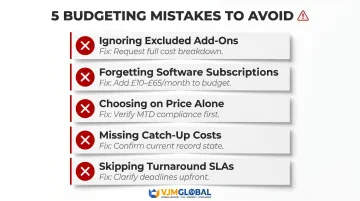
Common Budgeting Mistakes
- Check what's excluded from headline fees. A £100/month package that excludes VAT (£70/quarter), payroll (£30/month), and software (£20/month) actually costs £185/month — 85% more than advertised.
- Budget for software separately if needed. If your provider doesn't include Xero, QuickBooks, or Sage, add £10–£65/month to your figures.
- Don't choose on price alone. The lowest quote often comes from providers without MTD compliance systems or UK-qualified oversight. HMRC penalties for late or incorrect submissions can exceed a full year's bookkeeping fees.
- Confirm turnaround times upfront. Responsive support matters when HMRC deadlines approach — clarify service-level commitments before signing.
Cost-Effective, Compliant Solutions
Hybrid offshore-UK models are worth considering for businesses where budget is a real constraint. VJM Global, for example, has handled bookkeeping for 250+ UK businesses using India-based teams operating under UK compliance oversight — with clients typically saving up to 50% compared to UK-only providers. The trade-off is understanding how the provider handles HMRC deadlines, MTD submissions, and direct communication with your accountant.
Frequently Asked Questions
How much does outsourced payroll cost in the UK?
UK payroll outsourcing typically costs £3–£10 per payslip or £4–£12 per employee per month. Small teams (under 5 employees) pay fixed monthly fees of £25–£60. Payroll is often bundled with bookkeeping packages or charged as an add-on.
What is the typical monthly cost for outsourced bookkeeping for a small UK business?
Sole traders and micro-businesses typically pay £50–£150 per month. Small limited companies pay £100–£300 per month. Final cost depends on transaction volume and whether VAT or payroll support is included in the package.
Is outsourced bookkeeping cheaper than hiring an in-house bookkeeper in the UK?
Yes, significantly — outsourcing runs 40–60% cheaper once you account for salary, employer NI (now 15%), pension, recruitment, and overhead. A £300/month outsourced package costs £3,600 annually, compared to £38,500–£61,300 for in-house.
What factors have the biggest impact on outsourced bookkeeping rates?
Transaction volume is the primary driver, followed by scope of add-on services (VAT, payroll, management accounts) and provider type. Offshore or hybrid models cost 30–60% less than UK-only firms while maintaining compliance standards.
What should be included in a standard outsourced bookkeeping package?
Baseline deliverables include transaction entry, bank reconciliation, and basic financial reporting (profit and loss, balance sheet). Beyond these basics, VAT returns, payroll, CIS support, and management accounts are typically priced as add-ons.
How do I know if I'm overpaying for outsourced bookkeeping?
Benchmark your transaction volume and service scope against the UK price ranges in this guide, then verify your provider includes MTD-compliant software and UK-qualified oversight. Always compare total cost — add-ons and software subscriptions included — not just the headline monthly fee.