Introduction
UK accounting firms face mounting pressure from an unexpected quarter: American clients. Practices supporting UK businesses with US subsidiaries, or serving American expats who need IRS-compliant records, are running headlong into bookkeeping demands their training never covered.
The gap isn't trivial. US GAAP, multi-state sales tax obligations, and federal filing requirements operate under entirely different rules than FRS 102 or HMRC protocols.
This puts UK firms in a difficult position: build expensive in-house US accounting capability, or outsource to specialists who already have it. Most are choosing the latter. According to Grand View Research, the global finance and accounting outsourcing market reached $70.19 billion in 2025 and is projected to hit $142.66 billion by 2033 — outsourcing has moved well beyond cost-cutting into core business strategy.
This guide is designed to help UK practices navigate that decision — covering the UK-US standards gap, what outsourced US bookkeeping actually delivers, and what to look for in a provider.
Key Takeaways
- UK firms serving US clients often lack in-house US GAAP and IRS expertise—outsourcing fills that gap without the overhead of dedicated hires
- US GAAP and IRS rules differ significantly from UK standards, so knowing the basics helps you manage your outsourcing partner confidently
- Outsourced bookkeeping typically includes transaction recording, reconciliations, payroll support, financial reporting, and tax-ready records prepared to IRS documentation standards
- Prioritise providers with US GAAP proficiency, GDPR-compatible data handling, compatible software, and flexible engagement models
- A provider with dedicated US-compliant professionals and proven UK client experience removes the guesswork from cross-border bookkeeping
Why UK Firms Are Outsourcing US CPA Bookkeeping
UK accounting practices are acquiring US clients through three primary channels: digital advisory expansion into North American markets, servicing UK-headquartered businesses with US subsidiaries, and onboarding American expat clients requiring IRS-compliant financial records. Each scenario demands US CPA-standard bookkeeping expertise that most UK firms don't maintain in-house.
The commercial opportunity is substantial. The global finance and accounting outsourcing market was valued at $70.19 billion in 2025 and is projected to reach $142.66 billion by 2033, growing at 9.3% annually. North America commands 36.2% of this market, creating robust outsourcing infrastructure that UK firms can access. That access matters — because building equivalent expertise in-house carries a steep price tag:
- Hiring a UK-based accountant with active US GAAP and IRS compliance knowledge is expensive and rare
- According to the Robert Half 2026 UK Salary Guide, qualified financial accountants command £47,250-£58,500, while financial controllers earn £63,000-£92,500
- Professionals with niche expertise in US GAAP typically command 75th-percentile salaries
- Outsourcing to a specialist provider delivers the same expertise at 40-60% lower cost than equivalent in-house capacity
Cost isn't the only driver — US workload patterns create a structural staffing problem:
US workloads peak dramatically during tax season (January–April) and extension periods. Outsourcing allows UK firms to scale support up during these periods without adding permanent headcount, then scale back when demand normalises. This flexibility eliminates the fixed-cost burden of year-round staffing for seasonal work.
By offloading execution-heavy US bookkeeping tasks—transaction categorisation, reconciliations, payroll processing—UK firms free their advisors to focus on higher-value services, client advisory, and expanding their US client roster. That capacity reallocation is often what makes US market growth financially viable for a mid-size UK practice.
UK vs US Bookkeeping: What UK Firms Need to Understand Before Outsourcing
Accounting Standards Gap
UK firms typically operate under FRS 102 or IFRS, while US CPA bookkeeping must comply with US GAAP. The differences aren't cosmetic—they affect how transactions are recorded, how financial statements are structured, and what audit trails are required.
Key practical differences:
| Area | FRS 102 (UK) | US GAAP |
|---|---|---|
| Revenue Recognition | Section 23: risks-and-rewards model (updating to IFRS 15 model from Jan 2026) | ASC 606: prescriptive five-step model based on control transfer |
| Lease Accounting | Section 20: only finance leases on balance sheet; operating leases off-balance-sheet | ASC 842: nearly all leases on balance sheet as right-of-use assets |
| Financial Statement Format | Companies Act 2006 formats; "Net Assets = Equity" structure | More flexible; "Assets = Liabilities + Equity" format |
| Terminology | Profit and Loss Account, Debtors, Creditors, Stocks, Turnover | Income Statement, Accounts Receivable, Accounts Payable, Inventory, Revenue |
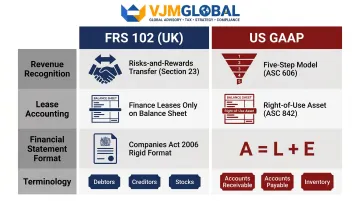
Source: VIF Training - UK GAAP vs US GAAP Key Differences Explained
Tax Compliance Divergence
UK firms are accustomed to VAT returns filed with HMRC. US work involves entirely different obligations:
Federal income tax forms your provider must handle:
- Form 1040: US Individual Income Tax Return
- Form 1065: US Return of Partnership Income
- Form 1120-S: US Income Tax Return for an S Corporation
- Form 1120: US Corporation Income Tax Return
State and local sales tax complexity:
- 45 states levy sales tax; 38 allow local-level taxes
- No federal sales tax equivalent to UK VAT—every state administers its own system
- Combined state-and-local rates range from 2.90% (Colorado) to 10.11% (Louisiana)
Your outsourced partner must be proficient in these specific forms and jurisdictional requirements, not just generally "tax-aware."
Payroll Compliance Differences
UK payroll runs through RTI and involves National Insurance. US payroll operates under different rules:
- FICA (Federal Insurance Contributions Act): 7.65% employer contribution (6.2% Social Security + 1.45% Medicare)
- Form 941: Employer's Quarterly Federal Tax Return for income taxes and FICA
- Form 940: Employer's Annual Federal Unemployment Tax Return
- State withholding: Separate income tax withholding rules across most states
- 401(k) administration: Retirement plan compliance if offered
Each of these requirements carries its own filing deadlines and penalty exposure—confirm your provider has direct experience with all of them, not just payroll processing in general.
Software and Chart of Accounts Compatibility
UK firms commonly use Xero or Sage with UK-configured charts of accounts. US CPA clients typically require QuickBooks Online or QuickBooks Desktop, with chart of accounts structures aligned to IRS reporting categories.
Confirm your outsourced provider can operate within the required platform from day one. A forced migration disrupts existing client workflows and creates unnecessary transition risk.
GDPR Obligations for UK Firms
Sharing client financial data with an offshore provider triggers obligations under UK GDPR and the Data Protection Act. Before signing any agreement, verify your outsourcing partner:
- Operates under a compliant Data Processing Agreement (DPA) covering Article 28's eight mandatory contractual provisions
- Has ISO 27001 or equivalent data security certification
- Uses appropriate safeguards for international transfers (IDTA, Standard Contractual Clauses, or adequacy decisions)
- Conducts Transfer Risk Assessments where required
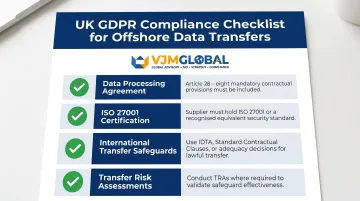
As data controller, the UK firm retains full compliance responsibility regardless of who processes the data offshore.
What Outsourced US CPA Bookkeeping Services Typically Include
Core Transactional Services
The foundation of any CPA-standard bookkeeping engagement includes:
- Daily or weekly transaction recording and categorisation to US GAAP standards
- Bank and credit card reconciliations ensuring records align with statements
- Accounts payable and receivable management including invoice processing, payment scheduling, vendor management, and collection tracking
- Month-end closing procedures with appropriate accruals and adjustments
Reporting and Compliance Layer
Outsourced providers should deliver:
- Monthly or quarterly financial statements formatted to US GAAP requirements:
- Profit & Loss Statement
- Balance Sheet
- Cash Flow Statement
- General ledger maintenance with proper documentation trails
- Audit-ready documentation aligned with IRS recordkeeping standards (Publication 583)
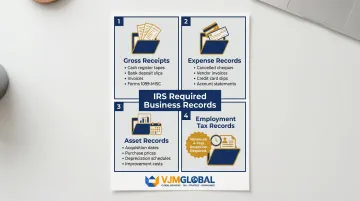
IRS requires businesses to maintain:
- Gross receipts documentation (cash register tapes, bank deposits, invoices, Forms 1099)
- Expense records (cancelled cheques, invoices, credit card slips)
- Asset records (acquisition dates, purchase prices, depreciation schedules)
- Employment tax records for at least 4 years
What's Typically Out of Scope But Adjacent
Payroll processing, sales tax filing, and tax return preparation (1040/1120/1065) may be offered as add-on services by the same provider. UK firms should clarify scope upfront to avoid gaps between their bookkeeping partner and their tax preparation workflow.
VJM Global, for example, provides real-time financial reporting through cloud-based platforms such as QuickBooks Online and Xero, giving clients on-demand access to dashboards and performance metrics between reporting cycles.
How UK Firms Should Choose the Right Outsourced US CPA Bookkeeping Partner
Verify US Compliance Credentials First
The provider's team should include CPAs, Enrolled Agents, or Chartered Accountants with active US GAAP and IRS documentation training. Ask specifically whether staff are trained to US standards, not just generally "accounting-qualified."
Key credential distinctions:
- CPAs: Licensed by state boards; can perform audits, attestation, tax, and advisory services
- Enrolled Agents: IRS-issued federal credential; specialise in tax preparation and IRS representation
- Both hold unrestricted rights to represent taxpayers before the IRS
VJM Global's team includes CPAs and Chartered Accountants specifically trained in US GAAP, IFRS, and PCAOB audit standards, with proficiency in US tax forms (1040, 1120, 1065) and software like Lacerte, ProSeries, and UltraTax.
Assess Data Security and GDPR Compatibility
Look for these security markers:
- ISO 27001 certification covers confidentiality, integrity, and availability of information across all formats — demonstrating systematic controls for protecting client financial data
- SOC 2 Type II certification goes further than Type I by testing that controls actually worked over 6–12 months, not just that they were designed correctly
GDPR compliance essentials:
- Willingness to sign a Data Processing Agreement (DPA) satisfying Article 28's eight mandatory provisions
- Role-based access controls limiting who can view client data
- Encrypted data transfer protocols
- Clear documentation of international transfer safeguards
Avoid providers who are vague about their security infrastructure or unwilling to provide certification evidence.
Confirm Software and Technology Alignment
The provider must support the specific accounting platforms used in your US CPA workflow. Most common are:
- QuickBooks Online and QuickBooks Desktop (most prevalent)
- Xero
- NetSuite
- Sage Intacct
Software incompatibility creates rework and delays. Verify during initial discussions that the provider actively uses the required platforms, not just claims familiarity.
Evaluate Engagement Model and Scalability
Look for providers offering tiered or flexible engagement models:
- Project-based: Fixed deliverables with a defined timeline — suits one-off catch-up work or new client onboarding
- Part-time: Ongoing support at reduced capacity, ideal for smaller US client portfolios
- Full-time dedicated resources: An embedded team member who works exclusively on your accounts
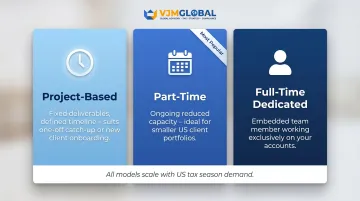
The model should scale with seasonal US tax workload spikes (January–April) without requiring a new contract every quarter. Ask whether they have handled UK firm clients with US client portfolios previously — this experience matters for understanding your workflow.
VJM Global as a Cross-Border Specialist
Meeting all five criteria above narrows the field considerably. VJM Global is one provider purpose-built for exactly this cross-border scenario:
- Dedicated team of CPAs and US-compliant professionals trained specifically in US GAAP and IRS standards
- 30+ years of experience in tax, audit, and advisory services
- 250+ UK businesses served with a 95% client retention rate
- EAI International membership — a globally recognised network of independent accounting firms, reflecting independently verified standards for cross-border compliance and client confidentiality
- Scalable engagement models that match cost to actual workload, eliminating the fixed-cost burden of year-round staffing
Their team can scale support during US tax season without permanent headcount increases, providing the flexibility UK firms need for seasonal workloads.
Red Flags and Key Questions to Ask Before Signing
Watch for Vague Compliance Claims
Any provider that cannot clearly state which specific US tax forms, IRS documentation standards, or GAAP frameworks their team is trained on should not be managing US CPA bookkeeping. General offshore accounting experience alone is not equivalent to US CPA firm workflows.
Specific red flags:
- Claims of "international tax experience" without naming US forms (1040, 1065, 1120-S, 1120)
- References to "generally accepted standards" without specifying US GAAP vs IFRS vs FRS 102
- Unable to describe how they handle state-level sales tax compliance across multiple jurisdictions
Identify Communication and Oversight Gaps
If a provider cannot offer direct bookkeeper access, defined turnaround times (SLAs), and a named account manager, UK firms risk losing visibility into the quality and status of their clients' books. Insist on:
- Weekly status summaries
- Named points of contact (account manager and lead bookkeeper)
- Clear escalation path for errors or urgent queries
- Documented review processes
According to AICPA Ethics Guidance (ET Section 1.700.040), the filing CPA retains professional responsibility for outsourced work—you must define scope, review deliverables, and maintain documentation of the review process.
Critical Questions to Ask Before Committing
That accountability obligation makes vetting your provider's actual capabilities—not just their marketing claims—essential. Before signing, get clear answers to these questions:
US expertise:
- Does the team have hands-on experience with US CPA firm workflows?
- Which US tax forms do your bookkeepers prepare daily? (Look for: 1040, 1065, 1120-S, 1120)
- How do you handle multi-state sales tax compliance?
Data security:
- Can you demonstrate GDPR-compliant handling for UK-origin client data?
- Do you hold ISO 27001 or SOC 2 Type II certification?
- Will you sign a Data Processing Agreement covering Article 28 requirements?
Operational capacity:
- What are your turnaround times for monthly reconciliations and reports?
- Can your team scale during the January–April US tax season?
- Which US accounting platforms does your team actively use?
Oversight and accountability:
- Will we have a named account manager and direct bookkeeper contact?
- What SLAs cover query resolution and error correction?
- How do you document and communicate discrepancies to the supervising CPA?
Frequently Asked Questions
Can UK firms legally outsource US CPA bookkeeping to a third-party provider?
Yes, UK firms can legally engage offshore or third-party bookkeeping providers for US CPA work, provided they comply with UK GDPR when transferring client data and ensure the provider operates under a signed Data Processing Agreement. No US regulation bars UK firms from outsourcing this function.
What is the main difference between UK bookkeeping standards and US CPA bookkeeping requirements?
UK bookkeeping follows FRS 102 or IFRS with VAT reporting to HMRC, while US CPA bookkeeping requires US GAAP compliance, IRS documentation standards, and state-specific tax obligations — affecting chart of accounts structure, financial statement formats, and tax filing workflows.
How do UK firms protect client data when outsourcing to an overseas bookkeeping provider?
Verify ISO 27001 certification, encrypted data transfer, role-based access controls, and a signed GDPR-compliant Data Processing Agreement. Providers with SOC 2 Type II certification provide independently audited data security assurance.
What accounting software should an outsourced US CPA bookkeeping provider support?
US CPA workflows most commonly use QuickBooks Online and QuickBooks Desktop, though Xero, NetSuite, and Sage Intacct are also common. UK firms should confirm software compatibility before onboarding to avoid disruptive migrations.
How much can UK firms save by outsourcing US CPA bookkeeping?
UK firms typically save 40–60% compared to the cost of hiring an in-house US GAAP-qualified accountant. Savings come from lower labour costs, eliminated recruitment and training overhead, and pay-as-you-go or retainer arrangements that scale with actual workload.
How quickly can a UK firm onboard an outsourced US CPA bookkeeping partner?
Most established providers complete onboarding within one to two weeks, covering software access setup, chart of accounts alignment, knowledge transfer, and a trial reconciliation.