This isn't a paperwork detail. It shapes who's liable if something goes wrong, what tax breaks you can claim, and how much compliance work lands on your desk each year.
UK-Singapore trade hit GBP29.0 billion in the four quarters to Q1 2026, up 20% year-on-year — a clear signal that more UK firms are weighing this exact decision right now.
The two structures differ sharply on liability exposure to the UK parent, access to Singapore's Start-Up Tax Exemption, and how the UK-Singapore Double Taxation Agreement applies. This article breaks down legal status, tax treatment, compliance burden and business scope, then gives you situational guidance based on where your company stands.
Key Takeaways
- A branch shares your UK parent's legal identity; a subsidiary stands alone as its own Singapore company
- Liability for Singapore debts sits fully with the UK parent under a branch; a subsidiary caps exposure at its own assets
- Only tax-resident subsidiaries can claim the Start-Up Tax Exemption — branches are locked out
- Filing is heavier for branches: audited accounts for both the branch and the UK parent
- The right choice hinges on liability appetite, tax planning and how closely Singapore activities match your UK parent's stated purposes
Branch vs Subsidiary: Quick Comparison
Here's the structural comparison UK businesses need before going further:
| Factor | Branch | Subsidiary (Pte Ltd) |
|---|---|---|
| Legal status | Extension of UK parent; not a separate entity | Separate Singapore company under the Companies Act |
| Liability | UK parent bears unlimited liability | Capped at the subsidiary's own capital and assets |
| Tax treatment | Non-resident; flat 17% rate | Resident; same 17% rate but eligible for exemptions |
| Start-Up Tax Exemption | Not available | Available if conditions are met |
| Annual filing | Audited accounts for branch AND UK parent | Own annual return; possible audit exemption |
| Business scope | Limited to UK parent's constitutional objects | Can define its own objects independently |
Legal Status and Liability
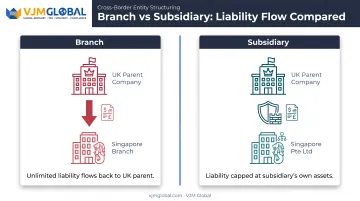
A branch operates as a direct extension of the UK parent — it carries no separate legal identity. If the branch racks up debt or faces a lawsuit in Singapore, that liability flows straight back to the UK company's balance sheet.
A subsidiary is a distinct legal person, typically registered as a Private Limited Company (Pte Ltd). The UK parent's exposure stops at whatever capital and assets sit inside the Singapore entity. For most UK businesses, that liability ring-fence is the deciding factor before tax or filing rules come into play.
Tax Treatment and Filing Burden
Both structures pay Singapore's 17% headline corporate tax rate. What changes is access to reliefs and treaty benefits.
Subsidiaries, as Singapore tax residents, can access the Start-Up Tax Exemption and the UK-Singapore DTA's residency-based benefits. Branches are treated as non-residents, so they cannot claim SUTE, though they can still use the ordinary Partial Tax Exemption.
Filing burden follows the same pattern: branches submit audited accounts for the Singapore operation and the UK head office. Subsidiaries file independently and, if they qualify as a small company, may skip the audit entirely.
What is a Branch Office?
A Singapore branch is a registered extension of the UK parent under the Companies Act 1967, with no independent legal identity of its own. Legally speaking, it is the UK company, just operating from a Singapore address.
UK firms consider this route when brand continuity and speed matter more than liability protection. That's the trade-off in plain terms.
Why UK firms pick a branch:
- Immediate use of the established UK brand and credit history, without building trust from scratch
- Simpler governance — no local board, no separate subsidiary AGM to run
- Faster path to signing Singapore contracts under a name clients and lenders already recognise
There's a catch worth flagging. A branch must register through ACRA with a locally resident authorised representative and a certified copy of the UK parent's constitution.
That constitutional link matters: a branch's activities generally need to stay aligned with what the UK parent is set up to do. It isn't free to invent a new line of business the way a subsidiary can.
Use Cases of Branch Office
Branches tend to appear early in a UK company's Asia expansion: a low-commitment foothold for firms whose main asset is the parent's reputation or licensing status, rather than a plan to build an independent Singapore business from scratch.
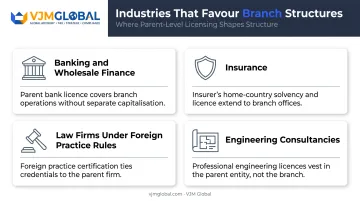
Industries where branches are common:
- Banking and wholesale finance, where licensing is tied to the parent's global standing
- Insurance, where underwriting capacity sits with the UK entity
- Law firms operating under foreign law practice rules
- Engineering consultancies relying on parent-level professional credentials
A regulated example: Singapore's Monetary Authority lists Kotak Mahindra (UK) Limited's Singapore branch as a licensed Capital Markets Services holder and exempt financial adviser. That listing confirms UK-incorporated regulated firms do operate through Singapore branches to meet local licensing frameworks.
Wholesale banks in Singapore are licensed under the Banking Act. Structuring through a branch lets the parent's existing licence and credit standing carry weight locally, instead of building a new entity's track record from scratch.
What is a Subsidiary Company?
A Singapore subsidiary is a separate legal entity, almost always structured as a Private Limited Company (Pte Ltd). ACRA permits the UK parent to hold shares as the sole shareholder, meaning 100% foreign ownership is allowed.
For UK businesses planning to stay in Singapore for the long haul, this is the default vehicle.
Core benefits:
- Limited liability shields the UK parent's balance sheet from Singapore-side risk
- Tax residency unlocks the Start-Up Tax Exemption and DTA benefits
- Full independence to define business activities that differ from the UK parent's objects
That flexibility comes with two standard requirements: at least one Singapore-resident director, and a company secretary appointed within six months of incorporation. Neither is negotiable under the Companies Act, but both are routine for firms already handling formation elsewhere.
When a Subsidiary Fits
Subsidiaries suit UK businesses planning to trade under their own name, hire locally, invoice Singapore customers directly, raise capital, or bid for government contracts that require local incorporation.
Where subsidiaries dominate:
- Technology and SaaS firms setting up regional headquarters
- E-commerce businesses needing local invoicing and banking
- Manufacturing and trading firms building a genuine Singapore footprint rather than a pass-through presence
Pte Ltd registrations far outnumber branches in Singapore's business registry. Most foreign entrants choose incorporation once they need more than a short-term liaison presence, because the tax and liability upside outweighs the extra governance work.
Branch vs Subsidiary: Which is Better for UK Businesses?
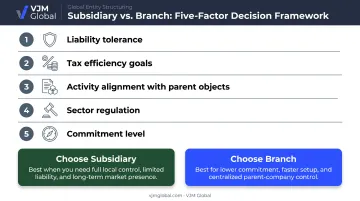
There's no universal winner here. The right call depends on five factors:
- Liability tolerance: can your UK balance sheet absorb Singapore-side risk, or do you need it ring-fenced?
- Tax efficiency goals: is SUTE access worth the incorporation effort?
- Activity alignment: do your planned Singapore activities fit within the UK parent's existing constitutional objects?
- Sector regulation: does your licence or lender relationship depend on the UK entity's name and credit standing?
- Commitment level: is this a toe in the water or a long-term regional base?
Choose a subsidiary if liability protection, tax incentives and independent growth top your list. This covers most UK SMEs, tech firms and trading businesses entering Singapore for the first time.
Choose a branch if brand continuity, parent credit standing, or licensing alignment with the UK entity is commercially non-negotiable. That typically applies to regulated financial services, insurance, or professional firms.
Model these trade-offs before you commit. Specialist cross-border advisory support, including VJM Global's entity structuring guidance, can map the tax and liability implications of each route against your Singapore plans before you file with ACRA.
Real-World Example and Final Recommendation
Picture a UK-based professional services firm eyeing Singapore as a bridge into the wider Asia-Pacific market. Its leadership faces the same fork every UK company hits: register a branch under the existing UK name, or incorporate a fresh Pte Ltd subsidiary?
The firm's early client conversations hinge on price competitiveness, and that's where the Start-Up Tax Exemption becomes the deciding factor. A branch, taxed as a non-resident, simply can't claim it. A subsidiary can, provided it meets the incorporation and residency conditions.
That single incentive gap tips many first-time UK entrants toward incorporation, even when a branch would have been operationally simpler to set up. The trade-off is slightly more governance work (a resident director, a company secretary, and an independent set of accounts) in exchange for tax headroom and a liability firewall that protects the UK parent.
There's no fixed formula for this decision. A regulated bank with a licence tied to its UK credit rating will reasonably choose differently than a software firm chasing local incentives and independent growth. The right structure tracks your risk appetite and growth stage, not a universal rulebook.
In short:
- Subsidiaries suit UK businesses seeking liability protection and tax efficiency for sustained Singapore growth
- Branches suit those needing immediate brand and credit leverage, particularly in regulated sectors
VJM Global supports UK businesses through exactly this evaluation. Where a Singapore entry later opens the door to India, the same team can carry that structuring work into the next market too.
Frequently Asked Questions
What is the difference between a subsidiary and a branch?
A branch is a legal extension of the parent company with no separate identity, meaning the parent carries full liability. A subsidiary is an independently incorporated entity with liability limited to its own assets.
What is a subsidiary company in the UK?
A UK subsidiary is a company incorporated in the UK and controlled by a parent through majority share ownership or voting rights. It's a distinct concept from a Singapore subsidiary but follows the same separate-legal-entity principle.
What are the different types of companies in Singapore?
The main vehicles are the private limited company (used for subsidiaries), the branch office, and the representative office. Sole proprietorships and partnerships exist too, but they suit smaller local setups rather than foreign market entry.
Can a UK company own 100% of a Singapore subsidiary?
Yes. Singapore permits full foreign ownership of a private limited company, with no local shareholding requirement. The only local condition is appointing at least one Singapore-resident director.
Is a branch office taxed the same as a subsidiary in Singapore?
Both face the same 17% headline corporate tax rate. However, a branch is taxed as a non-resident and cannot access the Start-Up Tax Exemption that a resident subsidiary can claim.
Which structure is better for a UK SME entering Singapore for the first time?
Most first-time UK SMEs favour a subsidiary for liability protection and tax incentives. A branch becomes more practical only when brand continuity or regulatory licensing tied to the UK parent is essential.