Introduction
Most UK companies assume setting up a Singapore branch office is straightforward — and the registration itself often is. What catches them off guard is the liability exposure: unlike a subsidiary, a branch office leaves the UK parent company directly responsible for all Singapore obligations. Setting up a branch office is one of the most direct routes to establish a formal business presence in the city-state, offering immediate brand recognition under your UK company name.
This guide is written specifically for UK-based companies exploring Singapore expansion. While the registration process typically completes within 1–3 business days through ACRA's online portal, UK companies face specific document requirements, tax implications, and liability considerations that generic guides often overlook. Missing them — particularly around apostille certification — can delay your launch by weeks.
This article covers what a Singapore branch office is, how it compares to a subsidiary, the specific documents UK companies must prepare (including apostille certification requirements), step-by-step registration through ACRA's BizFile+ portal, ongoing compliance obligations, and when a branch structure may not be the right fit. For UK businesses with broader Asian ambitions, we'll also cover how Singapore commonly serves as the first step toward India market entry.
Key Takeaways
- A Singapore branch office is an extension of the UK parent company—not a separate legal entity—meaning the parent bears unlimited liability for all branch operations
- Registration via ACRA's BizFile+ portal takes 1–15 working days (regulated industries: 14–60 days)
- UK companies must appoint a locally resident authorised representative and submit apostilled corporate documents
- Branch offices are taxed at 17% but cannot access Singapore's startup tax exemptions or the UK-Singapore DTA benefits
- Subsidiaries offer better liability protection and tax efficiency; branches suit companies prioritising immediate brand leverage with minimal setup complexity
Branch Office vs. Subsidiary: What UK Companies Need to Know
A Singapore branch office is a legal extension of the UK parent company registered under Singapore's Companies Act, operating under the same name and subject to the same constitutional restrictions as the parent.
Unlimited Liability Exposure
Because a branch is not a separate legal entity, any debts, claims, or legal actions against the Singapore branch can be pursued against the UK parent company and its global assets. A subsidiary avoids this entirely — liability stays limited to the subsidiary's own assets, leaving the parent insulated from Singapore-side exposure.
Tax Residency Status
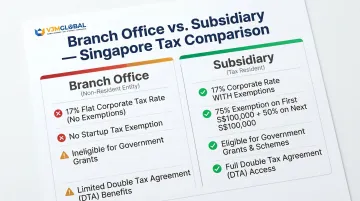
A branch office is treated as a non-resident entity for Singapore tax purposes. This means:
- Taxed at Singapore's flat 17% corporate rate on Singapore-sourced income
- Cannot access Singapore's startup tax exemption scheme (which exempts 75% of the first S$100,000 and 50% of the next S$100,000 of chargeable income for qualifying new companies)
- Ineligible for most government grants and incentive programmes reserved for Singapore-incorporated companies
- Limited DTA benefits — while the UK-Singapore Double Taxation Agreement applies to branch profits (as a permanent establishment), the branch itself cannot claim Singapore DTA benefits as a resident entity
Constitutional Activity Restrictions
A branch office can only conduct activities already permitted under the UK parent company's articles of association or memorandum. You cannot launch new business lines in Singapore that differ from your UK constitutional objects — a restriction that doesn't apply to subsidiaries, which can define their own activities independently.
Additional Filing Burden
Under Section 373 of the Companies Act, branch offices must file:
- Audited financial statements of the Singapore branch operations
- Audited financial statements of the UK parent company
- Annual return with ACRA, including updated particulars of the parent company
Running two parallel audit processes — one for Singapore, one for the UK parent — adds cost and coordination overhead that a standalone subsidiary avoids.
When a Branch Makes Sense
These constraints matter less to established UK firms where the parent's reputation is the primary commercial asset. Branches work well when:
- Financial services firms, law firms, and engineering consultancies need the parent's track record to win contracts
- Lenders are financing the Singapore operation against the parent's global balance sheet
- Brand continuity matters — the UK name carries more weight in market than a new Singapore entity would
- Governance simplicity is a priority — no local board, no separate shareholders, no subsidiary AGM requirements
UK-Specific Requirements and Documents to Prepare
Appoint a Locally Resident Authorised Representative
You must appoint at least one authorised representative who is locally resident in Singapore. Under the Companies Act, this person can be a Singapore citizen, Singapore permanent resident, or Employment Pass holder. They are personally responsible for statutory compliance.
Without existing Singapore contacts, you'll need to either second a UK employee and secure an Employment Pass, or engage a professional nominee service (typically £1,500–£3,000 annually).
Certify UK Corporate Documents
UK companies must provide certified true copies of:
- Companies House certificate of incorporation
- Articles of association (or memorandum and articles)
- Register of UK parent company's directors
- Latest audited financial statements (if audited accounts are required under UK law, which generally applies to non-exempt companies)
- Notice containing the parent company's UK registration number, business description, and legal entity type (a single document covering all three details)
Apostille Certification Process
Singapore joined the Hague Apostille Convention on 16 September 2021, simplifying document authentication for UK companies. You can now use the apostille process rather than full consular legalisation.
How it works:
- Have a UK solicitor or notary certify your documents as true copies
- Obtain an apostille from the UK's Foreign, Commonwealth & Development Office
- The apostilled documents are valid for use in Singapore
One timing rule catches many applicants off guard: ACRA requires certification no more than four months before submission, unless an exemption is granted. Plan your document preparation accordingly.
Registered Office Address
Your Singapore branch must have a physical registered office address (not a P.O. box) that is accessible to the public for at least three hours during normal business hours on each business day.
UK companies without an immediate physical presence can use a professional registered office address provider.
How to Register a Branch Office in Singapore: Step-by-Step
UK companies cannot self-file—you must engage a Corporate Service Provider (CSP) or registered filing agent to submit the application through ACRA's BizFile+ portal. Budget for both government fees and your CSP's professional fees before you begin.
Fees:
- Name application: S$15
- Registration: S$300
Processing times:
- Standard applications: approved shortly after payment
- Complex applications: up to 15 working days
- Regulated industries requiring referral authority approval: 14–60 days
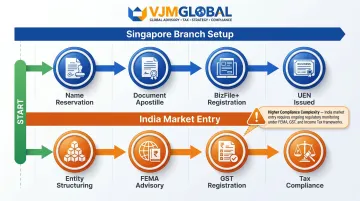
Step 1: Reserve the Branch Name
The Singapore branch must use the same name as the UK parent company. Your CSP submits a name reservation application through BizFile+.
Important: If your UK company has a common trading name, verify availability early. The name will be rejected if it is identical or too similar to an existing Singapore-registered entity.
Step 2: Prepare and Certify UK Documents
Have a UK solicitor or notary:
- Certify your incorporation documents as true copies
- Affix an apostille to make documents valid for Singapore use
- Ensure certification is dated within four months of your planned submission date
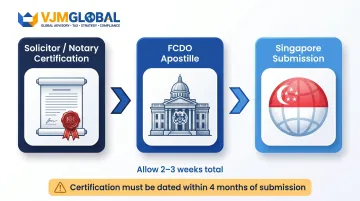
This step often takes 2–3 weeks, so begin early.
Step 3: Submit the Application via BizFile+
Your CSP logs into BizFile+ using their Corppass credentials and enters:
- UK parent company incorporation details
- Singapore registered office address
- Authorised representative details and consent
- Nominator/controller information for ROND/RONS and RORC registers
- All certified document uploads
You don't need to be physically present in Singapore for this step.
Step 4: Obtain Approval and Receive UEN
Once payment is made, ACRA reviews the application. Upon approval, your branch receives a Unique Entity Number (UEN), the identifier used for all government interactions and required on all business letters, invoices, and official notices.
You can download a free Business Profile from BizFile+ immediately upon approval.
For regulated sectors (financial services, legal practice, engineering, healthcare), additional approval from the relevant authority is required before commencing operations:
| Authority | Sector |
|---|---|
| Monetary Authority of Singapore (MAS) | Financial services, banking, insurance |
| Legal Services Regulatory Authority (LSRA) | Legal services |
| Professional Engineers Board (PEB) | Engineering services |
| Board of Architects Singapore (BOA) | Architectural services |
Post-Registration Obligations Every UK Company Must Fulfil
Annual Filing Obligations
Financial statements: Within 60 days of the UK parent's AGM, file:
- Audited financial statements of the Singapore branch
- Audited financial statements of the UK parent company
Tax filings:
- Estimated Chargeable Income (ECI): within 3 months of financial year end
- Annual corporate income tax return: by 30 November each year
GST Registration
If annual taxable turnover exceeds S$1 million, you must register for GST within 30 days of becoming liable.
Current GST rate: 9% (effective 1 January 2024).
Sector-Specific Licences
Certain industries require separate business licences from Singapore authorities:
- Financial services, healthcare, food & beverage, travel, education
Check Singapore's GoBusiness licensing portal for your specific sector requirements.
Planning India Market Entry Alongside Singapore
Many UK companies use Singapore as a regional hub before expanding into India. Once your Singapore branch is operational, India's regulatory environment warrants early attention — it is considerably more complex and carries higher penalties for missteps.
Common India compliance pitfalls for UK companies:
- GST registration errors and classification mistakes
- FEMA (Foreign Exchange Management Act) violations for foreign investments
- Transfer pricing documentation gaps for intra-group transactions
- Import/export duty misclassification
Getting India-side compliance right from the outset requires specialist support distinct from your Singapore advisors. VJM Global has worked with over 250 UK businesses on India market entry, covering:
- Entity structuring (subsidiary, branch, or liaison office)
- FEMA advisory and RBI permissions
- GST and corporate income tax compliance
- Cross-border accounting and management reporting
Engaging India-focused advisors early — running in parallel with your Singapore setup — helps avoid the compliance gaps that commonly arise when both expansions are managed as a single workstream.
When a Branch Office May Not Be the Right Fit for Your UK Business
Early-Stage SMEs Testing the Market
If you're an early-stage UK SME without an established brand or strong balance sheet, a subsidiary (private limited company) is the stronger choice:
- Unlimited liability exposure of a branch puts your UK parent's assets directly at risk
- No access to startup tax exemptions means paying the full 17% corporate rate (vs. an effective 4.25% on the first S$100,000 for qualifying subsidiaries)
- Limited access to government grants excludes you from most Singapore support programmes
Different Business Activities from UK Operations
If you intend to conduct business activities in Singapore that differ from your UK constitutional objects, you must use a subsidiary. A branch is constitutionally restricted to activities already permitted in the parent's articles of association.
Tax Efficiency Considerations
A branch office cannot:
- Benefit from Singapore's startup tax exemption scheme (up to S$125,000 exemption over three years)
- Access most Singapore government grants and incentive schemes
- Independently claim Singapore DTA benefits (as a non-resident entity)
All these advantages are available to Singapore tax-resident subsidiaries.
Investor and Client Perception
Certain Singapore clients, investors, and licensing authorities see a subsidiary as a stronger signal of long-term commitment. If any of the following apply to your expansion plans, a subsidiary is the more appropriate structure:
- Raising capital from Singapore-based investors
- Building a standalone APAC brand identity
- Pursuing government contracts that require local incorporation
In these scenarios, a branch's dependent legal status actively works against you — even if the setup costs are lower upfront.
Frequently Asked Questions
Frequently Asked Questions
How do I open a branch office in Singapore?
UK companies must engage a registered Corporate Service Provider (CSP) to file the application on BizFile+. The process involves reserving your company name, apostilling required UK documents (certificate of incorporation, articles of association, director register), appointing a Singapore-resident authorised representative, and paying the S$300 fee. Standard applications are approved within 1–15 working days.
What is the difference between a branch and a subsidiary in Singapore?
A branch is a legal extension of the UK parent (same name, no separate legal identity, parent liable for all debts, taxed as non-resident at 17%). A subsidiary is a separate legal entity (can have its own name, limited liability, may qualify for Singapore tax residency and startup exemptions of up to S$125,000 over three years).
What documents do UK companies need to register a Singapore branch office?
You need an apostilled or certified copy of your Companies House certificate of incorporation, certified copy of articles of association, director register, local authorised representative consent form, and the UK parent's latest audited financial statements. All documents must be certified within four months of submission.
Can a Singapore branch office claim benefits under the UK-Singapore Double Taxation Agreement?
Generally no. A branch is treated as a non-resident entity, so the UK parent claims DTA relief in the UK for Singapore taxes paid on branch profits. A subsidiary qualifying as a Singapore tax resident may access DTA benefits directly, subject to IRAS conditions.
How long does it take to register a branch office in Singapore?
Most straightforward applications are approved shortly after payment. Regulated industries requiring referral authority approval (such as financial services, legal practice, or engineering) can take between 14 and 60 days depending on the complexity and the authority involved.
Planning India operations alongside your Singapore expansion? VJM Global supports UK companies with India-side business registration, FEMA advisory, tax compliance, and accounting outsourcing. With 250+ UK businesses served and 30+ years of experience, our team handles India's regulatory requirements so you can focus on building your business. Contact us at [email protected] or call +91 9891576441 to discuss your expansion strategy.