Most freelancers start out as sole proprietors. It's the default, requires no paperwork, and works fine when you're testing an idea. But once client contracts get bigger, subcontractors enter the picture, or your work carries real liability exposure, that simplicity starts costing you.
This guide walks through exactly how to form an LLC for your freelance business, when it actually makes sense, the factors that shape your costs and taxes, and the mistakes that trip up freelancers most often.
Key Takeaways
- An LLC protects personal assets from business liabilities, a safeguard sole proprietorships lack
- Forming an LLC takes five core steps, from choosing a state to obtaining an EIN
- State filing fees range from $50 to $500, and skipped compliance costs can pile up quickly
- S-Corp tax election can reduce self-employment tax, but only once profit passes roughly $40,000–$60,000
- NRIs and international freelancers face added cross-border tax rules when forming a US LLC
How to Form an LLC for Your Freelance Business in the US
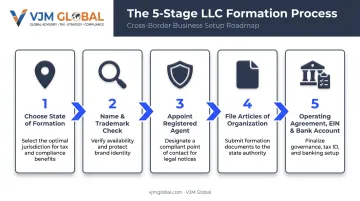
Forming an LLC isn't complicated, but skipping a step or filing in the wrong state creates headaches later. Here's the process, broken into five stages.
Step 1: Choose Your State of Formation
Most freelancers should form their LLC in the state where they actually live and work. Forming somewhere else, like Delaware or Wyoming, doesn't exempt you from registering as a "foreign LLC" in your home state if you're doing business there. That means paying two sets of fees for zero added benefit.
Before filing anything, check name availability on your state's Secretary of State website. If you're an international or NRI freelancer considering a US LLC, get jurisdiction-specific guidance first, since your tax exposure looks very different from a US resident's. Firms like VJM Global specialize in mapping this cross-border tax exposure for NRI and international founders before they file.
Step 2: Name Your LLC and Confirm Availability
Your business name needs to pass two checks:
- State-level availability — search your Secretary of State's database and confirm no other registered entity uses the same name
- Federal trademark clearance — run a search on the USPTO's trademark database before committing to a brand
State approval only means no one else registered that exact name in your state. It says nothing about federal trademark conflicts, which is why a separate USPTO search matters before you print business cards.
Your LLC name must also include a designator like "LLC" or "L.L.C." in the official filing.
Step 3: Appoint a Registered Agent
Every state requires an LLC to have a registered agent: a person or service with a physical address in the formation state, available during business hours to accept legal and tax notices.
You have two options:
- Act as your own agent using your home address (free, but your address becomes public record)
- Hire a registered agent service for privacy and reliability, typically $100-$300 a year
Freelancers working from home often prefer paying for a service just to keep their address off public filings.
Step 4: File Articles of Organization and Pay the State Fee
This is the actual formation document, filed with your state's business filing office. You'll typically need to provide:
- LLC name and business address
- Registered agent name and address
- Member or manager information
- Purpose of the business (often a general statement)
State filing fees vary enormously. Kentucky charges $40 for Articles of Organization, while Massachusetts charges $500 for the equivalent filing. Check your specific state before budgeting, since the difference between states can be more than 10x.
Step 5: Draft an Operating Agreement, Get an EIN, and Open a Bank Account
Three final pieces complete your setup:
- Operating Agreement — documents ownership percentages, decision-making authority, and exit terms. Not required in every state, but strongly recommended for multi-member LLCs.
- EIN (Employer Identification Number) — free through IRS.gov, needed for tax filing, hiring, and banking. Skip paid services that charge for this.
- Business bank account — separates personal and business funds, preserving the liability shield your LLC is supposed to provide.
When Should You Form an LLC for Your Freelance Business?
Forming an LLC isn't a day-one requirement. Plenty of freelancers operate profitably as sole proprietors for years before making the switch, and that's often the right call while you're still figuring out demand for your services.
According to the Small Business Administration, the decision should hinge on risk and asset exposure, not income level. There's no magic revenue number where an LLC suddenly becomes necessary. Instead, watch for these signals:
- You're signing higher-value contracts with enterprise clients who expect a formal business entity
- You've started bringing on subcontractors or collaborators
- Your work carries real liability exposure — consulting advice, coaching, creative deliverables with IP implications
- Clients or partners are asking about your business structure before signing
On the other hand, forming an LLC may be premature if your income is inconsistent, you're running an early-stage side hustle, or your work involves minimal legal and financial risk. A freelance illustrator doing occasional logo work faces a different risk profile than a consultant advising companies on financial strategy.
Key Factors That Affect Your LLC Formation
The paperwork is only part of the story. What actually determines your costs, tax outcome, and long-term compliance burden comes down to a handful of choices made during setup.
State of Formation (Home State vs. Delaware/Wyoming)
Choosing where to form affects filing fees, privacy protections, and whether you'll need foreign LLC registration. Delaware's appeal comes from its specialized business court and investor familiarity, which matters far more to venture-backed startups than solo freelancers. Wyoming offers member privacy since it doesn't require owner names on public record.
The catch: forming out-of-state without an actual business presence there usually adds foreign qualification costs without delivering any real benefit for freelancers.
Tax Election (Default Pass-Through vs. S-Corp)
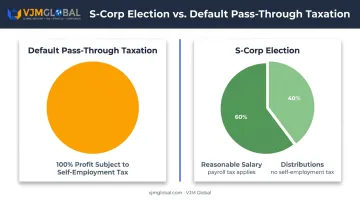
By default, LLC profits pass through to your personal return and get hit with self-employment tax on the full amount. Electing S-Corp status lets you split income into a "reasonable salary" (subject to payroll tax) and remaining distributions (not subject to self-employment tax).
The IRS sets no fixed income threshold for when this becomes worthwhile. What matters is whether your recurring profit, after paying yourself a defensible salary, comfortably exceeds the added payroll and compliance costs an S-Corp election requires.
Single-Member vs. Multi-Member Structure
Single-member LLCs are simpler: one owner, one tax return, no partnership disputes. Multi-member structures, common when freelancers team up on larger projects, need clearer terms around:
- Profit and loss splits
- Decision-making authority
- IP and client ownership if the partnership dissolves
Skipping a detailed Operating Agreement in a multi-member setup is one of the fastest ways to end up in a dispute over who owns what.
Tax Considerations for NRI/International Freelancers
NRIs, OCIs, and overseas freelancers forming a US LLC face a layer of complexity domestic freelancers don't. A foreign-owned US disregarded entity is generally required to file Form 5472 alongside a pro forma Form 1120 whenever there's a reportable related-party transaction. Missing that filing carries a base penalty of $25,000, regardless of whether any tax was actually owed.
International freelancers also need to think about:
- Double taxation on the same income under India's tax treaty network, which the US-India treaty (signed 1989) is designed to address
- Form 1040-NR filings for nonresident aliens engaged in US business activity
- FATCA disclosures, including Form 8938 for foreign financial assets
- FEMA compliance back in India, since foreign exchange rules interact directly with how NRI-owned foreign income gets reported
Advisory firms with cross-border experience, like VJM Global, work with NRI and OCI clients on the tax structuring and compliance side once a US entity exists. Their work typically includes applying DTAA provisions, handling nonresident filings, and managing FEMA-related reporting obligations. Getting this piece wrong isn't a minor paperwork issue. It can trigger double taxation or real penalties on both sides of the border.
Ongoing Compliance & Renewal Costs
Forming the LLC is a one-time event. Keeping it compliant isn't. Most states require annual or biennial reports, and some charge franchise taxes regardless of whether you made a profit that year.
| State | Recurring Fee |
|---|---|
| New York | $9 biennial statement |
| Kentucky | $15 annual report |
| Washington | $70 annual report |
| Massachusetts | $500 annual report |
| California | $800 annual LLC tax |
Miss a deadline, and states like Kentucky will administratively dissolve your LLC. Reinstating it later costs more time and money than simply filing on time would have.
Alternatives to Forming an LLC for Freelancers
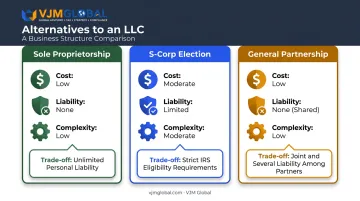
An LLC isn't the only structure available, and the right one depends on your income level, risk exposure, and growth plans.
Sole Proprietorship
This is where nearly every freelancer starts. It's free, requires no state filing, and works fine for low-risk, early-stage work.
Trade-off: there's no legal separation between you and your business. If a client sues or a debt goes unpaid, your personal assets are on the line.
S-Corporation Election (Within or Instead of an LLC)
Once your freelance income becomes consistent and substantial, electing S-Corp tax status can meaningfully cut your self-employment tax bill. You can layer this election on top of your LLC or run it as a standalone S-Corp.
Trade-off: you'll need to run payroll, file additional tax forms, and keep stricter records than a simple pass-through structure requires. Nonresident aliens aren't eligible S-Corp shareholders, which rules this option out for many international freelancers.
General Partnership
Two freelancers collaborating informally, without wanting to file paperwork right away, sometimes default into a general partnership without realizing it.
Trade-off: it's rarely the right long-term choice. Each partner carries unlimited personal liability, including for the other partner's business decisions. That's a bigger risk than most freelancers realize until something goes wrong.
Common Mistakes When Forming an LLC
Freelancers tend to make the same errors, and most are avoidable with a bit of planning:
- Commingling personal and business funds: mixing accounts undermines the liability protection an LLC provides, and courts can pierce the structure if finances aren't separate
- Chasing Delaware based on hype: most freelancers gain nothing from an out-of-state LLC and end up paying unnecessary foreign qualification fees
- Skipping the Operating Agreement: even solo freelancers should document ownership terms and succession plans, since undocumented decisions cause disputes later
- Missing compliance deadlines: annual reports and franchise taxes are easy to forget, but missing them risks administrative dissolution and costly reinstatement
Frequently Asked Questions
Do I need an LLC to freelance in the US?
No, an LLC isn't legally required. It adds liability protection and credibility once you take on larger clients or higher-risk work, but many freelancers operate for years as sole proprietors first.
How much does it cost to form an LLC?
Costs vary by state, ranging from around $40 to $500 for the initial filing fee. Add optional costs like a registered agent service or legal help on top of that.
What is the best state to form an LLC for a freelancer?
For most freelancers, home state formation is the most practical and cost-effective choice. "Business-friendly" states like Delaware mainly benefit companies raising outside investment, not solo operators.
Can a non-US resident or NRI form an LLC in the US?
Yes, non-US residents including NRIs and OCIs can form a US LLC. They should get advice on cross-border tax treaty implications and dual compliance obligations before doing so, since missteps can trigger double taxation.
Does an LLC protect freelancers from lawsuits?
An LLC protects personal assets from most business debts and lawsuits, provided you maintain proper separation between personal and business finances and follow your state's compliance rules.
Should I elect S-Corp tax status for my LLC?
S-Corp election can reduce self-employment tax once profits are consistently high enough to justify the added payroll and administrative requirements. Model the numbers with a tax professional before filing.