It's one of the most common freelancer dilemmas, and the confusion isn't your fault. The IRS treats your freelance income as business income automatically, no paperwork required. But separately, your state, city, or industry might require licenses or filings you haven't even heard of yet.
This guide breaks down exactly when registration is legally required, when it's optional but smart, and how to set your freelance business up the right way.
Key Takeaways
- IRS automatically classifies freelancers as sole proprietors, no federal registration needed
- DBA filings, sales tax permits, and licenses vary by state, city, and industry
- An LLC isn't mandatory, but it adds liability protection and credibility
- Tax compliance matters more long-term than the registration step itself
Do Freelancers Need to Register a Business in the US?
Short answer: not necessarily, but it depends on how you're operating.
The IRS automatically treats freelance and 1099 income as sole proprietorship income. You report it on Schedule C with your Form 1040, whether or not you've filed a single piece of paperwork with any government agency. There's no separate "freelancer registration" step at the federal level.
Here's the distinction that trips people up:
Federal tax obligations exist regardless: you owe income tax and self-employment tax on freelance earnings the moment you earn them. State and local registration is separate and location-dependent, since business licenses, sales tax permits, and trade name filings depend on where you live and work.
The Small Business Administration confirms this directly: a person doing business under their own legal name generally doesn't need to register a formal business structure at all, though state, local, and professional licensing rules can still apply.
"Registering a business" also means different things to different people. An EIN, a DBA, an LLC, and a local license are four separate filings. Most freelancers only need one or two of these, not all four.
When Registration or Licensing Becomes Legally Required
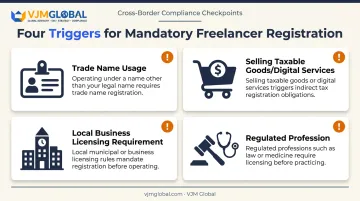
Registration stops being optional in a few specific scenarios:
- You're using a trade name. Names like "Bright Ideas Copywriting" usually require a DBA; LA County, for example, mandates a fictitious name filing for anyone dropping their surname.
- You're selling taxable goods or digital services. Washington, for instance, requires a business license application for sales tax-subject products, including downloads, streaming, and subscriptions.
- Your city requires local business licensing. Seattle, for example, requires most home-based businesses to get a license tax certificate, with no gross-income exemption for in-city operations.
- You work in a regulated profession. Legal, healthcare, financial advisory, and certain trades carry licensing rules on their own—freelance financial advisors, for instance, often need state investment adviser registration before taking clients.
Quick Self-Check: Do You Need to Register?
Ask yourself these five questions:
- Am I using a business name other than my own legal name?
- Do I sell products or services that require collecting sales tax?
- Do I regularly meet clients at a physical location in my city or county?
- Does my work fall under a regulated profession (legal, medical, financial, certain trades)?
- Do I want a dedicated business bank account, business credit, or a loan?
Answered yes to any of these? You likely need some form of registration. Answered no across the board? You can probably keep operating as a sole proprietor for now.
Business Structures for Freelancers: Sole Proprietor vs LLC vs S-Corp
Once you've settled the "do I need to register" question, the next decision is what structure actually fits your business.
Sole proprietorship is the default. No formal registration required, income passes straight through to your personal tax return, and setup costs nothing. The tradeoff: your personal assets (home, savings, car) aren't shielded from business debts or lawsuits.
LLC (Limited Liability Company) requires formal state registration and ongoing fees, but it separates your personal assets from business liabilities in most instances. It's a state-law entity, not a tax election, so an LLC's default tax treatment still flows through to your personal return unless you elect otherwise.
S-Corp election is a tax election, not a standalone business structure, applied to an LLC or corporation. It can reduce self-employment tax for higher earners: you pay yourself a "reasonable salary" and take remaining profit as distributions not subject to self-employment tax.
The catch: payroll administration, separate filings, and stricter IRS scrutiny on what counts as "reasonable compensation."
Partnerships and C-Corps are less common for solo freelancers but worth knowing:
- Partnerships fit freelancers collaborating with one or more co-owners, with income passing through to each partner
- C-Corps suit freelancers scaling into a larger venture with outside investors, though the entity itself pays corporate tax
| Entity Type | Best For | Pros | Cons |
|---|---|---|---|
| Sole Proprietorship | Solo freelancers just starting out | Zero setup cost, simple filing | No liability protection |
| LLC | Freelancers wanting asset protection | Liability shield, added credibility | State fees, more paperwork |
| S-Corp Election | Higher-earning freelancers | Potential self-employment tax savings | Payroll costs, compliance burden |
| Partnership | Freelancers with co-owners | Shared resources and workload | Joint liability in most structures |
| C-Corp | Freelancers scaling with investors | Access to outside capital | Double taxation risk |
When Should You Upgrade From Sole Proprietor?
Common triggers for switching structures include:
- Rising income that increases your tax exposure
- Increased liability risk, such as client contracts with higher stakes
- Hiring subcontractors who need to be paid and managed formally
- Needing business financing that requires a registered entity
On the income side, Forbes Advisor points to roughly $60,000 in annual net income as a common benchmark where an S-corp election starts making financial sense. That's an estimate based on payroll-tax savings outweighing added compliance costs, not an IRS-defined threshold. Run your own numbers before deciding.
Benefits of Registering Your Freelance Business
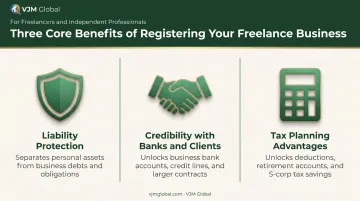
Even when it's not required, registering can pay off in three concrete ways.
Liability protection. Once you form an LLC, it generally separates your personal home, savings, and other assets from business debts and legal claims. If a client sues your business or you rack up business debt, your personal finances stay protected in most cases.
Credibility with banks and clients. A registered entity makes it easier to:
- Open a dedicated business bank account
- Build business credit separate from personal credit
- Qualify for loans or lines of credit
- Win larger contracts that specifically require working with a registered business
Tax planning advantages. Registration can unlock additional deductions, retirement account options like a Solo 401(k), and self-employment tax savings through an S-corp election for higher earners. Professional guidance matters here since the right structure depends heavily on your income trajectory and risk tolerance, not a one-size-fits-all rule.
Tax, Compliance & Bookkeeping Essentials Once You Register
Registration solves one problem. Staying compliant afterward is a different, ongoing job.
Self-employment tax sits at 15.3%, covering Social Security and Medicare, and it applies whether you're a sole proprietor or an LLC taxed as a disregarded entity. If you expect to owe $1,000 or more in tax for the year, you're generally required to make quarterly estimated payments.
When you need an EIN:
- Hiring employees
- Opening a business bank account under an LLC or corporation
- Filing pension or excise tax returns
If none of those apply, you can typically keep using your Social Security number as a sole proprietor.
Recordkeeping basics that actually matter:
- Separate business and personal bank accounts from day one
- Track every deductible expense with receipts or digital records
- Reconcile accounts monthly instead of scrambling at tax time
- Keep documentation for at least three years in case of an audit
Common mistakes freelancers make:
- Filing a DBA or LLC late after already operating under a trade name
- Missing quarterly estimated tax deadlines and facing penalties
- Commingling personal and business funds, which muddies deductions and liability protection alike
IRS tax gap research identifies nonfarm sole proprietor income as having one of the highest net misreporting rates of any income category. Freelancers without formal bookkeeping systems can fall out of compliance without ever realizing it.
This is where outsourced support earns its keep. Firms like VJM Global provide bookkeeping, tax compliance, and US GAAP-aligned financial reporting for freelancers formalizing their business, particularly those working with international clients or planning cross-border growth. Instead of building an in-house finance team, you get accurate filings and timely reporting handled for you, freeing up hours you'd otherwise spend reconciling spreadsheets.
How to Register Your Freelance Business: Step-by-Step
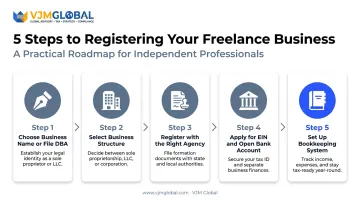
If you've determined registration applies to you, here's the practical sequence:
Choose a business name or file a DBA. If you're trading under anything other than your legal name, check your county or state's fictitious business name requirements first.
Select your business structure. Weigh your income level, liability exposure, and growth plans. Sole proprietorship works for many early-stage freelancers; LLC makes sense once liability or credibility becomes a concern.
Register with the right agency. This could mean filing LLC formation paperwork with your Secretary of State, applying for a local business license, or registering for a sales tax permit. Which one applies depends on your specific situation.
Apply for an EIN and open a business bank account. Even if an EIN isn't strictly required, a dedicated account keeps your finances clean and audit-ready.
Set up a bookkeeping system from day one. Don't wait until tax season. A simple system tracking income and expenses monthly saves enormous headaches later.
Frequently Asked Questions
Do freelancers need to register a company?
Most freelancers don't need to register a company to start earning since they're automatically classified as sole proprietors for tax purposes. Registration becomes necessary depending on your business name, location, and industry.
Is an LLC worth it for a freelancer?
It depends on your income level and liability risk. An LLC offers real asset protection and added credibility, but it comes with formation costs and ongoing state fees to budget for.
Do I need an EIN as a freelancer?
Sole proprietors without employees generally don't need an EIN and can use their Social Security number instead. You'll typically need one if you form an LLC, open certain business bank accounts, or hire subcontractors.
What happens if I don't register my freelance business when required?
Consequences vary by jurisdiction but can include fines, penalties, interest on unpaid fees, or legal exposure. Some cities also charge back-dated fees once they catch an unregistered local business.
Can I deduct business expenses without formally registering my business?
Yes. Sole proprietors can deduct ordinary and necessary business expenses on Schedule C without any formal registration, as long as records are accurate and expenses are properly substantiated.
How much does it typically cost to register a freelance business?
Costs vary widely by state and structure. DBA filings often run under $100, while LLC formation fees range from around $40 to $500 depending on the state, plus potential annual report or franchise tax fees.