39% of US workers freelanced in 2026, up four points from the year before, according to Upwork's Future Workforce Index. That's not a niche trend anymore.
Freelancing appeals to more people now because it costs less to start than a traditional business and offers real control over income and schedule. Career-changers, laid-off professionals, students, and parents needing flexible hours are all in the mix, not just designers and writers.
This article walks through the exact legal, financial, and operational setup freelancing in the US requires, step by step.
Key Takeaways
- Freelancing counts as a real business for tax purposes, regardless of income.
- Sole proprietorships suit most beginners; LLCs add protection as risk grows.
- Get an EIN, a business bank account, and start saving for taxes early.
- Contracts and insurance prevent disputes, not just resolve them later.
- Most setup tasks take a few focused hours, not weeks of planning
What Is a Freelance Business?
A freelance business is a self-employed, project- or service-based operation where you sell skills or deliverables directly to clients instead of working as someone's employee.
That status matters at tax time. The IRS treats freelancing as self-employment or independent contracting, which triggers specific obligations: 1099 forms from clients, self-employment tax, and quarterly filing requirements that don't apply to W-2 employees.
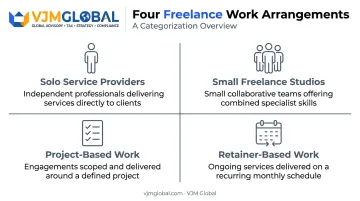
Freelance work comes in a few common shapes:
- Solo service providers — writers, designers, developers, consultants working alone
- Small freelance studios — an established freelancer who occasionally hires subcontractors for overflow work
- Project-based work — one-off deliverables with a defined end
- Retainer-based work — ongoing monthly arrangements with recurring clients
What to Know Before You Start Freelancing in the US
Before diving into setup, it helps to set realistic expectations. The first few months look different than most people expect, regardless of skill level.
The Reality of the First Few Months
New freelancers often spend more hours on admin, pitching, and setup than on billable work early on. That's normal, not a sign you're doing something wrong.
A few things to expect:
- Client acquisition takes time — steady, predictable income rarely arrives in month one
- Seasonal demand affects most industries, so income can be lumpy at first
- Business management (invoicing, taxes, contracts) matters as much as your actual skill
When Freelancing Makes Sense
Freelancing works best when there's a clear, recurring market need for your skill and you already have some network or portfolio to draw from. Timing matters more than ambition here.
The upside is real: you control pricing, choose clients, and build income that isn't tied to any single employer. That premium grows with specialization.
Demand for AI-related skills grew 109% year over year on Upwork, compared to 23% for other in-demand categories, according to Upwork's 2026 skills research. Specialized, in-demand skills are commanding real premiums right now.
Early Decisions and Common Mistakes When Setting Up a Freelance Business
Most setup problems trace back to skipping steps under time pressure, not lack of effort. New clients show up, admin gets pushed to "later," and later usually turns into a tax season scramble.
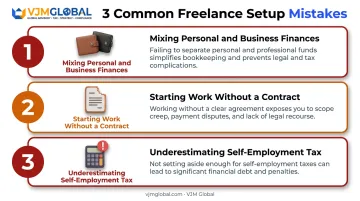
Watch for these three recurring mistakes:
- Mixing personal and business finances from day one. One bank account for everything makes tax time miserable and hides your actual profitability.
- Starting work without a signed contract. Without defined scope, payment terms, and protections in place, scope creep and non-payment disputes become far more likely.
- Underestimating self-employment tax. Nobody's withholding money from your paychecks anymore, and skipping quarterly payments leads to a painful bill (plus penalties) in April.
None of these require huge effort to avoid. They just require doing them before, not after, the first invoice goes out.
The Essential Freelance Business Setup Checklist (Step by Step)
This is the order most freelancers should tackle setup in. Most of it fits into a few focused hours across one week, not a multi-week project.
Step 1 – Choose Your Business Structure
By default, if you start doing freelance work without registering anything, you're automatically a sole proprietor. No filing required, no extra paperwork.
An LLC, on the other hand, is a separate legal entity you form at the state level. It generally protects your personal assets from business liability in most situations, according to SBA guidance.
Do you need an LLC to start freelancing? No. Most freelancers start as sole proprietors and convert to an LLC later once income or risk grows. It makes sense to form one when:
- Your income has grown enough that liability exposure matters
- Your work carries real risk (consulting, financial advice, physical services)
- A client specifically requires it before signing a contract
Step 2 – Get an EIN and Register for Taxes
An Employer Identification Number (EIN) lets you avoid putting your personal Social Security number on client paperwork and invoices. Applying directly through the IRS is free, and no third-party service is required.
Beyond the EIN:
- Check your state and city for business license or registration requirements, since these vary widely by location and profession
- If you're operating under a name other than your own legal name, you'll likely need to register a DBA (Doing Business As) with your state or county
- Some states also require a separate sales tax permit if you sell taxable products or certain services
Step 3 – Open a Business Bank Account and Set Up Bookkeeping
Separating business and personal finances from the start makes tax filing dramatically simpler and gives you a clear read on how the business is actually performing. The SBA recommends opening a dedicated business account as soon as money starts moving in either direction.
For bookkeeping, start simple:
- A basic spreadsheet works fine when you're just starting out
- Move to accounting software once invoice volume picks up
- Track every dollar of income and expense from your very first invoice
As your client base grows, tracking income, expenses, and deductible costs by hand gets harder to keep accurate. This is where outsourced bookkeeping support can take that ongoing tracking off your plate, keeping your records clean without eating into billable hours.
Step 4 – Plan for Taxes: Quarterly Payments and Deductions
Nobody withholds taxes from freelance income, so you're responsible for setting money aside yourself. A common approach is reserving roughly a quarter to a third of what you earn, though your actual estimated tax is calculated from expected income, deductions, and credits using Form 1040-ES.
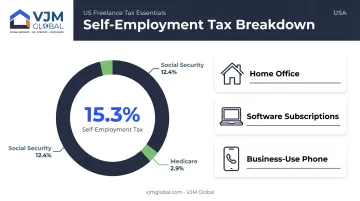
Self-employment tax runs 15.3% (12.4% Social Security plus 2.9% Medicare), and it generally kicks in once net self-employment earnings hit $400 for the year, per the IRS.
2026 estimated payment deadlines:
| Payment Period | Due Date |
|---|---|
| Q1 | April 15, 2026 |
| Q2 | June 15, 2026 |
| Q3 | September 15, 2026 |
| Q4 | January 15, 2027 |
Commonly overlooked deductions include home office expenses (the simplified method allows $5 per square foot, up to 300 square feet), software subscriptions, and the business-use portion of your phone. Getting these right consistently is exactly where a tax professional pays for themselves. Outsourced accounting partners like VJM Global work through quarterly estimate planning and deduction strategy so nothing gets missed at filing time.
Step 5 – Protect Yourself with Contracts and Insurance
Every project should start with a signed contract, not a verbal agreement or a friendly email thread. At minimum, it should cover:
- Scope of work and deliverables
- Payment terms and deposit or milestone structure
- Revision limits
- A kill fee if the project ends early
On insurance, two types matter most for freelancers: professional liability (errors & omissions), which covers claims tied to mistakes, missed deadlines, or professional negligence, and general liability, worth carrying if you meet clients in person or work on-site.
A clear late-payment and deposit policy, spelled out in the contract itself, protects your cash flow before a problem ever comes up.
Step 6 – Set Up Invoicing and Pricing Tools
Have a repeatable invoicing process ready before your first client, not after. Decide on your pricing or proposal template in advance so you're not negotiating from a blank page every time.
Track payment status closely. An unpaid invoice sitting quietly for three months is revenue you may never fully recover.
Step 7 – Build a Basic Online Presence
You don't need much to look credible to a new client. The minimum viable setup includes:
- A simple website or portfolio page
- A professional email address (not a personal Gmail handle)
- An updated LinkedIn profile
Depending on your field, add profiles on relevant freelance marketplaces or professional networks. A handful of testimonials and a small portfolio of past work go a long way toward winning over a client who's never heard of you before.
Conclusion
Starting a freelance business in the US comes down to completing a specific set of legal, financial, and operational basics. Ambition alone won't keep the IRS off your back. Structure, taxes, and bookkeeping done right early prevent expensive problems later.
Ongoing review of your pricing, tax planning, and client contracts matters more than how fast you launch.
If you'd rather spend your time on client work than tax admin, partners like VJM Global can keep your financial setup accurate and your quarterly filings on track while you focus on billable hours.
Frequently Asked Questions
What do I need to start a freelance business?
You need a business structure (sole proprietorship works to start), an EIN, a separate business bank account, and a signed contract and invoicing system ready before your first client.
Do I need an LLC to start freelancing?
No. You don't need an LLC to freelance legally — most freelancers start as sole proprietors. It becomes worthwhile once income or liability risk grows, or a client specifically requires it.
How much does it cost to start a freelance business in the US?
Costs are typically low. An EIN is free, and LLC filing fees range roughly from $50 to $125 depending on the state. Optional costs include insurance and website hosting.
Do freelancers need a business license?
It depends on your city, state, and profession. Requirements vary widely, so check your local government's business licensing page before assuming you don't need one.
How do freelancers pay taxes in the US?
Freelancers pay self-employment tax (15.3%) plus regular income tax, filed via Schedule C and quarterly estimated payments using Form 1040-ES throughout the year.
When should a freelancer hire an accountant or bookkeeper?
Once income becomes regular or tax filing starts feeling overwhelming, outsourcing bookkeeping and tax compliance saves time and reduces the risk of costly filing errors.