Introduction
A Singapore Certificate of Incorporation means nothing to a US licensing officer. Neither does an ACRA business profile or an SFA food licence.
The moment a Singapore company decides to sell, hire, or operate on US soil, it starts from zero. The US has no national business licence — only a patchwork of federal, state, and local requirements.
This trips up a lot of Singapore founders. They assume forming a Delaware LLC or a US C-Corp is the finish line. It's actually the starting point.
Incorporating a US entity and being licensed to operate it in a specific state or city are two separate steps. Different agencies run each one, with different fees and timelines.
This guide covers whether your Singapore-owned business needs a US licence, what types exist, how to apply, what it costs, and the mistakes that trip up foreign-owned entities in their first year of US operations.
Key Takeaways
- Forming a US LLC or C-Corp does not license you to operate; activity, location, and industry trigger licensing
- The US runs three licensing layers: federal, state, and local, each with its own agency and fee schedule
- "Nexus" (an office, employee, warehouse, or sales threshold) can trigger licensing duties even without incorporating in that state
- Fees range from under $100 for a city registration to several thousand dollars for regulated federal permits
- Missed renewal deadlines across multiple states are the costliest compliance failure for Singapore-owned entities
Do Singapore Companies Need a US Business License?
Only when your US activity, location, or industry triggers one. Before that question matters, a Singapore company needs a US legal presence—usually an LLC or C-Corp, or a foreign-qualified Singapore entity in the relevant state. Next comes a federal Employer Identification Number (EIN) from the IRS, required before opening a US bank account or filing most licence applications.
Here's the part that catches founders off guard: a US "business licence" isn't automatic, and it isn't universal. It works a lot like Singapore's own activity-based licensing system, where a general ACRA registration doesn't cover, say, a food establishment or a moneylending business. In the US, most licensing gets triggered by what you do, where you do it, and which industry you're in, not by the fact that you've incorporated.
Federal, State, and Local: The Three Layers of US Licensing
Every US business potentially answers to three separate licensing authorities:
- Federal — applies only to regulated industries. Agencies like the FDA, FCC, TTB, and DOT/FMCSA issue licences for food, telecom, alcohol, and transportation businesses respectively. Most Singapore SMEs in consulting, SaaS, or general trading never touch this layer.
- State — covers Secretary of State registration, sales tax or seller's permits, and professional or occupational licences (real estate, healthcare, financial advisory, and similar fields).
- Local — city or county general business licences, plus zoning, signage, and health permits tied to a physical premises.
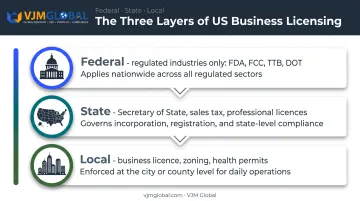
According to the US Small Business Administration, you should check federal, state, and local rules: state and city permits are common, while federal licences apply mainly when your industry is regulated.
When a Singapore-Owned Business Triggers a Licence Requirement
This is the layer that surprises most Singapore founders: you don't need a physical entity in a state to trigger obligations there. This concept is called nexus.
Nexus can be created by:
- Having an office, employee, or warehouse physically located in a state
- Storing inventory with a fulfilment partner or marketplace facilitator
- Crossing a state's economic sales threshold, even while operating entirely remotely from Singapore
Practical examples for Singapore SMEs:
- E-commerce sellers shipping into the US often need a state sales tax permit once they cross that state's economic nexus threshold
- Importers bringing goods through US customs generally need a customs bond for shipments valued above $2,500
- Fintech and payments firms processing US transactions may need state money transmitter licences, administered through the Nationwide Multistate Licensing System
Types of US Business Licenses Singapore Companies May Need
Types of US Business Licences Singapore Companies May Need
Licence requirements split cleanly by which layer of government is involved and how regulated your industry is. Here's what typically applies.
Federal-Level Licences
Federal licensing only kicks in for specific regulated industries:
- FDA — food facilities, cosmetics, and supplements for US consumption must register (food facilities renew every other year)
- FCC — telecom equipment and broadcast services need equipment authorisation or spectrum licensing before use
- TTB — alcohol wholesalers, importers, and exporters need a Basic Permit before buying or selling at wholesale
- DOT/FMCSA — companies running qualifying commercial vehicles across state lines need a USDOT number, and often operating authority
- SEC/FINRA — brokers dealing in securities generally must register with the SEC and join FINRA
Most consulting firms, SaaS companies, and general trading businesses skip this layer entirely. That mirrors most Singapore businesses, which need nothing beyond standard ACRA registration.
State-Level Licences and Registrations
This is where most Singapore companies actually spend their compliance effort. A US-formed (or Singapore-formed) entity needs a Certificate of Authority, also called foreign qualification, in every state where it does business, separate from its state of incorporation.
Texas, for instance, requires this filing for any foreign entity "transacting business" there, with late fees if you file more than 90 days after starting activity.
Beyond foreign qualification, watch for:
- Sales tax permits — required once you cross a state's economic nexus threshold
- Professional/occupational licences — for consultants, real estate agents, healthcare providers, and similar regulated roles
- Industry permits — staffing agencies, contractors, and similar sectors often need sector-specific state approval
Sales tax thresholds vary wildly by state— a detail that often catches foreign-owned e-commerce sellers off guard:
| State | Economic Nexus Threshold |
|---|---|
| Arkansas | $100,000 in sales OR 200 transactions |
| California | Over $500,000 in qualifying sales |
| Washington | Over $100,000 in gross receipts |
| New York & Connecticut | Both a sales threshold and a transaction count must be met |
These figures come from the Tax Foundation's 2024 state-by-state economic nexus comparison, and they shift periodically. Always confirm current thresholds before launching in a new state.
Local and Municipal Licences
Many cities and counties require a general business licence or business tax certificate regardless of industry. Seattle, for example, requires this certificate even for businesses based outside the city that conduct business there, including home-based operations and nonprofits, with annual renewal required.
Premises-specific permits add another layer:
- Health department permits for food and beverage operations
- Building and zoning permits for a physical office or warehouse
- Signage permits tied to storefront visibility
How to Apply for a US Business License as a Singapore Company
US licensing is a sequence of filings, not a single form. Miss a step, and later applications stall.
- Choose your entity structure. Decide between an LLC and a C-Corp, then appoint a registered agent in your state of formation and file the Articles of Organization or Incorporation.
- Obtain a federal EIN. This is required before opening a US bank account or applying for most licenses. The IRS confirms EIN applications are free, with online approval issued immediately in most cases.
- Foreign-qualify in every additional state where you'll have a physical or economic presence — not just your state of formation.
- Identify applicable licenses using your SIC/NAICS activity code and target state, then apply to each relevant federal, state, or local agency.
- Register for sales tax permits if you're selling taxable goods or services, and budget processing time before launch — don't assume same-day approval.
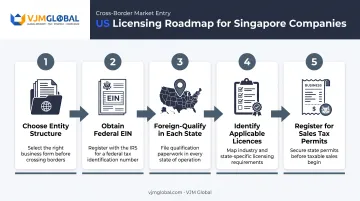
Requirements differ by state and change often. VJM Global can coordinate US incorporation, EIN registration, and multi-state compliance for Singapore-based businesses in one engagement.
Costs and Timelines for US Business Licensing
There's no single fee to budget for. Licence fees alone can run from low city charges to several hundred or several thousand dollars for regulated federal and state permits. Foreign qualification and other setup filings add more.
Sample fees Singapore companies often see:
- EIN application: free, with immediate online approval
- Seattle local business licence tax certificate: $71 annually, plus $10 per additional branch
- Texas foreign for-profit corporation registration: $750 filing fee
- New York foreign business corporation authority: $225, with expedited options from $25 to $150
Timelines vary just as much. Simple local licences can approve same-day online. Regulated federal licences that need inspection or review can take several weeks to several months.
Licence fees sit separate from entity formation or foreign-qualification costs, registered agent fees, and annual state franchise or report fees. Budget for all four categories, not the licence line alone.
Common Compliance Mistakes Singapore Companies Make When Entering the US
Singapore companies entering the US often hit the same compliance traps:
- Assuming ACRA registration carries weight in the US. It doesn't. The US treats each jurisdiction independently, and Singapore credentials transfer zero legal recognition.
- Registering in one state and assuming nationwide coverage. Each state where you have nexus needs its own foreign qualification and licences. Incorporation in Delaware doesn't cover activity in California.
- Missing renewal deadlines across multiple licences. State and local lapses can trigger fines or suspended operations. A compliance calendar (or a provider tracking multi-jurisdiction filings) helps avoid this.
- Delaying the EIN or registered agent appointment. Both block bank account opening and most licence applications, so treat them as day-one priorities, not afterthoughts.
Frequently Asked Questions
What is a business license in Singapore?
It's an activity-specific authorization from a Singapore government agency, separate from ACRA registration. The US splits this differently — licensing gets divided across federal, state, and local levels instead of one central system.
Where can I find my business license number in the USA?
It depends on the license type: your EIN appears on the IRS confirmation letter, your state registration number comes from the Secretary of State filing, and specific licenses carry certificate numbers from the issuing local or state agency.
Does a Singapore company need to register in every US state where it operates?
Yes. Foreign qualification is required in each state where the company has a physical presence, employees, or significant economic activity — not just the state of formation.
Can a Singapore company get a US business license without forming a US entity?
Generally, no. Most licenses require a registered US entity or foreign qualification first, since issuing agencies grant licenses to legally recognized businesses, not unregistered foreign companies.
How long does it take to get a US business license as a foreign company?
It ranges from same-day approval for simple local registrations to several weeks or months for regulated federal or state licenses requiring review or inspection.
What is the difference between a US business license and an EIN?
An EIN is a federal tax identifier issued by the IRS for tax filing purposes. A business license is a separate permit that authorises a specific regulated activity — they serve entirely different functions.