Introduction
Picture this: you've registered your US LLC, you're ready to open a business bank account or activate your Stripe account — and the application stops you cold, asking for a US Employer Identification Number (EIN). For most Singapore business owners, this is where the expansion stalls.
An EIN is a nine-digit federal tax ID issued by the IRS that uniquely identifies your business in the United States. Unlike Singapore's UEN, it's required for every major US business activity — opening bank accounts, filing taxes, and accepting payments on platforms like Stripe and Amazon.
Most EIN guides are written for US residents. This one is written for you — a Singapore-based business owner applying from outside the US, without a Social Security Number, and without a local registered agent on speed dial.
This guide covers what an EIN is, why Singapore businesses need one, the exact application process for non-US residents (including the ITIN question), and how to avoid the most common mistakes that delay or derail approval.
Key Takeaways
- A US EIN is a free, nine-digit number issued by the IRS to identify a business for tax and financial purposes
- Singapore businesses need an EIN to open a US bank account, receive payments via US platforms, hire US employees, or file US tax returns
- Singapore applicants cannot use the IRS online portal; they must apply by phone, fax, or mail using Form SS-4
- The "responsible party" can enter "foreign" or "N/A" for their US tax ID if they lack an SSN or ITIN
- Processing times range from immediate (phone) to four weeks (mail) — choose your method based on how urgently you need the EIN
What Is a US EIN?
An EIN (Employer Identification Number) is a unique nine-digit identifier in the format XX-XXXXXXX, issued by the Internal Revenue Service (IRS). It serves as a business's federal tax ID in the US — the functional equivalent of Singapore's UEN (Unique Entity Number) for local compliance.
Understanding the Terminology
The IRS uses several terms interchangeably, which can confuse international applicants:
- EIN, Federal Tax ID, and FEIN (Federal Employer Identification Number) all refer to the same nine-digit identifier
- TIN (Taxpayer Identification Number) is the broader umbrella term covering EINs for business entities, SSNs for US individuals, and ITINs for non-resident individuals
When US platforms or banks request a "TIN," they're asking for one of these numbers. For a Singapore-owned US LLC, the entity-level TIN is its EIN, while the individual director may separately need an ITIN.
What an EIN Is Not
An EIN covers federal tax identification only. A few things it does not replace:
- A state tax ID is separate and state-specific, issued by state revenue agencies for sales tax or state income tax obligations
- An SSN (Social Security Number) applies to individuals, not business entities
- A business license or permit — the EIN is a tax identifier, not authorization to operate in any state or industry
Why Singapore Businesses Need a US EIN
US Entity Formation Triggers EIN Requirement
Once you register a US LLC or corporation, an EIN becomes one of the first post-incorporation requirements. The IRS states that businesses need an EIN when they "operate a partnership or corporation," making it effectively mandatory before any business activity can begin.
Banking Access Depends on an EIN
Most US banks — and many international banks for US dollar accounts — require a valid EIN to open a business bank account. According to the US Department of Commerce's International Trade Administration, an "FEIN confirmation letter (or Form SS-4) is required by banks for tax reporting purposes." Without it, Singapore businesses cannot receive US dollar wire transfers or issue checks as a US entity.
Payment Platforms Mandate EIN for Tax Reporting
Popular US payment platforms require an EIN for IRS tax reporting compliance, particularly Form 1099-K issuance:
| Platform | EIN Requirement | Impact |
|---|---|---|
| Stripe | "You must enter a verifiable Taxpayer Identification Number (TIN) — an Employer Identification Number (EIN) or Social Security Number (SSN) — in order to use Stripe." | Account setup blocked without EIN |
| Shopify Payments | "An EIN is a requirement to use Shopify Payments in the United States." | Cannot process US payments |
| PayPal | TIN (SSN, EIN, or ITIN) required to avoid "potential limitations (such as tax holds) and 24% backup withholding." | 24% withholding on all transactions |
| Amazon Seller Central | US entities filing a W-9 require an EIN or SSN | Cannot complete tax interview |
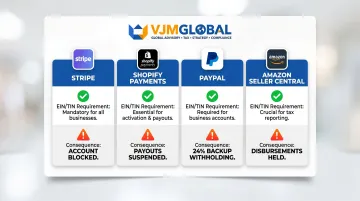
Beyond platform access, EIN requirements extend to direct employment and vendor relationships as well.
Employment and Contractor Payments Require an EIN
Any entity paying wages or filing employment taxes in the US must have an EIN. The IRS confirms that obtaining an EIN is the first step in meeting employment tax requirements. This applies to Singapore companies that:
- Hire remote US-based employees directly
- Engage US freelancers above IRS reportable thresholds
- Issue W-2s or 1099-NEC forms to US workers
Vendor Onboarding Processes Demand an EIN
US companies frequently require a W-9 (or W-8BEN-E for foreign entities) to process invoices. Many include EIN verification as a standard step in their supplier onboarding process. Without one, payment delays — or outright rejections — from US business partners are common.
How Singapore Businesses Can Obtain a US EIN
The Online Portal Is Off-Limits
Singapore-based applicants cannot use the IRS's online EIN application portal — that tool is restricted to entities with a principal place of business within the United States. International applicants have three methods available:
| Method | Contact | Processing Time | Best For |
|---|---|---|---|
| Phone | +1-267-941-1099 | Immediate (during call) | Urgent applications |
| Fax | 304-707-9471 (outside US) | ~4 business days | Standard timeline |
| IRS, Cincinnati, OH 45999 | ~4 weeks | Non-urgent applications |
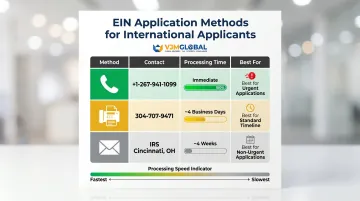
Phone hours: Monday-Friday, 6:00 a.m. to 11:00 p.m. Eastern Time (6:00 p.m. to 11:00 a.m. Singapore time).
Step 1: Identify Your Responsible Party
Every EIN application requires naming a "responsible party" — the individual who controls, manages, or directs the business and its funds. For a Singapore-owned US LLC, this is typically the principal director or owner.
Critical update for Singapore applicants: The IRS Form SS-4 instructions allow you to "enter 'foreign' or N/A on line 7b if the responsible party doesn't have and is ineligible to obtain an SSN or ITIN." This provision eliminates the ITIN prerequisite for many Singapore business owners.
Important restrictions:
- The responsible party must be a natural person, not another entity
- Nominees (formation agents, registered agents) cannot apply and should not be listed
- Each entity needs its own distinct EIN
Step 2: Complete IRS Form SS-4
Form SS-4 requires the following information:
- Legal name and address of the business entity
- Type of entity (LLC, corporation, etc.)
- Reason for applying
- Responsible party's name and TIN (or "foreign"/"N/A")
- Date business started
- Principal activity of the business
For foreign entities with no US tax filing obligation (e.g., applying solely for a US bank account), questions 11-17 can be marked "N/A" with the notation "For Banking Purposes Only."
Step 3: Apply via Your Chosen Method
Phone (Fastest): Call +1-267-941-1099 during business hours. The authorized responsible party must make the call personally and answer questions from Form SS-4 — the EIN is issued immediately during the call. Have your completed form ready for reference.
Fax: Submit the completed Form SS-4 to 304-707-9471 (for applicants outside the US). The IRS typically responds within four business days, faxing back confirmation with the assigned EIN.
Mail: Send Form SS-4 to Internal Revenue Service, Attn: EIN International Operation, Cincinnati, OH 45999. Allow around four weeks for processing — high volumes can push this timeline further.
Given the complexity of cross-border tax filings, working with an advisory firm experienced in US international tax matters — such as VJM Global — can help ensure Form SS-4 is completed correctly the first time, reducing the risk of rejection or unnecessary delays.
Key Requirements and Challenges for Singapore Applicants
Understanding the ITIN Path (When Needed)
The Form SS-4 "foreign"/"N/A" provision lets most Singapore applicants skip the ITIN requirement entirely. Some situations still require one, particularly for certain banking or platform verification processes. If you do need an ITIN via Form W-7, the IRS states processing takes 9-11 weeks when applied from overseas — factor this into your US market entry timeline.
Entity Formation Must Come First
The IRS explicitly advises: "Form your entity through your state before you apply for an EIN" to avoid processing delays. The proper sequence is:
- Form the US entity (LLC, corporation) through your chosen state
- Obtain the EIN from the IRS
- Open the US bank account
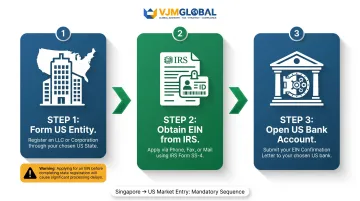
Applying for an EIN before completing state registration will result in delays or outright rejection.
The One-EIN-Per-Day Rule
The IRS issues only one EIN per responsible party per day. If you're setting up multiple US entities simultaneously (e.g., a holding company and operating subsidiary), you need to either:
- Stagger applications across different calendar days
- Designate different responsible parties for each entity
This applies regardless of application method — phone, fax, or mail.
Common Mistakes and Misconceptions Singapore Businesses Make
Attempting the Online Application
Many Singapore business owners attempt the IRS online EIN application and are surprised when they cannot complete it. The online portal requires a US address or US-based principal place of business. This doesn't mean Singapore businesses cannot get an EIN — it simply means you must use the international application channels (phone, fax, or mail).
Believing an EIN Expires
An EIN, once issued, is permanent and tied to the business entity forever. The IRS states it "can't cancel" an EIN once assigned; it becomes the entity's permanent federal taxpayer ID number. Singapore businesses sometimes mistakenly apply for a second EIN when they believe the first is no longer valid — this is unnecessary and can result in duplicate records that complicate future IRS filings.
Confusing EIN with Singapore UEN
Singapore business owners sometimes assume their Singapore UEN or tax reference number serves an equivalent function in the US — it does not. US entities, banks, and platforms require an IRS-issued EIN specifically. Beyond that, a US EIN is entity-specific: a Singapore parent company and its US subsidiary each require their own separate EINs.
Listing a Nominee as Responsible Party
The IRS explicitly prohibits nominees from applying: "Nominees can't apply for an EIN and shouldn't be listed on Form SS-4." Singapore businesses using US formation agents or registered agents must ensure the actual director or owner — not the agent — is listed as the responsible party.
Frequently Asked Questions
Can a non-US citizen get an EIN?
Yes, non-US citizens (including Singapore nationals) can obtain a US EIN. The IRS Form SS-4 instructions include specific provisions for foreign applicants, including the option to enter "foreign" or "N/A" for the responsible party's tax ID if they lack an SSN or ITIN.
Is an EIN only for U.S. companies?
No, EINs are required for any entity conducting taxable activities in the US, including foreign-owned US entities such as a Singapore-owned LLC. Foreign companies without a US entity may also need an EIN in specific circumstances, such as claiming tax treaty benefits or opening certain US bank accounts.
What is an EIN number used for?
An EIN is used across several core business activities:
- Filing US federal tax returns
- Opening a US business bank account
- Hiring US-based employees
- Receiving payments through US platforms (Stripe, Amazon, Shopify)
- Meeting vendor onboarding requirements with US clients
Is EIN the same as tax ID in the USA?
An EIN is a type of federal tax ID. "Tax ID" is the broader term (TIN) that includes SSNs, ITINs, and EINs. For business entities specifically, the EIN is the relevant identifier.
Is an EIN the same as your SSN?
No, they are different. An SSN is issued by the Social Security Administration to individuals, while an EIN is issued by the IRS to business entities. Both are types of TINs but serve distinct purposes and are not interchangeable.
Who qualifies for an EIN?
Any business entity that needs to interact with the US tax system qualifies , including US-based and foreign-owned companies such as Singapore-owned LLCs. Common triggers include:
- Having US-based employees
- Operating as a corporation or partnership
- Filing US federal tax returns
- Needing a US business bank account