Introduction
Singapore companies are eyeing the US market harder than ever, chasing credibility, capital access, and access to one of the world’s largest customer markets. "Opening a branch" gets thrown around a lot in these conversations.
Here's the problem: choose the wrong structure and you expose your Singapore parent to US liabilities and a tax bill it never needed to carry. Most guides use "branch" loosely to mean any US entity, but a true branch office is legally and tax-wise a different animal from a US subsidiary.
This article breaks down what a US branch actually is, the exact registration steps, the real costs, common mistakes Singapore founders make, and when a branch beats (or loses to) a subsidiary or an Employer of Record arrangement.
Key Takeaways
- A US branch is not a new company; your Singapore entity registers in a US state and liabilities flow straight to the parent
- Branches face a 30% branch profits tax on top of federal corporate tax, with no US–Singapore income tax treaty relief
- Registration needs a US registered agent, ACRA-certified documents, state foreign qualification, and an EIN
- Most Singapore companies choose a Delaware or Wyoming subsidiary instead to cap liability and tax exposure
- Expect a 2–6 week timeline, depending on the state and EIN filing method
What Is a US Branch Office and How Is It Different From a Subsidiary?
A US branch office isn't incorporated in the United States at all. It's an unincorporated extension of your Singapore parent, operating under the parent's legal name, with no separate legal identity in the US.
This trips up a lot of Singapore founders because ACRA has a distinct "branch registration" filing category back home. The US doesn't work that way. There's no separate "branch entity" form to file.
Instead, your existing Singapore company registers directly with a state's Secretary of State through foreign qualification. New York calls it an Application for Authority; Delaware calls it Qualification of a Foreign Corporation. The mechanism is the same everywhere.
Branch vs Subsidiary: Key Differences
| Factor | Branch | Subsidiary |
|---|---|---|
| Liability | Passes directly to the Singapore parent | Contained within the US entity |
| Taxation | US corporate tax plus 30% branch profits tax on repatriated earnings | 21% federal corporate tax; dividends taxed only when distributed |
| Banking/credibility | Harder: tied to a foreign legal name | Easier: has its own EIN and legal identity |
| Setup mechanism | Foreign qualification of existing entity | New entity formation |
Branch lawsuits and debts attach directly to the Singapore parent company. There's no US corporate shield between the two.
One exception: foreign banks and insurers sometimes need licensing structures a plain LLC or C-Corp subsidiary can't satisfy. If you're in a regulated sector, check with the OCC and Federal Reserve (banking) or state insurance departments before treating a subsidiary as the default path.
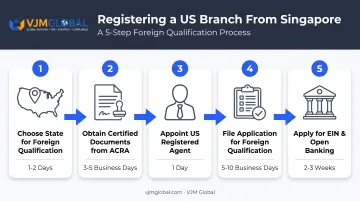
Step-by-Step: How to Register a US Branch Office From Singapore
Step 1: Choose the State for Foreign Qualification
Pick the state where you'll actually conduct business, not the state everyone recommends for incorporation. A branch is tied to where you transact, so "best state to incorporate" advice for Delaware doesn't automatically apply here.
- Check that state's Secretary of State website for its specific foreign qualification requirements and fee schedule
- Fees vary significantly: California charges $100, New York charges $225, Delaware charges $245 for the qualification filing itself
Step 2: Obtain Certified Corporate Documents From Singapore
Request an authenticated Certificate of Incorporation and Business Profile from ACRA. Singapore is a Hague Apostille Convention member, so these documents typically need an apostille rather than embassy legalization for use in a US filing.
- Confirm your target state's document validity window — some states require certificates issued within a recent period (often six months)
- Check the exact certificate type your chosen state accepts before ordering authentication, since requirements aren't uniform across states
Step 3: Appoint a US Registered Agent
Every state requires a registered agent with a physical street address (no P.O. Boxes) in the state where you're qualifying, to receive legal and tax notices on your behalf.
- Budget roughly $50-$300 annually for this service
- This is a mandatory, ongoing requirement — not a one-time setup item
Step 4: File the Application for Foreign Qualification
Submit the Application for Certificate of Authority (the exact name varies by state) alongside your certified Singapore documents and registered agent details.
Processing timelines swing widely by state:
- Delaware offers expedited paid tiers, including same-day and 1-hour options
- New York offers similar expedited options, including 24-hour and 2-hour service
- Standard, non-expedited processing can still take a few weeks in slower-moving states
Step 5: Apply for an EIN and Open US Banking/Tax Registrations
You'll need an EIN before you can bank, hire, or file taxes. Without a US Social Security Number for the responsible party, you cannot use the online EIN application. File Form SS-4 by phone, fax, or mail per IRS instructions, and note "foreign" on the responsible party line.
Processing speed depends entirely on the method:
- Phone: immediate issuance for international applicants
- Fax: generally about 4 business days
- Mail: roughly 4 weeks
Once issued, register for applicable state taxes and open a US bank account. If a traditional bank balks at opening an account remotely for a foreign branch, several fintech platforms support remote account opening for foreign branches.
Requirements, Costs, and Ongoing Compliance for a US Branch
Documentation Checklist
- ACRA Business Profile and certified Certificate of Incorporation
- Board resolution authorizing the US branch
- Passport copies of directors and authorized signatories
- Registered agent confirmation for your chosen state
What It Costs to Set Up
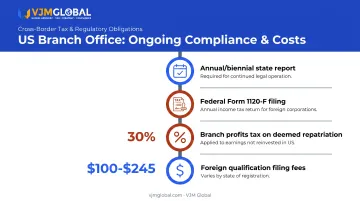
Foreign qualification filing fees run $100–$245 in the states founders compare most often (California, New York, and Delaware). That figure excludes registered agent fees, document authentication, and advisory work, so treat it as a floor rather than an all-in budget.
Ongoing Filing Obligations
- Annual or biennial state report in your qualification state (Delaware: annual report by June 30, $250 fee; New York: biennial statement)
- Federal Form 1120-F: the US tax return for a foreign corporation’s branch income
- Branch profits tax under IRC 884, computed on the dividend-equivalent amount—not only on cash wired back to Singapore
The IRS applies branch profits tax to a deemed repatriation: earnings not reinvested in qualifying US branch assets are taxed at 30%, even if you never move a dollar back to Singapore. The US and Singapore have no comprehensive income tax treaty, so there is no reduced rate to fall back on.
Model that exposure before you lock in a branch structure, not after the first return is due. A cross-border advisor such as VJM Global can estimate total effective tax on Form 1120-F and compare it with the cost of using a subsidiary instead.
Staffing: Getting a Singapore Employee to the US
If you're relocating someone to run the branch, the L-1A intracompany transfer visa is the standard route. USCIS requires at least one continuous year of executive or managerial employment with the Singapore parent within the three years before filing. Branch registration does not grant immigration status. The L-1A petition is a separate process.
Common Mistakes Singapore Companies Make When Opening a US Branch
Three missteps show up repeatedly when Singapore companies open a US branch:
Assuming a branch limits liability. Singapore's own branch structure might feel like it offers some separation. In the US, it doesn't.
All branch liabilities (lawsuits, debts, contract disputes) pass directly to the Singapore parent. A subsidiary, by contrast, generally contains that exposure within the US entity itself.
Underestimating the combined tax hit. Federal corporate tax plus a 30% branch profits tax adds up fast, and with no US-Singapore treaty to soften it, there's no relief valve.
Companies that model this out often find a subsidiary's 21% rate on retained earnings (taxed on distributions only when actually paid) is often cheaper over several years.
Registering in Delaware when operations happen elsewhere. Delaware's reputation as the "default" US state doesn't apply to branches the way it might for subsidiary incorporation.
If your actual business activity happens in, say, Texas, qualifying in Delaware doesn't authorize you to operate there. You'd need a second foreign qualification in the operating state, doubling compliance burden and fees for no real benefit.
Branch vs Subsidiary vs Employer of Record: Which Should You Choose?
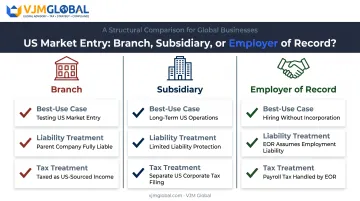
Not every US expansion needs the same structure. Here's how the three options stack up:
| Structure | Best for | Liability | Tax treatment |
|---|---|---|---|
| Branch | Short-term market testing, industry-specific licensing needs | Passes to Singapore parent | 21% federal tax + 30% branch profits tax |
| Subsidiary (LLC/C-Corp) | Raising US capital, long-term operations, liability protection | Contained in US entity | 21% corporate tax; dividends taxed on distribution |
| Employer of Record | Hiring US staff only, no entity needed | N/A (no entity formed) | Handled through EOR provider's payroll |
Choose a branch only when you're testing the market short-term, operating in a licensed regulated industry, or when avoiding a new legal entity genuinely outweighs the liability and tax cost. It's a narrow use case.
Choose a subsidiary if liability protection matters, you plan to raise US investor capital, or you want to sidestep uncapped branch profits tax exposure. That is why most Singapore companies expanding into the US register a Delaware or Wyoming entity rather than a branch. Past year one, the math usually favors the subsidiary.
Choose an Employer of Record if you only need to hire and pay US-based staff, with no local entity. VJM Global's EOR service covers compliant hiring in 100+ countries, including the US, so you can put someone on the ground without a branch or subsidiary.
The provider typically:
- Acts as the legal employer of record
- Runs payroll and statutory contributions
- Manages benefits and offboarding
Frequently Asked Questions
Can a foreigner open a company in the USA?
Yes. There's no citizenship or residency requirement to own a US LLC or C-Corp. "Opening a branch," however, is a different process built on foreign qualification, with liability consequences that a straightforward subsidiary formation doesn't carry.
What is the difference between a US branch office and a US subsidiary?
A branch is an unincorporated extension of your Singapore parent, meaning US liabilities pass straight back to the parent company. A subsidiary is a separate legal entity that contains liability and files its own US taxes.
Do US branch offices pay branch profits tax?
Yes. Branches pay a statutory 30% branch profits tax on repatriated earnings, and Singapore companies get no rate reduction since there's no comprehensive US-Singapore income tax treaty.
How long does it take to register a branch office in the USA from Singapore?
Typically 2-6 weeks, depending on your state's processing speed and how you apply for your EIN. Fax applications generally process in about 4 business days; mail applications can take roughly 4 weeks.
Do I need an EIN to operate a US branch?
Yes. An EIN is mandatory for banking, tax filing, and hiring. Since online EIN applications aren't available to nonresident applicants, you'll need to file Form SS-4 by phone, fax, or mail instead.
Which visa is needed to send a Singapore employee to manage a US branch?
The L-1A intracompany transfer visa is the standard route. It requires at least one continuous year of prior executive or managerial employment with the Singapore parent company within the three years before filing.