Opening that account sounds simple on paper. In practice, Singapore-owned founders run into US-specific hurdles: forming the right entity first, assembling documentation that satisfies foreign-ownership policies, and sometimes even a branch visit.
This guide covers the exact steps, the required documents, how traditional banks compare to fintech platforms, and the tax obligations a Singapore-owned US account creates.
Key Takeaways
- Most US banks require a registered LLC or Corporation plus an EIN before account opening
- Non-residents need KYC documents and often a US address—not US citizenship
- Traditional banks take weeks and in-person visits; fintechs like Mercury, Wise, and Relay onboard remotely in days
- US accounts trigger EIN-linked IRS filings, W-8BEN forms, and possible FBAR/FATCA reporting
- Cross-border specialists like VJM Global help founders avoid delays and compliance gaps early
How to Open a Business Bank Account in the USA from Singapore: Step-by-Step
Getting from "Singapore founder" to "funded US bank account" follows a fairly fixed sequence. Skipping a step, or doing them out of order, is the single biggest cause of delays.
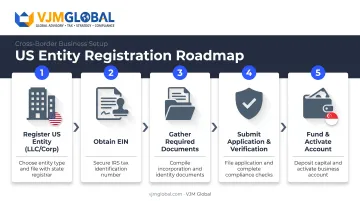
Step 1: Register a US Business Entity
Almost every US bank wants to see a US-registered LLC or corporation before they'll even review an application. Bank of America's own LLC application, for instance, states the business must be US-formed with US operations.
Delaware is the most common choice for foreign-owned entities. The state reports more than 2 million registered legal entities and over 66% of the Fortune 500, largely due to its flexible corporate statutes and specialized Court of Chancery. Wyoming is a lighter-weight, lower-cost alternative that also allows fully online formation.
Singapore founders usually complete this step remotely. VJM Global handles LLC and corporation registration from overseas, including:
- Articles of Organization or Incorporation
- Operating Agreement or Bylaws
- Registered agent appointment
- FinCEN beneficial ownership (BOI) filing
Getting these filings right up front cuts mismatched paperwork when the bank reviews your file.
Step 2: Obtain an Employer Identification Number (EIN)
Your EIN is the tax ID your bank will ask for by name. The IRS requires you to form your entity first, then apply for the EIN using Form SS-4.
Founders without a US Social Security Number or ITIN simply write "foreign" on line 7b. Since there's no US legal residence to use, the online EIN tool isn't available; applications go through:
- Fax – roughly 4 business days if a return fax number is provided
- Mail – around 4 weeks
- International phone – no published turnaround, but often faster in practice
A third-party designee (an accountant or formation agent) can file the SS-4 and receive the EIN on your behalf, which is useful when you're managing this from Singapore time zones.
Step 3: Gather the Required Documents
Have these ready before you apply anywhere:
- Passport for each beneficial owner
- Certificate of formation or incorporation
- EIN confirmation letter from the IRS
- Proof of a US registered agent or business address
- Proof of Singapore residential address (some banks request this)
- Notarized copies of the above (bank-dependent)
Requirements vary by provider, so confirm the exact list before submitting anything.
Step 4: Submit Your Application and Complete Verification
Traditional banks and fintechs diverge sharply here. Chase, for example, allows online applications only for certain single-owner structures; multi-member LLCs typically need a branch visit. Fintech platforms like Mercury run the entire process through a web or mobile application.
Whichever route you choose, expect questions about:
- The nature of your business and industry
- Source of funds
- Expected transaction volumes and countries of operation
- Whether the business has a genuine US nexus
Step 5: Fund and Activate Your Account
Minimum opening deposits vary widely. Wells Fargo asks for $25, while Mercury and Relay charge no account-opening fee or minimum balance at all. Once your account is live, connect it to your accounting or invoicing software immediately. That keeps US revenue and expenses separate from your Singapore books from day one.
Who Should Open a US Business Bank Account from Singapore (and When)
Not every Singapore business expanding westward needs a US account on day one. The decision should track your actual US-facing activity, not just ambition.
It makes sense when you have:
- Recurring revenue from US customers
- US vendors, contractors, or employees to pay
- Active fundraising conversations with US investors
- A US subsidiary already formed for tax or commercial reasons
It may not be worth pursuing yet if:
- US transactions are occasional or low-volume
- You're still testing US market demand
- A multi-currency wallet already covers your USD needs without entity, EIN, and full-account overhead
If you're in the "not yet" group, a lighter interim setup usually beats rushing entity formation.
Documents & Entity Requirements You'll Need Before Applying
Entity and EIN Requirements
No entity, no account. This holds regardless of your residency status. Most banks want a US-formed LLC or corporation, an active EIN, and formation documents that match your bank application exactly:
- Same legal name
- Same address
- Same ownership structure
KYC and Identity Documentation
Beneficial owners typically provide a passport and proof of Singapore address. An ITIN isn't always required.
Fintechs like Wise and Relay accept passport-based ID for non-US owners without an SSN or ITIN. Some traditional banks (including Bank of America's LLC application) still request US residency or an SSN.
US Address Requirement
A registered agent address satisfies the formation requirement, but banks increasingly distinguish this from an operating address.
Wells Fargo and Mercury explicitly state that a registered-agent or virtual mailbox address doesn't count as the business's principal address. A virtual US office with genuine mail handling is generally safer than a bare registered-agent listing.
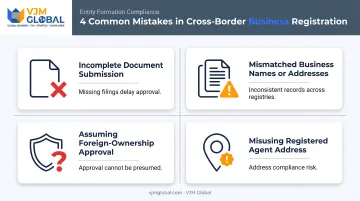
Common Mistakes to Avoid
- Submitting an incomplete document set and restarting the review clock
- Mismatched business names or addresses between entity filings and the bank application
- Assuming every bank welcomes foreign ownership without confirming its policy first
- Using a registered agent address where the bank requires a physical operating address
Traditional Banks vs Fintech Platforms: Which Route Should You Choose
Singapore founders generally pick between a traditional US bank, a fintech platform, or a hybrid approach. Many open a fintech account first for speed, then add a traditional bank relationship once the business scales.
Traditional US Banks
Chase, Bank of America, and Wells Fargo all require a formed US entity and an EIN, and typically request more extensive documentation. Multi-owner applications often require a branch visit or notarized forms from absent owners. None of the three publishes a guaranteed approval timeline, but the process commonly stretches into weeks once entity formation and EIN issuance are factored in.
Fintech and Digital Platforms
Mercury, Wise, and Relay offer remote onboarding built for exactly this situation. Mercury states applications are typically reviewed within 1-2 business days once submitted, though a US-formed entity is still required. Wise verification can take up to 10 working days. None of these platforms require a branch visit.
Key Comparison Factors
| Provider | Monthly Fee | Minimum Deposit | Approval Time |
|---|---|---|---|
| Chase | $15 (waivable) | $0 | Not published |
| Bank of America | $16 (waivable) | Not published | Not published |
| Wells Fargo | $15 (waivable) | $25 | Not published |
| Mercury | $0 | $0 | 1-2 business days |
| Wise Business | $0 (one-time $31 setup) | Not published | Up to 10 working days |
| Relay | Not published | $0 | 1-2 business days |
Before committing, compare at least two or three providers on:
- In-person requirements versus fully remote onboarding
- Monthly fees and minimum balance thresholds
- Published or reported approval timelines
- Whether the provider's current policy actually welcomes foreign-owned businesses without a US co-founder or resident
For most Singapore founders, a fintech platform is the practical first step. A traditional bank relationship can follow once volume, lending needs, or vendor requirements justify the extra friction.
Tax & Compliance Obligations for Singapore-Owned US Bank Accounts
Forming a US entity and opening an account creates IRS obligations that exist independently of where the business actually operates.
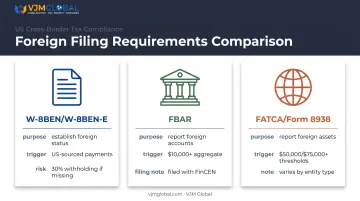
These filings come up most often:
- W-8BEN / W-8BEN-E: Establishes foreign status with withholding agents. Without one on file, US-sourced payments can face up to 30% withholding. Individuals file W-8BEN; entities file W-8BEN-E.
- FBAR (FinCEN Form 114): Required once your US entity's foreign financial accounts exceed $10,000 at any point in the calendar year. File electronically with FinCEN, separate from your income tax return. Non-compliance can bring significant civil and criminal penalties.
- FATCA (Form 8938): Covers broader foreign financial assets and applies differently by entity type. Thresholds for specified domestic entities start above $50,000/$75,000, but not every US entity qualifies, so confirm applicability case by case.
A practical wrinkle for Singapore founders: the US and Singapore don't have a full income tax treaty. Singapore has confirmed a FATCA Model 1 intergovernmental agreement, but that's a reporting arrangement, not a tax treaty. Relief from double taxation typically comes through foreign tax credits (Form 1116 for individuals, Form 1118 for corporations) rather than treaty exemption.
These filings cut across US and Singapore rules at the same time. VJM Global's tax and compliance team helps Singapore-owned entities handle FBAR, FATCA, and W-8 filings in both jurisdictions so deadlines and penalty exposure are less likely to slip.
Frequently Asked Questions
What happens if I have more than $10,000 in a foreign bank account?
A US entity must file an FBAR if its aggregate foreign financial accounts exceed $10,000 at any point during the year. Missing this filing can trigger steep civil penalties, and willful violations may bring higher fines or criminal exposure.
Which US banks allow foreigners to open accounts?
Most traditional banks require a US entity and EIN regardless of the owner's nationality; foreign-ownership rules still vary by bank. Fintech platforms are more accessible for foreign-owned businesses without extensive US ties.
Do I need to visit the US in person to open a business bank account?
Many traditional banks still require in-person verification or notarized forms, particularly for multi-owner entities. Fintech platforms typically offer fully remote onboarding from start to finish.
Can I open a US business bank account without forming a US company?
Traditional banks almost always require an entity first. Some fintech multi-currency accounts let Singapore businesses hold and transact in USD without forming a US company.
How long does it take for a Singapore-owned business to open a US bank account?
Entity formation, EIN issuance, and traditional bank approval combined can take several weeks. Fintech approval is often just 1–2 business days once your entity and EIN are in place.
Do I need an ITIN or SSN to open a US business bank account?
Not always. A passport, combined with entity documents and an EIN, is often sufficient, though some traditional banks do request an SSN from beneficial owners.