Capital flows back this up. Singapore's direct investment stock in the United States climbed from $47.8 billion in 2020 to $71.7 billion in 2024, a jump of nearly 50% in four years, according to the US Department of Commerce's SelectUSA program. That figure tracks overall investment rather than a specific count of new LLCs or corporations, but it signals how much cross-border business activity is happening between the two markets.
What it actually costs to register and maintain a US entity from Singapore isn't fixed. Fees swing depending on the state you pick, whether you form an LLC or a C-Corp, and how much professional support you bring in.
This guide breaks down registration fees, ongoing maintenance costs, the biggest cost drivers, and practical budgeting tips built for Singapore-based founders.
TL;DR
- One-time registration: $100 (state filing only) to $2,000+ with agent, EIN, and formation support
- Annual maintenance: typically $800–$3,000+ for franchise tax, registered agent, and accounting
- State, entity type, and compliance complexity raise costs; DIY and low-fee states keep them down
- DIY fits simple entities; full-service pays off when raising funds or hiring in the US
How Much Does It Cost to Register a US Company From Singapore? (Pricing Overview)
There's no single "registration fee" for a US company. Total cost depends on three variables: which state you incorporate in, whether you choose an LLC or C-Corp, and whether you file yourself or hire a formation agency. First-year outlay usually runs from a few hundred dollars on a lean DIY path to several thousand with full-service support.
Singapore founders tend to make the same three mistakes:
- Picking a state (usually Delaware) only because it's famous, without checking whether the fees match their needs
- Forgetting that a registered agent is required in every US state, not an optional add-on
- Underestimating remote EIN and bank-account setup costs when you have no SSN or ITIN
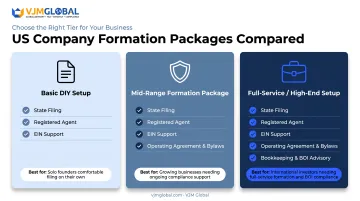
Here's how the three common formation approaches compare.
Basic DIY Setup
What's typically included:
- State filing fee ($100–$110 for an LLC or C-Corp in states like Delaware or Wyoming)
- One year of registered agent service
- Self-filed EIN application (free from the IRS, but slow without a US mailing address)
Best for: Solo founders comfortable handling US paperwork remotely, including IRS phone calls, without local support.
Mid-Range Formation Package
What's typically included:
- Entity formation with the relevant Secretary of State
- Registered agent appointment
- EIN application support
- Operating agreement (LLC) or bylaws (C-Corp)
- Basic first-year compliance calendar
Best for: Singapore SMEs setting up a US LLC or C-Corp to invoice American clients, trade internationally, or open a US bank account.
Full-Service / High-End Setup
What's typically included:
- Delaware C-Corp formation with legal document drafting
- US bank account facilitation
- Ongoing bookkeeping and tax compliance, including Form 1120 and Form 5472
- Beneficial Ownership Information (BOI) advisory
Best for: Singapore companies raising US venture capital, hiring US-based staff, or expecting multi-state compliance from day one.
Providers like VJM Global typically bundle these components (Secretary of State filing, EIN, registered agent, formation documents, and BOI reporting) into one engagement. That matters more once your compliance calendar spans two countries instead of one.
Key Factors That Affect the Cost of a US Entity for Singapore Owners
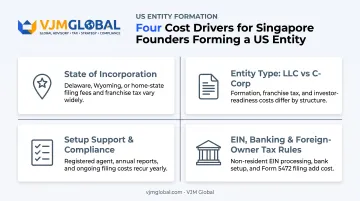
Cost varies mainly with four drivers: which state you pick, how you structure the entity, how much compliance work you outsource, and the extra EIN, banking, and tax steps that come with foreign ownership.
State of Incorporation
Delaware and Wyoming are the two most common choices for foreign founders, but their ongoing costs differ substantially.
| State | Filing fee | Annual recurring cost |
|---|---|---|
| Delaware | $110 (LLC) / $109 (C-Corp) | $50 annual report + $175–$400 minimum franchise tax |
| Wyoming | $100 | Greater of $60 or 0.0002 × Wyoming-based assets |
| California | Varies by entity | $800 minimum annual franchise tax |
Wyoming stays cheap because its annual fee ties to assets physically located in-state. For most Singapore-owned entities with no Wyoming presence, that lands close to the $60 floor. Delaware's franchise tax applies regardless of activity level.
Entity Type: LLC vs C-Corp
A foreign-owned single-member LLC is treated as a disregarded entity for federal tax purposes. It still must file a pro forma Form 1120 with Form 5472 attached if it has reportable related-party transactions, including owner contributions and withdrawals.
A C-Corp has no disregarded-entity treatment. It files Form 1120 every year regardless of profitability and faces corporate income tax exposure, so C-Corp accounting fees generally run higher than LLC fees.
Setup Support and Ongoing Compliance
How much you outsource, and how complex foreign-owner rules get, drives a large share of total cost. The main levers:
- Registered agent scope (mail-forwarding only vs. bundled filing support)
- EIN application path (fax in about 4 business days vs. mail in about 4 weeks)
- Banking KYC under FinCEN beneficial-ownership rules
- Form 5472 exposure, including the $25,000 late-filing penalty
A bare-bones registered agent only forwards legal mail. Bundled packages add filing reminders, document storage, and sometimes annual report prep. That support is worth the premium when you manage filings from Singapore's time zone.
Founders without an SSN or ITIN cannot use the IRS online EIN application, which needs a US-based responsible party. You apply by phone, fax, or mail instead. Fax takes about 4 business days; mail runs closer to 4 weeks.
Banking adds friction too. Under FinCEN's Customer Due Diligence rule, banks must verify beneficial owners of any legal-entity customer. Foreign-owned entities usually need extra documents, and many founders use third-party help to open the account.
Foreign ownership also triggers IRS requirements a US-owned entity does not face. Filing Form 5472 late or incorrectly carries a $25,000 penalty, plus another $25,000 for every 30 days of continued noncompliance after IRS notice, according to the IRS's Form 5472 instructions. That penalty alone is why most Singapore owners hire an accountant who handles cross-border filing.
Annual Maintenance Cost Breakdown for Singapore-Owned US Companies
Registering the company is just the entry fee. Staying in good standing means budgeting for several recurring and periodic costs every year.
| Cost item | Frequency | What it covers |
|---|---|---|
| Registered agent renewal | Recurring | Legally required US point of contact; fees vary by provider |
| State franchise tax / annual report | Recurring | Delaware: $50 report + $175–$400 minimum tax. Wyoming: greater of $60 or 0.0002 × in-state assets |
| Federal tax filings (Form 1120 & 5472) | Recurring | Mandatory for foreign-owned entities; usually needs a US-savvy accountant given the penalty exposure |
| BOI reporting | Periodic | Rules have changed; see below |
| Bookkeeping & accounting | Recurring | Keeps records IRS-compliant; commonly outsourced given the distance |
| Banking & currency conversion | Recurring | SGD-USD spreads, wire fees, virtual payment platform charges |
What's Changed With BOI Reporting
FinCEN's finalized rule now limits Beneficial Ownership Information reporting mostly to entities formed under foreign law that register to do business in a US state. A US-formed LLC or C-Corp, even one wholly owned by a Singapore resident, is currently exempt from BOI reporting, according to FinCEN's official BOI guidance.
This differs from earlier rules that required broader foreign-ownership disclosure. Given how often this requirement has changed, verify current status before assuming your entity is exempt or in-scope.
Why Bookkeeping Isn't Optional
Foreign owners managing a US entity from Singapore rarely have the bandwidth to reconcile US bank statements and prepare IRS-ready records themselves. Outsourced bookkeeping is the norm for remote Singapore-based owners, and it feeds accurate numbers into Form 1120 and 5472 filings.
Cross-border banking compounds those operational costs. Moving money between SGD and USD accounts adds conversion spreads and wire fees on top of bank or payment-platform transfer charges.
DIY vs Professional Service Provider — Cost Comparison
Comparing self-managed registration against a full-service cross-border firm comes down to three things: upfront cost, risk tolerance, and how much you value your own time.
| Factor | DIY | Full-Service Provider |
|---|---|---|
| Upfront cost | Lower: state fees plus your research time | Higher: bundles registered agent, EIN support, and a compliance calendar |
| Risk of compliance errors | Higher: easy to miss franchise tax, BOI, or annual report deadlines across two jurisdictions | Lower: firms with dual Singapore-US experience, such as VJM Global, track statutory deadlines on your behalf |
| Long-term value | Fine for simple, low-activity entities | Better for companies planning to scale, hire, or raise US funding |
DIY makes sense for a low-activity holding LLC with no US bank account, no employees, and minimal transactions.
A cross-border firm earns its fee once operations get more active, including when you:
- Invoice US clients
- Open a US bank account
- Plan to raise venture funding
At that stage, coordinating Singapore-side accounting with US-side compliance gets complicated fast.
How to Budget Smartly and Reduce Costs
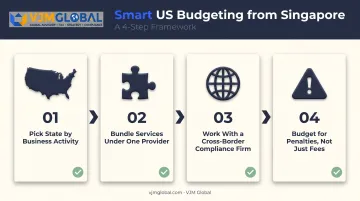
Smart budgeting matches your setup to what you're actually doing, not the cheapest state fee.
- Pick the state based on your business activity, not the headline fee. Wyoming's low annual cost only helps if your operations genuinely sit outside Delaware's ecosystem of investors and courts.
- Bundle registered agent, accounting, and compliance services under one provider. Juggling separate vendors for filing reminders, bookkeeping, and tax prep usually creates duplicate charges and gaps in coverage.
- Work with a firm that understands both Singapore and US rules. Coordinating EIN applications, tax filings, and banking across two regulatory systems is where most costly mistakes happen. A multi-jurisdiction team like VJM Global is built to catch that overlap before it becomes a missed deadline.
- Budget for penalties, not just fees. A missed Form 5472 filing costs $25,000 — far more than most founders would spend on professional support in a given year.
Balance upfront savings against the real cost of a compliance mistake. IRS penalties for late or incorrect filings routinely exceed what proper support would have cost.
Frequently Asked Questions
How much does it cost to register a US company from Singapore?
State filing fees alone run $100 to $110 for an LLC or C-Corp in states like Delaware or Wyoming. Bundled formation packages that include a registered agent and EIN support cost more, and they handle steps DIY filings often miss.
What is the cheapest US state to register a company in?
Wyoming is among the cheapest to form and maintain, with low formation fees and annual report costs near a $60 floor when you have no in-state assets. Delaware and California cost more; "cheapest" still depends on whether you need Delaware's courts or will operate in California.
Do Singapore-owned US companies need a US bank account?
It isn't legally required, but it makes receiving payments and building credibility with American clients far easier. Opening one remotely is harder: banks require beneficial-owner verification, so most foreign founders use third-party help.
What are the annual costs of maintaining a US LLC owned by a Singaporean?
Expect registered agent renewal, state franchise tax or annual report fees, and federal filings such as Form 5472 (with a pro forma Form 1120 when required) every year. Combined, these typically fall between $800 and $3,000+ depending on the state and accounting support used.
Is there a tax treaty between the US and Singapore?
No. Singapore does not currently appear on the IRS list of countries with a comprehensive income tax treaty with the United States. Cross-border income is assessed under standard US domestic tax rules, not treaty-based relief.
Can I register and maintain a US company without ever visiting the US?
Yes. A registered agent handles your legal address, and remote-friendly formation providers can file paperwork on your behalf. The main friction points are EIN applications without an SSN/ITIN and opening a US bank account.