Interest is picking up for a reason. The US-Singapore Free Trade Agreement (USSFTA), the boom in Amazon US and Shopify dropshipping, and the appeal of dollar-denominated revenue are pulling in a wider range of businesses than before.
This isn't just large trading houses anymore. SME manufacturers, ecommerce sellers, and even freight and logistics companies based in Singapore are exploring US market entry. This guide walks through both sides of that process: setting up your US entity and import structure, and staying compliant on the Singapore export side.
Key Takeaways
- A US entity, EIN, and Importer of Record status are required before you can clear goods with US Customs
- Singapore Customs/TradeNet clearance still applies, even when the buyer and entity are US-based
- HTS classification, a customs bond, and FDA/USDA/CPSC compliance are non-negotiable
- Dual tax exposure—US sales tax nexus and Singapore corporate tax/GST—is routinely overlooked
What Is a Singapore-to-USA Import-Export Business?
A Singapore-to-USA import-export business is a trade model where a Singapore-based individual or company sources, ships, and sells goods into the US market, or imports US goods for resale in Asia. The setup must meet legal and customs rules in both countries.
This section covers the mechanics of moving goods and money across two jurisdictions legally. Branding and market positioning come later.
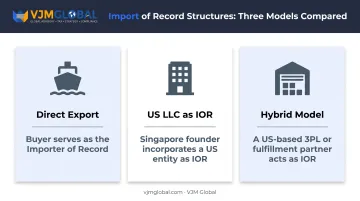
In practice, founders tend to structure this one of three ways:
- Direct export — a Singapore company ships straight to a US buyer, with the buyer acting as Importer of Record.
- US LLC as IOR — the Singapore founder incorporates a US entity that imports the goods itself.
- Hybrid model — goods move through a US-based 3PL or fulfillment partner, so you need less physical US infrastructure.
Why Start a US Import-Export Business From Singapore? (When It Makes Sense)
This move works under the right conditions. It isn't automatically the right call for every business. Here's what makes it worth pursuing.
The market size is enormous. US goods imports hit $3.42 trillion in 2025, according to Census Bureau trade data. Even a sliver of that demand can support a sustainable business.
US-Singapore Free Trade Agreement (USSFTA) tariff treatment. The agreement's tariff phaseout has been complete since 2013, and qualifying Singapore-origin goods are exempt from the US Merchandise Processing Fee, according to US Customs and Border Protection. The catch: your specific HTS line has to satisfy the rule of origin. Shipping from Singapore alone doesn't qualify you.
Other structural advantages:
- Singapore's currency stability and low corruption reduce operational risk on the sourcing side
- The World Bank's Logistics Performance Index has ranked Singapore's infrastructure among the world's best for years
- Amazon US and Shopify give Singapore sellers an asset-light way to test demand before warehousing or a full US presence
What to Know Before You Start
Most first-time founders underestimate the dual compliance load: you must satisfy two regimes at once. Singapore's export rules and America's import/entity rules run on separate tracks, and both need attention from day one.
Set realistic expectations on timeline and capital before you commit.
Time and effort: Registering a US entity remotely, obtaining an EIN without a Social Security Number, and opening a US bank account from Singapore all take longer than domestic incorporation. Add customs bond setup and transpacific transit, and your first shipment rarely clears US Customs quickly.
Costs that catch people off guard:
- US state filing fees and registered agent fees (recurring, not one-time)
- Customs bond premiums
- Singapore export permit costs via TradeNet
- Ongoing dual-jurisdiction tax filing (often budgeted last, and regretted)
How to Start an Import-Export Business in the USA from Singapore – Step-by-Step
This breaks the process into practical stages, covering both the Singapore export side and the US import side. Skip any one of them and you risk a shipment stuck at the border - or worse, a compliance issue that surfaces months later.
Three mistakes come up constantly: skipping the customs bond, ignoring US sales tax nexus rules, and assuming Singapore export permits don't apply just because the buyer is overseas. They do apply.
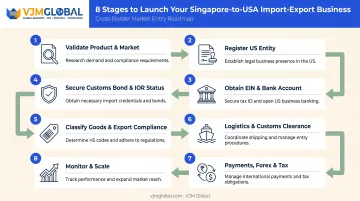
Step 1 – Validate Your Product and US Market Opportunity
Before anything else, confirm there's real demand and that your product isn't buried in regulatory red tape.
- Check whether your product falls under FDA, USDA, or CPSC jurisdiction - food, cosmetics, supplements, meat/poultry, toys, and electronics all carry extra requirements
- Use USA Trade Online or USITC DataWeb to size demand and competition by HTS category
- Run your landed cost (product cost + freight + duty) against realistic US resale pricing before signing anything
Step 2 – Choose a US Business Structure and Register Your Entity
Most Singapore founders choose between an LLC and a C-Corp. Delaware and Wyoming are popular for their predictable corporate law and lower ongoing fees, though Nevada, Texas, Florida, and California are also common depending on where you plan to operate.
Because you're not a US resident, a registered agent is mandatory - there's no way around it.
Typical documents needed:
- Passport
- Registered agent details
- Articles of Organization (LLC) or Articles of Incorporation (C-Corp)
Firms offering remote US entity formation for foreign founders, such as VJM Global, can handle this filing without requiring you to set foot in the US.
Step 3 – Obtain an EIN, US Bank Account, and US Mailing Address
Your EIN comes from the IRS via Form SS-4. Singapore-resident founders without a Social Security Number can still apply, but the process usually takes longer and often requires phone or mail submission instead of the instant online system.
For banking, you'll generally choose between:
- Fintech-friendly providers - faster remote onboarding, fewer in-person requirements
- Traditional banks - often require a US visit or existing US business ties
If you don't have a physical US presence, you'll also need a US mailing or virtual office address for correspondence and registered filings.
Step 4 – Register as Importer of Record and Secure a Customs Bond
Under US Customs and Border Protection rules, someone has to be the Importer of Record (IOR) - the party legally responsible for duties, classification, and entry accuracy. This is usually your US entity, with the Importer Number tied to its EIN.
A customs bond is required for most commercial imports above $2,500, or for regulated commodities regardless of value.
CBP's continuous bond minimum is $50,000, or 10% of duties/taxes/fees paid in the prior 12 months, whichever is greater. That figure is the bond's face amount, not the premium you pay a surety.
- Continuous bond - covers all entries over a 12-month period, better for regular shippers
- Single-entry bond - covers one shipment, suited to occasional importers
Premium pricing varies by surety, so get quotes rather than assuming a flat rate.
Step 5 – Classify Your Goods and Handle Singapore Export Compliance
Get your HTS code right first - it determines your duty rate and whether any US agency sign-off is required before the goods can even ship.
On the Singapore side:
- Check TradeNet to confirm whether your goods are controlled or classified as strategic goods requiring an export permit
- A typical TradeNet application runs about S$3.19 (S$0.90 statutory fee plus S$2.29 processing), based on Singapore Customs' published fee schedule
- Obtain a Certificate of Origin or self-certification statement to support a USSFTA preference claim - your US importer needs this documentation, not just your say-so
Step 6 – Set Up Logistics, Freight Forwarding, and Customs Clearance
Work with a freight forwarder or customs broker who specifically knows the Singapore-US lane, not just general Asia-Pacific freight. Lane-specific experience saves you from documentation errors that generic forwarders miss.
Before shipping, lock down:
- Incoterms with your buyer - FOB and CIF are most common for this lane
- Bill of Lading or Airway Bill, commercial invoice, and packing list
- Importer Security Filing (ISF, or "10+2") for ocean freight - required at least 24 hours before your goods load at the foreign port
Transit times vary by routing and carrier schedule, so check current sailing schedules rather than relying on generic transit-time estimates.
Step 7 – Manage Cross-Border Payments, Forex, and Tax Compliance
Payment structure matters as much as product cost. Common options include letters of credit, wire transfers, and multi-currency business accounts that reduce conversion friction between SGD and USD.
Tax exposure hits both sides, and this is where most founders get caught off guard:
- US side - economic nexus can trigger state sales tax obligations even for a foreign-owned entity, plus federal filings (Form 1120 for C-Corps, or 1065 if your LLC is taxed as a partnership)
- Singapore side - corporate tax filing continues as normal, and exported goods can be zero-rated for GST if export evidence is completed within 60 days of supply; miss that window and you're standard-rated at 9%
Keeping both sides aligned is time-consuming. Cross-border tax firms like VJM Global handle the parallel US and Singapore filings so you stay compliant without juggling two regimes yourself.
Step 8 – Monitor Performance and Scale
Once shipments are flowing, track:
- Shipment cycle time and landed cost accuracy against your original projections
- Duty drawback recovery opportunities on re-exported or returned goods
- US tariff policy changes - they shift fast and can erode margins overnight
Once order volume stabilizes, reinvest in US-based warehousing or a 3PL partner to cut shipping lead times and improve delivery consistency.
How VJM Global Supports Your Singapore-to-USA Import-Export Business Setup
The hardest part of Singapore-to-USA trade is not one filing—it is running compliance in both jurisdictions without gaps. VJM Global’s cross-border setup is built for that dual track.
- Entity registration: End-to-end US formation for Singapore founders—Secretary of State filing, EIN, registered agent, and FinCEN BOI reporting—with no travel required
- Cross-border tax compliance: Dual-jurisdiction bookkeeping, US federal and state filings (Forms 1120, 1120-S, 1065, sales tax nexus), plus Singapore corporate tax and GST
- Ongoing back-office support: Bookkeeping, payroll, and compliance reporting so you do not need an in-house US team
With 30+ years in entity formation and compliance across 100+ countries, the firm keeps US and Singapore obligations moving together after launch.

Frequently Asked Questions
How can I start an import/export business in the USA from Singapore?
Register a US entity, obtain an EIN and customs bond, secure Singapore export clearance through TradeNet, and set up logistics and cross-border tax compliance. Each step depends on the one before it, so sequencing matters.
What goods does Singapore export to the USA?
Singapore's exports to the US skew toward electronics, machinery, pharmaceuticals, and chemicals, reflecting its strength as a manufacturing and re-export hub. The US imported roughly $38.1 billion in goods from Singapore in 2025, according to USTR.
How much does an export permit cost in Singapore?
A typical TradeNet application costs about S$3.19, covering the statutory and processing fees. Costs can vary depending on permit type, especially for strategic or controlled goods requiring additional approval.
How much does it cost to get an import permit in the USA?
There's no flat "import permit" fee. You pay a customs bond premium (continuous bonds have a $50,000 minimum face value) plus per-entry fees such as the Merchandise Processing Fee. USSFTA-qualifying goods are exempt from the MPF.
Do I need to set up a US company to import goods into the USA?
It's not always legally mandatory, but it's strongly recommended. A US entity simplifies banking, customs bonding, and tax compliance more than importing as a foreign individual or company.
What is a customs bond and do I need one to import into the US?
A customs bond guarantees payment of duties, taxes, and fees to CBP if you don't pay them yourself. It's required for most commercial imports over $2,500 and for many regulated commodities regardless of value.