Regulatory complexity, a digital ecosystem that operates entirely outside Western platforms, and a "first-to-file" IP system that punishes late movers all create genuine risk for unprepared entrants. The 2024 Negative List eliminated all remaining manufacturing sector restrictions, and the upcoming Encouraged Foreign Investment Catalogue (effective February 2026) adds 1,679 items across advanced manufacturing and modern services — clear signals that China is actively courting quality foreign capital.
The question is no longer whether to enter. It's how to structure entry intelligently. This article covers the core decisions that determine success: legal structure selection, geographic targeting, regulatory compliance, IP protection, digital localization, and a practical five-step entry process.
Key Takeaways
- China functions as a collection of regional sub-markets — a regional-first approach reduces risk for foreign entrants
- Three legal structures are available: WFOE (full control), Joint Venture (partner access), or Representative Office (low-cost exploration)
- China's "first-to-file" IP system means registration must happen before market entry
- The 2024 Negative List cut to 29 restricted areas and removed all manufacturing restrictions
- Market research, structure selection, compliance planning, and IP registration must all precede launch
Why China Still Matters for Global Businesses
World Bank data puts China's 2024 nominal GDP at $18.74 trillion. The State Council estimates the middle-income group at over 400 million — with projections that this figure could exceed 800 million within 15 years.
China's trade architecture amplifies the opportunity further:
- RCEP membership — China is party to the Regional Comprehensive Economic Partnership, now in force for all 15 member economies, creating preferential trade access across the Asia-Pacific
- 111+ bilateral investment treaties in force — providing legal protection frameworks for foreign investors across multiple jurisdictions
- Pilot zones in Beijing, Shanghai, Hainan, and Shenzhen are expanding full foreign ownership in healthcare, biotech, and digital infrastructure
The 2025 Encouraged Foreign Investment Catalogue, effective February 1, 2026, contains 1,679 items — a net increase of 205 — with additions concentrated in advanced manufacturing, modern services, and central and western regional development.
Companies screening whether their activity qualifies for catalogue incentives should complete that review before February 2026, when the new classifications take effect and site selection decisions carry direct tax and ownership implications.
Choosing Your China Market Entry Mode
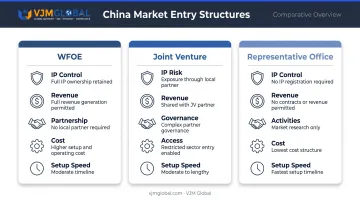
Three legal vehicles are available to foreign businesses. The right choice depends on the company's industry, IP sensitivity, need for operational control, and long-term objectives.
Wholly Foreign-Owned Enterprise (WFOE)
A WFOE is a limited liability company 100% owned by foreign investors — the default operating vehicle for companies that need to generate revenue directly in China.
Key advantages:
- Full operational control with no mandatory Chinese partner
- Direct hiring capability and payroll management
- Ability to issue Chinese tax invoices (fapiao) to domestic customers
- Stronger IP protection through direct ownership of contracts and registrations
Key drawbacks:
- Higher setup costs and longer registration timelines than other structures
- Strict adherence to declared business scope — operating outside it creates compliance risk
- Sector-specific capital and licensing requirements apply in regulated industries
- Registered capital must be fully paid within five years under current Company Law
WFOEs are the preferred structure for tech-heavy companies with significant IP inventories and businesses seeking a long-term independent presence.
Joint Venture (JV)
Both equity JVs and cooperative JV models remain available under the Foreign Investment Law framework (which replaced the old EJV and CJV statutes from January 1, 2020).
Primary advantages:
- Access to sectors where foreign ownership remains restricted
- Leverage of local partner's networks, regulatory relationships, and market knowledge
- Faster initial market penetration through an established partner base
Significant risks:
- Governance conflicts and operational misalignment are common
- IP leakage risk — especially where the partner has access to proprietary processes
- Exit terms are frequently under-specified, creating costly disputes
Before signing anything, conduct thorough due diligence on the prospective partner's connections to state-owned enterprises, regional specialization, and IP track record.
Representative Office (RO)
The RO is the lowest-cost, fastest entry point — but it comes with hard limits. An RO cannot sign contracts, issue invoices, collect payments, or directly employ Chinese staff. It exists purely for liaison, market research, and relationship-building.
For companies not yet ready to commit capital to a full legal entity, an RO still provides genuine ground-level visibility. Use it to assess market conditions, build local relationships, and determine whether a WFOE or JV makes sense before making that larger investment.
Choosing the Right Entry Geography
China's 33 provinces and municipalities are economically fragmented. Entering "China" without specifying which China is not a strategy.
Tier 1 vs. Tier 2 Cities
| Tier 1 (Beijing, Shanghai, Guangzhou, Shenzhen) | Tier 2 (Wuhan, Chengdu, Hangzhou, Xi'an, Chongqing) | |
|---|---|---|
| Consumer market | Mature, concentrated | Rising rapidly |
| Competition | Intense | First-mover opportunities |
| Operating costs | High | Lower |
| International business | Dense ecosystem | Growing |
The right tier depends on your sector, budget, and timeline — not just brand ambition. According to PwC's Chinese Cities of Opportunity 2024 report, Shenzhen leads in Technology and Innovation, while Hangzhou ranks 5th, Wuhan 8th, and Chengdu 10th overall — all offering distinct advantages depending on sector.
Industrial Cluster Targeting for B2B Companies
Rather than selecting a city and then finding customers, map the industrial cluster first:
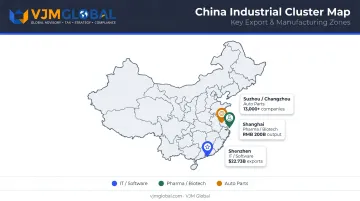
- IT and software — Shenzhen ranked first among China's software cities in 2023, with software exports of $22.73 billion and 35.4% of China's national market share
- Pharma and biotech — Shanghai's biopharma output was projected to exceed RMB 200 billion in 2024
- Auto parts — Suzhou and Changzhou in Jiangsu host 13,000+ automotive parts companies, with anchor suppliers including Bosch, Magna, and Faurecia
These clusters also reveal where your competitors are already entrenched — and where gaps remain. For SMEs especially, a regionally focused entry — one target city, one channel — outperforms attempting nationwide coverage from day one.
Navigating China's Regulatory and Compliance Landscape
China's regulatory environment rewards preparation. Understanding the registration process, sector-specific licensing requirements, and labour obligations upfront saves significant time and avoids costly compliance gaps later.
Business Registration
The five-in-one licence consolidates five government registrations — business licence, organisation code, tax registration, social insurance, and statistical certificate — into a single application through the local Administration for Market Regulation (AMR). Despite the consolidated process, sector-specific permits still require separate applications, and the overall process remains genuinely complex for foreign entities.
Sector-Specific Licensing
Regulated sectors require additional approvals beyond the standard licence:
- Value-Added Telecom Services (VATS) — Licence from MIIT required; foreign ownership generally capped at 50%, though a 2024 pilot program is expanding access
- Food operations — Food Operation Licence from SAMR (under Order No. 78, effective December 2023)
- Finance — Each financial sub-sector (banking, insurance, securities) has its own regulator and approval pathway; foreign ownership limits and conditions vary significantly by activity type
Labour Law Compliance
China's employment framework is strongly pro-employee. Key requirements:
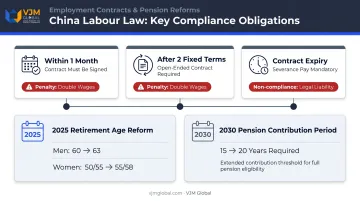
- Written contracts must be signed within one month of the start date — non-compliance triggers double salary penalties
- After two fixed-term contracts, employers must generally offer open-ended contracts
- Statutory severance is mandatory even upon natural contract expiration, unless the employee refuses renewal on equal terms
Recent reforms to plan for:
- From January 2025, retirement ages are being gradually raised over 15 years — men from 60 to 63, women from 50/55 to 55/58
- From 2030, the minimum pension contribution period increases from 15 to 20 years
Social insurance contributions (pension, medical, unemployment, work injury, maternity, plus housing provident fund) vary by city and industry — budget compliance costs by target city, not national averages.
Protecting Intellectual Property in China
China operates a strict "first-to-file" system. Under Patent Law Article 9, when two or more applicants file for the same invention, the patent right goes to whoever filed first — not the original inventor. The same principle applies to trademarks.
The scale of the problem is significant: CNIPA addressed 205,000 malicious trademark registration cases in H1 2024 alone. In 2024, courts accepted 529,370 new IP cases and customs detained 41,600 shipments containing 81.6 million infringing items.
These numbers make clear that proactive registration — before you market, partner, or distribute — is the only reliable defense. Here's where to start.
Pre-Entry IP Registration Checklist
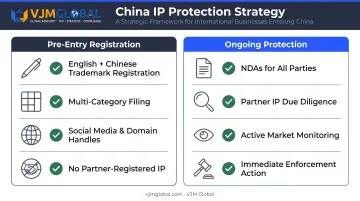
- Register trademarks in both English and Chinese characters before any marketing activity
- Register across multiple categories to deter infringers from adjacent registrations
- Secure relevant social media handles and internet domain names as part of registration
- Never allow a Chinese distributor or partner to register IP on the company's behalf — the registration will be theirs, not yours
Ongoing IP Protection
Registration alone won't hold. Sustained protection requires active monitoring and contractual controls:
- Require NDAs from all employees, partners, and contractors with access to proprietary information
- Conduct IP due diligence on prospective partners before sharing anything sensitive
- Monitor the market actively for infringements and act immediately — deterrence requires visible enforcement
- Once IP is compromised in China, legal remedies exist but recovery is slow and outcomes are uncertain — enforcement before infringement happens is the only strategy that reliably works
Localising for the Chinese Market
China's digital ecosystem is entirely distinct from Western markets. Baidu held 47.16% of China's search market as of May 2026 (StatCounter). WeChat and Douyin dominate social and commerce. Tmall and JD.com lead e-commerce, not Amazon.
According to the US International Trade Administration, China's e-commerce market reached RMB 15.4 trillion ($2.2 trillion USD) in 2023, up 11.9% year-on-year. Taobao/Tmall held 44% of the market, JD.com 24%, and Pinduoduo 19%. By December 2023, livestreaming e-commerce had reached 597 million users — 54.7% of all Chinese internet users. Companies entering without a China-specific digital presence simply aren't commercially visible.
Cross-Border E-Commerce as a Lower-Risk Entry Channel
For product businesses not yet ready for a legal entity, cross-border e-commerce (CBEC) offers a viable testing channel:
- Single-transaction limit: RMB 5,000; annual individual limit: RMB 26,000
- Within these limits, import tariffs are temporarily 0%; import VAT/consumption tax collected at 70% of the statutory rate
- CBEC trade grew from RMB 2.11 trillion in 2022 to RMB 2.63 trillion in 2024
Cultural Localisation Requirements
- Adapt packaging, formulation, and pricing to local expectations rather than converting Western defaults
- Rewrite brand messaging from scratch: Chinese consumers respond to quality, safety, and prestige signals, and direct translation of Western copy rarely lands
- Align campaigns with the Chinese shopping calendar: Double 11 generated RMB 1.44 trillion in GMV in 2024, 618 generated RMB 742.8 billion, and Chinese New Year drives significant commerce volumes
- Treat regulatory compliance in health, food, and property marketing as non-negotiable — misleading claims in these categories carry serious legal consequences
Step-by-Step China Market Entry Process
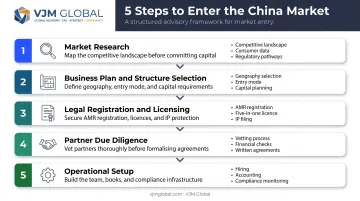
Step 1 — Market Research
Conduct deep category research covering the competitive landscape, consumer preferences, pricing benchmarks, and regulatory pathways. Desk research must be validated with in-market visits and qualitative interviews with industry stakeholders before any financial commitment is made.
Step 2 — Business Plan and Structure Selection
Develop a China-specific business plan defining the target geography, entry mode (WFOE, JV, or RO), capital commitment, revenue model, and timeline. Align structure selection with the company's sector, IP sensitivity, and long-term control requirements. Engaging experienced cross-border advisory professionals early reduces setup risk and prevents costly compliance delays.
Step 3 — Legal Registration and Licensing
Engage local legal experts to manage entity registration through the AMR, obtain the five-in-one business licence, and secure all sector-specific permits before commencing operations. Register IP simultaneously or in advance. Establish corporate bank accounts and tax registration with the relevant authorities.
Step 4 — Partner Selection and Due Diligence
Identify and vet local agents, distributors, or JV partners through formal due diligence — financial checks, legal background verification, sector experience, and assessment of connections to state-owned enterprises. Written agreements must clearly define roles, IP ownership, and exit terms before any partnership is formalised.
Step 5 — Operational Setup and Ongoing Compliance
Hire local staff in compliance with Chinese labour law. Establish accounting and reporting systems aligned with PRC standards. Institute a monitoring process for regulatory changes, IP enforcement, and performance benchmarks. China's regulatory and consumer landscape evolves rapidly — revisit strategy every three to five years.
Frequently Asked Questions
What is the easiest way for a foreign business to enter the Chinese market?
A Representative Office is the fastest and lowest-cost entry point — suitable for market research and relationship-building before committing capital. For product businesses, cross-border e-commerce is an accessible initial channel that doesn't require a legal entity in China.
Can a foreign company own 100% of a business in China?
Yes. Through a WFOE, foreign investors can own 100% of their Chinese entity. The 2024 Negative List eliminated all manufacturing sector restrictions. Certain industries — telecoms, some agricultural sectors — remain regulated and may still require Chinese partnership or have ownership caps.
How long does it take to set up a WFOE in China?
WFOE setup typically takes 3 to 6 months from document preparation and authentication through registration and post-registration tasks, according to established China advisory sources. Regulated industries requiring additional approvals can take longer.
Do I need a Chinese partner to enter the Chinese market?
A local partner is not legally required for a WFOE or RO, but is mandatory in restricted sectors. Even where optional, a well-vetted partner can significantly accelerate market access and regulatory navigation, especially during the first two years of operations.
What are the biggest challenges for foreign businesses entering China?
The most common failure factors are regulatory complexity, IP protection risks, cultural and digital localisation gaps, fragmented regional markets, and insufficient financial commitment. Underestimating these challenges upfront is the primary reason foreign ventures in China fail.
How do I protect my intellectual property when entering China?
Register trademarks and patents in China before entering, in both English and Chinese characters. Conduct thorough partner due diligence, use NDAs before sharing proprietary information, and prioritize early filing. China's IP enforcement has improved, but prevention is far more effective than post-breach litigation.