But "how much does it cost?" has no clean answer. A budget free zone licence can start below AED 6,000. A mainland operation with office space and multiple visas can exceed AED 50,000 in year one. The gap between those figures comes down to jurisdiction, business activity, office type, and visa requirements — and entrepreneurs who don't understand those variables routinely underbudget or pick the wrong structure.
This guide breaks down costs by jurisdiction, identifies the biggest cost drivers, separates one-time from recurring expenses, and gives you a framework for building a realistic two-year budget.
Key Takeaways
- Dubai business setup costs range from roughly AED 5,500 to AED 50,000+ in year one, depending on jurisdiction and operational requirements
- Mainland, Free Zone, and Offshore each carry distinct cost structures, ownership rules, and market access rights
- Trade licence fees, office space, and visa costs are the three biggest variables — each can swing total spend by AED 10,000 or more depending on your choices
- Annual renewal costs typically run 70–100% of initial setup fees, so year-two expenses should be factored into your startup budget from the outset
- Hidden costs — PRO fees, bank account setup charges, and notarisation — routinely add AED 3,000–8,000 that first-time applicants don't anticipate
How Much Does It Cost to Start a Business in Dubai?
There is no single fixed price. Costs depend on which of the three jurisdictions you choose, what activities your licence covers, how many visas you need, and what type of office space you require.
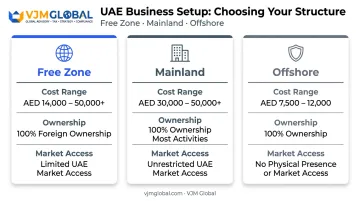
Here's how the three tiers compare at a glance:
| Jurisdiction | Typical First-Year Range | Foreign Ownership | UAE Market Access |
|---|---|---|---|
| Free Zone | AED 14,000 – AED 50,000+ | 100% | Limited (B2B within zone or via distributor) |
| Mainland | AED 30,000 – AED 50,000+ | 100% (most activities) | Unrestricted |
| Offshore | AED 7,500 – AED 12,000 | 100% | None (no physical presence) |
Mainland Company Setup Cost
Mainland companies are licensed by Dubai's Department of Economy and Tourism (DET) and can trade anywhere in the UAE without restrictions. That flexibility comes with higher costs.
Key cost components for a mainland setup:
- Trade name reservation: AED 620 (official Invest in Dubai fee)
- Trade licence issuance: AED 1,070 + AED 300 Dubai Chamber membership
- Physical office rental: AED 15,000 – AED 30,000/year for a small office
- Ejari registration: AED 177.75 (online) or AED 220 (service centre)
- Investor visa (government components): ICP fees of AED 300–800 + medical fitness AED 250–350 + Emirates ID AED 100/year
Total first-year estimates from UAE advisory firms range from AED 30,000 to AED 50,000+ for a small mainland company with one visa and a modest office. Professional licence setups — consultants, legal, medical — tend to sit at the lower end. Commercial and trading licences run higher because they attract additional government approvals.
Free Zone Company Setup Cost
Dubai has approximately 30 free zones, and costs vary considerably between them. All offer 100% foreign ownership and many bundle licence, workspace, and visa fees into packages.
Indicative pricing across popular free zones:
- RAKEZ (Ras Al Khaimah): SME package from AED 14,000/year, including licence, one residence visa, and coworking access
- Meydan Free Zone: Standard digital licence from AED 12,500 (includes flexi-desk); investor visa from AED 4,000
- IFZA: Zero-visa annual licence from approximately AED 12,900; one-visa package around AED 14,900
- DMCC: Jump Start Package with flexi-desk from AED 43,780 — reflecting its status as Dubai's most prestigious free zone and the higher administrative infrastructure that comes with it
A typical first-year free zone setup (licence + flexi-desk or coworking + one investor visa) lands between AED 14,000 and AED 20,000 for budget-tier zones, rising to AED 43,000+ for DMCC.
Watch what's excluded from advertised packages: establishment card fees, medical fitness, Emirates ID, immigration file fees, and health insurance are often separate line items.
Offshore Company Formation Cost
If you need a UAE legal entity purely for holding assets, international trading, or corporate structuring — with no requirement for a physical UAE presence — offshore formation is the most cost-efficient route.
Current offshore formation costs:
- RAK ICC: AED 3,250 for a 1-year IBC; AED 6,700 for 2 years; renewal from AED 3,950/year
- JAFZA Offshore: Annual renewal AED 2,500; setup estimated at USD 2,000–2,500 via registered agents
- Ajman Offshore: Setup and renewal around AED 7,500, including registered agent fee
What offshore includes: Certificate of Incorporation, registered agent, MOA. What it excludes: UAE residence visas, physical operating office, and the right to trade directly in the UAE market.
Key Factors That Affect Business Setup Costs in Dubai
Five variables account for most of the cost difference between business setups in Dubai — and understanding them upfront prevents budget surprises later.
Jurisdiction Choice
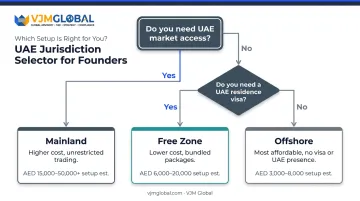
Jurisdiction is the single biggest cost differentiator:
- Mainland requires a physical office, carries higher government fees, but gives unrestricted UAE market access
- Free Zone bundles costs and offers lower entry prices, but restricts direct mainland trading
- Offshore is the most affordable option but provides no visa entitlement and no UAE operational presence
Business Activity and Licence Type
Your activity determines your licence category — professional, commercial, or industrial — and directly affects government fees. Regulated sectors require additional external approvals, which add both cost and time:
- Healthcare: Dubai Health Authority (DHA) approval required
- Education: KHDA sign-off mandatory
- Financial services and F&B: Sector-specific authority clearances apply
Each approval carries its own fee and can extend your setup timeline by several weeks.
Office Space Requirements
Office type is one of the largest recurring cost variables:
- Physical office (mainland): AED 15,000 – AED 30,000/year for small units
- Free zone flexi-desk: AED 16,000 – AED 19,000/year (DMCC); included in some Meydan and RAKEZ packages
- Coworking/hot desk: from AED 720/month (Servcorp UAE)
- Virtual office address: from AED 490/month
Mainland companies cannot substitute a flexi-desk for a physical office — physical presence is mandatory.
Number of Visas Required
Each UAE residence visa carries government fees, medical fitness costs (AED 250–350), and Emirates ID fees (AED 100/year). Free zone visa quota is often tied to office size — scaling your team means scaling your workspace, multiplying both costs simultaneously.
Company Structure and Share Capital
Each structure — LLC, FZ-LLC, sole proprietorship, and branch office — carries different documentation requirements and cost implications. Key points to know:
- The UAE Ministry of Economy has confirmed no minimum share capital for LLCs unless specified in the Articles of Association
- Some free zones require a nominal share capital deposit, typically refundable upon dissolution
Your chosen structure also determines how many local approvals and notarisation steps are required, which adds to both fees and processing time.
Full Cost Breakdown: One-Time vs Recurring Expenses
The licence fee is just the entry point. A realistic budget must account for both setup costs and the annual expenses that follow.
One-Time Setup Costs
| Cost Item | Approximate AED Range |
|---|---|
| Trade name reservation | AED 620 |
| Licence issuance (DET) | AED 1,070 + AED 300 |
| MOA/Articles of Association notarisation | Varies by notary |
| Investor visa (government fees) | AED 600 – AED 1,000 |
| Medical fitness | AED 250 – AED 350 |
| Emirates ID (initial) | AED 100/year |
| Business setup advisory/PRO fees | AED 1,500 – AED 5,000 (one-time or retainer) |
PRO service fees for individual tasks typically run AED 200–800 per task. Engaging a setup advisor upfront to handle approvals, document attestation, and authority submissions is usually a one-time cost, but it prevents errors that cost far more to fix.
Recurring Annual Costs
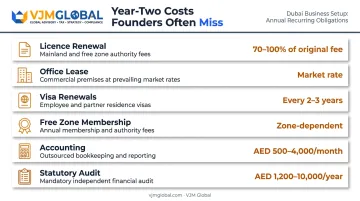
These are the costs that catch founders off guard in year two:
- Licence renewal: typically 70–100% of original licence fee
- Office lease renewal: same rate as year one, subject to market movement
- Visa renewals: every 2–3 years, similar government fee structure
- Free zone authority membership fees: zone-dependent
- Accounting and bookkeeping: AED 500–1,000/month for startups; AED 2,000–4,000/month for SMEs
- Statutory audit: AED 1,200–10,000/year for small companies (mandatory in DMCC, JAFZA, Meydan, RAKEZ, and IFZA)
Late renewal penalties are real. RAK ICC charges 10% in month two of overdue renewal, rising to 50% by month five. JAFZA Offshore charges AED 120 per 30 days late.
For businesses with cross-border obligations — particularly those with India-side operations or investment flows — outsourced accounting support through a firm like VJM Global can cover UAE and India-side compliance without the overhead of an in-house finance team.
Hidden and Overlooked Costs
Several costs are almost never included in advertised packages:
- Corporate bank account minimum balances: Emirates NBD business accounts require AED 25,000–50,000 minimum balance depending on product tier; RAKBANK RAKstarter and Mashreq NEO BIZ Pro offer zero-balance alternatives
- Mandatory health insurance: Required for all visa holders in Dubai. The DHA Essential Benefits Plan (EBP) starts at approximately AED 535/year — budget this for every sponsored employee
- External regulatory approvals: Activities requiring DHA, KHDA, or telecom regulator sign-off carry their own fees and are almost never included in advertised setup prices
How to Estimate the Right Budget for Your Dubai Business
The right budget is not the lowest available price — it's the one that covers your actual requirements and leaves room for year-two renewal costs.
Before building your cost estimate, answer these questions:
- What jurisdiction suits your market access needs? If you're selling directly to UAE consumers or businesses, mainland is likely necessary. If you're running international operations from Dubai, a free zone may suffice.
- Do you need a UAE residence visa? Every visa adds AED 4,000–5,000+ in year one.
- What office setup will satisfy your licence requirements? Mainland requires physical space; free zones offer lower-cost alternatives.
- How many employees will you sponsor in year one? Visa quota limits may require a larger office than you'd otherwise need.
- Does your activity require external regulatory approvals? If yes, add both cost and timeline buffer.
Once you've answered those questions, the next step is projecting beyond year one.
Build a Two-Year Projection
Most founders budget for setup costs and ignore renewal. That's a mistake — renewal costs for licence, office, and visas typically represent 70–100% of your initial setup spend.
Multi-year licence packages from several free zones reduce this burden:
- DMCC: 5% off for 2-year renewal, 20% off for 5-year renewal
- Meydan: 15% discount for multi-year licences
- IFZA: 15% savings on 2-year packages, 30% on 5-year packages for zero-visa plans
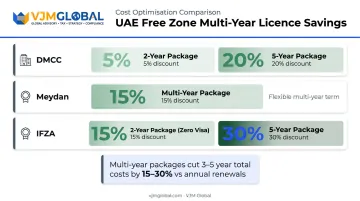
For founders committed to Dubai beyond year two, locking in a multi-year package at a budget-tier free zone cuts total three-to-five-year costs by 15–30% compared to annual renewals.
Conclusion
Starting a business in Dubai can cost as little as AED 5,500–6,000 for a minimal free zone licence without visas, or exceed AED 50,000 for a mainland company with office space and a small team in year one. The gap comes down to four variables:
- Jurisdiction — free zone vs. mainland vs. offshore
- Office requirement — flexi-desk, shared space, or dedicated unit
- Visa count — each visa adds AED 3,000–5,000+ in fees
- Activity type — regulated sectors (healthcare, finance, education) carry additional approval costs
Low advertised prices reflect stripped-down packages that rarely match real operational needs. Map your structure to your activity, headcount, and client requirements — then model both year-one setup costs and year-two renewal fees before signing any agreements.
Frequently Asked Questions
What is the minimum cost to start a business in Dubai?
The lowest entry point is a free zone licence without visas, which can start around AED 6,000–12,900 depending on the zone. RAKEZ's BusinessWomen Package starts at AED 6,000; IFZA and Meydan begin around AED 12,500–12,900. Budget an additional AED 3,000–7,000+ for visa fees, health insurance, and banking setup — these are not included in headline package prices.
Is it cheaper to set up a business in a Dubai free zone or on the mainland?
Free zones are generally 40–60% less expensive than mainland in year one, with no local sponsor requirement and bundled package options. Mainland setup is the better choice when you need unrestricted access to the UAE market, despite the higher cost.
Do I need a local sponsor to start a business in Dubai?
Free zone and offshore companies require no local sponsor and allow 100% foreign ownership. For mainland companies, UAE reforms under Federal Decree-Law No. 26 of 2020 now permit 100% foreign ownership across most commercial activities — though some regulated sectors still require a local service agent.
How long does it take to set up a business in Dubai?
Free zone setups generally complete in 1–3 weeks; Meydan's Fawri instant licence can be issued in under 60 minutes. Mainland setups generally take 3–6 weeks, depending on business activity approvals and documentation requirements.
What are the ongoing annual costs after setting up a business in Dubai?
Annual costs include licence renewal (70–100% of initial fee), office lease, visa renewals every 2–3 years, mandatory audit (most free zones), and accounting fees. For a one-visa free zone setup, plan for AED 15,000–25,000 in total annual renewals — more if you add visas or upgrade office space.
Can a foreigner own 100% of a business in Dubai?
Yes — and this applies to both free zone and mainland structures. Free zones have always allowed full foreign ownership; mainland reforms since 2021 extended this to most commercial activities. In practice, this means no mandatory local partner and full rights to repatriate profits, with narrow exceptions in defence, banking, and telecoms.