Introduction
Indian entrepreneurs are flocking to Dubai at unprecedented rates. In 2025, 18,486 Indian-owned companies joined the Dubai Chamber of Commerce, marking 11% year-over-year growth and securing India's position as the #1 nationality for new non-UAE business registrations in the emirate. With India-UAE bilateral trade crossing USD 100.06 billion in FY 2024-25—a 19.6% jump—the business case for Dubai has never been stronger.
Dubai's reputation as a business-friendly hub is well earned, but license costs are not a single fixed number—and that surprises many first-time entrants. The final figure depends on license type, jurisdiction (mainland vs. free zone), business activity, and layered regulatory requirements that aren't always obvious upfront.
This guide breaks down Dubai business license fee structures from an Indian entrepreneur's perspective, covering cost ranges in both AED and approximate INR equivalents, key cost drivers, and the hidden charges that often inflate the final bill.
Key Takeaways
- Dubai business license fees range from AED 10,000 to AED 50,000+ annually (₹2.3 lakh to ₹11.5 lakh+)
- Free zones offer lower entry costs and 100% foreign ownership; mainland licenses provide full local market access at higher fees
- License fees are just one piece: registration, visas, and office space push total first-year costs 2–3x higher
- Remitting setup funds requires compliance with FEMA regulations and RBI's Liberalized Remittance Scheme
How Much Does a Dubai Business License Cost?
There's no single fixed cost for a Dubai business license. The fee depends on license type, business jurisdiction, number of activities, and whether you choose mainland or free zone setup.
What commonly trips up Indian entrepreneurs: budgeting only for the license fee. The reality? Registration charges, visa processing, office space requirements, and government approvals can double or triple your initial estimate.
Free Zone License Costs
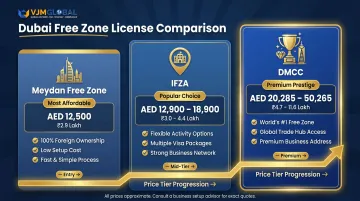
Free zone licenses typically range from AED 10,000 to AED 30,000 per year (approximately ₹2.3 lakh to ₹6.9 lakh). Costs vary widely between free zones:
- Meydan Free Zone: Starts at AED 12,500 (₹2.9 lakh) with flexible pay-as-you-grow pricing
- IFZA: Packages from AED 12,900-18,900 (₹3.0-4.4 lakh) depending on visa allocation
- DMCC: Standard trading/service license at AED 20,285/year (₹4.7 lakh); General Trading License at AED 50,265/year (₹11.6 lakh)
What's typically included:
- Business license valid for 1 year
- Flexi-desk or shared workspace access
- Visa allocations (number varies by package)
- Company registration and incorporation
Best for: Indian entrepreneurs wanting 100% ownership, tax-free operations, and no requirement for local market trading. Ideal if you're servicing international clients or running consulting/services businesses.
Mainland License Costs
Mainland Dubai licenses vary by category:
- Professional License: AED 10,000-15,000 annually (₹2.3-3.5 lakh)
- Commercial/Trading License: AED 15,000-24,500 annually (₹3.5-5.6 lakh)
- Industrial License: AED 25,000-50,000+ total setup (₹5.8-11.5 lakh+)
What's typically included:
- DED license issuance fee (AED 1,070)
- Dubai Chamber of Commerce membership (AED 300)
- Trade name reservation
- Activity classification fees
Best for: Indian entrepreneurs who want direct access to the UAE local market without restrictions, or those looking to bid on government contracts and trade freely within Dubai.
General Trading License
Beyond the standard categories above, the General Trading License deserves separate attention. It's particularly popular among Indian traders because it covers import, export, wholesale, retail, and distribution across multiple product categories under a single license.
Cost comparison by jurisdiction:
- Mainland: AED 29,000-35,000 all-in (₹6.7-8.1 lakh), including registration, trade name reservation, and approval fees
- DMCC Free Zone: AED 50,265/year license fee + AED 29,000 one-time registration (₹11.6 lakh + ₹6.7 lakh)
This removes the need for separate licenses per product category, a meaningful cost and time saving for diversified trading operations.
Note: ₹ conversions are approximate, based on ~₹23/AED. Verify current exchange rates before budgeting.
Key Factors That Affect Dubai Business License Fees
Two businesses in the same industry can pay dramatically different license fees. Five factors drive most of that gap: business activity type, jurisdiction, number of activities, office space, and visa quota. Understanding each one before you budget prevents costly surprises.
Type of Business Activity
The nature of your business—trading, consulting, manufacturing, or professional services—determines both license category and fee structure.
Industries requiring special regulatory approvals face additional costs:
- Healthcare businesses need Ministry of Health approvals
- Food-related activities require Dubai Municipality clearances
- Education services involve Knowledge and Human Development Authority fees
Each approval adds AED 2,000–10,000+ (roughly ₹46,000–₹2.3 lakh) to your total cost.
Jurisdiction: Free Zone vs. Mainland
Free zones:
- Lower license fees (AED 12,000–30,000 range)
- 100% foreign ownership by default
- Cannot trade directly with UAE local market without a distributor
- Streamlined digital setup process
Mainland:
- Higher fees but unrestricted local market access
- Previously required local sponsor; since 2021 reforms, 100% foreign ownership now permitted in most sectors
- Required for government contract bidding
- Greater visa flexibility tied to office size
Sectors still requiring a local UAE partner on the mainland: security/defense, banking/finance, insurance, telecommunications, fisheries, postal services, and currency printing.
Number of Business Activities
Each activity added to your license may attract additional fees. Indian entrepreneurs often list multiple activities to reduce setup trips. That strategy works, but only with accurate classification knowledge. Mismatches lead to costly amendments later.
Two things to keep in mind:
- The base DED license fee is AED 1,070 (approximately ₹24,600) for standard activities
- Complex or high-volume activity lists push fees higher and may trigger regulatory review
Office Space Requirement
Most jurisdictions require proof of a physical or flexi-desk address to issue a license.
Annual office costs:
- Flexi-desk/shared workspace: AED 12,000–25,000 (₹2.8–5.8 lakh)
- DMCC flexi-desk: AED 16,000–19,000 (₹3.7–4.4 lakh)
- Mainland Ejari-registered office: AED 10,000–25,000 (₹2.3–5.8 lakh)
- Private office in prime locations: AED 30,000–80,000+ (₹6.9–18.4 lakh+)
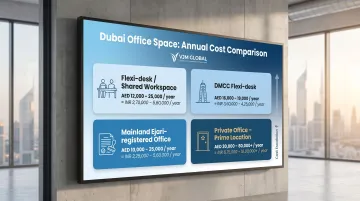
Free zone packages often bundle flexi-desk access; mainland setups require separate budgeting.
Visa Quota
The number of visas linked to your license affects total cost. Each visa adds AED 3,500–7,000 (₹80,500–₹1.6 lakh) to setup expenses.
- Investor/partner visa: AED 4,000–7,000
- Employee visa: AED 3,000–12,000 (varies by MOHRE company category)
- DMCC employment visa: AED 2,972.50 (outside UAE) or AED 4,220 (status change inside UAE)
Free zone visa quotas are tied to office size and license package tier—worth planning for early-stage businesses with small teams.
Complete Cost Breakdown: What Indian Entrepreneurs Actually Pay
The license fee is just one line item. First-year costs for a Dubai business setup typically range from AED 40,000 to AED 120,000+ (₹9.2–27.6 lakh), depending on jurisdiction, visa count, and business activity. Here's what that total is made of.
| Component | Cost (AED) | Cost (₹) | Frequency |
|---|---|---|---|
| Trade/Professional License | 10,000–50,000 | ₹2.3–11.5 lakh | Annual |
| Registration & Incorporation | 9,000–12,000 | ₹2.1–2.8 lakh | One-time |
| Investor Visa | 4,000–7,000 | ₹92,000–1.6 lakh | One-time |
| Employee Visa (per person) | 3,500–6,000 | ₹80,500–1.4 lakh | One-time |
| Establishment Card | 1,825–2,000 | ₹42,000–46,000 | Annual |
| Office/Flexi-desk Space | 12,000–25,000+ | ₹2.8–5.8 lakh+ | Annual |
| Government Approvals (varies) | 2,000–10,000+ | ₹46,000–2.3 lakh+ | Varies |
License Fee (Annual, Recurring)
AED 10,000–50,000 per year (₹2.3–11.5 lakh)
This is the base cost of your trade or professional license, varying by type and jurisdiction. Renewal costs in subsequent years are comparable, so factor this into your long-term financial plan.
Registration and Incorporation Fee (One-Time)
AED 9,000–12,000 (₹2.1–2.8 lakh)
Covers company registration, articles of association, memorandum of association, and document processing with the relevant authority (DED or free zone).
DMCC-specific: Standard Articles of Association cost AED 2,020; non-standard AED 3,000.
Visa and Immigration Costs (One-Time + Recurring)
- Investor visa: AED 4,000–7,000 per person (₹92,000–₹1.6 lakh)
- Employee visa: AED 3,500–6,000 per person (₹80,500–₹1.4 lakh)
- Establishment card: AED 1,825–2,000 annually (₹42,000–46,000)
Each visa includes medical fitness tests, Emirates ID processing, and visa stamping. A five-person team, for example, can add AED 17,500–30,000 in visa costs alone before accounting for the establishment card.
Office Space (Annual, Recurring)
AED 12,000–25,000+ per year for flexi-desk (₹2.8–5.8 lakh+)
Office space is mandatory for license issuance. Free zone packages often bundle this cost; mainland setups require separate budgeting, plus Ejari registration at AED 220–500 annually.
Additional Government Approvals and Hidden Fees
These costs are frequently overlooked during initial planning:
- Trade name reservation: AED 620 (₹14,300)
- MOA notarization: AED 500–5,000 (₹11,500–₹1.15 lakh)
- Initial approval certificate: AED 120–345 (₹2,800–7,900)
- External authority approvals (Municipality, Ministry of Health): AED 2,000–10,000+ (₹46,000–₹2.3 lakh+)
- Local sponsorship fees for specific mainland structures: AED 6,000–15,000+ annually (₹1.4–3.5 lakh+)
- Corporate bank account setup: AED 0–2,000 (₹0–46,000)
Mainland vs. Free Zone: Which Is Right for Indian Entrepreneurs?
Where you register your business determines who you can sell to, how much it costs, and how much paperwork you'll manage. Here's how the two options compare for Indian entrepreneurs:
Free Zones
- 100% foreign ownership, no sponsor required
- Tax exemptions and streamlined digital setup
- Ideal for international markets, consulting, or services businesses
- Cannot trade directly in UAE local market
Mainland
- Full local market access and government contract eligibility
- Previously required local sponsor; since 2021 reforms, 100% foreign ownership permitted in most sectors (exceptions apply in a few strategic industries such as defense and oil)
- Higher regulatory requirements and costs
- Better for businesses targeting UAE consumers or B2B clients locally
Decision framework:
| Factor | Free Zone | Mainland |
|---|---|---|
| Ownership | 100% foreign | 100% foreign (most sectors) |
| Local market access | Restricted | Unrestricted |
| License fee | AED 12,000-30,000 | AED 15,000-35,000+ |
| Visa flexibility | Package-based quota | Office size-based quota |
| Setup complexity | Low | Moderate to high |
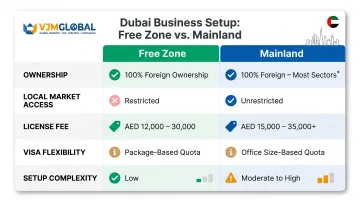
Most Indian entrepreneurs starting with consulting, IT, or export-linked services choose free zones — lower costs and faster setup make sense when your clients aren't UAE-based. If you're building a retail operation, distribution network, or targeting UAE government contracts, mainland registration is worth the added cost and complexity.
Budgeting Mistakes Indian Entrepreneurs Often Make
These four patterns consistently inflate first-year costs — and most are avoidable with upfront planning.
- The advertised license fee is rarely the full picture. Registration charges, visa fees, office space, and approvals typically push your real first-year spend to 2–3x the base figure.
- Annual renewals catch many entrepreneurs off guard in year two. Licenses renew at comparable cost each year, and late renewal penalties run from AED 250 up to AED 10,000 if you're caught operating after administrative closure.
- Picking the cheapest free zone package without checking activity classifications is a costly shortcut. If your intended operations don't match the zone's permitted activities, you'll pay for license amendments that wipe out any savings.
- India-side obligations get overlooked entirely. FEMA reporting requirements, LRS limits, and potential TCS charges on outward remittances all need to be factored in before you move funds abroad.
How to Plan and Fund Your Dubai Business Setup from India
India-Side Financial Compliance
When remitting funds from India to set up a business abroad, you must comply with FEMA (Foreign Exchange Management Act) and the RBI's Liberalized Remittance Scheme (LRS).
LRS permits up to USD 250,000 per financial year per individual for overseas investment, including business setup costs — so map your total setup costs against this limit before committing to a timeline.
TCS (Tax Collected at Source) of 20% applies on investment-related remittances above ₹10 lakh (per Budget 2025). It's recoverable when filing Indian tax returns, but it will affect your immediate cash flow.
India-UAE Double Tax Avoidance Agreement (DTAA)
India and UAE have a DTAA that affects tax residency status, dividend repatriation, and reporting obligations. Key provisions:
- Dividends taxed at 10% (versus 30% default Indian TDS)
- Interest at 12.5%
- Royalties at 10%
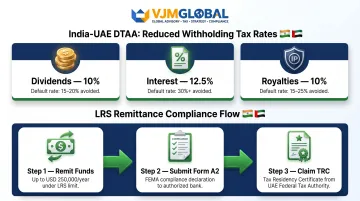
To claim treaty benefits, you'll need a Tax Residency Certificate (TRC) from the UAE Federal Tax Authority.
Getting these pieces right — FEMA compliance, LRS limits, and DTAA claims — requires expertise on both sides of the border, not just the UAE side.
VJM Global's international taxation and FEMA advisory team helps Indian entrepreneurs structure Dubai operations tax-efficiently while staying compliant in India. This covers transfer pricing for intra-group transactions, profit repatriation, and foreign asset disclosure requirements.
Frequently Asked Questions
How much does it cost to get a business license in Dubai?
Dubai business licenses range from AED 10,000 to AED 50,000+ annually (₹2.3–11.5 lakh+). However, total first-year costs—including registration, office space, visas, and approvals—typically reach AED 25,000–80,000 (₹5.8–18.4 lakh), significantly higher than the license fee alone.
What is the difference between a mainland and free zone license in Dubai?
Free zone licenses offer 100% foreign ownership and faster setup but restrict direct local market trading. Mainland licenses provide full UAE market access and government contract eligibility—and since the 2021 commercial companies law reform, most mainland sectors now also allow 100% foreign ownership.
Can Indian nationals own 100% of a business in Dubai?
Yes. In Dubai free zones, 100% foreign ownership has always been standard. Since the 2021 UAE commercial companies law reform, Indian nationals can now own 100% of businesses in most mainland sectors without a local UAE sponsor.
How do Indian entrepreneurs transfer money to fund a Dubai business setup?
Funds can be remitted under India's Liberalized Remittance Scheme (LRS), which permits up to USD 250,000 per individual per financial year. Each remittance requires FEMA compliance and proper bank documentation (Form A2). TCS applies at 20% on investment remittances above ₹10 lakh.
How much does it cost to renew a Dubai business license?
Renewal fees typically match initial license costs—AED 10,000–30,000 depending on license type (₹2.3–6.9 lakh). Renewals are due annually. Late renewal attracts penalties starting at AED 250, escalating to AED 500/month for establishment card delays and AED 10,000 for operating after administrative closure.
What documents do Indian entrepreneurs need to apply for a Dubai business license?
Core documents required include:
- Passport copies and passport-sized photographs
- UAE visa or entry stamp copy
- Proof of business address (Ejari or flexi-desk agreement)
- Trade name reservation certificate
- Memorandum of Association
- Activity-specific approvals (e.g., Dubai Municipality or Ministry of Health, where applicable)