: A Complete Guide for UK Entrepreneurs](https://file-host.link/website/vjmglobal-l8s6go/assets/blog-images/8485e7f8-d554-4129-ba81-46fad5ed86e1/1778198559912800_0455201f5ade49db891471dabbf08ad4/360.webp)
Introduction
The UK-UAE trade relationship has accelerated sharply since Brexit. Total bilateral trade reached £25.3 billion in the 12 months to Q3 2025—an 8.1% year-on-year increase. With approximately 14,200 UK businesses now exporting to the UAE and more than 2,500 UK companies registering in Dubai in 2024 alone (a 14.2% rise), Dubai has become the UK's most significant Middle Eastern expansion target.
Three forces are driving this shift: post-Brexit trade diversification, ongoing UK-GCC free trade negotiations, and Dubai's position as a bridge between Europe, Asia, Africa, and the GCC. For UK entrepreneurs navigating rising domestic tax rates and economic uncertainty, Dubai offers a credible alternative base.
The advantages are concrete:
- 0% personal income tax and potential 0% corporate tax on qualifying free zone income
- 100% foreign ownership now permitted in most structures
- ~240,000 British nationals already resident, with established professional networks in place
This guide covers every major decision: jurisdiction (mainland, free zone, or offshore), legal structure, licence applications, UAE and UK tax obligations, and corporate banking. Whether you're a tech founder, consultant, or trading business, you'll find a clear path forward—and the common pitfalls to avoid.
Key Takeaways
- Dubai offers 0% personal income tax and potential 0% corporate tax on qualifying free zone income
- Three setup routes: Mainland (9% tax, full UAE market access), Free Zone (0% on qualifying income), or Offshore (international holding)
- Full setup typically completes in a few weeks, covering activity selection, licensing, office lease, and banking
- 100% foreign ownership is permitted in most mainland LLCs and all free zones—no local sponsor needed in most cases
- UK tax residency doesn't end automatically; HMRC's Statutory Residence Test and the UK-UAE Double Taxation Convention still apply
Why Dubai Makes Sense for UK Entrepreneurs
Strategic Advantages Tailored to UK Founders
Dubai offers UK entrepreneurs practical advantages beyond tax efficiency. Total UK-UAE trade reached £25.3 billion in the four quarters to Q3 2025 — with the UAE ranking as the UK's 20th largest trading partner — which signals a well-established commercial corridor rather than an emerging market bet.
Key structural advantages include:
- Bridges Europe, Asia, and Africa, with direct access to GCC and MENA markets
- Pro-business regulatory environment with transparent legal frameworks
- No personal income tax on salaries, bonuses, or dividends (vs. the UK's progressive rates up to 45%)
- Over 2,500 UK companies registered in Dubai in 2024, with shared legal firms, service providers, and peer networks already in place
Practical UK-Specific Benefits
UK passport holders face fewer logistical hurdles than most nationalities when setting up in Dubai. Entry, banking, and day-to-day operations are relatively straightforward:
- 90-day visa on arrival, valid within a 180-day period — no pre-arranged entry visa required
- The AED is pegged to the USD at 3.6725, which eliminates AED currency volatility (GBP/USD exposure remains)
- Contracts, government portals, and professional services operate in English
- HSBC and Barclays both operate in Dubai, providing familiar banking relationships from day one
Who Should Consider Dubai
Dubai works well for a specific type of UK founder — not universally. It suits:
- UK entrepreneurs actively targeting GCC and MENA markets
- Founders in trading, tech, financial services, or consulting who need a tax-efficient regional base
- UK businesses scaling internationally that require a hub with operational substance
- Founders genuinely willing to relocate (HMRC's Statutory Residence Test applies rigorously)
It's a poor fit for UK founders who plan to run a Dubai entity remotely while remaining UK tax-resident. Without proper cross-border tax planning, that structure creates more risk than it resolves.
The First Big Decision: Mainland, Free Zone, or Offshore
Before you register a company name or sign a lease, you must choose your jurisdiction type. This single decision shapes everything: ownership structure, tax treatment, market access, office requirements, and compliance obligations.
Mainland
Mainland companies are registered with Dubai's Department of Economy and Tourism (DET) and can trade freely anywhere in the UAE and internationally.
Key features:
- 100% foreign ownership permitted for most activities since 2021 (Federal Decree-Law No. 26 of 2020)
- Physical office required: Must lease a physical office with an Ejari-registered tenancy contract
- 9% corporate tax on taxable income above AED 375,000 (approximately £81,000 as of 2024)
- Full UAE market access: Trade directly with UAE customers, government entities, and local businesses
- Stricter compliance: Emiratisation rules apply to larger companies; regulatory oversight more intensive
- Strategic sector exceptions: Defence, banking, and oil & gas may still require an Emirati partner or separate approvals
Free Zone
Dubai hosts 30 operational free zones, each offering sector-specific licensing and incentives.
Key features:
- 100% foreign ownership across all activities
- 0% corporate tax on qualifying income for Qualifying Free Zone Persons (QFZPs)—subject to substance, audited financials, and de minimis thresholds
- 100% profit repatriation, no currency restrictions
- Flexi-desk and co-working options: DMCC, IFZA, and Dubai South offer low-cost workspace arrangements
- Market access restriction: Free zone companies cannot trade directly with UAE mainland customers without a local distributor or separate mainland licence
Which free zone you pick matters as much as the jurisdiction itself. The table below maps each zone to its industry focus — matching your activity to the right zone improves your regulatory fit, networking access, and credibility with clients:
| Free Zone | Primary Focus | Notable Feature |
|---|---|---|
| DMCC | Commodities, trading, crypto, AI | 30,000+ companies; world's leading free zone |
| DIFC | Financial services, fintech | Independent common-law jurisdiction |
| Dubai Internet City | Technology, software | Home to Microsoft, Google offices |
| Dubai Media City | Media, publishing, advertising | Dedicated media licensing |
| JAFZA | Logistics, trade, manufacturing | Largest customs-bonded zone in Middle East |
| IFZA | General business, multi-sector | Competitive pricing; quick setup |
Offshore
Offshore entities (primarily JAFZA Offshore and RAK ICC) operate entirely outside the UAE. They're not suited for running an operational business in Dubai — but they serve a clear purpose for certain structures:
- 100% foreign ownership and high confidentiality
- No UAE market access, no UAE office, no mainland trading permitted
- Bank account access is possible but requires thorough documentation
- Best suited for holding structures, international trading vehicles, or IP ownership
Offshore companies must register for UAE corporate tax but may qualify for the 0% rate on qualifying income.
Decision Matrix
| Factor | Mainland | Free Zone | Offshore |
|---|---|---|---|
| Foreign ownership | 100% (most activities) | 100% | 100% |
| Corporate tax | 9% above AED 375,000 | 0% on qualifying income | 0% if qualifying |
| UAE market access | Unrestricted | Restricted (FZ-to-FZ or export) | Not permitted |
| Office requirement | Physical office (Ejari registered) | Flexi-desk or physical | None |
| Visa eligibility | Yes | Yes (tied to office size/package) | No |
| Compliance burden | High | Moderate | Low |
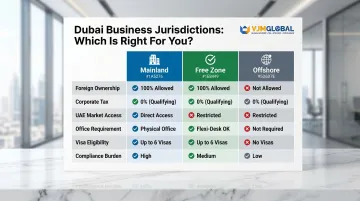
Quick guide: Choose mainland if you need to sell directly to UAE customers. Choose free zone if you're exporting, serving international clients, or trading within free zones. Choose offshore if you need a holding structure with no UAE presence.
How to Set Up a Business in Dubai: Step by Step
The setup process follows a strict sequence across five stages — from choosing your licence type to opening a bank account and securing your visa. Skipping steps or submitting incomplete documentation causes costly delays, so understanding what's required at each stage matters before you begin.
Step 1: Choose Your Business Activity and Licence Type
Your business activity determines your licence type, legal structure, and regulatory approvals.
Licence categories recognised by Dubai's Department of Economy and Tourism:
- Commercial/Trading: Import, export, retail, general trading
- Professional: Consulting, advisory, IT, legal, accounting
- Industrial: Manufacturing, food production, textiles
- Tourism: Travel agencies, hotels, tour operators
- Agricultural: Farming, fisheries
- Crafts/Freelance: Individual creative and service activities
Each category covers hundreds of sub-activities. For example, "Professional" includes management consulting, IT consulting, digital marketing, and accounting services.
Activities requiring additional approvals:
- Financial services (SCA, CBUAE, DFSA)
- Healthcare (DHA, MOH)
- Education (KHDA)
- Food and beverage (Dubai Municipality)
- Legal services
- Media and broadcasting (National Media Council)
Common mistake: UK founders pick a licence category that's too broad (creating compliance gaps) or too narrow (restricting future growth). Match your chosen activities precisely to what your business will actually do from day one.
Step 2: Select Your Legal Structure and Free Zone
Legal structures available to UK entrepreneurs:
| Structure | Legal Identity | Liability | Key Feature |
|---|---|---|---|
| LLC (Limited Liability Company) | Separate entity | Limited to share capital | Most common mainland structure; 100% foreign ownership permitted |
| Branch Office | Extension of parent | Unlimited (parent liable) | Must match parent's activities; no separate capital required |
| Subsidiary | Separate entity | Limited to invested capital | Can have different activities from parent; requires own MOA |
| Sole Proprietorship | Individual | Unlimited personal liability | Single owner; available for professional activities |
| Representative Office | Extension of parent | Parent liable | Marketing/liaison only; cannot generate revenue in UAE |
Critical distinction: A Branch Office is not a separate legal entity — the UK parent company bears unlimited liability for all branch obligations. A Subsidiary (typically formed as an LLC or FZCO) is a separate legal entity, limiting the parent's exposure to the capital invested.
Free zone selection:
With your legal structure confirmed, the next decision is which free zone fits your activity:
- Tech and software: Dubai Internet City, Dubai Silicon Oasis
- Media and creative: Dubai Media City, Dubai Design District
- Financial services and fintech: DIFC, DMCC
- General trading and consulting: DMCC, IFZA, Dubai South
- Logistics and manufacturing: JAFZA, Dubai South
Step 3: Register Your Trade Name and Get Initial Approval
Trade name rules (Dubai DET):
- Must include the abbreviation of the legal structure (e.g., LLC, FZE)
- No names of rulers, government agencies, or government logos
- No religious, political, or offensive references
- If using a personal name, must be the full name of the owner or partner
- Must be unique and not confusingly similar to existing registered names
- Must align with chosen economic activities
The trade name is registered with the DET (for mainland) or the relevant free zone authority.
Initial approval is a formal "no objection" confirming the proposed business activity, trade name, and legal structure are acceptable. It does not grant the right to operate — it simply allows you to proceed to the next steps (MOA preparation, office lease, final licence issuance). Initial approval is valid for a limited period.
Step 4: Secure Office Space and Submit Final Documentation
Office requirements:
- Mainland: Physical office with Ejari-registered tenancy contract (no virtual offices)
- Free zone: Flexi-desk, co-working, or physical office depending on the zone and visa requirements
DMCC offers flexi-desks and co-working spaces eligible for up to 3 UAE residency visas. IFZA and Dubai South also offer flexible workspace options.
Documents needed for final licence submission:
- Initial approval receipt
- Attested lease contract or flexi-desk agreement
- Memorandum of Association (MOA) or Articles of Association
- Passport copies of all shareholders and directors
- Passport-size photographs
- Shareholder/board resolutions
- Sector-specific government approvals (e.g., DHA for healthcare, SCA for financial services)
VJM Global's team of business setup professionals has assisted over 250 UK businesses with company formation, documentation preparation, and compliance filings — helping ensure documents are correctly prepared and submitted to avoid rejections or delays.
Step 5: Open a Corporate Bank Account and Apply for Your Visa
Corporate banking:
Once the licence is issued, you can open a corporate bank account. Options include:
- UAE banks: Emirates NBD, Abu Dhabi Commercial Bank (ADCB)
- International banks familiar to UK founders: HSBC, Barclays (corporate and private banking; no retail banking in UAE)
Account opening timelines:
- The Dubai Unified Licence (DUL) system has reduced average business bank account opening from 65 days to approximately 5 days for eligible entities
- Free zone companies not on the DUL system typically face 7 to 21 working days, depending on KYC documentation completeness and business complexity
Residence visa process:
The business licence entitles the owner to apply for a UAE residence visa. Key steps:
- Entry permit application
- Medical fitness test (blood test for communicable diseases)
- Emirates ID application (biometric registration)
- Visa stamping
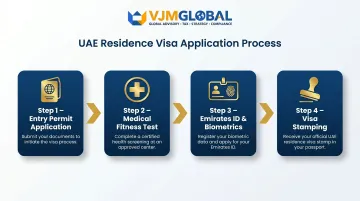
The visa applicant must be physically present in the UAE for the medical test and biometrics.
Visa allocations vary by free zone and office type:
- DMCC: Flexi-desk/co-working = up to 3 visas; physical office = approximately 1 visa per 9 square metres
- IFZA: Packages structured by visa count (1-visa, 2-visa, 3-visa, 5-visa)
Critical for UK entrepreneurs: Maintaining UAE residency has implications for UK tax residency. HMRC's Statutory Residence Test applies rigorously — professional advice is essential before committing.
Costs and Tax: What UK Entrepreneurs Need to Know
Setup Costs
Free zone packages (official pricing):
| Free Zone | Package | Cost (AED) | Visas Included |
|---|---|---|---|
| DMCC | Jump Start (1-year, flexi-desk) | 43,780 | 1 included (eligible for 3) |
| DMCC | Basic Biz | 35,484 | 1 |
| IFZA | 1-Visa Licence | ~14,900 | 1 |
| IFZA | 2-Visa Licence | ~16,900 | 2 |
| IFZA | 3-Visa Licence | ~18,900 | 3 |
Component costs (DMCC example):
- Registration fee: from AED 9,000 (one-time)
- Licence fee: AED 10,000–50,000 (annual)
- Share capital: average AED 50,000 (refundable)
Mainland DED setup costs: Indicative first-year costs range from AED 15,000–30,000 for licensing alone (excluding office lease). Costs vary by activity type, legal structure, and number of activities.
Hidden costs to budget for:
- Licence renewal fees (annual)
- PRO (Public Relations Officer) services for visa processing and documentation
- Document notarisation and attestation
- Ejari registration fees
- Office lease deposits
UAE Corporate Tax Framework
UAE corporate tax (effective June 2023):
- 0% on taxable income up to AED 375,000 (approximately £81,000)
- 9% on taxable income exceeding AED 375,000
Qualifying Free Zone Persons (QFZPs) can retain a 0% rate on qualifying income if they meet these conditions:
- Maintain adequate substance in the UAE (staff, assets, operating expenditure)
- Derive qualifying income (transactions with other free zone persons or specified qualifying activities)
- Do not elect to be subject to the standard 9% rate
- Comply with transfer pricing rules (arm's length principle and documentation)
- Prepare audited financial statements
- Non-qualifying revenue must not exceed the de minimis threshold (5% of total revenue or AED 5 million, whichever is lower)
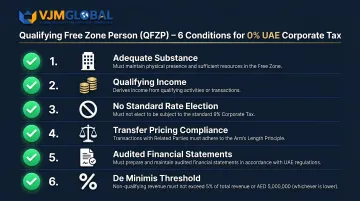
Corporate tax registration is mandatory for all taxable persons, regardless of profitability. Failure to register within the deadline attracts an administrative penalty of AED 10,000.
VAT registration:
Mandatory registration threshold: AED 375,000 in annual taxable turnover. Voluntary registration threshold: AED 187,500.
UK Tax Residency: What Still Applies to You
UK tax residency does not end automatically when you register a UAE company. Many UK entrepreneurs mistakenly assume that opening a Dubai business exempts them from UK tax. It does not.
HMRC Statutory Residence Test (SRT):
To become non-UK resident, you must meet one of the Automatic Overseas Tests:
- 16-Day Test: Previously UK-resident; spend fewer than 16 days in the UK in the tax year
- 46-Day Test: Not UK-resident in any of the previous 3 tax years; spend fewer than 46 days in the UK
- Full-Time Work Abroad: Average 35+ hours/week abroad; fewer than 91 days in UK; fewer than 31 UK work days
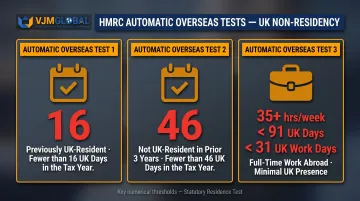
If no automatic test is met, the Sufficient Ties Test applies. Five ties are assessed: Family, Accommodation, Work, 90-Day, and Country ties. The more ties you retain, the fewer days you're permitted in the UK before becoming UK-resident.
UK-UAE Double Taxation Convention:
A comprehensive UK-UAE Double Taxation Convention has been in force since 25 December 2016. It covers Income Tax, Corporation Tax, and Capital Gains Tax on the UK side, and taxes withheld at source and all other taxes on the UAE side.
The treaty provides mechanisms for avoiding double taxation on business profits, employment income, dividends, and capital gains. It does not, however, exempt you from UK tax if you remain UK tax-resident.
What this means for UK entrepreneurs:
- If you remain UK tax-resident under the SRT, you are subject to UK worldwide taxation—including UAE income
- The DTA allows you to claim foreign tax credits for UAE taxes paid, but if UAE tax is 0%, no credit is available
- Professional cross-border tax advice is strongly recommended before committing to a Dubai setup. Getting this wrong exposes you to unexpected UK tax liability on your UAE income.
VJM Global provides cross-border tax advisory services covering international tax planning and multi-jurisdictional compliance, helping UK entrepreneurs navigate the interaction between UAE corporate tax and UK tax residency obligations.
Conclusion
Setting up a business in Dubai as a UK entrepreneur is achievable and increasingly common. More than 2,500 UK companies registered in Dubai in 2024 alone, joining an established ecosystem of 240,000 British nationals and extensive UK-UAE trade ties.
The decisions made early—jurisdiction type, legal structure, business activity, and cross-border tax planning—carry long-term consequences that are difficult and expensive to reverse. Getting these wrong can lead to:
- Restricted market access from choosing the wrong free zone
- Double taxation from underestimating UK residency obligations
- Compliance penalties from miscategorising your business activity
The best outcomes come from doing the groundwork properly: understanding the three jurisdiction options, matching your activity to the right free zone, preparing documentation accurately, and seeking expert cross-border tax and compliance support before launch. Get the structure right from the start, and Dubai becomes a genuinely viable base for serving the Middle East, Africa, and South Asia — without sacrificing your UK compliance standing.
Frequently Asked Questions
How much does it cost to set up a business in Dubai?
Free zone packages start from approximately AED 14,900 (IFZA) to AED 43,780 (DMCC) for the first year, including licence and flexi-desk or co-working space. Mainland setups typically cost AED 15,000–30,000 for licensing alone, plus office lease costs. Ongoing expenses include annual licence renewals, visa fees, PRO services, and office rent.
Can a foreigner start a business in Dubai?
Yes. UK nationals and other foreigners can fully own a business in Dubai. 100% foreign ownership is standard in all free zones and has been permitted in most mainland activities since 2021, removing the historic requirement for an Emirati partner.
What kind of small business can I start in the UAE?
Popular sectors for foreign entrepreneurs include consulting, trading, e-commerce, tech services, media, and professional services. The activity must correspond to a licensed category approved by the relevant authority (DET for mainland or the specific free zone).
What is the 3,000 rule in Dubai?
The 3,000 rule refers to the AED 3,000 minimum monthly salary threshold for sponsoring a spouse or dependents on a UAE residence visa, applicable when the employer provides suitable accommodation. If accommodation is not provided, the minimum salary threshold is AED 4,000 per month.
Do UK entrepreneurs need a visa to set up a business in Dubai?
UK passport holders can visit the UAE visa-free for up to 90 days within a 180-day period. Setting up and operating a business requires a UAE residence visa, which the business licence enables the founder to apply for. Note that maintaining UAE residence has implications for UK tax residency status.
Is there a double taxation agreement between the UK and UAE?
Yes. A UK-UAE Double Taxation Convention has been in force since 25 December 2016, covering Income Tax, Corporation Tax, and Capital Gains Tax. The treaty provides relief mechanisms, but UK entrepreneurs should not assume UAE income is automatically exempt from UK tax, as HMRC's Statutory Residence Test determines tax residency regardless of the DTA.