Introduction
Dubai's appeal for Singapore businesses continues to grow as companies look to diversify beyond Southeast Asia. The strategic advantages are concrete: zero personal income tax, no capital gains tax on personal holdings, and a GMT+4 time zone that bridges Asian, European, and African markets within a single working day.
The numbers reflect this momentum. Bilateral merchandise trade between Singapore and the UAE reached S$24 billion in 2024, with Singapore investments into the UAE totalling S$4.9 billion in 2023 — figures that signal a well-established corridor, not an emerging one.
Setup costs for a Dubai mainland company, however, are not fixed. They vary across four key dimensions:
- Business activity type — different sectors carry different licensing fees
- Legal structure — LLC, branch office, and sole establishment each have distinct cost profiles
- Office requirements — mainland companies mandate a physical, tenanted space
- Ongoing compliance — annual renewals, visa quotas, and sector approvals add recurring costs
Singapore businesses often underestimate the full investment, particularly document legalisation costs and the government approval layers that sit well beyond the basic trade licence fee.
This guide breaks down the complete cost picture for Singapore businesses entering the Dubai mainland: from one-time government fees and mandatory physical office rent, to visa processing costs and the unique documentation requirements that foreign-incorporated companies face.
Key Takeaways
- First-year costs range AED 25,000–60,000+ (approximately SGD 8,900–21,350+), depending on business activity, office size, and visa requirements
- Biggest cost drivers: trade license category, mandatory physical office rent, number of visas, and sector-specific approvals
- Singapore businesses face additional costs: document legalization, apostille fees, and cross-border structuring fees not typical for local applicants
- Lean setups (single director, shared office, professional license) start at the lower end — regulated industries and prime-location offices push costs far higher
- Working with experienced cross-border advisors reduces errors, avoids penalties, and streamlines the process from Singapore
How Much Does Dubai Mainland Company Formation Cost for Singapore Businesses?
There is no single fixed price for Dubai mainland company formation. Costs depend on your DET license category (commercial, professional, or industrial), legal structure (LLC vs branch vs sole establishment), office size, and number of visas required.
Singapore businesses also carry additional costs that UAE-based founders don't face — primarily document legalization fees for Singapore-origin company records.
The two most common budgeting mistakes Singapore businesses make: (1) only accounting for the initial license fee while ignoring mandatory office rent and recurring renewal costs, and (2) not budgeting for the document legalization process required for Singapore-origin company documents.
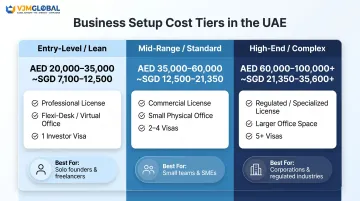
Here's how costs typically break down across three setup levels.
| Setup Level | AED Range (Year 1) | SGD Equivalent | Best For |
|---|---|---|---|
| Entry-Level / Lean | AED 20,000–35,000 | ~SGD 7,100–12,500 | Solo founders, consultants testing the market |
| Mid-Range / Standard | AED 35,000–60,000 | ~SGD 12,500–21,350 | Trading companies, service firms, small teams |
| High-End / Complex | AED 60,000–100,000+ | ~SGD 21,350–35,600+ | Regulated sectors, larger operations |
Entry-Level / Lean Setup (AED 20,000–35,000 first year)
- Professional or consultancy license via DET
- Flexi-desk or shared office (Ejari registered)
- One investor visa
- Basic immigration setup
This tier suits Singapore solo founders, freelancers, or consulting firms testing the Dubai market with a minimal initial commitment.
Mid-Range / Standard Setup (AED 35,000–60,000 first year)
- Commercial or trading license
- Small private office (200–400 sq ft)
- 2–4 investor/employee visas
- Ejari, MOA notarization, establishment card
- Corporate bank account setup
This is the most common entry point for Singapore SMEs — enough structure for full UAE market access without over-committing on overhead.
High-End / Complex Setup (AED 60,000–100,000+ first year)
- Regulated activity licenses (healthcare, food, financial services)
- Larger office space with 5+ visas
- Multiple activity approvals from specialized authorities (Dubai Municipality, DHA, etc.)
- Higher professional fees for cross-border structuring
The right fit for Singapore companies in regulated sectors, businesses pursuing government tender eligibility, or those building substantial UAE operations from day one.
Key Factors That Affect Setup Cost for Singapore Businesses
Pricing for a Dubai mainland company is shaped by regulatory, operational, and structural decisions. Pricing for a Dubai mainland company is shaped by regulatory, operational, and structural decisions. Singapore businesses face additional variables that local or regional founders do not.
Type of Business Activity and License Category
DET categorizes licenses into three primary types, each carrying different base fees:
Commercial License (trading, import/export, wholesale, retail):
- Base fee range: AED 5,000–15,000
- Example: Import/export trading company, wholesale distribution, retail operations
Professional License (for services, consultancies, artisans):
- Base fee range: AED 10,000–20,000
- Example: Marketing consultancy, IT services, business advisory firms
Industrial License (for manufacturing/production):
- Base fee range: AED 15,000–25,000
- Example: Light manufacturing, food production, industrial operations
Regulated sectors require additional approvals from external authorities, adding approval timelines of 4–12 weeks depending on the authority:
- Healthcare: Dubai Health Authority (DHA) approval required; clinic setup from AED 50,000+
- Food & Beverages: Food safety permit from Dubai Municipality in addition to DET license
- Financial Services: Central Bank of the UAE or Securities and Commodities Authority (SCA) approval
Legal Structure: LLC vs Branch Office vs Sole Establishment
Singapore businesses can enter Dubai through three primary structures:
LLC (Limited Liability Company):
- Most common since 2021 reforms allowing 100% foreign ownership for most activities
- Separate legal entity with limited liability
- Setup cost range: AED 18,000–50,000+
- Requires MOA notarization (AED 1,500–2,000)
- Broad activity scope: commercial, professional, industrial
Branch Office:
- Extension of Singapore parent company
- Unlimited liability (parent company liable)
- Setup cost range: AED 51,000–99,000
- Higher initial cost but no separate share capital requirement
- Activities restricted to parent's core operations
Sole Establishment:
- Single owner only, no separate legal identity
- Unlimited personal liability
- Setup cost range: AED 10,000–25,000
- Primarily for professional services
- No MOA required
Office Space Location and Size
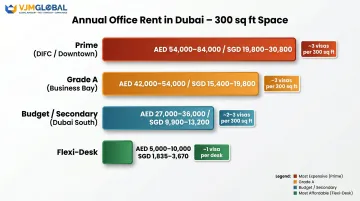
Mainland companies must have a registered physical office with Ejari registration. Office rent varies significantly by location and directly determines the visa quota allowed (typically one visa per 100 square feet).
Annual rent ranges by location:
- Prime locations (DIFC, Downtown Dubai): AED 180–280 per sq ft
- Grade A locations (Business Bay): AED 140–180 per sq ft
- Budget/Secondary (Dubai South): AED 90–120 per sq ft
- Flexi desk options: AED 5,000–10,000 annually
For a standard 300 sq ft office, expect:
- Prime location: AED 54,000–84,000/year (SGD 19,200–29,900)
- Mid-range location: AED 42,000–54,000/year (SGD 14,950–19,200)
- Budget location: AED 27,000–36,000/year (SGD 9,600–12,800)
Number of Investor and Employee Visas Required
Each visa carries fees for processing, medical testing, Emirates ID, and mandatory health insurance:
- Investor visa (including medical + Emirates ID): AED 3,500–4,000 per person
- Employee visa (including medical + Emirates ID): AED 4,000–5,000 per person
- Establishment card (required before any visa applications): AED 750–1,000
- Mandatory health insurance: AED 320/year (basic) to AED 800–1,500/year (comprehensive)
Visa count is one of the most controllable cost variables in the entire setup. Deciding how many visas you actually need at launch — versus adding them later — can save AED 10,000–20,000 in year one.
Singapore-Specific Documentation and Legalization Costs
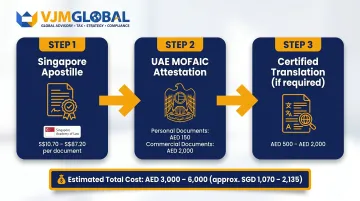
Unlike UAE-based founders, Singapore businesses must have their incorporation documents apostilled and attested. This adds a cost layer that local founders don't face.
Required documents:
- ACRA Certificate of Incorporation
- Memorandum & Articles of Association
- Board resolutions authorizing Dubai setup
- Director/shareholder passports
Legalization process:
Singapore Apostille (via Singapore Academy of Law):
- Legalisation fee: S$10.70 per document (waived for notarised documents)
- Authentication fee for notarised documents: S$87.20 (including GST)
UAE MOFAIC Attestation:
- Personal/educational documents: AED 150 per document
- Commercial documents: AED 2,000 per document
Certified translation (if required): AED 500–2,000
Total estimated cost for Singapore document legalization: AED 3,000–6,000 (SGD 1,070–2,135), depending on number of documents and translation needs.
Complete Cost Breakdown: What Singapore Businesses Actually Pay
The full investment goes well beyond the trade license fee. For most Singapore founders, total first-year costs fall between AED 30,000 and AED 120,000 — depending on activity type, office choice, and headcount.
Trade License and DET Registration Fees
- Trade name reservation: AED 620
- Initial approval: AED 120
- License issuance (base via DET portal): AED 1,070 (includes knowledge + innovation fees)
- Effective total by activity category: AED 7,000–25,000
- Dubai Chamber membership: AED 300–3,000 (varies by license type)
Annual renewal costs are broadly comparable to initial issuance fees.
Office Space and Ejari Costs
- Flexi-desk/co-working: AED 5,000–10,000/year (lower cost, limited visa quota)
- Dedicated office (200–400 sq ft): AED 15,000–50,000+/year (location-dependent)
- Ejari registration: AED 200–250 (one-time per contract)
- DEWA deposit: Based on commercial consumption
- DEWA activation: AED 155 (small meter)
- Market fees: 2.5% of annual rent (min AED 250, max AED 10,000)
Office choice has an outsized impact on total cost — a dedicated space in a premium location can add AED 40,000+ annually compared to a flexi-desk arrangement.
Visa and Immigration Fees
- Establishment card: AED 750–1,000
- Investor visa (all-in): AED 3,500–4,000
- Employee visa (all-in): AED 4,000–5,000
- Mandatory health insurance: AED 320–1,500/year per person
Per-person total first-year cost: AED 4,000–6,500
Document Legalization and MOA Costs (Singapore-Specific)
- Singapore apostille fees: S$10.70–87.20 per document
- UAE MOFAIC attestation: AED 150–2,000 per document
- Document translation: AED 500–2,000
- MOA drafting and notarization (LLC): AED 1,500–2,000
Total estimated: AED 3,000–6,000 for Singapore document legalization
This cost applies specifically to foreign-incorporated businesses. Singapore founders frequently underestimate it — budget for it upfront.
Annual Operating and Compliance Costs
- Trade license renewal: AED 8,000–15,000
- PRO services: AED 5,000–10,000
- Accounting/bookkeeping: From AED 3,000 (small companies)
- VAT registration and filing (mandatory above AED 375,000 in taxable supplies): Variable
- Health insurance renewal: AED 800–1,500 per employee
- Visa renewals: AED 2,000–5,000 per person
UAE Corporate Tax (effective for financial years starting 1 June 2023 or later):
- 0% on taxable income up to AED 375,000
- 9% on taxable income above AED 375,000
Annual operational expenses can reach AED 20,000–100,000 depending on team size and business complexity. For a lean two-person operation, recurring compliance and office costs alone typically run AED 25,000–40,000/year — making the second and third years costlier than most founders expect.
Dubai Mainland vs Free Zone: Which Is Better for Singapore Businesses?
Free zones have historically been the default entry point for Singapore companies — lower costs and 100% foreign ownership made them attractive before the UAE's landmark Federal Decree-Law No. 26 of 2020. That law extended 100% foreign ownership to most mainland activities, which shifts the calculus considerably. Mainland now offers something free zones cannot: direct, unrestricted access to the UAE's local market.
| Dimension | Dubai Mainland | Dubai Free Zone |
|---|---|---|
| Initial setup cost | AED 25,000–60,000+ | AED 15,000–40,000 |
| Market access | Trade freely in UAE local market + internationally | International + within zone; need distributor for UAE mainland |
| Office requirements | Physical office mandatory; Ejari registered | Flexi-desk, virtual office options available |
| Visa quota | Tied to office sq ft (~100 sq ft per visa) | Tied to license package purchased |
| Government tenders | Eligible to bid directly | Generally restricted; must partner with mainland entity |
| 100% foreign ownership | Yes (most activities post-2021) | Yes (all activities) |
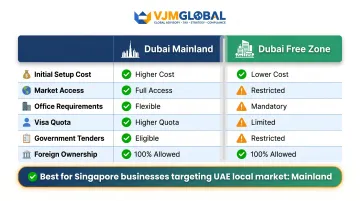
Mainland is the stronger fit for Singapore businesses that:
- Target UAE-based B2B or B2C customers directly
- Want to bid on government or semi-government projects
- Plan retail or service operations requiring a physical presence outside a free zone
- Need a UAE entity that can transact locally without routing through a distributor
Free zone remains the better option when:
- Operations are purely export or re-export focused
- Running a digital or tech business with no local trade requirements
- Testing the market at lower initial investment
Note: Switching from a free zone to mainland later is possible, but it triggers additional setup costs — factor that into your structure decision upfront.
How Singapore Businesses Can Reduce Dubai Mainland Setup Costs
Start Lean on Office
Opt for a registered flexi-desk or shared office initially to meet Ejari requirements at lower cost. This limits visa quota but is a valid starting point. Upgrading office space (and thus visa quota) can be done later as the business grows without major license disruption.
Bundle Compliance Services
Outsourcing PRO services, accounting, VAT filing, and annual audit to a single advisory firm is typically more cost-effective than hiring in-house or engaging multiple local vendors. Bundling these under one provider reduces coordination overhead and minimizes the risk of compliance gaps across jurisdictions.
Firms like VJM Global, with 30+ years of experience in cross-border accounting, tax planning, and international business setup, bring the kind of multi-jurisdiction coordination that Singapore companies need when establishing UAE operations — ensuring both entities remain compliant without duplicating effort or cost.
Choose Business Activities Carefully
Adding multiple or regulated activities unnecessarily inflates both initial approval costs and annual renewal fees. To keep the structure lean:
- Define your core UAE operations before submitting any license application
- Select only activities you will actually conduct in Year 1
- Avoid regulated categories unless operationally required — these trigger additional approvals
- Add further activities later through license amendments as the business scales
Frequently Asked Questions
What types of businesses can you start with AED 50,000 in Dubai?
AED 50,000 comfortably covers a lean mainland setup for most professional, consulting, trading, or e-commerce businesses—including license, flexi-desk office, one investor visa, and basic compliance setup. Regulated sectors (healthcare, financial services) or larger team requirements may exceed this budget.
Can Singapore companies own 100% of a Dubai mainland company?
Yes. Following UAE's 2021 Commercial Companies Law reforms (Federal Decree-Law No. 26 of 2020 and No. 32 of 2021), 100% foreign ownership is permitted for most mainland business activities. Unlike free zones, a mainland entity carries no geographic trade restrictions, giving Singapore businesses full access to the UAE market.
What documents does a Singapore company need to set up a Dubai mainland entity?
Key documents include the ACRA Certificate of Incorporation, Memorandum & Articles of Association, a board resolution authorizing the Dubai setup, and director/shareholder passports. All documents must be apostilled in Singapore and attested by UAE MOFAIC before submission.
How long does it take for a Singapore company to complete Dubai mainland formation?
The typical timeline is 2–5 weeks from document submission. However, Singapore businesses should allow additional time (1–2 weeks) for the apostille and attestation process before the Dubai application can be filed.
Is there a minimum share capital requirement for a Singapore business setting up a Dubai mainland LLC?
There is no mandatory minimum capital deposit for most mainland LLCs. A share capital amount (commonly AED 300,000) is declared in the MOA, but this does not need to be physically deposited unless the specific business activity requires it.
What are the annual renewal costs for a Dubai mainland company?
Annual renewal costs cover license renewal, office lease, visa renewals, and PRO/compliance services, and typically fall in the same range as first-year setup costs once one-time fees are excluded. Singapore businesses should budget AED 20,000–50,000+ per year in ongoing operational expenses.