
On paper, opening a Hungarian company looks simple. In practice, the real cost, timeline and paperwork depend heavily on which entity you choose, how your UAE documents get legalised, and whether you handle registration remotely or fly in yourself.
This guide walks UAE-based founders through the exact steps, requirements, costs, common mistakes, and alternative entry routes into Hungary.
Key Takeaways
- Hungary’s 9% corporate tax is the lowest in the EU; a Kft (LLC) can register in 1 working day under the simplified procedure
- UAE nationals and companies can own 100% of a Hungarian entity with no local resident director required
- Minimum Kft share capital is HUF 3 million (~€7,300–8,000); most formation steps can be completed remotely
- Formation can support a Hungarian guest self-employment residence permit (valid up to three years)
- A licensed Hungarian legal representative plus a cross-border formation partner cuts documentation and compliance risk
How to Set Up a Business in Hungary from the UAE: Step-by-Step Process
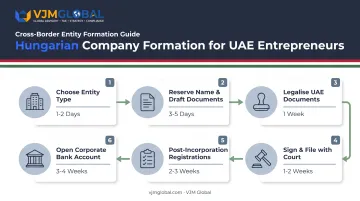
Step 1: Choose Your Entity Type and Business Activity
Most UAE founders pick between three structures:
- Kft (Korlátolt Felelősségű Társaság) - the Hungarian LLC, with liability limited to capital contributions and a minimum capital requirement of HUF 3 million
- Zrt (private joint-stock company) - suited to larger operations, requiring HUF 5 million minimum capital and a three-person board
- Nyrt (public joint-stock company) - reserved for companies planning a stock exchange listing, requiring HUF 20 million minimum capital
For most first-time UAE entrants, a Kft is the practical choice. Confirm early whether your intended activity, such as financial services, healthcare or education, requires a special licence under Hungarian law. Skipping this check is one of the fastest ways to stall a filing.
Step 2: Reserve a Company Name and Draft Founding Documents
Your company name needs a distinctive element plus the correct legal-form tag (Kft, Zrt, etc.), and it must clearly differ from any existing registered name. Name reservations are valid for 60 days.
Founding documents (the Deed of Foundation or Articles of Association) must then be prepared, typically in bilingual format for foreign founders. Hungarian law allows two routes:
- A notarial deed, executed before a Hungarian notary
- A private document countersigned by an attorney (or, for eligible founders, by a bar counsel)
Either route works, but the countersigning lawyer needs to be properly licensed in Hungary.
Step 3: Gather and Legalise Documents From the UAE
You'll need:
- Passport copies for all shareholders and directors
- Proof of UAE residential address
- For corporate founders: a notarised, attested certificate of incorporation and a board resolution authorising the Hungary investment
Here's where UAE founders often get caught off guard. Hungary is not on the UAE's Apostille pathway for this purpose, since the UAE isn't a Contracting Party to the Hague Apostille Convention in the way this route requires.
Instead, the verified chain runs: your UAE issuing authority, then UAE Ministry of Foreign Affairs (MOFA) attestation, then legalisation through the Hungarian Embassy in Abu Dhabi. Build in several weeks for this, not days.
Step 4: Sign and File With the Hungarian Court of Registration
You have two options for signing:
- Travel to Hungary and sign in person
- Grant power of attorney to a Hungarian legal representative to sign and file on your behalf remotely
Either way, registration/change applications are filed electronically, and legal representation is mandatory. According to the Courts of Hungary, the simplified procedure takes 1 working day, while the general procedure takes 15 working days. Court duty is free for a Kft under either route; a Zrt pays HUF 50,000 (simplified) or HUF 100,000 (general).
Step 5: Complete Mandatory Post-Incorporation Registrations
Filing with the Court of Registration triggers most of your initial tax registration automatically through Hungary's one-stop system. Still, you'll want to confirm:
- NAV tax number issuance (largely automatic, but some data may need a follow-up filing)
- KSH statistical code, generated automatically alongside registration
- Chamber of Commerce registration, required within 5 working days, with an annual contribution of HUF 5,000
- EU VAT number if you plan to trade with taxable businesses in other EU member states
Step 6: Open a Hungarian Corporate Bank Account
This is the step most likely to require your physical presence, though it isn't a universal rule. Some banks, such as OTP, allow a foreign representative who cannot travel to submit certified identity documents instead. Practically, though, plan for an in-person visit as your default assumption.
Once share capital is released after incorporation, it doesn't need to stay locked in the account. You can use it for operating expenses immediately.
What You Need Before Starting: Requirements for UAE Founders
Before you engage a Hungarian legal representative, get these in order:
- Minimum share capital: roughly HUF 3 million (~€7,300–8,000) for a Kft, HUF 5 million for a Zrt, or HUF 20 million for a Nyrt
- Registered Hungarian office address: a virtual office or registered agent service works if you don't have physical premises yet
- Individual founders: valid passport and proof of UAE address
- Corporate shareholders: attested certificate of incorporation plus board resolution
- Local Hungarian accountant: statutory bookkeeping and filings must be done in Hungarian
- Documented funds: evidence to support a residence permit application if you plan to relocate
Getting the documentation right the first time, particularly the attestation chain from the UAE, saves weeks compared to correcting a rejected filing.
Key Factors That Affect Cost, Timeline and Entity Choice
Four variables drive most of the variation in what UAE founders actually pay and how long the process takes.
| Factor | Why It Matters | Impact on Outcome |
|---|---|---|
| Entity type | Kft, Zrt and Nyrt carry different capital, governance and liability rules | A Kft is fastest and cheapest; Zrt/Nyrt suit capital-raising plans but add cost and compliance |
| Remote vs in-person | Power of attorney covers most filing steps, but banks often prefer an in-person visit | Remote-first setups cut travel costs but may add days for courier and legalisation |
| Tax regime (CIT vs KIVA) | Standard CIT is 9%; KIVA taxes payroll and retained profit at 10% instead | KIVA can suit payroll-heavy businesses with modest retained profit; eligibility caps at 100 employees and HUF 6 billion revenue |
| VAT position | Businesses can elect domestic VAT exemption below an annual revenue ceiling of HUF 20 million | Staying under the threshold simplifies early-stage compliance; standard VAT is 27%, with reduced rates of 18% and 5% |
On KIVA, the 10% headline rate looks close to the 9% CIT rate, but the tax bases are calculated differently. Whether KIVA saves you money depends on payroll size and how much profit you retain versus distribute. Run that calculation with an accountant before incorporation.
Common Mistakes UAE Entrepreneurs Make When Setting Up in Hungary
These mistakes show up often among founders moving from Gulf jurisdictions into the EU system—and each one costs time or money:
- Underestimating attestation timelines. The UAE MOFA-to-Hungarian-Embassy legalisation chain can take weeks, not days. Start it in parallel with other steps.
- Selecting a heavier entity than needed. Picking a Zrt when a Kft would do locks in higher capital and governance obligations with no real benefit.
- Assuming everything is remote. Most steps work via power of attorney, but bank account opening is rarely fully remote.
- Skipping accounting setup at incorporation. Books must be kept in Hungarian; missed NAV, VAT, or chamber deadlines trigger avoidable penalties.
Is Direct Incorporation Right for You? Alternatives for UAE Businesses
Full incorporation isn't always the right call, especially if you're testing the EU market or only need a handful of staff on the ground.
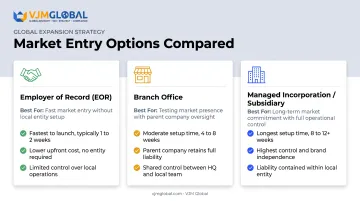
Alternative 1: Employer of Record (EOR) in Hungary
When it's better: You want to hire Hungarian or EU staff without setting up a local entity at all.
Trade-offs: Faster market entry and lower upfront cost, but you get less direct control over local operations and no independent legal presence in Hungary.
Alternative 2: Branch Office of the UAE Company
When it's better: You want a Hungarian presence without creating a separate legal entity.
Trade-offs: Simpler than forming a subsidiary, but your UAE parent company stays fully liable for whatever the branch does. That liability exposure is worth weighing against the setup simplicity.
Alternative 3: Managed Incorporation with Cross-Border Advisory Support
When it's better: You still want a Hungarian entity, but prefer entity formation, tax registration, accounting and compliance run as one coordinated process instead of juggling separate local vendors.
Trade-offs: You pay a service fee for coordination, but it cuts the risk of the filing and compliance mistakes listed above.
Firms such as VJM Global support entity formation, accounting, tax and payroll compliance across 100+ countries. From the UAE, they can coordinate Hungary document preparation, liaison with local legal representation, and post-incorporation compliance planning.
Choose EOR if you only need people on the ground, a branch if light presence is enough, and a subsidiary—DIY or managed—when you want a full local legal footprint.
Frequently Asked Questions
How do I register a company in Hungary from the UAE?
Engage a licensed Hungarian legal representative to draft and file your incorporation documents. You can sign remotely via power of attorney or in person, then complete tax, VAT and chamber registration afterward.
Can a UAE company or individual own 100% of a Hungarian company?
Yes. Hungary permits full foreign ownership with no local resident director or shareholder requirement, though you still need a registered Hungarian office address.
Do I need to visit Hungary to register my company from the UAE?
Most steps can be done remotely through power of attorney. Bank account opening usually works best with an in-person visit, though some banks accept certified documents through a representative if you cannot travel.
How long does it take to set up a business in Hungary from the UAE?
Court registration itself takes 1 working day under the simplified procedure or 15 working days under general registration. Document attestation from the UAE and bank account setup typically add several more weeks.
Is there a double tax treaty between the UAE and Hungary?
Yes, in force since 2015. Under Article 11, dividends paid to a beneficial owner resident in the other state are taxable only in the recipient's country of residence, helping avoid double taxation on profits.
Can setting up a Hungarian company lead to EU residency for UAE nationals?
Company founders or executives may apply for a guest self-employment residence permit, valid up to three years total. It does not automatically lead to permanent residency or citizenship.