Introduction
Dutch entrepreneurs are increasingly looking south. Portugal's EU market access, lower operating costs and a fast-growing tech scene in Lisbon and Porto have made it an attractive base for expansion.
Trade between the two countries reached €9 billion in goods and services in 2024, with the Netherlands ranking as Portugal's sixth-largest client and fourth-largest supplier.
As EU citizens, Dutch founders face no legal restrictions on opening a business in Portugal. But the paperwork, timelines and tax rules look nothing like the KvK and Belastingdienst system back home. Many first-time founders underestimate this gap.
This guide walks through the exact steps, realistic costs, the right legal structure and the tax obligations Dutch entrepreneurs need to plan for. It also flags the mistakes that trip up even experienced business owners.
Key Takeaways
- No visa is required, but a Portuguese NIF, local address and possibly a resident representative are still mandatory
- Registration takes one day (Empresa na Hora) to a few days (Empresa Online) and costs a few hundred euros
- Choosing between an Lda, branch or subsidiary changes liability, tax residency and reporting duties
- Ongoing compliance requires a certified accountant, VAT registration and social security filings
- The NL-PT tax treaty helps avoid double taxation across both markets
Why Dutch Businesses Are Choosing Portugal for Expansion
Portugal and the Netherlands share deep ties through the EU and NATO, with regular high-level economic exchanges reinforcing an already strong trading relationship. Bilateral trade of around €9 billion reflects decades of commercial cooperation between the two countries.
Support exists on both sides of the border:
- AICEP Portugal Global guides foreign investors, including Dutch companies, through incorporation, taxation, labour rules and location decisions
- The Dutch-Portuguese Chamber of Commerce (CCPH) and CCINP offer market intelligence, matchmaking and partner introductions
- Bilateral chambers and AICEP are the main ports of call for outbound Dutch founders, since the NFIA focuses on investment into the Netherlands
The practical edge for Dutch founders is straightforward: no visa or work permit is needed. Non-EU entrepreneurs must secure a D2 or D3 visa before registration can even begin.
Portugal's SME tax incentives sit alongside existing Dutch operations rather than replacing them. That makes Portugal a genuine expansion play, not a relocation decision.
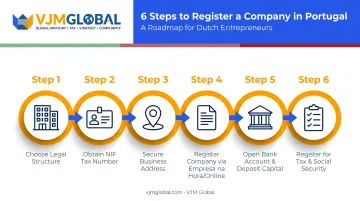
Step-by-Step: How to Set Up a Business in Portugal from the Netherlands
Step 1: Choose Your Legal Structure and Entity Type
Before anything else, decide whether you're incorporating a new Portuguese company (Lda), opening a branch, or setting up a subsidiary of your existing Dutch BV. This choice determines your liability exposure from day one.
Match your decision to:
- Number of shareholders involved
- Planned capital contribution
- Long-term growth and investment plans
Step 2: Obtain Your Portuguese Tax Identification Number (NIF)
Nothing moves without a NIF. As an EU citizen, you can request one directly at a Portuguese Tax Authority (AT) office, or remotely through a tax representative if you'd rather not travel.
Since Dutch residents fall under the EU/EEA rule, appointing a fiscal representative is optional, not mandatory. That is a real time-saver compared with non-EU founders. Every subsequent step, from opening a bank account to registering the company, depends on having this number first.
Step 3: Secure a Portuguese Business Address and Resident Representative
Your registered office needs a complete Portuguese address, including district, municipality, parish and the seven-digit postcode. A simple mailbox address won't satisfy this requirement.
Address options include:
- Coworking spaces
- Virtual offices
- Shared office arrangements
If none of your shareholders is a Portuguese resident, you'll need to appoint a resident legal representative to liaise with local authorities on your behalf.
Step 4: Register the Company via Empresa na Hora or Empresa Online
You have two main routes. Which fits depends on how fast you need to launch and whether you can attend in person. Empresa Online then splits by article type:
| Route | Timing | Cost |
|---|---|---|
| Empresa na Hora (in-person) | Under 1 hour | €360 (€435 with a separate name-admissibility certificate) |
| Empresa Online 2.0, platform articles | 5-day review | €220 |
| Empresa Online 2.0, custom articles | 10-day review | €360 |
These fees come from Portugal's official company-formation guidance, updated for 2026.
One catch for Dutch founders: if you're forming a branch or subsidiary, your Dutch corporate documents need an apostille and certified translation into Portuguese. Portugal's language waiver only applies to English, French or Spanish, so Dutch-language documents don't qualify. Build in extra time for this.
Step 5: Open a Portuguese Business Bank Account and Deposit Share Capital
Traditional Portuguese banks often require in-person visits. Digital business banks usually move faster if you are handling setup remotely from the Netherlands.
Capital deposit rules vary by structure:
- Unipessoal Lda or Lda: cash can be deposited within five working days, or by the end of the first financial year
- SA: at least 30% of the €50,000 minimum capital must be deposited within five days of the permanent certificate becoming available
Step 6: Register for Tax, Social Security and Obtain Sector Licences
You must declare the start of business activity to the Tax Authority within 15 days, and this filing must go through a certified accountant, known locally as a TOC. Appointing one early avoids scrambling at the deadline.
Two more filings to track:
- RCBE beneficial ownership declaration — due within 30 days of incorporation
- Sector-specific licences — checked through Portugal's Business Counter before you invoice your first client
Coordinating filings from Amsterdam or Rotterdam while a Lisbon venture gets off the ground leaves many Dutch founders stretched.
A cross-border advisor such as VJM Global can help align documentation, translations and reporting so the Portuguese setup stays coordinated with your Dutch entity.
Choosing the Right Legal Structure for Your Portuguese Company
The structure you pick shapes your liability, tax residency and reporting duties for years to come.
Sociedade Unipessoal por Quotas (single-member Lda) suits solo Dutch founders or freelancers best. Minimum statutory capital is just €1, and personal assets stay protected because it is a separate legal entity.
Sociedade por Quotas (Lda) is Portugal's most common SME structure for two or more partners. Capital contribution per shareholder stays flexible, and liability generally doesn't extend to personal assets.
Sociedade Anónima (SA) fits larger ventures seeking outside investors. It requires a minimum capital of €50,000 and mandatory board and audit structures, making it overkill for most first-time market entries.
Branch vs. Subsidiary of an Existing Dutch BV
This distinction matters for companies already trading in the Netherlands:
- A branch operates as an extension of the parent company — no new legal entity, no separate capital requirement, but the Dutch parent remains fully liable for the branch's obligations
- A subsidiary is a separate Portuguese legal entity, with its own liability profile and tax residency
| Portuguese structure | Closest Dutch equivalent |
|---|---|
| Sociedade Unipessoal por Quotas | BV (single shareholder) |
| Sociedade por Quotas (Lda) | BV |
| Branch of a Dutch parent | Filiaal |
| Sociedade Anónima (SA) | NV |
Costs, Taxes and Compliance You Need to Budget For
Formation costs are only the starting point. Ongoing tax and compliance obligations run for the life of the company.
Registration fees to budget for:
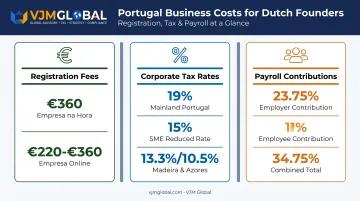
- Empresa na Hora: €360 (or €435 with a name certificate)
- Empresa Online 2.0: €220 to €360 depending on article type
- Name-admissibility certificate: €75 ordinary, €150 urgent
- RCBE assisted filing: €15
Corporate Income Tax and VAT
Portugal's 2026 mainland IRC rate sits at 19%, with a reduced 15% rate on the first €50,000 of taxable profit for qualifying SMEs.
Madeira and the Azores offer lower headline rates at 13.3% standard and 10.5% for qualifying SMEs. Madeira's International Business Centre regime offers 5% IRC through 2033 for companies that meet specific licensing and job-creation criteria.
VAT follows a three-tier system that looks different from the Dutch framework's simpler two-rate structure:
| Region | Standard | Intermediate | Reduced |
|---|---|---|---|
| Mainland | 23% | 13% | 6% |
| Madeira | 22% | 12% | 4% |
| Azores | 16% | 9% | 4% |
Small businesses with Portuguese turnover under €15,000 annually may qualify for a VAT exemption, though EU-established enterprises must also keep total EU-wide turnover below €100,000 to use it.
Payroll and Ongoing Compliance
Employer social security contributions run at 23.75%, with employees contributing 11%, for a combined rate of 34.75%. Budget also for a mandatory certified accountant (TOC), which every Portuguese company must retain on an ongoing basis.
A double taxation treaty between the Netherlands and Portugal (in force since 1999) prevents the same income being taxed twice. Multi-jurisdiction support from a firm like VJM Global or a specialised Portuguese tax adviser helps founders coordinate filings across both markets without duplicating effort or missing a deadline.
Common Mistakes Dutch Entrepreneurs Make When Expanding to Portugal
Dutch founders often assume Portuguese bureaucracy moves at the same pace as the KvK. It doesn't.
- Secure a NIF, business address and translated documents weeks before you arrive. Leaving these until the day before your registration appointment causes avoidable delays.
- Budget for a mandatory certified accountant (TOC). Portuguese tax filings go through this local representative; skipping tax representation creates dual-reporting gaps between the Netherlands and Portugal.
- Weigh branch versus subsidiary before you incorporate. The wrong choice has lasting effects on liability, tax residency and reporting obligations.
Frequently Asked Questions
How much does it cost to set up a business in Portugal?
Registration fees range from €220 to €435 depending on the route: Empresa na Hora, Empresa Online, or the notarial path. Ongoing certified accountant fees are separate and billed monthly.
Which business is profitable in Portugal?
Strong sectors include tourism, agriculture and wine, and technology and logistics. Tourism alone contributed 11.9% of GDP in 2024, according to Turismo de Portugal's data.
Can a foreigner start a business in Portugal?
Yes, there's no restriction on foreign nationals opening a business in Portugal. EU citizens like Dutch entrepreneurs face far fewer formalities than non-EU founders.
Do I need a visa to start a business in Portugal as a Dutch citizen?
No. As an EU citizen, you don't need a visa or residence permit to open or operate a company. Non-EU founders, by contrast, must secure a D2 or D3 visa first.
Can I keep my Dutch BV and open a branch in Portugal instead of forming a new company?
Yes, a branch lets your existing Dutch BV operate in Portugal without creating a separate legal entity. You'll need parent-company documents apostilled and translated, and your BV remains liable for the branch's obligations.
How long does it take to register a company in Portugal from the Netherlands?
Empresa na Hora completes registration in under an hour in person; Empresa Online takes five to ten days. NIF acquisition, translations, and other document prep often extend the real timeline beyond registration alone.