This guide is written for Indian companies, foreign subsidiaries, NRIs, and OCIs operating in India who are relocating a registered office or adding a new business premise. Whether you're moving your principal place of business or opening an additional location, the process has specific rules.
Skip the paperwork or miss a deadline, and you risk failed statutory notices, Input Tax Credit reconciliation headaches, and audit red flags. This article walks through what the amendment process actually is, the exact steps on the GST portal, the documents you'll need, and the point where a simple amendment stops working and a fresh registration becomes necessary.
Key Takeaways
- Same-state changes require Form GST REG-14 approval within 15 working days
- Different-state moves mean cancelling your GSTIN and reapplying, since PAN and State are locked
- Principal and Additional Place changes both use REG-14, but need matching address proof
- Missing a Form GST REG-03 notice within 7 days can get your amendment rejected
What Is Change of Address in GST Registration?
Under Section 28 of the CGST Act, 2017, every registered taxpayer must inform the proper officer of any change to their registration particulars, including business address, within the prescribed timeframe. The mechanism for doing this is Rule 19, which requires electronic filing through Form GST REG-14 on the GST portal.
The outcome is straightforward: a legally updated GST registration certificate that reflects where your business actually operates. This matters because notices, refund communications, and audit correspondence get sent to the registered address on file. If that address is stale, important compliance mail can go missing entirely.
Address amendment is not the same as filing a fresh GST registration, which is required only when you're moving to a new state, or triggering GSTIN cancellation, a separate process that ends your registration entirely.
REG-14 amendment only applies when your business continues operating within the same state or Union Territory. Once you cross a state line, the rules change completely.
Core Fields vs Non-Core Fields
The GST portal splits registration details into two buckets, and knowing which one your change falls into determines how fast it gets processed.
| Field Type | Examples | Approval Needed? |
|---|---|---|
| Core fields | Principal/additional place of business, legal name, stakeholder details | Yes, officer review required |
| Non-core fields | Email, mobile number, bank account details | No, updates automatically |
Address changes always fall under core fields. That means a tax officer has to review and approve your amendment before it takes effect, which is why the process isn't instant.
Why This Matters for Indian and Foreign-Owned Companies
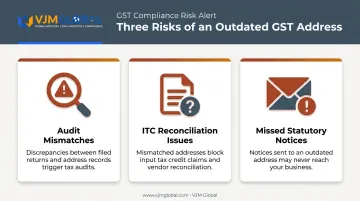
An outdated GST address isn't just a clerical inconvenience. It creates real compliance friction:
- Audit mismatches — auditors flag discrepancies between your GST address and your actual operating location
- ITC reconciliation issues — input tax credit claims can get questioned when supplier and recipient addresses don't line up across records
- Missed statutory notices — if the department sends a notice to your old address, "I never received it" is not a valid defense
Lenders, procurement teams, and regulatory bodies routinely cross-check your GST address against bank statements and lease agreements. A mismatch there is treated as a red flag during due diligence, not a minor oversight.
Foreign companies and NRIs setting up entities in India often relocate offices during their first few years of operation, whether that's moving from a temporary co-working space to a leased office or consolidating multiple locations. This makes address amendment a recurring compliance need, not a one-off task.
VJM Global supports such businesses with end-to-end GST amendment filing, treating it as part of an ongoing compliance relationship rather than a one-time request.
Step-by-Step Process to Change Address on the GST Portal
The entire process runs online, with no physical office visit required, and it only works for relocations within the same state. You'll choose between two address categories, each with its own sub-section in the form:
- Principal Place of Business — your main registered location
- Additional Place of Business — any secondary location tied to the same GSTIN
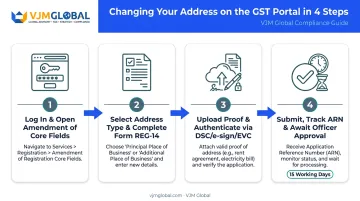
Step 1: Log In and Open the Amendment of Core Fields Section
After logging into the GST portal with your taxpayer credentials, navigate to Services > Registration > Amendment of Registration (Core Fields). This opens the form where all core field changes, including address, are managed.
Step 2: Select Address Type and Complete Form GST REG-14
Officially titled "Application for Amendment in Registration Particulars," Form GST REG-14 requires you to enter the new address details along with a mandatory reason for the change. Every entry needs to match your supporting documents exactly, down to spelling and unit numbers. Small discrepancies here are one of the most common causes of delay.
Step 3: Upload Address Proof Documents and Authenticate
Upload your supporting documents (PDF or JPEG format works best, keeping each file reasonably compact) and then authenticate the filing based on your business structure:
- DSC (Digital Signature Certificate) — mandatory for companies and LLPs
- Aadhaar e-sign — commonly used by proprietors and individuals
- EVC (Electronic Verification Code) — available depending on entity type
An expired DSC or an inactive EVC is a frequent reason submissions fail at this stage. Check both before you start to avoid a failed submission.
Step 4: Submit, Track ARN, and Await Officer Approval
Submitting the form generates an Application Reference Number (ARN), which you can track anytime under Services > Track Application Status. From here, a GST officer reviews the application within 15 working days. They'll either approve it outright or issue Form GST REG-03 requesting clarification.
Documents Required and Key Factors That Affect Approval
The documents you need depend entirely on how you hold the premises. According to CBIC's Instruction No. 03/2025-GST, the evidence requirements break down as follows:
| Premises Type | Documents Needed |
|---|---|
| Owned property | Property tax receipt, electricity bill, or municipal khata copy (any one) |
| Registered rent/lease | Lease agreement plus one ownership document from the lessor |
| Unregistered rent/lease | Agreement, lessor ownership proof, and lessor identity proof |
| Shared/co-working space | Consent letter, consenter's identity proof, and one ownership document |
A few factors that directly affect approval:
- Authentication requirements vary by entity type. Companies and LLPs must use DSC; other structures have more flexibility with e-sign or EVC.
- Statutory timelines are strict. Officers have 15 working days to review your application, and you get 7 working days to respond to a REG-03 notice.
- Missed deadlines trigger automatic approval. Under Rule 19, the amendment gets auto-approved if the officer takes no action within these windows.
- Who can file matters. Only the proprietor, an authorized partner, a director or company secretary, a designated LLP partner, or a GST practitioner/CA with proper authorization can submit the amendment.
- PAN and State are locked. No matter how your business structure changes, these two fields cannot be altered through REG-14. Any change here requires a completely different process.
Common Mistakes and When Amendment Isn't the Right Approach
Most rejections come down to a handful of avoidable errors:
- Document-name mismatches: the address on your proof document doesn't exactly match what's typed in the form
- Oversized or unsupported files: uploading formats or file sizes the portal rejects outright
- Ignoring REG-03 notices: missing the 7-working-day clarification window
- Filing multiple amendments simultaneously: this tends to confuse the review process and slow everything down
One misconception worth clearing up: an in-state address change does not alter your GSTIN. The number stays the same because your registration is simply being updated, not replaced. The GSTIN only changes when you cancel your existing registration and apply fresh in a different state.
REG-14 amendment is not the right tool if you're relocating across a state line. In that scenario:
- Apply for fresh GST registration in the new state
- Wait until the new GSTIN is active
- Cancel the old GSTIN only after the new one is confirmed
Many businesses keep the old and new GSTINs running briefly in parallel during this transition. This overlap helps avoid gaps in Input Tax Credit continuity while the switch is finalized.
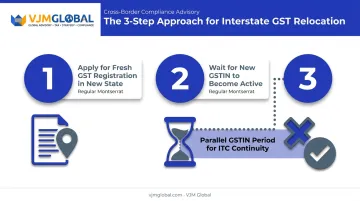
This dual-running period is a practical workaround businesses commonly use, not a formally codified GST provision. Plan the timing with your tax advisor rather than assuming an automatic grace period.
Conclusion
The address amendment process on the GST portal is genuinely simple once you use the correct form, gather matching documents, and pick the right authentication method for your entity type. Stay within the 15-working-day framework, and most filings go through without complications.
Beyond the paperwork, timely address updates matter for a bigger reason: for Indian and foreign-owned companies alike, they aren't just a box-ticking exercise. They protect you from compliance risk, audit complications, and the kind of due-diligence delays that lenders and procurement teams create when records don't match up.
This ongoing risk is easier to manage with the right partner. VJM Global works with foreign companies and NRIs across the USA, UK, and Australia on business setup and ongoing Indian tax compliance, including GST amendment filing as part of a broader post-incorporation advisory relationship. If your registered office is changing and you'd rather not navigate REG-14 alone, reaching out to their compliance team is a reasonable next step.
Frequently Asked Questions
How do I change my address in GST registration?
File Form GST REG-14 under Amendment of Registration (Core Fields) on the GST portal, then upload your address proof. Complete authentication via DSC, e-sign, or EVC depending on your entity type.
What is the time limit for change of address in GST registration?
You must file the amendment within 15 days of the change taking effect. The GST officer then typically reviews and approves it within 15 working days.
How do I check the status of my change of address in the GST portal?
Use the Application Reference Number (ARN) generated after submission and track it under Services > Track Application Status on the portal.
Can I change my GST address if I am shifting to another state?
No. REG-14 only works for in-state moves. For interstate relocation, you need fresh registration in the new state followed by cancellation of the old GSTIN.
Will my GSTIN change after an address amendment?
No, your GSTIN stays the same for in-state amendments. It only changes if you cancel your registration and reapply in a different state.
What documents are required to change address in GST registration?
It depends on the premises type: ownership proof for owned property, a rent agreement plus NOC for leased space, or a consent letter for shared premises.