Introduction
Over the past decade, the Canary Islands have become one of Europe's most attractive spots for company formation. Beyond the sunshine and beaches, founders are drawn by the EU-approved ZEC low-tax regime, a strategic Atlantic location, and a growing base of remote-first businesses setting up shop here.
Founders like the math: full EU market access, straightforward registration, and a corporate tax rate that undercuts mainland Spain by a wide margin. Compare that to the paperwork-heavy setup process in France or Germany, and the appeal is obvious.
Interest comes from every direction: EU expansion seekers, non-EU investors chasing Schengen access, tech founders running distributed teams, and logistics companies eyeing the free trade zones at Las Palmas and Tenerife.
This guide walks through the company types available, what you'll need to qualify, how the ZEC tax advantage works, and the full incorporation process from start to finish.
Key Takeaways
- Two paths exist: standard SL/SA incorporation or the ZEC regime with its 4% corporate tax rate
- ZEC entities require €50,000–€100,000 in investment and job creation, while standard companies need only minimal share capital
- Foreigners can incorporate freely with an NIE number, though ZEC entities need a Canary Islands–resident director
- Timelines differ: standard setup runs 2–4 weeks, while ZEC approval takes longer due to Consortium review
- Beyond tax, expect lower IGIC rates, free trade zones, and full EU/Schengen market access
What Is Canary Islands Company Formation?
Canary Islands company formation is the legal process of registering a business entity in Spain's Canary Islands autonomous region. It follows the same Spanish commercial law that governs mainland incorporation, but it comes with regional tax incentives that mainland companies simply don't get.
There are two core paths to choose from:
| Route | Entity Type | Corporate Tax Rate |
|---|---|---|
| Standard | Sociedad Limitada (SL) or Sociedad Anónima (SA) | 25% (Spain's standard rate) |
| ZEC | Specially authorized entity under the Zona Especial Canaria | 4% on qualifying income |
Other formats exist too, depending on your situation:
- Autónomo: sole trader registration for freelancers and solo consultants
- Branch: an extension of a company already operating elsewhere
- Subsidiary: a separate incorporated entity for companies expanding into Spain
Which path makes sense depends on your business model, growth plans, and the capital you're willing to commit upfront. The next section breaks down each option in detail.
Why Start a Business in the Canary Islands? (When It Makes Sense)
The Canary Islands aren't the right fit for every business. But for companies that qualify, the advantages stack up quickly.
EU, eurozone, and Schengen membership gives founders legal certainty most offshore jurisdictions can't match. You get unrestricted access to the European single market without the compliance gray areas that come with non-EU tax havens.
The tax math is the real headline. Spain's standard corporate rate sits at 25%, while ZEC-qualifying income is taxed at just 4%. Take a mid-size company with €500,000 in qualifying taxable profit:
- Standard rate (25%): €125,000 in corporate tax
- ZEC rate (4%): €20,000 in corporate tax
- Savings: €105,000 annually
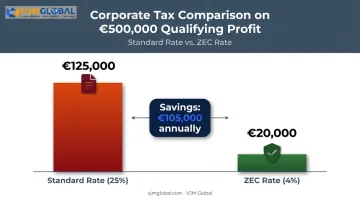
This scale of savings changes how founders plan capital allocation, making tax efficiency a core part of the business case for setting up in the Canary Islands.
IGIC, the Canary Islands' version of VAT, also runs lower. The standard IGIC rate sits at 7%, with a reduced 3% rate and select 0% categories, versus mainland Spain's 21% VAT. ZEC entities also benefit from exemptions on qualifying goods and services moved between ZEC entities, rather than a blanket zero rate.
Add in the geography: the islands sit between Europe, Africa, and the Americas. Free trade zones at Las Palmas and Tenerife exempt qualifying non-EU goods from import duties indefinitely, a genuine draw for logistics and trade businesses.
Finally, the Reserve for Investments in the Canary Islands (RIC) lets qualifying companies reduce their taxable base by up to 90% of undistributed profits, provided that money gets reinvested locally within three years.
What You Need Before You Start: Requirements & Documents
Many founders assume standard and ZEC requirements are roughly the same. They're not, and mixing them up wastes time.
Standard vs. ZEC Requirements
| Requirement | Standard (SL/SA) | ZEC Entity |
|---|---|---|
| Company age | New or existing | Must be newly created |
| Eligible sectors | Any legal activity | Approved sectors only (tech, logistics, R&D, renewables, audiovisual, manufacturing) |
| Minimum investment | Share capital only | €100,000 (Tenerife/Gran Canaria) or €50,000 (other islands) |
| Job creation | None required | 5 jobs (Tenerife/Gran Canaria) or 3 jobs (other islands) within 6 months |
| Director residency | No requirement | At least one Canary Islands–resident director |
Core Documents for Any Company
- Passport or national ID for all shareholders and directors
- NIE (foreigner tax ID number) for foreign shareholders and directors
- Company name reservation certificate from the Mercantile Registry
- Bank certificate confirming capital deposit
- Drafted company bylaws
- Notarized Public Deed of Incorporation
- NIF (tax identification number) application
Additional ZEC-Only Documents
ZEC applicants must submit these additional items before operating under the 4% regime:
- A detailed business plan
- The formal ZEC Consortium application
- Proof of meeting sector, investment, and job thresholds
- Director residency documentation
- Formal ZEC approval
Common miss: founders sometimes assume ZEC benefits apply automatically once the entity is registered. They don't. Fail to meet the sector, investment, or employment thresholds, and tax authorities can apply the standard 25% rate retroactively.
How to Form a Company in the Canary Islands – Step by Step
The process breaks into practical stages that apply to both standard and ZEC entities, with ZEC-specific steps flagged where they diverge. Watch for three common mistakes: underestimating NIE processing time, under-capitalizing an SA, and starting ZEC operations before formal Consortium approval lands.
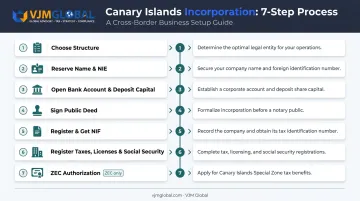
Choose your company structure. Decide between an SL, SA, or ZEC-authorized entity based on available capital, tax goals, and where you see the business in five years.
Reserve your company name and obtain NIE numbers. Submit name options to the Spanish Mercantile Registry while foreign shareholders and directors apply for their NIE tax ID numbers — this step often takes longer than founders expect.
Open a business bank account and deposit share capital. For an SL, contributions can sometimes be recorded directly in the deed. For an SA, at least 25% of the €60,000 minimum must be paid upfront, backed by a bank certificate confirming the deposit.
Draft and sign the Public Deed of Incorporation. Work with a Spanish notary to finalize company bylaws and formally execute the incorporation deed.
Register the company and apply for a tax ID (NIF). Submit the signed deed to the Mercantile Registry and request the company's NIF from the Spanish Tax Agency using Form 036.
Register for local taxes, licenses, and Social Security. Complete IGIC registration through Model 400, secure the local opening license (licencia de apertura), and register for Social Security before hiring any staff.
(ZEC only) Apply for ZEC authorization. Submit the business plan to the ZEC Consortium and demonstrate compliance with investment, job, and sector requirements. Resolution generally takes around two months. Don't start ZEC-rate operations before approval is confirmed in writing.
Canary Islands Taxes and Compliance After Incorporation
Incorporation is the easy part. Staying compliant afterward is where most founders need help.
Corporate tax follows two tracks: the standard 25% Spanish rate, or the ZEC's 4% rate applied only to income generated through qualifying ZEC activities carried out materially within the Canary Islands. Registering as a ZEC entity doesn't convert all worldwide income to the lower rate automatically.
IGIC obligations run alongside corporate tax. Most goods and services fall under the 7% standard rate or 3% reduced rate, with select transactions qualifying for exemptions (a meaningfully lighter load than mainland Spain's 21% VAT).
| Tax | Rate | Applies To |
|---|---|---|
| Corporate tax (standard) | 25% | General income under Spanish law |
| Corporate tax (ZEC) | 4% | Qualifying ZEC activities carried out in the Canary Islands |
| IGIC (standard) | 7% | Most goods and services |
| IGIC (reduced) | 3% | Select goods and services |
Filing deadlines matter. Penalties for missing them add up fast:
- Form 200 (annual corporate tax return): due within 25 days following the six-month mark after your tax year ends, typically July 1–25 for calendar-year companies
- Form 202 (advance payments): due in the first 20 days of April, October, and December
Spain also maintains an extensive network of double taxation treaties, which matters for foreign shareholders repatriating profits. The applicable withholding rate depends on residence, beneficial ownership, and the specific treaty terms, not ZEC status alone.
Founders juggling Spanish compliance often have operations in other countries too, with India being a common example given its own FDI and tax treaty rules. Managing paperwork across multiple jurisdictions gets complicated fast.
VJM Global advises international founders on this kind of cross-border compliance, from treaty-based tax planning to bookkeeping across entities in different countries. If your Canary Islands entity feeds into a larger international structure, one advisory partner tracking both sides can save considerable back-and-forth.
Frequently Asked Questions
Are the Canary Islands a tax haven?
No. The ZEC is an EU-approved low-tax zone with legally sanctioned incentives, fully compliant with European Commission state-aid rules. It's a regulated regime, not an unsupervised offshore arrangement.
Can a foreigner set up a company in Spain?
Yes, foreigners can incorporate freely once they obtain an NIE number. ZEC entities have one extra requirement: at least one director must reside in the Canary Islands.
Which country owns the Canary Islands?
The Canary Islands are an autonomous region of Spain, fully part of the EU, eurozone, and Schengen Area. They're not a separate country or independent jurisdiction.
What is the ZEC and how does it reduce corporate tax?
The ZEC is a European Commission-approved special economic zone offering a 4% corporate tax rate to companies that meet investment, sector, and job-creation criteria. It only applies to qualifying income.
How long does it take to form a company in the Canary Islands?
Standard incorporation typically takes 2–4 weeks, depending on NIE processing and notary availability. ZEC authorization takes longer, since the Consortium review period runs around two months.
Do I need to create jobs to get Canary Islands tax benefits?
Standard companies have no job-creation requirement at all. ZEC companies, however, must create 5 jobs (Tenerife/Gran Canaria) or 3 jobs (other islands) within six months to qualify for the 4% rate.