Introduction
Plenty of US entrepreneurs set up a UK limited company to sell on Amazon UK and in the EU, reach European buyers after Brexit, or hold assets through a UK structure. Many now want out—and closing a UK company works nothing like dissolving a US LLC or corporation.
Companies House and HMRC control the process, not your state's Secretary of State. You may be signing forms from a New York kitchen table, managing a UK bank account you cannot easily visit, and working out what a foreign dissolution means for your IRS filings. A "simple" strike-off gets complicated fast.
This guide covers the steps to dissolve a UK company, how to choose between strike-off and liquidation, and the US tax prep to finish first. It also flags the mistakes that most often delay or derail the process.
Key Takeaways
- Voluntary strike-off via Form DS01 is the cheapest and fastest route for a solvent, non-trading UK company
- Your company must show no trading activity or name change in the last 3 months to qualify
- All UK tax liabilities and final accounts must be settled with HMRC before you apply
- Plan for added US-owner steps: cross-timezone director signatures, possible Form 5471/8858 filings, and GBP fund repatriation
- Expect a minimum of 2-3 months for the process, driven by the mandatory Gazette notice period
How to Close a UK Limited Company: Step-by-Step Guide
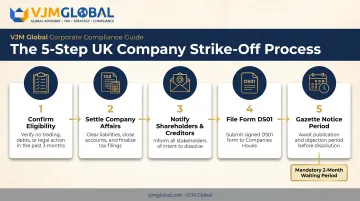
Step 1: Confirm Your Company Is Eligible for Strike-Off
Companies House applies four tests before it will accept a DS01 application. Your company must meet all four:
- Has not traded or sold stock in the last 3 months
- Has not changed its name in the last 3 months
- Is not currently threatened with liquidation
- Has no agreement in place with creditors, such as a Company Voluntary Arrangement (CVA)
Fail any of these, and strike-off isn't available. You'll need to look at liquidation instead, which we cover below.
Step 2: Settle All Company Affairs Before Applying
This is where most applications fall apart. Before filing, directors must:
- Notify HMRC that the company is closing
- Pay any outstanding Corporation Tax, VAT, and PAYE
- Prepare final statutory accounts and a final Company Tax Return marked as the last one
- Close payroll properly, issuing final payslips and P45s if the company had employees
Every asset needs to be distributed and every UK bank account closed before you apply. Anything still sitting in the company at dissolution becomes Crown property, known as bona vacantia.
Getting it back later means a court-ordered restoration, which costs time and money you probably don't want to spend twice.
Step 3: Notify Shareholders, Creditors and Other Interested Parties
Within 7 days of submitting the DS01, you're legally required to send a copy to:
- All shareholders
- Every creditor, including HMRC
- Employees
- Any director who didn't sign the application
Skipping this step is a legal offence. Companies House notes it can carry an unlimited fine.
Step 4: File Form DS01 with Companies House
A majority of directors must sign the application. For a two-director company, that means both. For three directors, at least two need to sign.
This is where US-based founders often hit friction: coordinating signatures with a UK-based co-director across a five- to eight-hour time difference, especially when one party is slow to respond. Plan for this delay rather than being surprised by it.
You have two filing options. Fees follow the Companies House fee schedule:
| Filing method | Fee | Payment |
|---|---|---|
| Online (dedicated strike-off service) | £13 | Debit or credit card |
| Paper DS01 | £18 | Cheque or postal order |
Online filing is faster and cheaper. Paper filing only makes sense if a director genuinely cannot access the online service.
Step 5: Monitor the Gazette Notice Period and Respond to Objections
Once Companies House accepts your application, it publishes a notice in the Gazette for the company's place of incorporation (London, Edinburgh, or Belfast). Per Companies House guidance on striking off, the registrar cannot strike the company off until at least 2 months after that first notice.
HMRC and creditors can object during this window if liabilities remain outstanding or filings are missing. Once the two months pass with no objection, a second Gazette notice confirms dissolution, and the company legally ceases to exist. Correspondence to the registered address stops from that point forward.
Choosing the Right Closure Route: Is Your Company Solvent or Insolvent?
Solvency is the fork in the road that decides everything else. Can the company pay all its debts, with interest, within 12 months? If yes, you're on the solvent path. If no, insolvency rules take over.
Solvent companies
Two main options:
- Strike-off — best when little remains to distribute and affairs are simple
- Members' Voluntary Liquidation (MVL) — better when the company holds significant retained profits
MVL needs a directors' declaration of solvency. Distributions can sometimes be treated as capital rather than income for tax purposes—worth checking with an advisor before you commit.
Insolvent companies
Typically one of these paths:
- Creditors' Voluntary Liquidation (CVL) — directors start the process and hand control to a licensed insolvency practitioner
- Compulsory liquidation — court-ordered after a creditor petition
Once insolvency looks likely, directors must prioritize creditor interests. Keep trading as if nothing has changed and you risk personal liability for wrongful trading.
This is not a call to delay or treat lightly.
Edge case: no acting director. If a US sole director is unreachable or incapacitated, the company does not simply freeze. Shareholders—or an executor if the director has died—usually must appoint a replacement before closure can proceed. Tax filing duties continue even when no one is actively managing the company.
Get a professional solvency assessment before you pick a route. Misjudging status can draw HMRC objections on strike-off—or personal liability later.
What US Business Owners Need to Prepare Before Closing a UK Company
Financial and Statutory Requirements
Before applying for strike-off, make sure these are done:
- Final statutory accounts, plus a final CT600 Corporation Tax Return marked as the last filing
- Corporation Tax, VAT, and PAYE settled in full
- Formal VAT deregistration with HMRC, if the company was registered
- Any overdue confirmation statement filed (gaps in the statutory record are a common trigger for objections)
VJM Global handles UK confirmation statements, statutory accounts, and CT600 filings. That housekeeping must be current before a strike-off application is filed with Companies House.
US Tax Reporting Considerations for American Directors and Shareholders
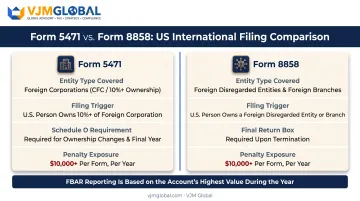
Here's the part US owners most often miss: dissolving the UK entity doesn't end your US reporting obligations. Depending on your ownership and role, you may still need to file Form 5471 or Form 8858 for the company's final tax year, and account for GILTI or Subpart F exposure on your personal or business return.
- Form 5471 requires checking the "final" box and completing Schedule O when a foreign corporation ceases to exist
- Form 8858 applies if the UK entity was treated as a disregarded entity or branch for US tax purposes
- Penalties for missing these filings start at $10,000 per form, per year, and can climb from there
VJM Global's cross-border tax practice files both UK compliance returns and US international forms, which helps you avoid a missed informational return and the penalties that follow.
Repatriating remaining GBP funds to a US account also means FX conversion and ongoing US reporting. FBAR reporting is based on the account's highest value during the year; closing it mid-year does not erase that requirement.
Managing the Process Remotely as a Non-UK-Resident Director
You'll still need a UK registered office or agent address to receive Companies House and HMRC correspondence, even after every director has relocated to the US permanently.
Practically, this means:
- Using digital or e-signatures wherever Companies House accepts them
- Couriering physical documents on the rare occasions paper is unavoidable
- Having a local advisor liaise directly with HMRC and Companies House so timezone gaps don't turn into weeks of delay
Common Mistakes and Alternatives to Strike-Off
Common Mistakes US Owners Make
- Assuming inactivity equals closure. A company that's stopped trading is still legally alive and liable for filings until it's formally struck off
- Filing DS01 before settling HMRC. This almost guarantees an objection and resets the entire two-month clock
- Forgetting other directors need to sign too. A majority of all directors must approve the application, not just the US-based founder — a frequent snag in multi-director companies
Alternatives Worth Considering
Strike-off isn't always the right move:
- Dormancy keeps the company registered if you might resume UK operations later. Yearly confirmation statements and dormant accounts still apply, but the load is lighter than active trading
- Members' Voluntary Liquidation fits when retained profits are worth extracting tax-efficiently, rather than losing them in a rushed strike-off
Restoration via court order remains possible for up to 6 years after dissolution, but it's expensive and slow. Getting closure right the first time avoids that rework entirely.
Conclusion
Closing a UK company properly protects US owners on three fronts: no assets lost to the Crown, no HMRC penalties chasing you home, and no surprise US tax reporting gaps on your personal or business return.
Success comes down to two things. Pick the correct route, whether that's strike-off, MVL, or CVL. Then finish the prep work before you apply: settle HMRC, file final accounts, and distribute assets.
UK and US rules intersect on timing, signatures, and tax reporting. Advisors who understand both sides, such as VJM Global, help you shut down the UK entity without flying back to handle it in person.
Frequently Asked Questions
Can a US citizen close a UK limited company entirely remotely, without visiting the UK?
Yes. DS01 filing, Gazette notices, and HMRC communication can all be handled remotely using e-signatures, a UK registered address, and optionally a local advisor managing correspondence on your behalf.
How much does it cost to close a UK limited company?
Online DS01 filing costs £13; paper filing costs £18. MVL or CVL routes involve additional insolvency practitioner fees, which vary by case complexity.
How long does it take to dissolve a UK company from the US?
Typically 2-3 months minimum, driven mainly by the mandatory two-month Gazette notice period. It takes longer if HMRC or a creditor objects.
Do I need to file anything with the IRS when I close my UK company?
Yes, in many cases. US persons may need to file Form 5471 or Form 8858 for the final tax year and should consider GILTI or Subpart F implications. Professional cross-border tax advice is strongly recommended.
What happens if I just stop filing and abandon my UK company instead of closing it properly?
The company stays legally active, keeps accruing penalties, and will eventually face involuntary strike-off, leaving a public non-compliance record tied to its directors.
Can HMRC object to my company being struck off?
Yes. Outstanding Corporation Tax, VAT, or PAYE liabilities, or missing filings, are among the most common reasons HMRC objects and strike-off applications get rejected.