India-UAE trade ties have grown sharply since the CEPA entered into force on May 1, 2022. According to IBEF, bilateral trade reached US$70.05 billion in FY26 through November 2025, with the UAE ranking as India's third-largest trading partner. As commercial relationships deepen, more UAE businesses are moving beyond informal arrangements toward formal Indian incorporation — and that means navigating a regulatory process that is genuinely unfamiliar territory.
This guide covers what a CIN is, which entity structures qualify for one, and the exact steps UAE firms must follow to obtain it — including the document requirements and post-registration obligations that most firms miss.
Key Takeaways
- A CIN is a 21-character alphanumeric code issued by the Registrar of Companies (ROC) upon incorporation — it is your Indian company's permanent legal identifier
- UAE firms seeking a CIN must register a Wholly Owned Subsidiary (WOS) or Private Limited Company — Branch and Liaison Offices receive an FCRN, not a CIN
- The entire process runs through the MCA portal via SPICe+, with UAE documents requiring authentication by the Indian Embassy before submission
- FEMA compliance and FC-GPR filing with the RBI are mandatory within 30 days of share allotment
- Timeline is 2–4 weeks once documents are in order; the biggest delays come from document authentication and arranging an Indian resident director
What Is a Company Registration Number (CIN) in India?
The CIN is a 21-character alphanumeric identifier assigned by the Registrar of Companies under the Ministry of Corporate Affairs. Each segment carries specific information: the company's listing status, a 5-digit industry code, 2-letter state code, year of incorporation, company type, and a 6-digit sequential registration number.
Under Section 12(3)(c) of the Companies Act, 2013, every registered company must display its CIN on all business letters, billheads, notices, and official publications. Non-compliance attracts a penalty of ₹1,000 per day under the Act, with no grace period after incorporation.
What the CIN Unlocks
Without a CIN, an entity cannot legally operate in India in any substantive sense. The CIN enables:
- Opening an Indian corporate bank account
- Signing contracts enforceable under Indian law
- Invoicing Indian clients in INR
- Filing tax returns (income tax, GST)
- Hiring employees directly on Indian payroll
- Bidding for government tenders
CIN vs. Related Identifiers — Clearing Up Confusion
UAE firms frequently confuse the CIN with three other identifiers:
| Identifier | What It Is | Who Receives It | |------------|------------|-----------------|\n| CIN | Company's registration number | Incorporated Indian companies (Pvt Ltd, WOS) | | DIN | Director Identification Number | Individual directors (Section 153) | | GSTIN | 15-digit GST tax number | Any GST-registered business | | FCRN | Foreign Company Registration Number | Branch Offices and Liaison Offices (FC-1 route) |
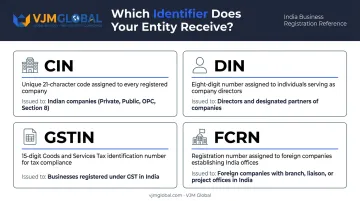
The structure you choose determines which registration route applies. A Branch Office or Liaison Office never receives a CIN — it operates under an FCRN through the FC-1 filing process. UAE firms that incorporate as a Private Limited or Wholly Owned Subsidiary get a CIN; those that open a Branch Office do not. Filing under the wrong route means restarting the entire registration process, often losing weeks and adding avoidable costs.
Why UAE Firms Are Registering Companies in India
DPIIT data shows UAE FDI equity inflows into India reached US$4.345 billion in FY 2024-25, with cumulative inflows crossing US$23.85 billion from April 2000 to June 2025. UAE firms are not just trading with India — they are establishing permanent operations there.
Formal incorporation through a CIN-backed entity delivers capabilities that no other arrangement can match:
- INR invoicing — essential for B2B contracts with Indian companies
- Direct payroll — hire Indian employees without third-party employer-of-record arrangements
- Government contracts — most public procurement requires an Indian-registered entity
- Profit repatriation — FEMA rules allow dividend repatriation, but only from a properly incorporated entity
- Banking — Indian banks will not open corporate current accounts without a CIN
There is also a compliance dimension to consider. UAE firms conducting substantive business activity in India without registration risk Permanent Establishment (PE) exposure under Indian tax law — meaning their global profits could become subject to Indian taxation. FEMA violations add a separate layer of exposure. Operating informally past a certain threshold of activity is not a grey area; it carries direct legal and financial consequences.
How UAE Firms Can Obtain a CIN: Step-by-Step
Before starting on the MCA portal, the entity structure decision must be made. The choice determines whether you receive a CIN at all:
| Entity Type | Registration Route | Identifier Issued | Can Generate Indian Revenue? |
|---|---|---|---|
| Wholly Owned Subsidiary (WOS) / Private Limited Company | MCA / SPICe+ | CIN | Yes |
| Branch Office | RBI / FC-1 | FCRN (not CIN) | Yes (limited scope) |
| Liaison Office | RBI / FC-1 | FCRN (not CIN) | No |
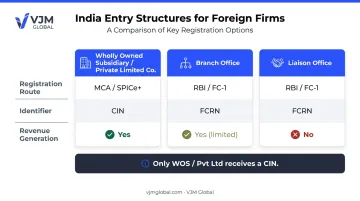
UAE firms seeking a CIN must incorporate as a WOS or Private Limited Company. The steps below apply to that route.
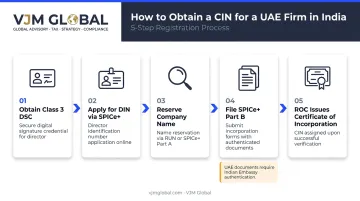
Step 1: Obtain Digital Signature Certificates (DSC)
Every proposed director must hold a Class 3 DSC from an MCA-approved Certifying Authority. For UAE-resident directors, this requires a valid passport, overseas address proof, and email ID. Foreign nationals typically take slightly longer to process than Indian residents — factor this into your timeline.
Step 2: Apply for Director Identification Numbers (DIN)
Each director needs a unique DIN, which can be applied for within the SPICe+ form for up to three directors. One critical requirement that catches many UAE firms off-guard: at least one director must be an Indian resident who has stayed in India for at least 182 days in the financial year (Companies Act, 2013, Section 149(3)). Identify this director — whether an employee, local partner, or a professional nominee — before initiating the SPICe+ process.
Step 3: Reserve a Company Name via MCA Portal
Use SPICe+ Part A or the RUN (Reserve Unique Name) service on the MCA portal to reserve the company name. Key rules:
- The name must not resemble any existing registered company or trademark
- Private Limited Companies must include "Pvt. Ltd." in the name
- MCA review typically takes 1–2 working days (practitioner-observed estimate, not an official SLA)
Step 4: File SPICe+ Form Part B with Supporting Documents
Part B captures all incorporation details: registered office address, authorised capital, director and shareholder information, and linked forms (e-MOA, e-AOA, INC-9).
One point UAE firms consistently underestimate: the registered office must be a physical address in India. A UAE address is not accepted. Many UAE firms use a registered agent address or a professional office service for this purpose initially, which is accepted practice under Indian company law.
Step 5: ROC Verification and Certificate of Incorporation (COI)
After submission and fee payment, the ROC reviews the application. Upon approval, the Certificate of Incorporation (COI) is issued via email. The COI automatically contains the CIN, PAN, and TAN. Once issued, the CIN must appear on all official company documents, invoices, and regulatory filings.
Documents UAE Firms Need — Including FEMA Requirements
For UAE Directors and Shareholders
Every foreign national director or shareholder must submit:
- Valid passport (mandatory for all foreign nationals)
- Overseas address proof (utility bill or bank statement, not older than 2 months)
- Passport-size photograph and specimen signature
- Form DIR-2 (written consent to act as director, under Section 152(5))
Critical authentication point: India joined the Hague Apostille Convention in 2005, but the UAE has not. UAE-origin documents cannot be apostilled. Instead, they must be notarised and then authenticated by the Indian diplomatic or consular officer in the UAE, per Rule 13 of the Companies (Incorporation) Rules, 2014. This step is frequently missed and causes ROC rejection.
UAE directors without an Indian PAN card must apply for one separately. PAN is mandatory for tax compliance once the company is incorporated.
For the Registered Office in India
- Rental or lease agreement for the Indian address
- No Objection Certificate (NOC) from the property owner
- Recent utility bill for the Indian premises
FEMA and RBI-Specific Requirements
Once documents are in order, UAE firms must also satisfy regulatory requirements that don't apply to domestic Indian incorporations:
- The investment must fall under an FDI-permissible sector under DPIIT's current policy
- Within 30 days of share allotment, the company must file FC-GPR (Foreign Currency — Gross Provisional Return) with the RBI through an Authorised Dealer Bank
- Non-compliance under FEMA Section 13 can attract penalties of up to 3 times the sum involved, or up to ₹2 lakh where the amount is not quantifiable, plus ₹5,000 per day for continuing contraventions
VJM Global's business setup team handles MCA incorporation and FEMA/RBI compliance in parallel. Running both tracks simultaneously cuts weeks off the overall timeline compared to addressing them sequentially.
Common Mistakes and Post-Registration Compliance
Mistakes That Delay UAE Registrations
Three errors account for the majority of delays and ROC rejections:
- Submitting un-authenticated foreign documents — the Indian Embassy authentication step is non-negotiable for UAE-origin documents and is consistently missed
- Choosing Branch or Liaison Office expecting a CIN — these structures receive an FCRN, not a CIN, and have significant activity restrictions
- Filing without an Indian resident director — the 182-day residency requirement under Section 149(3) cannot be waived; filing without this in place causes outright rejection
Beyond these three, there's one more misconception that catches firms off guard: a UAE trade licence or commercial registration does not authorise substantive commercial activity in India. A separate Indian-incorporated entity is legally required — operating without one creates both PE tax exposure and FEMA violations.
Post-Registration Compliance Deadlines
After receiving the CIN, UAE firms face several time-bound obligations:
| Milestone | Deadline |
|---|---|
| Appoint statutory auditor | Within 30 days of incorporation (Section 139(6)) |
| Hold first board meeting | Within 30 days of incorporation (Section 173(1)) |
| File INC-20A (commencement of business) | Within 180 days of incorporation (Section 10A) |
| File FC-GPR with RBI | Within 30 days of share allotment |
| GST registration | As applicable based on turnover or transaction type |
VJM Global provides ongoing compliance and accounting support to help UAE firms meet these deadlines without gaps. With 250+ UAE businesses served and a 95% client retention rate, the firm brings direct experience managing these post-registration cycles for international clients.
Frequently Asked Questions
How do I check if a company is registered in India?
Visit mca.gov.in, go to MCA Services, and select "View Company/LLP Master Data." Enter the company's CIN or name to see its registration status, CIN, and key corporate details — all publicly accessible without login.
How do I register a company in India?
Registration is completed online via the MCA portal. The process covers obtaining a DSC and DIN, reserving a company name via SPICe+ or RUN, submitting incorporation documents (MOA, AOA, SPICe+ Part B), and receiving the Certificate of Incorporation with the CIN from the ROC.
What is a CIN in India?
A CIN is a unique 21-character alphanumeric code assigned by the Registrar of Companies to every incorporated Indian company. It encodes the company's listing status, industry, state, year of incorporation, company type, and sequential number — and must appear on all official company documents.
How long does it take for a UAE company to register in India?
The typical timeline is 2–4 weeks from complete document submission. UAE firms should factor in additional time for Indian Embassy authentication of foreign documents and confirming an Indian resident director before filing.
Can a UAE company own 100% of an Indian company?
Yes — UAE companies can own 100% of an Indian subsidiary (WOS) in most sectors under the automatic FDI route, per DPIIT's current policy. Some sectors require prior government approval. UAE firms should confirm their specific sector's FDI eligibility against DPIIT's Consolidated FDI Policy before filing.
What is the difference between a CIN and an FCRN?
The ROC issues a CIN to fully incorporated Indian companies — WOS or Private Limited Companies. Foreign company offices (Branch Offices or Liaison Offices) registering via Form FC-1 receive an FCRN (Foreign Company Registration Number) instead. The entity structure chosen determines which identifier applies and what business activities are legally permitted.