This guide cuts through that confusion. It explains what OPC actually is under Indian law, who among UK audiences can use it (spoiler: it's a narrower group than most assume), how it compares to other India entry routes, and what ongoing compliance looks like once you're registered.
Key Takeaways
- Only natural persons who are Indian citizens — including NRIs — can form an OPC; UK corporate entities and British nationals without Indian citizenship are ineligible
- The 2021 MCA amendment reduced the residency threshold to 120 days and opened OPC to NRIs for the first time
- OPCs have no AGM requirement and use the lighter MGT-7A annual return, reducing remote compliance burden
- The old mandatory conversion thresholds (₹50 lakh / ₹2 crore) were removed in 2021 — voluntary conversion via Form INC-6 is now the standard pathway
- UK-resident founders face tax obligations in both jurisdictions — the UK-India Double Taxation Agreement provides relief mechanisms worth understanding before registering
What Is a One Person Company Under Indian Law?
Under Section 2(62) of the Companies Act, 2013, a One Person Company is defined as a company with only one person as its member. Section 3(1) classifies it as a private company, meaning it carries the protections and obligations of the private limited structure, but designed for a single founder rather than multiple shareholders.
The company name must include the words "One Person Company" in brackets wherever it appears, operating as a private limited entity.
For a UK business owner exploring India entry options, that distinction matters — OPC gives you the legal protection of a registered company without requiring co-founders or multiple directors.
How OPC Differs from a Standard Private Limited Company
Several structural features set OPC apart, and most of them work in a solo founder's favour:
- No AGM: Section 96(1) explicitly exempts OPCs from the annual general meeting requirement
- Lighter annual return: MGT-7A (abridged format) instead of the full MGT-7 form
- No cash flow statement: Section 2(40) permits OPCs to omit this from their financial filings
- Financial statements: Due within 180 days of financial year close under Section 137
- Board meetings: Minimum two per year with at least 90 days between them — waived entirely if there is only one director
The Nominee Mechanism
OPC incorporation requires naming a nominee in the Memorandum of Association. This person, who must provide prior written consent, steps in only if the sole member dies or becomes legally incapacitated.
The nominee role is strictly limited:
- Holds no ownership rights during the member's lifetime
- Has no voting rights or management authority
- Activates only as a continuity measure, not a co-ownership arrangement
Can UK Nationals or UK Companies Form an OPC in India?
The answer depends on who is asking — and the rules differ sharply between corporate entities, NRIs, and OCI cardholders.
UK Corporate Entities: Categorically Ineligible
A UK-registered limited company, LLP, or any other corporate body cannot form an OPC in India. MCA's OPC FAQ is unambiguous: only a "natural person" can be the sole member and nominee. Corporate bodies are excluded regardless of nationality.
UK-Based Indian Citizens: Eligible Since 2021
The eligibility landscape changed with MCA's February 2021 amendment, effective 1 April 2021. That amendment:
- Opened OPC registration to NRIs for the first time
- Reduced the residency threshold from 182 days to 120 days in India during the preceding financial year
A UK-based Indian national (NRI) who spent at least 120 days in India in the preceding financial year now meets the residency test. The member and nominee must both be natural persons who are Indian citizens — resident in India or abroad.
British Nationals Without Indian Citizenship: Not Eligible
If you hold only a British passport, you cannot be an OPC member or nominee under the current MCA rules. Eligibility is tied to Indian citizenship, not residency or visa status in India.
The OCI Question
OCI cardholders are not automatically eligible. The MCA FAQ specifies "Indian citizen" — and OCI status does not confer Indian citizenship under the Citizenship Act.
As of April 2021, no MCA circular explicitly extends OPC eligibility to OCI-only holders. If you hold OCI status but not Indian citizenship, seek direct clarification from MCA or consult a qualified adviser before proceeding.
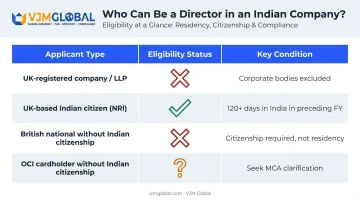
Eligibility at a Glance
| Applicant Type | OPC Eligible? | Key Condition |
|---|---|---|
| UK-registered company / LLP | No | Corporate bodies excluded |
| UK-based Indian citizen (NRI) | Yes | 120+ days in India in preceding FY |
| British national (no Indian citizenship) | No | Citizenship required, not residency |
| OCI cardholder (no Indian citizenship) | Unclear | Seek MCA clarification |
One-OPC Rule
A person can only be the member of one OPC at a time. The nominee can also only serve as nominee for one OPC simultaneously.
Key Benefits of OPC for UK-Based Indian Entrepreneurs
Liability Protection and Separate Legal Identity
The clearest advantage of OPC over an unregistered sole trader or partnership structure is limited liability. Your personal assets — whether held in the UK or India — are shielded from business debts and court judgements. A sole proprietorship offers no such protection; exposure is unlimited.
The OPC's separate legal identity also has practical day-to-day value. The company can:
- Hold property and open bank accounts in its own name
- Enter contracts directly with Indian counterparties
- Build a business credit history independent of the founder
- Present greater credibility to lenders, government bodies, and enterprise clients than an unregistered structure
Compliance Advantages Over Other Corporate Forms
For a solo founder managing Indian operations from the UK, the compliance simplifications matter:
- No AGM: Eliminates the need to travel to India for an annual meeting
- No cash flow statement: One fewer document to prepare and file
- MGT-7A: Shorter, less detailed annual return form than the full MGT-7
- Single-director exemption: If you're the only director, the two-board-meeting requirement is waived
That said, OPC is not compliance-free. A qualified Chartered Accountant must conduct the statutory audit annually. ROC filings (AOC-4 and MGT-7A), income tax returns, and first auditor appointment within 30 days of incorporation are all mandatory.
Managing these from the UK — across time zones, with Indian regulatory deadlines — creates real risk of missed filings and penalties. An in-country compliance partner handles the calendar so you don't have to.
VJM Global handles the full compliance cycle for OPC clients, covering ROC filings, statutory audits, income tax returns, and secretarial compliance, allowing UK-based founders to focus on running the business rather than monitoring MCA deadline calendars.
Business Continuity and the Conversion Path
The nominee mechanism provides perpetual succession without court intervention. If the UK-based founder becomes incapacitated or passes away, the nominee steps in immediately to maintain business continuity — a meaningful protection for an India-based operation with employees, contracts, and assets.
When you're ready to bring in co-founders or equity investors, conversion to a Private Limited Company is straightforward: file Form INC-6 within 30 days of the special resolution. Conversion is now entirely voluntary — the MCA's 2021 amendment removed the old mandatory triggers (₹50 lakh paid-up capital or ₹2 crore average annual turnover) that many guides still cite as current rules. This makes OPC a logical first step for founders who expect the India operation to scale.
OPC vs. Other India Market Entry Options
Because UK corporate entities cannot use OPC, UK companies need a different vehicle entirely. The table below clarifies where OPC fits — and where it doesn't.
| Feature | OPC | Private Limited (WOS) | Branch Office | Liaison Office |
|---|---|---|---|---|
| Who can use it | Indian citizen natural person (NRI eligible) | Foreign corporate or individual | Foreign company | Foreign company |
| Liability | Limited | Limited | Parent company liable | Parent company liable |
| Permitted activities | Commercial, subject to FDI restrictions | Commercial, subject to FDI | Same as parent company | Promotional only — no revenue |
| RBI/FEMA approval | Not typically required (NRI non-repatriation basis) | FDI route applies | RBI approval required | RBI approval required |
| Compliance burden | Light (no AGM, abridged return) | Moderate | Moderate-high | Low-moderate |
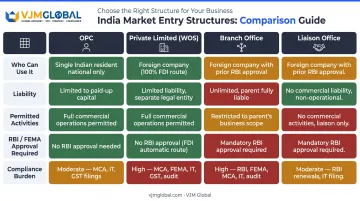
In short, OPC suits a single UK-based Indian founder who wants full ownership and sole decision-making authority, with no plans for co-founders or equity capital — provided the sector has no FDI restrictions on OPC. A UK company trying to establish a presence in India should use a different structure altogether:
- Wholly Owned Subsidiary (Private Limited) — for full commercial operations
- Branch Office — for activities that mirror the parent company's scope
- Liaison Office — for promotional activities only, with no revenue generation
FEMA and NRI Investment Into an OPC
Understanding the investment basis matters before you proceed — here's how the rules apply.
DPIIT's Consolidated FDI Policy clause 3.4.2(vi) states that NRI investment under Schedule IV of the FEMA Non-Debt Instruments Rules, 2019 on a non-repatriation basis is treated as domestic investment, at par with resident Indian investment. This is the standard framework for a UK-based NRI investing their own funds into an OPC they are the sole member of.
VJM Global found no OPC-specific RBI clarification at the time of writing. If your investment is on a repatriation basis, the FDI route applies — bringing sectoral caps and prohibited sector restrictions into scope, including:
- Lottery businesses and gambling
- Chit funds
- Real estate trading or development
VJM Global's FEMA advisory team handles NRI investment structuring, RBI permissions, and compliance under FEMA for OPC and other India entry structures.
UK-India Tax Considerations
The UK-India Double Taxation Agreement, in force since 25 October 1993, covers dividends and provides relief mechanisms to prevent double taxation. For AY 2026-27, Indian domestic company tax rates are 25% for companies with turnover not exceeding ₹400 crore in the previous year, or 30% for larger companies — plus a 4% health and education cess on top.
An optional rate of 22% is available under Section 115BAA.
A UK-resident founder drawing salary or dividends from an OPC will have UK income tax obligations on those receipts, with DTA relief available on a case-by-case basis depending on their specific residency position. This area requires professional advice — both from an India-side adviser and from a UK-qualified accountant — rather than reliance on general guidance.
How to Register an OPC in India: Step-by-Step
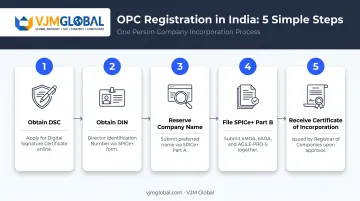
The entire process runs through MCA's SPICe+ portal with no physical document submission required.
- Obtain a Digital Signature Certificate (DSC) — Required for all digital filings. Note for UK applicants: MCA's Aadhaar-linked DSC process may involve additional steps for overseas residents — confirm current requirements with your adviser before starting
- Obtain a Director Identification Number (DIN) — Applied for within SPICe+ Part B
- Reserve the company name — Via SPICe+ Part A
- File SPICe+ Part B — Includes the Memorandum and Articles of Association (eMOA/eAOA) plus the AGILE-PRO-S form, which simultaneously registers the company for PAN, TAN, and statutory employer registrations (EPFO/ESIC)
- Receive the Certificate of Incorporation — Issued by the Registrar of Companies
Documents You'll Need
Before starting, gather the following:
- PAN card (personal, for the Indian citizen founder — mandatory)
- Aadhaar card or equivalent identity proof acceptable under current MCA rules
- Address proof — utility bill or bank statement not older than 2 months
- Passport-size photograph
- Registered office address proof with NOC from the property owner
- Nominee's consent via Form INC-3
For NRIs in the UK, clarify document authentication requirements (notarisation, apostille) with your registration adviser before submission.
Post-Incorporation: INC-20A
Within 180 days of incorporation, you must file Form INC-20A — the Declaration of Commencement of Business. Missing this deadline triggers:
- ₹50,000 penalty for the company
- ₹1,000 per day for officers in default (capped at ₹1 lakh)
- Risk of strike-off proceedings initiated by the Registrar
VJM Global supports UK-based Indian founders through each stage of this process, from DSC procurement and SPICe+ filing to the INC-20A declaration.
Ongoing Compliance Requirements After OPC Registration
Annual ROC Filings
| Filing | Form | Deadline |
|---|---|---|
| Financial statements | AOC-4 | Within 180 days of financial year close |
| Annual return | MGT-7A | Within 60 days of deemed AGM date |
Missing these deadlines carries serious consequences. Three consecutive years of non-filing triggers director disqualification under Section 164(2), and the ROC can strike the company off the register under Section 248 for failure to carry on business.
Audit, Board Meetings, and Director KYC
- First auditor: Must be appointed within 30 days of incorporation; if the Board fails to act, members must appoint within 90 days
- Statutory audit: Annual, by a qualified Chartered Accountant — no exemption
- Board meetings: Minimum two per year with at least 90 days between them, unless there is only one director
- Income tax return: Annual filing required for the OPC
- Director KYC (DIR-3 KYC): Following MCA's 2026 amendment, this is now required once every three years (not annually); directors who completed KYC to date have a next due date of 30 June 2028
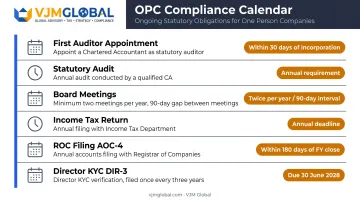
Managing these deadlines from the UK means coordinating across time zones, navigating MCA portal requirements, and staying in sync with Chartered Accountants in India — all while running your core business. VJM Global handles post-incorporation compliance for OPC clients end-to-end, from ROC filings and statutory audits to income tax returns and secretarial obligations.
Frequently Asked Questions
Can a single person form a One Person Company (OPC) in India?
Yes — OPC is designed precisely for this. One natural person acts as both the sole member and director, and must appoint a nominee at incorporation. The person must be an Indian citizen (resident or NRI); minors cannot be members or nominees.
Which is better, an OPC or a Private Limited Company in India?
OPC suits solo founders who want full control, lighter compliance obligations, and no external investors in the near term. A Private Limited Company is the better choice once you're expecting co-founders, equity funding, or significant growth. OPC can convert to Private Limited via Form INC-6 if circumstances change.
Can a UK national who is not an Indian citizen form an OPC in India?
No. Only natural persons who are Indian citizens — whether resident in India or NRIs — are eligible. A British national without Indian citizenship cannot be a member or nominee of an OPC. A UK corporate entity is also ineligible.
Can a UK company use an OPC to enter the Indian market?
No. Indian law requires the sole OPC member to be a natural person, which excludes all corporate entities. UK companies should evaluate a Wholly Owned Subsidiary (Private Limited Company), Branch Office, or Liaison Office depending on their intended activities and revenue model.
How long does OPC registration take in India?
End-to-end registration via the SPICe+ portal typically takes approximately 13–15 days once all documents are in order. Delays most commonly arise from name rejections, document deficiencies, or DSC issuance timelines for overseas applicants.
What are the tax obligations for a UK-based founder running an OPC in India?
The OPC pays Indian corporate tax on its profits (25–30% plus cess, with optional 22% under Section 115BAA). A UK-resident founder drawing salary or dividends may have UK income tax obligations on those receipts, with potential relief under the UK-India Double Taxation Agreement.