Introduction
For decades, the UAE's zero-tax status was the single biggest reason multinationals, regional headquarters, and entrepreneurs chose Dubai or Abu Dhabi over other hubs. That changed on 1 June 2023, when Federal Decree-Law No. 47 of 2022 brought corporate tax to the UAE for the first time — a 9% rate on taxable income above AED 375,000, with a 0% band below that threshold.
Any business operating in or moving to the UAE now needs a clear picture of who pays, at what rate, and what exemptions apply. Get this wrong and the cost is real — both financially and in terms of regulatory standing. This guide covers the rates, exemptions, calculation steps, compliance rules, and the strategic benefits that still make the UAE one of the most tax-efficient jurisdictions in the world.
TL;DR
- UAE corporate tax applies at 0% on taxable income up to AED 375,000 and 9% on income above that threshold, effective from 1 June 2023
- Multinational enterprises (MNEs) with global consolidated revenue above €750 million face a 15% Domestic Minimum Top-up Tax (DMTT) from January 2025
- Qualifying Free Zone Persons can retain a 0% rate on qualifying income if they meet substance and compliance conditions
- Several categories are fully exempt, including government entities, extractive businesses, qualifying investment funds, and small businesses with revenue under AED 3 million (until end of 2026)
- All taxable businesses must register with the Federal Tax Authority (FTA) and file annual returns within 9 months of their fiscal year-end
UAE Corporate Tax Rates: The Complete Breakdown
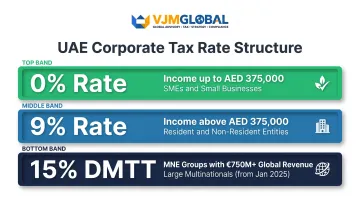
The UAE corporate tax system follows a tiered structure: a 0% rate for income up to AED 375,000, a 9% rate above that threshold, and a separate 15% minimum tax for large multinationals. Each tier targets a different category of taxpayer.
Standard Rates for Resident and Non-Resident Persons
0% band on the first AED 375,000:
- Applies to taxable income up to AED 375,000 per tax period
- Available per taxable person, regardless of the number of business activities
- Designed specifically to support SMEs and reduce tax burden on smaller operations
9% rate on income exceeding AED 375,000:
- Applies to all taxable income above the AED 375,000 threshold
- Covers both ordinary profits and capital gains (no separate capital gains tax exists—gains are treated as ordinary income)
- Applies equally to UAE resident entities and non-resident persons with UAE taxable income
Free Zone Corporate Tax Rules
Qualifying Free Zone Persons (QFZPs) can access a 0% rate, but must meet strict conditions:
- Maintain adequate substance in a designated UAE Free Zone
- Earn only qualifying income (see below for qualifying activities)
- Not elect out of the Free Zone regime
- Comply with arm's length transfer pricing rules for related party transactions
- Maintain transfer pricing documentation
- Prepare audited financial statements annually
De minimis threshold for non-qualifying income:
- Non-qualifying revenue must not exceed the lower of AED 5 million or 5% of total revenue
- If exceeded, the 9% rate applies to all non-qualifying income
- QFZPs are not eligible for the 0% band on their non-qualifying income—9% applies immediately
Qualifying activities for 0% treatment include:
- Manufacturing and processing of goods/materials
- Holding shares and securities for investment
- Treasury and financing services to related parties
- Fund, wealth, and investment management
- Headquarter services to related parties
- Ship ownership, management, and operation
- Reinsurance services
- Aircraft financing and leasing
- Distribution from designated zones
- Logistics services
- Ancillary activities to the above
Excluded activities (taxed at 9%):
- Transactions with natural persons (with narrow exceptions)
- Banking and insurance activities (except reinsurance)
- Finance and leasing (except for ships, aircraft, or related party treasury)
- Immovable property ownership or exploitation (except commercial property transactions between Free Zone Persons)
The Free Zone rules above apply broadly to most businesses. For large multinational groups, however, a separate minimum tax layer applies regardless of Free Zone status.
Domestic Minimum Top-up Tax (DMTT) for Large MNEs
Starting 1 January 2025, the UAE introduced a 15% Domestic Minimum Top-up Tax aligned with the OECD Pillar Two GloBE Model Rules. This ensures large multinational groups pay at least a 15% effective tax rate in the UAE.
Who is subject to DMTT:
- Constituent entities of MNE groups with annual consolidated global revenues of €750 million or more
- The threshold must be met in the consolidated financial statements of the Ultimate Parent Entity in at least 2 of the 4 preceding financial years
If a large MNE's effective tax rate in the UAE falls below 15%, the DMTT closes the gap to reach that minimum. This aligns the UAE with OECD Pillar Two reform and prevents base erosion by multinational groups.
Who Is Subject to Corporate Tax in the UAE?
UAE corporate tax liability hinges on one core distinction: whether you're classified as a resident or non-resident person. Each category carries different tax triggers and obligations.
Resident Persons
UAE tax residents are taxed on worldwide income. Three categories qualify:
- UAE-incorporated entities: All mainland and Free Zone entities incorporated, established, or registered in the UAE
- Foreign entities managed from the UAE: If key management decisions are made in the UAE, the foreign company may be treated as a UAE resident
- Individual business owners with turnover above AED 1 million: Individuals conducting business activities in the UAE whose annual turnover exceeds AED 1 million in a calendar year — taxed only on UAE business income, not global personal income
Non-Resident Persons
Non-residents become liable for UAE corporate tax when any of three conditions apply:
Permanent Establishment (PE) in the UAE:
- Taxed on income attributable to the PE
- A PE typically includes a fixed place of business, branch, office, factory, or construction site lasting more than 6 months
UAE-sourced income not linked to a PE:
- Income from goods or services sold or provided in the UAE
- Income from UAE immovable property
- Interest from loans secured in the UAE or from UAE resident borrowers
- Royalties or IP used in the UAE
- Insurance premiums on UAE-located assets
Nexus in the UAE:
- Applies to digital services and similar activities as defined by Cabinet Decision No. 56 of 2023
- Relevant for e-commerce, digital platforms, and remote service providers
One point worth noting for cross-border operations: the UAE currently applies a 0% withholding tax on dividends, interest, royalties, and service fees paid to non-residents. There's no practical withholding obligation at this time — a significant draw for businesses managing international payment flows.
Corporate Tax Exemptions and Reliefs Available in the UAE
The UAE corporate tax framework carves out significant exemptions for entities of social, economic, or strategic importance. Exemptions fall into four categories: automatic, notification-based, Cabinet-listed, or application-based — and knowing which applies to your structure can directly reduce your tax exposure.
Automatically and Conditionally Exempt Entities
Key exempt categories:
- Government entities: Federal and emirate governments, departments, authorities, and public institutions qualify for automatic exemption
- Natural resource businesses: Companies in extraction activities already taxed at the emirate level must notify the Ministry of Finance to claim exemption
- Public benefit entities: Charities, religious organizations, and educational institutions listed in Cabinet Decisions qualify automatically
- Investment funds: Funds meeting regulatory oversight and ownership diversity requirements — FTA approval required
- Pension and social security funds: Public and private funds subject to regulatory oversight — FTA approval required
- Wholly owned subsidiaries: Subsidiaries of exempt entities (government bodies, investment funds, pension funds) — FTA approval required
Small Business Relief
Startups and early-stage businesses can benefit significantly:
- Resident businesses with revenue not exceeding AED 3 million in the current tax period and all prior periods ending on or before 31 December 2026 may elect Small Business Relief
- When elected, taxable income is treated as zero—no corporate tax payable
- Once revenue crosses AED 3 million in any period, the relief no longer applies — so tracking this threshold is essential
Participation Exemption and Other Income Reliefs
Participation Exemption — Dividends and capital gains from a "participating interest" are fully exempt from UAE corporate tax. To qualify, the interest must meet all of the following:
- Ownership of at least 5% of the shares, or acquisition cost exceeding AED 4 million
- Held for at least 12 months (or intention to hold for 12+ months)
- The participation must be subject to a minimum 9% tax rate in its own jurisdiction
- Not more than 50% of the participation's assets consist of non-qualifying ownership interests
Domestic dividends from UAE tax residents are automatically exempt with no conditions.
Two additional reliefs apply in cross-border scenarios:
- Foreign PE income: UAE residents can elect to exempt income from a foreign permanent establishment, provided that PE is subject to at least 9% tax in the foreign jurisdiction
- International transportation: Non-resident operators of aircraft and ships can access exemptions if their home jurisdiction offers reciprocal treatment to UAE operators
How to Calculate Corporate Tax in the UAE
UAE corporate tax calculation starts with accounting net profit as reported in standalone financial statements prepared under IFRS or IFRS for SMEs. You then apply a series of prescribed adjustments to arrive at taxable income.
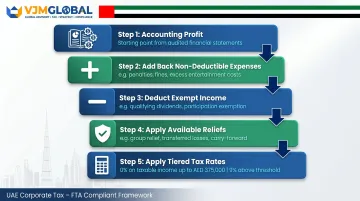
Step-by-step calculation process:
- Start with accounting profit: Use net profit from audited or unaudited financial statements
- Add back non-deductible expenses:
- Penalties and fines
- Entertainment expenses exceeding 50% of the amount incurred
- Corporate tax charge itself
- Dividends and profit distributions
- Charitable contributions not paid to qualifying public benefit entities
- Deduct exempt income:
- Qualifying dividends under the participation exemption
- Capital gains on qualifying participations
- Income covered by Small Business Relief
- Apply reliefs:
- Small Business Relief (if elected)
- Group relief (transfer losses between group entities with 75%+ common ownership)
- Loss carry-forward (offset up to 75% of current taxable income, with no time limit)
- Apply the tiered 0%/9% rates:
- First AED 375,000 of taxable income: 0%
- Remaining taxable income: 9%
Worked example:
A company reports accounting profit of AED 700,000. It has AED 50,000 of non-deductible adjustments (entertainment and penalties) and no exempt income.
- Taxable income = AED 700,000 + AED 50,000 = AED 750,000
- First AED 375,000 taxed at 0% = AED 0
- Remaining AED 375,000 taxed at 9% = AED 33,750
Total corporate tax payable: AED 33,750
That translates to an effective rate of 4.5% on total profit of AED 750,000, well below the headline 9% rate.
Key Benefits of UAE's Corporate Tax Regime for Global Businesses
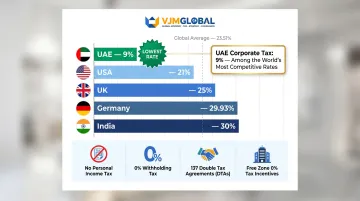
Despite introducing corporate tax, the UAE remains one of the most competitive tax jurisdictions globally. The UAE's 9% rate compares favourably to major economies: the USA at 21% federal, the UK at 25%, Germany at 29.93%, and India at 30%. The global average corporate tax rate stands at 23.51%, making the UAE's 9% rate highly attractive.
Structural benefits beyond the rate:
- No personal income tax on individuals: Employees and business owners pay zero personal income tax
- 0% withholding tax: No WHT on dividends, interest, royalties, or service fees paid to non-residents
- Extensive treaty network: 137 Double Taxation Agreements (DTAs) concluded, reducing cross-border tax friction
- Free Zone 0% incentives: QFZPs can access 0% on qualifying income indefinitely
- Small Business Relief: Startups with revenue under AED 3 million pay zero tax until end of 2026
- Loss carry-forward with no time limit: Losses offset up to 75% of future taxable income indefinitely
These features make the UAE highly efficient for holding structures, regional headquarters, and cross-border operations.
Navigating these benefits requires careful structuring. VJM Global's international taxation team—with 30+ years of experience across 15+ industries—advises businesses on cross-border tax efficiency for operations connecting India and the UAE. This includes identifying applicable DTAs, assessing Free Zone eligibility, and ensuring full compliance with FTA requirements.
UAE Corporate Tax Compliance: Registration, Filing, and Penalties
The Federal Tax Authority (FTA) enforces registration, filing, and documentation requirements across three core compliance pillars: registration, annual filing, and ongoing provisions around transfer pricing and interest deductions.
Registration Requirement
Who must register: All taxable persons must register with the FTA and obtain a corporate tax registration number. Certain exempt persons (qualifying public benefit entities and investment funds) must also register.
Registration deadlines:
- Existing UAE entities (incorporated before 1 March 2024): Deadlines staggered by license issuance month (31 May–31 December 2024)
- New entities (incorporated on or after 1 March 2024): 3 months from date of incorporation
- Foreign entities effectively managed from UAE: 3 months from end of financial year
- Non-residents with PE existing as of 1 March 2024: 9 months from date of PE existence
- Non-residents with PE established after 1 March 2024: 6 months from date PE comes into existence
- Non-residents with nexus: 3 months from date nexus established
- Natural persons: 31 March following the calendar year turnover exceeds AED 1 million
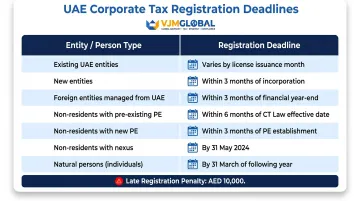
Penalty for late registration: AED 10,000
Annual Filing Obligation
Once registered, entities must meet annual filing and payment obligations tied to their tax period.
Filing deadline: Corporate tax returns must be filed and payment made within 9 months of the end of the relevant tax period.
Example: For a fiscal year ending 31 December 2024, the return and payment deadline is 30 September 2025.
Returns must include:
- Financial statements (audited where required)
- Taxable income calculations with adjustments
- Transfer pricing documentation
Zero taxable income filing: Even entities with zero taxable income must file returns.
Compliance-Related Provisions
Beyond registration and filing, two additional rules affect how taxable income is calculated and reported.
Transfer pricing documentation:
- Master File and Local File required for entities with standalone revenue exceeding AED 200 million, or MNE groups with consolidated revenue exceeding AED 3.15 billion
- All related-party transactions must follow the arm's length principle
- Transfer pricing rules apply to transactions with related parties and permanent establishments
Interest deduction limitation:
- Net interest expense deductible up to the higher of AED 12 million or 30% of tax-adjusted EBITDA
- Excess interest carried forward for up to 10 subsequent tax periods
- Historical debt (terms agreed before 9 December 2022) exempt from this limitation
Penalties for non-compliance:
- Late filing penalties start at AED 500 per month and increase with the duration of non-compliance
- Material inaccuracies can result in penalties of up to 50% of unpaid tax
- Repeated non-compliance may trigger FTA audits and suspension of business activities
Frequently Asked Questions
What is the corporate tax rate in the UAE?
The UAE applies a dual-tier structure: 0% on taxable income up to AED 375,000 and 9% on income above that threshold. Large MNEs with global revenue exceeding €750 million are subject to a 15% Domestic Minimum Top-up Tax from January 2025.
Who must pay corporate tax in the UAE?
UAE-incorporated entities (mainland and Free Zone), foreign entities effectively managed in the UAE, and natural persons with business turnover above AED 1 million must pay corporate tax. Non-residents with a permanent establishment or UAE-sourced income are also subject to tax.
How is corporate tax calculated in the UAE?
Tax is calculated starting from accounting net profit under IFRS, then adjusted before applying the tiered rates:
- Add back non-deductible expenses (penalties, excess entertainment costs)
- Subtract exempt income (qualifying dividends, participation exemption gains)
- Apply the 0%/9% rates to the resulting taxable income
What income is exempt from corporate tax in the UAE?
The following income categories are exempt from UAE corporate tax:
- Qualifying dividends and capital gains under the participation exemption
- Income of government bodies and exempt entities
- Qualifying Free Zone Person income
- Income covered by small business relief (revenue ≤ AED 3 million through end of 2026)
Are companies required to file corporate tax returns in the UAE?
Yes. All taxable persons—including those with zero taxable income—must file annual corporate tax returns with the FTA within 9 months of the end of their tax period. Failure to file results in penalties.
How can businesses legally reduce their corporate tax liability in the UAE?
Common strategies to reduce UAE corporate tax liability include:
- Electing small business relief if revenue qualifies
- Using the participation exemption for dividends and capital gains
- Establishing as a Qualifying Free Zone Person
- Applying group relief to offset losses across related entities
- Carrying forward tax losses against up to 75% of future taxable income