Introduction: UAE's Corporate Tax Shift — What UK Businesses Must Know
Introduction: What UAE Corporate Tax Means for UK Businesses
The UAE ended decades of zero-tax status in June 2023 when Federal Decree-Law No. 47 of 2022 introduced federal corporate tax for financial years beginning on or after 1 June 2023. For UK businesses that set up Gulf operations specifically to trade tax-free, that advantage is now gone — and the structure that made sense five years ago may be working against you today.
The core challenge is dual taxation risk. UK companies with UAE operations may now face tax obligations in both jurisdictions — up to 9% in the UAE plus the UK's 25% corporation tax rate on profits above £250,000. Without proper structuring, the same profits could be taxed twice.
Avoiding that outcome requires clarity on three things: when UAE CT applies, which exemptions remain available, and how to use the UK-UAE Double Taxation Agreement to your advantage. The scale of compliance is significant — over 640,000 entities registered for UAE CT before the September 2025 deadline, confirming this law catches far more businesses than many initially expected.
Key Takeaways
- UAE corporate tax applies at 0% on profits up to AED 375,000 and 9% above that threshold for financial years starting on or after 1 June 2023
- UK businesses face UAE CT obligations if they operate a registered UAE entity, create a permanent establishment, or earn UAE-sourced income
- Free Zone companies qualify for 0% rates on eligible income by meeting substance, activity, and compliance requirements
- The UK-UAE Double Taxation Agreement provides relief mechanisms preventing double taxation on the same profits
- Federal Tax Authority registration is mandatory; returns and payment fall due within 9 months of the fiscal year-end
UAE Corporate Tax at a Glance: Rates, Scope, and Key Rules
Federal Decree-Law No. 47 of 2022 introduced the UAE's first federal corporate tax, effective for financial years beginning on or after 1 June 2023. Before this, the UAE had no federal corporate tax — making this a material change for any UK business with UAE operations.
Rate Structure
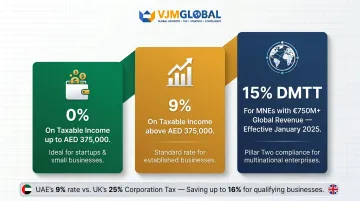
The UAE applies a dual-tier system significantly lower than the UK's 25% rate:
- 0% on taxable income up to AED 375,000
- 9% on taxable income exceeding AED 375,000
Large multinational enterprises (MNEs) face a separate rate. Under Cabinet Decision No. 142 of 2024, a 15% Domestic Minimum Top-up Tax (DMTT) applies from 1 January 2025 to groups with consolidated global revenues of at least €750 million in two of the four preceding fiscal years. This aligns with OECD Pillar Two GloBE rules and directly affects large UK multinationals operating in the UAE.
Small Business Relief
UAE-resident businesses with revenue under AED 3 million can elect to treat taxable income as zero for tax periods ending on or before 31 December 2026, per Ministerial Decision No. 73 of 2023. This benefits smaller UK-owned UAE entities during the transition period but ends for periods after December 2026.
Calculating Taxable Income
Taxable income starts from accounting net profit prepared under accepted standards:
- IFRS (default standard)
- IFRS for SMEs (if revenue doesn't exceed AED 50 million)
- Cash basis (if revenue doesn't exceed AED 3 million)
Once the accounting basis is confirmed, several adjustments apply before arriving at the final taxable figure:
- Adding back non-deductible expenses
- Deducting exempt income (such as qualifying dividends under participation exemption)
- Offsetting tax loss carry-forwards (capped at 75% of taxable income per year, with no time expiry)
Getting these calculations right from year one matters — errors in classifying exempt income or carry-forward offsets can create unexpected tax liabilities. VJM Global has supported 250+ UK businesses on cross-border tax matters and can help ensure your UAE structure is set up correctly from the start.
Does UAE Corporate Tax Apply to UK Businesses?
Tax Residency Test
A UK company becomes a UAE tax resident if it:
- Incorporates a UAE subsidiary (mainland or Free Zone) — this entity is automatically a UAE tax resident with worldwide income taxable in the UAE
- Is effectively managed and controlled from the UAE — even if incorporated in the UK, a company whose board meetings occur in Dubai or whose senior management operates primarily from the Emirates will be treated as a UAE tax resident
Most UK companies avoid residency by maintaining genuine management and control in the UK and establishing a separate UAE subsidiary rather than operating as a branch.
Avoiding residency, however, doesn't eliminate all UAE tax exposure. A separate risk — Permanent Establishment — can apply even to UK companies with no UAE entity.
Permanent Establishment (PE) Risk
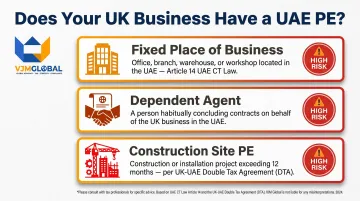
Under Article 14 of the CT Law, a PE arises when a UK company has:
- A fixed place of business in the UAE (office, branch, warehouse, workshop)
- A dependent agent habitually concluding contracts on its behalf in the UAE
- A construction or building site lasting more than 12 months (per the UK-UAE DTA)
Income attributable to that PE is taxed at 9% in the UAE regardless of whether a formal subsidiary has been incorporated. Common PE triggers for UK businesses include:
- Maintaining a Dubai sales office staffed by UK employees
- Having a warehouse for inventory storage and distribution
- Employing local representatives with authority to bind contracts
UAE-Sourced Income for Non-Residents
UK businesses without a PE but earning specific UAE-sourced income remain subject to UAE CT on that income. Article 13(2) of the CT Law defines UAE-sourced income to include:
- Sales of goods delivered or used in the UAE
- Services rendered or utilised in the UAE
- Rental income from UAE property
- Interest where the borrower is a UAE resident
- Intellectual property used or exploited in the UAE
- Disposal of shares in UAE-resident entities
Simply invoicing UAE customers from the UK doesn't automatically trigger UAE CT. What matters is where the economic activity occurs, not where the invoice originates.
Natural Persons Threshold
UK individuals operating as sole traders or freelancers in the UAE face UAE CT only if annual UAE business turnover exceeds AED 1 million (approximately £210,000). The following income types fall outside this threshold entirely:
- Employment income
- Personal investment returns
- Real estate rental income
Free Zones and UK Companies: Is the Tax Advantage Still Real?
Free Zone companies (DIFC, JAFZA, DMCC, etc.) remain subject to UAE CT registration and filing obligations. However, Qualifying Free Zone Persons (QFZPs) can access a 0% rate on "qualifying income" — but this is not automatic.
QFZP Eligibility Conditions
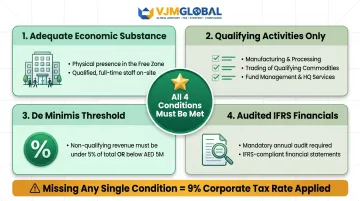
To access the 0% rate, UK-owned Free Zone entities must meet all four conditions:
Adequate Economic Substance — Maintain sufficient physical presence in the Free Zone, employ qualified personnel in core activities, and incur operating expenditure proportionate to those activities.
Qualifying Activities Only — Per Ministerial Decision No. 229 of 2025, qualifying income must derive from:
- Manufacturing or processing of goods
- Trading of qualifying commodities
- Holding shares and securities for investment
- Fund management and wealth management services
- Headquarter services to related parties
- Treasury and financing services to related parties
- Logistics and distribution services within Free Zones
- Ship ownership and operation
- Reinsurance services
- Aircraft financing and leasing
De Minimis Threshold — Non-qualifying revenue must not exceed the lower of 5% of total revenue or AED 5 million.
Audited IFRS Financials — QFZPs must prepare audited financial statements complying with IFRS. Missing this requirement alone disqualifies the entity from QFZP status for the current tax period and the four subsequent periods.
Excluded Activities That Trigger 9% Rate
Meeting the conditions above secures 0% on qualifying income — but certain revenue streams are excluded regardless of Free Zone status. Free Zone entities pay 9% on income from any of these activities:
- Transactions with natural persons (except for specific permitted activities)
- Banking and insurance activities (excluding reinsurance and captive insurance)
- Ownership or exploitation of immovable property outside Free Zones
- Finance and leasing activities (with specified exceptions)
The income source matters as much as the entity type. A DIFC company earning management fees from unrelated UAE mainland clients pays 9% on that income — it only qualifies at 0% if those fees meet the definition of headquarter services to related parties.
The UK-UAE Double Tax Treaty: How It Protects UK Businesses
The UK-UAE Double Taxation Agreement signed 12 April 2016 prevents the same profits being taxed in full in both jurisdictions. Without this treaty protection, a UK parent receiving profits from a UAE subsidiary could face a compounded effective tax rate.
Permanent Establishment Treatment
Under DTA Article 7, profits attributable to a UAE PE of a UK company are taxed in the UAE. The UK then provides credit relief, reducing UK tax liability by the UAE tax already paid. This ensures the effective rate doesn't exceed the higher of the two countries' rates.
Example: A UK company with a UAE branch earning AED 1 million in profits pays AED 56,250 UAE CT (9% on AED 625,000 above the threshold). When those profits are repatriated to the UK, the UAE tax paid is credited against the UK's 25% liability, preventing double taxation.
Participation Exemption Interaction
The UAE offers a participation exemption for dividends where the parent company holds:
- ≥5% ownership in shares or capital
- For an uninterrupted period of at least 12 months
- In a subsidiary subject to tax at ≥9% (statutory or effective rate)
Per Ministerial Decision No. 302 of 2024, when combined with the UK's dividend exemption under Part 9A of the Corporation Tax Act 2009, this can eliminate tax at both levels for qualifying dividends.
Transfer Pricing Obligations
Both the UAE CT Law and HMRC require related-party transactions to be priced at arm's length. UK businesses with UAE related parties must maintain contemporaneous transfer pricing documentation (prepared at the time of the transaction), particularly if:
- UAE revenues exceed AED 200 million in the relevant tax period, OR
- The entity is part of an MNE group with consolidated revenue of at least AED 3.15 billion
Under Ministerial Decision No. 97 of 2023, Master File and Local File documentation must be submitted within 30 days of FTA request.
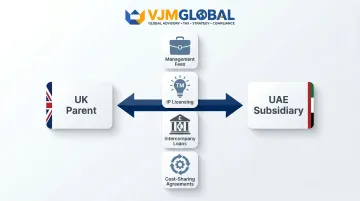
Common intercompany arrangements requiring arm's-length structuring include:
- Management fees charged by UK parent to UAE subsidiary
- IP licensing arrangements (trademarks, technology, know-how)
- Intercompany loans and financing arrangements
- Cost-sharing agreements for shared services
VJM Global assists UK businesses with Master File and Local File preparation, benchmarking studies, and dual-jurisdiction compliance — covering both UAE FTA requirements and HMRC expectations.
UAE Corporate Tax Compliance: A Practical Guide for UK Businesses
UAE CT Registration
All UAE taxable persons (including UK-owned UAE entities) must register with the Federal Tax Authority and obtain a Corporate Tax Registration Number.
Registration Deadlines per FTA Decision No. 3 of 2024:
| Entity Type | Deadline |
|---|---|
| Entities with licences issued before 1 March 2024 | Based on trade licence issuance month (e.g., January licence = 31 May 2024) |
| Resident entities incorporated on/after 1 March 2024 | Within 3 months of incorporation |
| Non-resident PE created on/after 1 March 2024 | Within 6 months of PE establishment |
| Non-resident with UAE-sourced income | Within 3 months of establishing nexus |
| Resident natural persons (turnover >AED 1 million) | By 31 March of subsequent calendar year |
Failure to register within the prescribed timeline carries an AED 10,000 penalty under Cabinet Decision No. 75 of 2023 (as amended by Cabinet Decision No. 10 of 2024).
Filing, Payment, and Record-Keeping
Filing and Payment:
- Corporate tax returns must be filed electronically within 9 months of the tax period end
- Payment is due within the same timeframe
- Example: For a 31 December fiscal year-end, the deadline is 30 September of the following year
Record Retention:
- All records, financial statements, and transfer pricing documentation must be retained for 7 years following the end of the relevant tax period
- This applies to both taxable and exempt persons
Zero-Income Filing: Even entities with zero taxable income (including those claiming Small Business Relief) must file a return.
These requirements apply regardless of trading activity or profit status — meaning UK businesses with dormant UAE entities still carry active compliance obligations. VJM Global supports UK businesses through each step, from FTA registration to return preparation and correspondence.
Frequently Asked Questions
What is the UAE corporate tax rate?
The UAE applies a two-tier structure: 0% on taxable income up to AED 375,000 and 9% on amounts above this threshold. Large MNEs with consolidated global revenues above €750 million face a 15% Domestic Minimum Top-up Tax from January 2025 under OECD Pillar Two requirements.
Who must pay the UAE corporate tax?
UAE CT applies to UAE-resident juridical persons (including Free Zone companies), foreign entities effectively managed from the UAE, non-residents with a permanent establishment or UAE-sourced income, and natural persons with UAE business turnover exceeding AED 1 million.
Is the UAE no longer tax free?
The UAE is no longer fully tax-free for most businesses since June 2023. Rates remain low compared to most jurisdictions — 9% standard versus the UK's 25% — but blanket zero taxation no longer applies to the majority of commercial entities. Specific exemptions and Free Zone benefits still apply under strict conditions.
Is there corporate tax in Freezone Dubai?
Yes, Free Zone companies must register and comply with UAE CT. Qualifying Free Zone Persons can access a 0% rate on qualifying income by meeting substance, activity, and compliance conditions — including audited IFRS financials. Income from excluded activities is taxed at 9%.
Is audit mandatory for corporate tax in the UAE?
Qualifying Free Zone Persons must prepare audited IFRS financial statements as a condition of their 0% rate. For all other taxable persons, audited financials are not universally required under the CT Law, though the FTA can request them in specific cases.
What is the new tax rule in UAE from 2026?
Small Business Relief (allowing businesses with revenue under AED 3 million to treat taxable income as zero) ends for tax periods after 31 December 2026. Small UK-owned UAE entities that relied on this relief must prepare for standard UAE CT obligations from 2027 onwards.