Introduction
Every Delaware LLC needs a Registered Agent before the state will approve formation. This applies whether you're a lifelong Delaware resident or a founder in California, Texas, or overseas who's never set foot in the state.
New business owners often get tripped up here. They confuse the Registered Agent with their business address, or assume the person who signed their Certificate of Formation automatically fills this role. Neither is true.
This guide breaks down what a Delaware Registered Agent actually does, why the state mandates one, who's eligible to serve, and how to pick the right setup for your LLC. Whether you're US-based or forming an entity from abroad, you'll leave knowing exactly what's required.
Key Takeaways
- A Registered Agent accepts lawsuits (Service of Process) and official state mail for your LLC
- Delaware law requires a Registered Agent with a physical in-state address for your entity's life
- Options include self-service, a friend, your own address, or a commercial provider ($100-$300/year)
- Skipping this requirement risks default judgments or cancellation of your Certificate of Formation
What Is a Delaware Registered Agent?
A Registered Agent is the individual or company legally designated to receive Service of Process and official state notices for your Delaware LLC. When someone sues your business, this is who gets served. When the Division of Corporations sends a compliance notice, this is where it lands.
The Physical Address Requirement
Delaware law is specific here. Your Registered Agent's office must be an actual street address in Delaware, complete with street number, city, and zip code. A Certificate of Formation must list this registered office address alongside the agent's name.
A PO box alone won't satisfy this rule. Under Senate Bill 98, which took effect August 1, 2025, agents also can't perform their duties solely through a virtual office or a bare mail-forwarding arrangement. The law expects a real, functioning point of contact, not just a mailbox that redirects to someone's inbox.
Agents need to be reasonably available, too. Delaware's statute requires the office to be "generally open" and the agent "generally present" during normal business hours, not staffed around the clock, but reliably reachable during the workday.
Registered Agent vs. Organizer vs. Owner
Once the address and availability rules are handled, the next point of confusion is usually who does what — these roles get mixed up constantly:
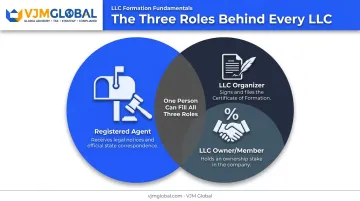
- Registered Agent – Receives legal notices and state correspondence
- LLC Organizer – The person who signs and files the Certificate of Formation
- LLC Owner/Member – Has an ownership stake in the company
One person can technically wear all three hats, but they're legally distinct functions. You'll sometimes see this role called "Agent of Process" or "Statutory Agent" depending on which state's paperwork you're reading. Delaware's own statute uses "registered agent for service of process," but they all mean the same thing.
Why Every Delaware LLC Needs a Registered Agent
This isn't a formation-day checkbox. Delaware Code Title 6, Chapter 18 requires every LLC to maintain a Registered Agent continuously, for as long as the entity exists.
Here's what's actually at stake:
- Courts need a reliable contact. If your business gets sued and there's no agent to serve, a court may still let the case proceed without you
- The state relies on that same contact. Franchise tax notices, compliance reminders, and other official communications all route through your agent
- Missing a notice has real consequences. Delaware LLCs owe a flat $300 annual tax due by June 1, and missing it adds a $200 penalty plus 1.5% monthly interest
What Happens When an Agent Disappears
Picture this: a founder acts as their own agent, then moves out of state without updating their address. The state can't reach them. Under Sec. 18-104, if an agent resigns and no replacement is named within 30 days, the Certificate of Formation gets canceled, effectively shutting the LLC down administratively.
Default judgment risk is just as real. A Wolters Kluwer analysis of a 2024 federal case found that even when an agent was properly served, the LLC still lost by default because the agent failed to notify the company in time. The court held the business responsible for its agent's failure, not the other way around.
None of this is best-practice advice. It's a statutory requirement, and the Delaware Division of Corporations enforces it.
Who Can Serve as Your Delaware Registered Agent
Delaware law recognizes four categories of eligible agents. Each comes with a different mix of cost, privacy, and reliability.
Being Your Own Registered Agent
This works only if you're a Delaware resident with a physical street address in the state, and you're available there during normal business hours. It's free, but it comes with a catch: your home address becomes permanent public record, searchable by anyone, including marketers and data brokers. Missing a delivery while traveling can cost your LLC good standing with the state.
Appointing a Friend or Family Member
Non-residents sometimes ask a Delaware-based contact to serve instead. This can work if that person meets the same residency and address requirements. The risk here is dependency. You're trusting someone else to check mail consistently and forward legal documents fast enough that you don't miss a deadline. If they relocate or forget to check the mailbox, you could miss a lawsuit notice.
Using Your LLC's Own Address
If your LLC already operates from a physical office in Delaware (not just a mailing address), it can serve as its own registered office. This is uncommon for small or single-member LLCs but occasionally fits businesses with an existing Delaware footprint. A Delaware warehouse or storefront, for instance, already meets this requirement.
Hiring a Commercial Registered Agent Service
For most out-of-state and international founders, this is the practical choice. Commercial providers:
- Maintain a staffed Delaware office that meets the physical address requirement
- Scan and forward documents digitally, often within hours of receipt
- Keep your personal address off public filings
- Send renewal and compliance reminders so deadlines don't slip
Pricing varies more than people expect. Some providers advertise fixed rates around $50/year after an included first year, others sit closer to $120 annually, and a few large corporate services price well above $400. Budget for $50-$300/year as a working range, but compare actual providers before committing.
Choosing and Setting Up Your Registered Agent
Not all providers are created equal, and the setup process has a specific order of operations.
Red Flags to Watch For When Hiring a Registered Agent Service
Before handing over your formation documents, check for these warning signs:
- PO box or shared mailbox only: no actual staffed Delaware office behind the listing
- Rock-bottom pricing with no visible team, reviews, or history, often a sign the provider resells client data or cuts corners on service
- No transparent pricing or real customer support — you want a provider you can actually reach when a lawsuit lands
A quick way to vet a provider: search for their business history, read independent reviews, and confirm they'll answer questions before you sign anything. Delaware's own list of registered agents is offered purely as a convenience; the state doesn't vouch for anyone on it.
Steps to Appoint a Registered Agent When Forming Your LLC
Once you've vetted a provider, appointing them follows a specific sequence tied to your formation paperwork.
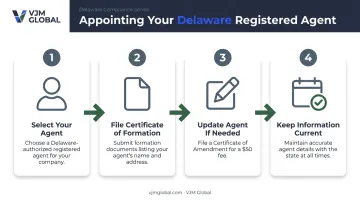
- Select your agent first. Their name and Delaware address are required fields on the Certificate of Formation, so you can't file without this decided.
- File your Certificate of Formation with the agent's details included.
- Update your agent if things change. Switching providers later requires filing a Certificate of Amendment Changing Only the Registered Office/Agent, which carries a $50 filing fee.
- Keep the information current. This isn't a one-time task. A lapse in valid agent coverage can trigger compliance issues fast.
Beyond Formation: Staying Compliant as a US Business Owner
Forming your LLC and appointing a Registered Agent gets you started, but compliance obligations continue well beyond that point. Ongoing requirements include:
- Paying the $300 annual LLC tax to Delaware
- Keeping accurate bookkeeping records year-round
- Filing IRS reports that don't pause just because your entity is technically "formed"
Many US founders running a Delaware LLC are also looking beyond US borders, particularly toward India, whether to hire remote talent, open a subsidiary, or manage cross-border transactions. That's a different compliance world entirely: FEMA advisory, RBI approvals, entity structuring, and ongoing Indian tax filings.
VJM Global works with US-based founders navigating exactly this scenario. Our team of CPAs and Chartered Accountants offers accounting outsourcing and compliance guidance as a Delaware entity expands into the Indian market.
If your growth plans include India, working with a firm that understands both regulatory frameworks helps you avoid the gaps that get missed between two systems.
Conclusion
A Registered Agent is more than a paperwork requirement. It functions as a legal safeguard that keeps your Delaware LLC reachable for lawsuits, tax notices, and everything in between.
Whether you serve as your own agent, lean on a trusted contact, or hire a commercial provider comes down to your residency, privacy tolerance, and how much reliability you need. There's no universally "right" answer, just the one that fits your situation.
And remember: compliance doesn't end at formation. Keeping your agent information current, paying your annual franchise tax on time, and staying on top of filings protects your LLC from administrative dissolution and keeps it in good standing with the state of Delaware.
Frequently Asked Questions
What is a registered agent in Delaware?
A Registered Agent is the person or company legally designated to accept lawsuits and official state notices on behalf of your Delaware LLC. Delaware law requires every LLC to maintain one continuously.
Can I be my own registered agent for my LLC in Delaware?
Yes, if you're a Delaware resident with a qualifying physical street address available during normal business hours. Keep in mind your address becomes public record.
How much does a registered agent cost for an LLC in Delaware?
It's free if you serve as your own agent or use an eligible friend's address. Commercial services typically run $100-$300 per year, though prices vary by provider.
How do I get a registered agent in Delaware?
Choose an eligible individual, friend, or commercial service before filing, since their name and Delaware address are required fields on your Certificate of Formation. File the form once that's settled.
What happens if my Delaware LLC doesn't have a valid registered agent?
You risk missed lawsuits, default judgments, and possible cancellation of your Certificate of Formation. This happens if the state can't reach you or a replacement agent isn't named in time.
Is registered agent information public in Delaware?
Yes. The agent's name and Delaware address listed on your Certificate of Formation become part of the public record and are searchable by anyone.