Without this proof, procurement teams face a real problem: how do you justify a vendor invoice with no GSTIN during an audit? Foreign companies sourcing from Indian freelancers or small manufacturers often discover this gap only after their finance team flags an input tax credit (ITC) or TDS query.
This guide covers who needs to issue a non-GST registration declaration, what it should contain, how to draft and sign it correctly, and how to avoid the compliance risks that come from skipping this step.
Key Takeaways
- Vendors below the threshold, in exempt supply, or under reverse charge skip GST registration but must still issue a formal declaration.
- No government body prescribes a statutory format, though certain elements make the document legally protective.
- Declarations must sit on business letterhead, carry a signature, and bear the company seal.
- Recipients use these declarations to determine ITC eligibility, TDS/TCS treatment, and audit protection.
- A supplier crossing the threshold later must reissue the declaration with the new GSTIN.
What is a Declaration of Non-GST Registration?
A declaration of non-GST registration is a self-issued undertaking, distinct from any government certificate. The supplier confirms they aren't liable to register under the CGST, SGST, UTGST, or IGST Act, 2017. They draft it, sign it, and hand it directly to the business paying them.
This distinction matters because GST law itself has no concept of an "exemption certificate." There's no portal to download it from or application form to file, and it never carries a government stamp.
How It Differs from a GST Certificate
A GST registration certificate (Form REG-06) is issued by the government to businesses that are registered. A non-registration declaration works the opposite way: it's private and unofficial, created entirely by the unregistered party for the recipient's records.
Typical issuers include:
- Freelance consultants and designers working with overseas clients
- Small service providers below the exemption threshold
- Labour contractors supplying manpower to larger firms
- Micro-businesses and home-based sellers transacting with corporates
Any registered business or foreign entity receiving invoices from these categories should request this document before making payment, not after.
When and Who Needs to Submit This Declaration
Not every unregistered vendor qualifies automatically. The declaration should state a specific, verifiable reason.
Turnover Thresholds
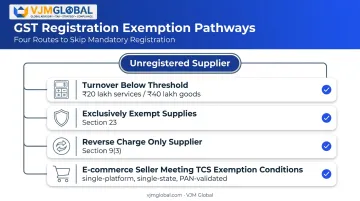
GST registration becomes mandatory once a supplier's aggregate turnover crosses the prescribed limit:
| Supply type | Standard states | Special category states |
|---|---|---|
| Services | ₹20 lakh | ₹10 lakh (Manipur, Mizoram, Nagaland, Tripura) |
| Goods (conditional exemption) | ₹40 lakh | ₹20 lakh (10 listed states/UTs including Telangana, Puducherry, Sikkim) |
This goods threshold was introduced through Notification No. 10/2019-Central Tax, effective 1 April 2019, and comes with conditions. It doesn't apply universally, so verify the supplier isn't excluded by product type, inter-state supply, or compulsory registration categories under Section 24. CBIC's own clarification confirms these state-wise variations apply to both goods and services.
Exempt Supplies and Reverse Charge
Two other categories don't need registration regardless of turnover. These include suppliers dealing exclusively in wholly exempt or non-taxable goods/services under Section 23, and reverse charge suppliers whose entire taxable supply falls under Section 9(3), where the recipient pays GST directly.
A vendor with even one taxable, non-RCM supply outside this exemption can't rely on it for their whole business. The declaration should name the exact exemption category, not just say "not registered."
E-commerce Vendors and TCS
Platforms like Amazon or Etsy must collect TCS on seller transactions under Section 52. But eligible unregistered goods suppliers operating through one e-commerce operator, within a single state, and enrolled via PAN validation are exempt from this collection since October 2023.
For example, a home-based crafts seller listing exclusively on one platform within their own state, and staying below the goods threshold, doesn't need GST registration. The platform shouldn't deduct TCS from their payouts once the seller submits a valid non-registration declaration confirming eligibility.
Why Foreign Companies Request This Document
Foreign companies, NRIs, and OCIs setting up vendor relationships in India ask for this declaration for three practical reasons:
- ITC clarity: confirms no GST was charged incorrectly, which would otherwise complicate credit claims
- TDS/TCS applicability: determines correct withholding treatment on the payment
- Audit protection: demonstrates due diligence if the vendor's status is later questioned
GST Non-Registration Declaration Format (Sample Template)
There's no statutory format prescribed by CBIC or the GST portal for this document. A review of official form inventories and the ICAI's registration handbook confirms no such form exists in government records. That said, industry practice has settled on a fairly consistent structure.
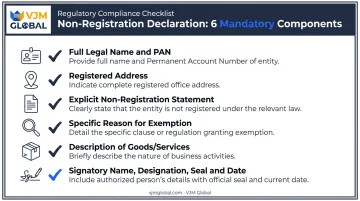
Mandatory components should include:
- Full legal name of the business or individual
- Registered address and PAN
- An explicit statement of non-registration under CGST/SGST/UTGST/IGST Act, 2017
- The specific reason: exempt supply, below-threshold turnover, or RCM-only supply
- Description of the goods or services supplied
- Signatory name, designation, and date
Sample Declaration Text
DECLARATION OF NON-GST REGISTRATION

[On Company Letterhead]

Date: [DD/MM/YYYY]

To,
[Recipient Business Name and Address]

I/We, [Supplier/Business Name], having office at [Address], PAN [XXXXX],
hereby declare that:

1. We are not registered under the CGST/SGST/UTGST/IGST Act, 2017.
2. Reason for non-registration: [Below prescribed turnover threshold /
   Exclusively exempt supply / Supply covered entirely under reverse charge]
3. Goods/Services supplied: [Description]
4. We undertake to inform [Recipient] immediately and share the new GSTIN
   if we become liable for GST registration in the future.
5. We indemnify [Recipient] against any loss, penalty, or ITC denial
   arising from incorrect information in this declaration.

Signature: _______________
Name: _______________
Designation: _______________
Seal/Stamp: _______________
The indemnification clause matters more than most suppliers realize. It shifts liability back to the vendor if their declared status turns out to be false, protecting the recipient from downstream penalties.
This declaration is often confused with a similarly named document, the "GST Declaration for Authorised Signatory." That form serves a different purpose: it's submitted within the GST registration application to authorize someone to act on the applicant's behalf. The non-registration declaration, by contrast, is never uploaded to the GST portal.
How to Draft, Sign and Submit the Declaration
This document isn't complicated to create, but a few formalities make it enforceable.
Format requirements:
- Print it on the business's official letterhead, showing name and address
- Include the signature of the proprietor, partner, or authorized signatory
- Add the printed name and designation below the signature
- Apply the business seal or stamp to authenticate it
Unlike the authorized signatory declaration used during GST registration, this document stays entirely private. It's shared directly between supplier and recipient for internal records and isn't filed with any government authority.
Since no government office monitors this document, both parties must keep it accurate through periodic review. Review cycle: turnover status can change within a financial year, and a vendor comfortably below ₹20 lakh in April might cross it by December. Recipients should:
- Ask suppliers to reconfirm their status annually or each financial year
- Flag any threshold crossing mid-year rather than waiting for renewal
- Treat each declaration as time-bound, not permanent
For businesses managing dozens of vendor relationships, this becomes an operational task, not just a legal one. It often makes sense to fold this into the broader vendor onboarding checklist alongside PAN verification and bank details.
Risks of Non-Compliance and Why Professional Guidance Matters
Getting this wrong carries real financial consequences on both sides of the transaction.
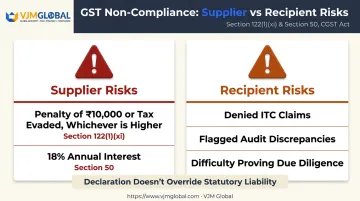
For suppliers who wrongly declare non-registration after crossing the threshold, Section 122(1)(xi) of the CGST Act imposes a penalty of ₹10,000 or the tax evaded, whichever is higher. Interest under Section 50 also applies on unpaid tax, currently notified at 18% per annum.
For recipients who fail to collect updated declarations, the exposure shows up differently:
- Denied ITC claims if a vendor was actually liable to charge GST
- Flagged discrepancies during GST audits
- Difficulty proving due diligence if tax authorities question a vendor relationship
A declaration doesn't override statutory liability. If a vendor was legally required to register, the declaration provides no shield for either party when the facts don't match.
This is where the assessment gets tricky for foreign companies unfamiliar with Indian turnover rules, exemption notifications, and state-specific thresholds. VJM Global works with US, UK, and Australian businesses to get this right.
The firm assesses GST applicability before a vendor relationship goes live, drafts declarations that hold up under scrutiny, and manages documentation as part of broader business setup and compliance support in India.
Frequently Asked Questions
What should you do if you're not registered for GST?
If your turnover is below the threshold or you deal exclusively in exempt supplies, you don't need to register. Issue a signed non-registration declaration to clients confirming your status and the specific reason.
How to get a GST declaration certificate?
There's no official government certificate for non-registration. You self-draft a declaration on your business letterhead following the standard format, then sign and seal it.
Is a GST non-registration declaration mandatory for unregistered businesses?
GST law doesn't legally mandate it, but most corporate recipients require it as standard practice to protect their ITC claims and maintain audit-ready documentation.
What happens if a business crosses the turnover threshold after giving this declaration?
The business must register for GST, obtain a GSTIN, and promptly inform the recipient with updated details for all future invoices and returns.
Can foreign companies or NRIs request this declaration from Indian vendors?
Yes. Foreign entities and NRIs setting up operations in India routinely collect these declarations from small vendors to support ITC eligibility and support compliance verification.
Is there a specific government-prescribed format for this declaration?
No. GST law doesn't mandate a fixed format, but a standard structure covering the key declaration elements is widely used across industries and generally accepted by auditors.