That growth reflects a persistent question for founders, startups, and foreign businesses entering India: should you register for GST even if you're not legally required to?
Many companies, especially NRIs and foreign entities setting up shop in India, struggle with this exact dilemma. This article breaks down the real advantages and disadvantages of GST registration, then offers a practical framework to help you decide, along with how professional guidance can smooth out the process.
Key Takeaways
- GST registration is mandatory above set turnover thresholds, and compulsory for specific business categories
- Registered businesses gain input tax credit, legal credibility, and access to bigger contracts
- The trade-off: heavier compliance workload, cash flow pressure, and added administrative costs
- Your decision depends on client type (B2B vs. B2C), growth plans, and foreign ownership status
Understanding GST Registration in India
GST is a destination-based tax that consolidated dozens of overlapping state and central levies into one structure. For businesses, this means a single registration number (GSTIN) instead of juggling multiple state tax IDs.
Current Turnover Thresholds
Registration becomes mandatory once turnover crosses these limits, according to the GST Council's official registration guide:
| Supplier Type | Standard Threshold | Special Category States |
|---|---|---|
| Exclusive goods suppliers | ₹40 lakh | ₹20 lakh (Arunachal Pradesh, Manipur, Meghalaya, Mizoram, Nagaland, Puducherry, Sikkim, Telangana, Tripura, Uttarakhand) |
| Services or mixed supplies | ₹20 lakh | ₹10 lakh (Manipur, Mizoram, Nagaland, Tripura) |
Always verify current limits on the official GST portal before applying, since notifications can adjust these figures.
Who Must Register Regardless of Turnover
Certain categories trigger mandatory registration no matter how small the business is:
- Casual taxable persons (no threshold exemption applies)
- Non-resident taxable persons, who must apply at least 5 days before starting business
- Interstate suppliers of goods (with some service-supplier exemptions under Notification 10/2017)
- E-commerce operators required to collect tax at source
- Certain overseas OIDAR (Online Information Database Access and Retrieval) suppliers
For foreign companies, NRIs, and OCIs setting up branches or subsidiaries in India, this last point matters most. If your operation involves any cross-border supply or import/export activity, registration usually isn't optional.
Advantages of GST Registration for Indian Companies
Registration isn't just a compliance checkbox. It unlocks real operational and financial benefits that unregistered businesses simply don't have access to.
Legal Recognition and Credibility
A GSTIN establishes your company as a recognized supplier in the eyes of government bodies, corporates, and international clients. Many large buyers, particularly multinational procurement teams, will only work with GST-registered vendors as a matter of policy.
Input Tax Credit Reduces Effective Costs
Registered businesses can claim credit for GST paid on business purchases, which eliminates the cascading "tax on tax" effect that plagued the pre-GST system.
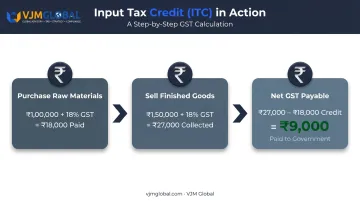
Example:
- A manufacturer buys raw materials worth ₹1,00,000 plus 18% GST (₹18,000)
- They sell finished goods for ₹1,50,000 plus 18% GST (₹27,000)
- Instead of remitting the full ₹27,000, they claim credit for the ₹18,000 already paid and only pay ₹9,000 to the government
That's a direct cash saving, provided the supplier has filed their return and the invoice matches.
Easier Interstate Trade Across States
GST registration lets companies trade across state lines without separate state-level registrations for this purpose. The e-way bill system, rolled out nationwide for interstate movement in April 2018, removed the old checkpoint delays that used to slow down goods transport and inflate logistics costs.
Access to Government Tenders and Corporate Contracts
Many government tenders and large corporate supply agreements list GST registration as a mandatory eligibility criterion. Skipping registration can mean losing out on contracts before you even get to the bidding stage.
Improved Access to Loans and Funding
Banks and NBFCs increasingly use GST filing history as verifiable proof of turnover and business legitimacy when assessing loan applications. A clean GST compliance record can genuinely improve your credit prospects.
The Composition Scheme for Smaller Businesses
Small taxpayers don't have to accept full compliance complexity. The Composition Scheme offers:
- 1% tax rate for manufacturers and traders (turnover up to ₹1.5 crore, or ₹75 lakh in select northeastern states)
- 5% tax rate for restaurants under the same turnover limit
- 6% tax rate for eligible service suppliers with turnover up to ₹50 lakh
- Simplified quarterly payments (CMP-08) and one annual return (GSTR-4)
The catch: composition taxpayers can't collect tax from customers or claim input tax credit.
Disadvantages of GST Registration for Indian Companies
Registration comes with real costs, not just paperwork inconvenience. Founders need to weigh these honestly before deciding.
Increased Compliance Burden
Regular taxpayers typically file:
- GSTR-1 (monthly, due the 11th of the following month, or quarterly under QRMP)
- GSTR-3B (monthly, due the 20th, or quarterly with monthly tax payment)
- GSTR-9 (annual return, generally due December 31)
Missing deadlines isn't cheap. The statutory CGST late fee under Section 47 of the CGST Act runs ₹100 per day, capped at ₹5,000, with similar state-side charges applying on top. Delayed tax payments also attract 18% annual interest.
Cash Flow Impact
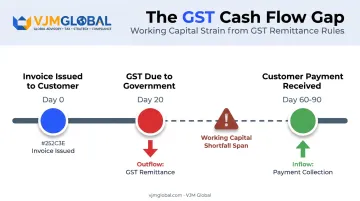
Registered businesses must remit collected GST to the government on a fixed schedule, regardless of whether customers have actually paid their invoices yet. For companies with long receivable cycles, such as export-heavy businesses or B2B service providers billing on 60-90 day terms, this can strain working capital.
Technical and Portal-Related Challenges
The GSTN portal can slow down or throw errors during peak filing periods near deadlines. These glitches have historically caused missed filings and unnecessary penalty exposure, even when businesses tried to file on time.
Complexity for Multi-State or Small Businesses
A few structural headaches worth flagging:
- Separate GST registration is required for each state where you operate
- Correct HSN/SAC code classification for goods and services adds administrative work
- Reconciling books against GSTR-1 and GSTR-3B data becomes a recurring monthly task
Rising Professional and Administrative Costs
Most businesses end up hiring accountants or tax consultants to stay compliant. For startups and foreign-owned entities unfamiliar with Indian tax procedures, this overhead can feel disproportionate to their size, especially in the first year of operations.
Should Your Company Register for GST? A Practical Decision Framework
There's no universal answer here. The right call depends on your turnover trajectory, client base, and growth ambitions.
When Voluntary Registration Makes Sense
Businesses below the threshold sometimes benefit from registering anyway if they:
- Sell primarily to other registered businesses (B2B) who expect GST-compliant invoices
- Want to claim input tax credit on significant purchases
- Plan to scale past the threshold within the next year or two
When Registration Is Mandatory
Once turnover crosses the applicable limit, or your business falls into a compulsory category, you must apply within 30 days of becoming liable. Missing this window can trigger a penalty of ₹10,000 or the tax evaded, whichever is higher.
Business-Type Considerations
- Service businesses operating purely intrastate may stay under the threshold longer than product businesses
- Interstate suppliers generally need to register early since the exemptions are narrow
- E-commerce sellers face specific rules; goods sellers below the threshold can sometimes stay unregistered only if they operate through a single state and meet enrolment conditions
Foreign Companies, NRIs, and OCIs
If you're establishing a subsidiary, branch, or liaison office in India, GST registration is typically necessary from day one. Import/export activity, cross-border invoicing, and documentation requirements leave little room for the "wait and see" approach that domestic small businesses sometimes use.
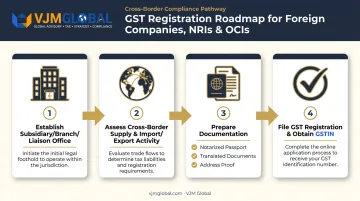
Cross-border structures also face more complex pre-registration analysis, covering business nature, supply types, and registration category. VJM Global works with foreign companies, NRIs, and OCIs on exactly this analysis before they file, so registration decisions hold up as operations scale.
How VJM Global Simplifies GST Registration and Ongoing Compliance
Navigating GST as a foreign company or NRI means dealing with unfamiliar forms, language requirements, and documentation standards, all while trying to run a business back home.
VJM Global's team of Chartered Accountants and tax professionals manages GST registration end-to-end: reviewing your business structure, preparing documentation, and handling queries raised during the application process.
For foreign entities, this typically includes guidance on notarized passport requirements, translated documents, and address proof standards that trip up applicants unfamiliar with Indian procedures.
With 30+ years of experience and a track record supporting 500+ US, 250+ UK, and 250+ Australian businesses, VJM Global brings practical familiarity with the specific compliance gaps foreign founders tend to hit first.
Support doesn't stop at registration. Once you're live, VJM Global's ongoing support includes:
- Filing monthly or quarterly GSTR-1 and GSTR-3B returns
- Reconciling books against filed returns
- Managing accounting outsourcing and bookkeeping
- Advising on cross-border transactions and FEMA compliance
- Supporting audits and internal control reviews
By handling registration and the recurring compliance workload discussed earlier together, VJM Global lets founders focus on operations rather than chasing deadlines on an unfamiliar portal.
Frequently Asked Questions
Is it better to be GST registered or not?
It depends on your turnover, client base, and growth plans. B2B-focused businesses or those seeking input tax credit often benefit from voluntary registration, even below the threshold.
What is the GST registration threshold limit in India?
The standard limits are ₹40 lakh for exclusive goods suppliers and ₹20 lakh for services, with lower limits in special category states. Always confirm current figures on the official GST portal.
Can I cancel or surrender my GST registration later if it's no longer required?
Yes, through Form GST REG-16, citing grounds like business discontinuation or no longer meeting registration criteria. The officer typically issues a cancellation order within 30 days of application.
What are the penalties for not registering for GST when required?
Non-registration attracts a penalty of ₹10,000 or the tax evaded, whichever is higher, plus 18% annual interest on unpaid tax amounts.
Is GST registration compulsory for all businesses in India?
No. It's mandatory only beyond the turnover threshold or for specific categories like e-commerce operators and interstate suppliers. Smaller businesses outside these categories can register voluntarily.
How long does GST registration take in India?
Standard applications are typically processed within 7 working days if documentation is complete; cases requiring Aadhaar verification or physical checks can take up to 30 days. Working with GST specialists like VJM Global helps avoid the document errors that cause most delays.