
That gap in law creates real practical differences. Get the structure wrong, and you could end up with unlimited personal liability, the wrong tax treatment, or an admin burden you didn't sign up for. Investors care about this too — fund structures and professional partnerships look for very different things.
This guide breaks down what LPs and LLPs actually are, where each one gets used in practice, and how to work out which fits your business or fund.
Key Takeaways
- LPs need one general partner (unlimited liability) and limited partners (liability capped at investment)
- LLPs give every member limited liability and stand as a separate legal entity, much like a company
- Fund managers and passive investors typically favour LPs; active professional partnerships favour LLPs
- Both register at Companies House, but their filing and disclosure duties differ sharply
LP vs LLP: Quick Comparison
Before the full breakdown, here's how the two structures stack up side by side.
| Feature | LP | LLP |
|---|---|---|
| Legal personality | None (unless registered as a Scottish LP or PFLP with specific provisions) | Separate legal entity, distinct from its members |
| Liability | General partner: unlimited. Limited partner(s): capped at contribution | All members limited, as set out in the LLP agreement |
| Formation | Registered under the 1907 Act via form LP5 | Incorporated under the 2000 Act via form LL IN01 |
| Minimum participants | 1 general partner + 1 limited partner | 2 members, including 2 designated members |
| Management | General partner runs the business; limited partners stay passive | Any member can take part in management |
| Taxation | Tax-transparent; partners pay tax individually | Tax-transparent for income tax, but treated as a body corporate for other purposes |
| Filing duties | Minimal: mostly formation and event-driven notices | Annual accounts and a confirmation statement required |
Two things stand out immediately. First, an LP keeps a strict line between the person running the show and the people funding it. Second, an LLP behaves far more like a limited company once it's up and running — which brings both protection and paperwork.
What is a Limited Partnership (LP)?
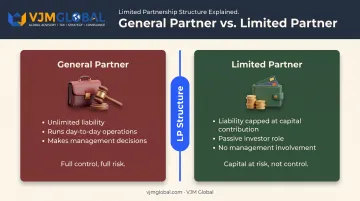
An LP is a partnership formed under the Limited Partnerships Act 1907. It needs at least one general partner, who carries unlimited liability for the firm's debts, and at least one limited partner, whose liability is capped at whatever capital they've put in.
That trade-off is the whole point. The general partner runs the business and answers for everything; limited partners hand over capital and stay out of day-to-day management. Step into management as a limited partner, and you risk losing that liability protection.
LPs also offer something investors value: confidentiality. Unlike companies, LPs aren't required to publicly disclose the full terms of the partnership agreement, which makes the structure attractive for investment vehicles where commercial terms need to stay private.
The PFLP variation
Since 6 April 2017, qualifying investment LPs can register, or convert to, Private Fund Limited Partnership (PFLP) status. This simplifies the regime further:
- No compulsory capital contribution from limited partners
- Contributed capital can be withdrawn without triggering the standard LP liability clawback
- Less information needs filing at registration (no need to disclose the fund's general business nature or each partner's contribution)
- A statutory "white list" lets investors sit on advisory committees or give consent without being treated as taking part in management
Where LPs are used
LPs dominate the UK's private capital fund landscape. The general partner (usually the fund manager) controls operations, while investors sit as limited partners providing capital and staying passive.
Fund finance and film finance both rely on this model: a manager holds operational control while investors fund the venture and stay out of day-to-day decisions.
In evidence to the House of Lords in March 2017, the government confirmed that around 250 fund managers operated roughly 780 UK venture capital and private equity schemes under the 1907 Act LP structure. The figure is from 2017, but it still shows how entrenched the LP is as the UK's default fund vehicle.
What is a Limited Liability Partnership (LLP)?
An LLP is a hybrid business structure under the LLP Act 2000. It combines the tax transparency that partnerships are known for with the liability protection and separate legal personality you'd normally associate with a company.
That combination solves a specific problem: professional partners want to share profits flexibly and run the business together, but they don't want one partner's mistake exposing everyone's personal assets.
Core benefits include:
- Personal asset protection for every member, not just some
- Flexible profit-sharing arrangements, set out in the LLP agreement rather than fixed by shareholding
- Easier partner admission and exit, without the complexity of transferring shares
Designated members vs ordinary members
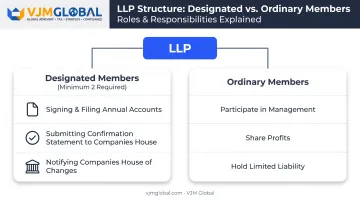
Every LLP needs at least two designated members at all times. They carry the same underlying rights as ordinary members, but with added statutory duties:
- Signing and filing accounts
- Submitting the confirmation statement
- Notifying Companies House of membership or office changes
Where LLPs are used
LLPs are the structure of choice for professional services firms — solicitors, accountants, architects, consultants — where every partner is actively involved and wants liability protection without giving up partnership flexibility.
The legal sector shows this clearly. Data from the Solicitors Regulation Authority puts the count at 1,421 LLPs among 8,916 regulated solicitor firms in England and Wales, or roughly 16% of the regulated population. A meaningful share of the profession chooses the structure for the liability shield it gives active, hands-on partners.
LP vs LLP: Which Structure Should You Choose?
The decision usually comes down to four questions:
- Will investors be passive or active? Passive capital points toward an LP; active co-management points toward an LLP.
- Who should carry unlimited liability? If nobody should, rule out the standard LP.
- Do you need a separate legal entity? Contracts, property, and continuity through membership changes all favour an LLP.
- Can you handle annual filing obligations? LLPs require accounts and a confirmation statement every year; standard LPs don't.
Choose an LP if you're raising a fund with a managing general partner and passive investors who want confidentiality over their capital arrangements.
Choose an LLP if you're running an active, multi-partner professional or trading business where everyone needs liability protection and wants a say in management.
Some businesses also weigh a private limited company (Ltd) against both. A Ltd separates ownership (shares) from management (directors), which suits external investors who stay out of day-to-day running—but it brings its own disclosure regime.
Match the structure to three factors: how much control you want to keep, how you plan to fund the business, and how much compliance work you can take on.
Setting Up Your LP or LLP: How VJM Global Can Help
Getting the structure right is only half the job. You still need to register with Companies House, draft a partnership or LLP agreement that matches how the business will run, and keep up with HMRC and reporting obligations.
Many businesses stumble on that follow-through, not on the LP vs LLP choice itself.
VJM Global has supported 250+ UK businesses and foreign companies entering the UK market with entity formation, Companies House registration, and the ongoing compliance work that comes after. That includes:
- Company and partnership registration through Companies House
- Drafting the agreements that govern how partners or members work together
- Corporation Tax registration with HMRC and Unique Taxpayer Reference (UTR) support
- Annual accounts preparation and confirmation statement filing
- VAT registration where turnover crosses the threshold, plus PAYE payroll compliance

VJM Global's team includes Chartered Accountants and finance professionals who work with UK tax rules and reporting standards day to day. The firm holds a 95% client retention rate across the businesses it supports.
If you're weighing up an LP, an LLP, or a limited company for your next UK venture or fund, get in touch with VJM Global's UK entity formation team to choose the structure that fits your objectives.
Frequently Asked Questions
How is an LP different from an LLP?
An LP has at least one general partner with unlimited liability and passive limited partners. An LLP gives every member limited liability and exists as a separate legal entity in its own right.
How does an LLP work in the UK?
An LLP registers at Companies House with at least two designated members, who carry extra statutory duties. It must file annual accounts and a confirmation statement, much like a limited company.
What are the key differences between a Ltd and an LLP in the UK?
A Ltd has shareholders and directors, with ownership tied to shares. An LLP has members governed by an LLP agreement, with profit-sharing arrangements agreed rather than fixed by shareholding.
Can an LP be converted into an LLP in the UK?
There's no direct statutory conversion route. Businesses typically incorporate a new LLP, transfer the assets and contracts across, then wind up the old LP. Professional advice is strongly recommended.
Do LPs need to file accounts with Companies House?
Standard LPs generally have minimal public filing requirements compared to LLPs. Certain LPs, such as Private Fund Limited Partnerships (PFLPs), have their own specific but still lighter-touch obligations.
Which is cheaper and faster to set up, an LP or an LLP?
LPs are generally cheaper and faster overall. Registration is £124 for a standard LP versus £100–£156 for an LLP depending on filing method, but LPs need far less documentation upfront.