This isn't just a naming quirk. The structure you pick shapes your tax exposure under the UK-Singapore Double Taxation Agreement, who needs to sit on your compliance paperwork, and how credible your business looks to UK banks, clients and HMRC. Get it wrong, and you're either overpaying tax or under-delivering on the professionalism UK partners expect.
This guide breaks down UK LLPs and Ltd companies side by side, with a Singapore-specific lens on which one actually fits your business.
Key Takeaways
- UK "Ltd" is the closest match to Singapore's Pte Ltd; the UK has no separate "LLC" category
- LLPs are tax-transparent (members pay personal tax); Ltd companies pay Corporation Tax as a separate entity
- Singapore residents can be LLP members or Ltd shareholders/directors without living in the UK
- LLPs suit professional partnerships; Ltd companies suit scaling or investment-ready businesses
- Private limited companies make up 92.22% of the UK register vs 0.90% for LLPs (Companies House, 2025–26)
LLP vs Ltd: Quick Comparison for Singapore Businesses
Here's how the two structures compare on the points that matter most to a Singapore entrant.
| Factor | UK LLP | UK Ltd |
|---|---|---|
| Legal status | Separate legal entity, body corporate under the LLP Act 2000 | Separate legal entity under the Companies Act 2006 |
| Tax treatment | Tax-transparent; members pay Income Tax personally on profit share | Pays Corporation Tax on company profits |
| Liability | Limited to investment, except in personal negligence cases | Limited to unpaid share value |
| Compliance | Accounts, confirmation statement, PSC register; no Corporation Tax return | Accounts, confirmation statement, PSC register, Corporation Tax return, PAYE if hiring |
| Best suited to | Professional partnerships entering jointly with UK partners | Trading, tech or product businesses scaling in the UK |
Where the tax numbers actually land
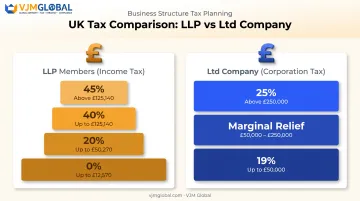
The tax gap is the biggest practical difference. For 2026-27, individual LLP members pay Income Tax on their profit share at the standard bands:
- 0% up to £12,570
- 20% up to £50,270
- 40% up to £125,140
- 45% above that
Rates are set out on gov.uk's Income Tax rates page. A corporate LLP member pays Corporation Tax instead of personal Income Tax.
A Ltd company pays Corporation Tax at 19% on profits up to £50,000, with marginal relief up to £250,000, and 25% above that. For a Singapore founder retaining profit inside the UK entity rather than distributing it, the Ltd route is often more tax-efficient at scale.
What Is a UK Limited Liability Partnership (LLP)?
A UK LLP blends partnership-style flexibility with limited liability protection. It's a separate legal entity, a body corporate under the LLP Act 2000, but it isn't taxed like one.
That structure makes it particularly relevant for Singapore professional firms opening a UK branch or joint venture with local partners. Three features drive that appeal:
- Tax transparency avoids the double layer of tax that a company structure can create, since profits flow straight to members
- Private LLP agreements keep profit-sharing terms off the public record, unlike a company's shareholder agreements
- No formal board requirement means governance stays lighter than a Ltd company's director/shareholder split
Singapore companies or individuals can become LLP members without living in the UK. There's no residency bar on membership itself, though Companies House does require each member's usual residential address and country of residence on file, along with a UK registered office.
At least two designated members must be in place at all times. These are the people responsible for statutory filings, distinct from ordinary members who simply hold a profit share.
Where LLPs Fit for Singapore Firms
An LLP tends to make sense at a specific point in a Singapore firm's UK entry: when the business is a professional partnership joining forces with UK-based practitioners rather than setting up a standalone trading arm.
LLPs are especially common in legal, accountancy, architecture and consulting practices across the UK. That's largely because these sectors already operate on a partner-profit-share model back home, so an LLP mirrors familiar economics while adding UK limited liability protection.
A Singapore accountancy or consultancy firm entering a UK joint venture, for example, would typically find the LLP's private profit-sharing terms and lighter governance a more natural fit than a full company structure.
What Is a UK Limited Company (Ltd) — the LLC Equivalent?
Here's the terminology point that trips up most Singapore founders: the UK has no entity called an "LLC." The private limited company (Ltd) is the closest functional match to what Singapore calls a Pte Ltd: separate legal personality, limited liability, and Corporation Tax at the company level.
Calling it an "LLC" is comparison shorthand rather than an official UK classification, but it's the right mental model.
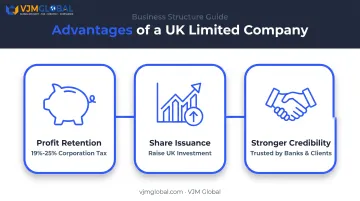
A Ltd company offers three operational advantages over an LLP for most trading businesses:
- Profit retention at Corporation Tax rates of 19%-25%, rather than personal Income Tax rates that can reach 45%
- Share issuance to raise UK investment, which an LLP structure doesn't support in the same way
- Stronger perceived credibility with UK clients, landlords and banks, who are simply more used to dealing with limited companies
A Singapore parent company or individual founders can hold 100% of the shares as sole shareholders, and there's no requirement for a UK-resident director. The company still needs a UK registered office, but the people running it can sit in Singapore.
One early structural decision matters: setting up a UK Ltd subsidiary versus registering a UK branch of the Singapore parent. A branch isn't a separate legal entity. Liabilities flow back to the Singapore parent. Most Singapore businesses prefer a subsidiary precisely because it separates UK trading risk from the parent company.
Where Ltd Companies Fit for Singapore Businesses
A Ltd company typically enters the picture when a Singapore business is opening a local sales office, warehouse, or trading entity rather than joining a professional partnership.
E-commerce, manufacturing, distribution, tech and retail businesses commonly choose this route. Singapore SMEs expanding into UK retail or distribution, for instance, need an entity that can sign commercial leases, hold stock, hire staff under PAYE, and eventually take on UK or international investment. An LLP's partnership structure simply isn't built for that trajectory.
LLP vs Ltd: Which Should Singapore Businesses Choose?
There's no single right answer. The best structure depends on how you weigh four factors:
- Nature of the business — professional services partnership versus trading or product company
- Investment plans — whether you'll need to raise UK capital through share issuance
- Profit distribution preference — flexible, private profit-sharing versus retained earnings at company tax rates
- Compliance appetite — an LLP skips the Corporation Tax return; a Ltd company carries fuller filing obligations
The Double Taxation Agreement changes the maths
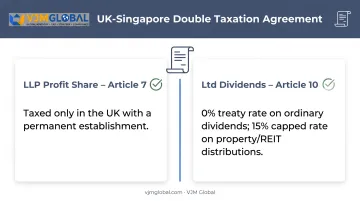
This is the factor Singapore founders most often miss. The UK-Singapore Double Taxation Agreement treats LLP profit share and Ltd dividends differently.
Under the synthesised text of the 1997 UK-Singapore Double Taxation Agreement, LLP business profits fall under Article 7. They are taxed only in the UK where there is a UK permanent establishment.
Ltd company dividends fall under Article 10. The treaty rate for ordinary dividends is 0%, though property or REIT distributions face a capped rate of 15%.
That distinction can shift the effective tax outcome for a Singapore parent entity, depending on how profits are repatriated. Get professional tax advice before finalising the structure. It is not a detail to guess at.
Choose an LLP if your Singapore business is a professional partnership entering the UK jointly with local partners, and you prioritise flexible, private profit-sharing over investment-readiness.
Choose a Ltd company if you want a scalable, investment-ready UK subsidiary with lower retained-profit tax and stronger commercial credibility with banks and clients.
Real-World Example: A Singapore Business Entering the UK
Picture a Singapore-based consulting firm preparing to open a UK office. The founders face a familiar dilemma: partner-style profit-sharing fits their business model, but they're unsure whether an LLP will look credible enough to UK corporate clients used to dealing with limited companies.
The uncertainty usually comes down to three questions:
- How UK tax will treat their profit share once repatriated to Singapore
- How much annual compliance the structure adds on top of their Singapore filings
- Whether UK banks will treat an LLP as seriously as a Ltd company when opening a business account
Working through these questions with a cross-border adviser before incorporating, rather than after, usually determines whether the structure fits or needs unwinding a year later.
VJM Global's cross-border entity formation team helps Singapore businesses make that call. They assess whether an LLP or Ltd company fits the model, then handle the filings that follow:
- Registration with Companies House
- Corporation Tax registration with HMRC and the Unique Taxpayer Reference
- Ongoing Confirmation Statement and CT600 cycle
If you're weighing this decision for your own UK expansion, get the structure assessed before you file anything with Companies House. Talk to VJM Global about your specific business model before registering your UK entity.
Conclusion
Neither an LLP nor a Ltd company is universally "better." A professional partnership entering the UK jointly with local practitioners will usually find the LLP's flexibility and privacy more useful. A growth-focused business chasing UK investment or trading volume will typically outgrow an LLP fast and need a Ltd company's share structure and credibility from day one.
What matters is connecting that choice back to practical outcomes:
- Tax efficiency under the UK-Singapore Double Taxation Agreement
- Compliance that does not duplicate what you already file in Singapore
- Commercial credibility with UK banks and clients
Get advice on your specific situation before you incorporate. It is far easier to choose the right structure upfront than to restructure after the fact. VJM Global supports Singapore businesses with UK entity formation and ongoing tax and compliance across both jurisdictions.
Frequently Asked Questions
What is the difference between LLC and LLP in Singapore?
In Singapore, "LLC" commonly refers to a Private Limited Company (Pte Ltd), taxed at the corporate rate and suited to scaling businesses. An LLP is partner-based, taxed at each partner's personal rate, and commonly used by professional firms.
Which is better for my business, an LLP or an LLC?
There's no universal answer. It depends on ownership structure, risk exposure, and whether you need to raise capital. A limited company (Ltd) suits most growth-focused businesses; an LLP suits licensed professional partnerships.
Does the UK have an LLC like Singapore does?
No. The UK has no entity called "LLC." The UK Ltd (private limited company) is the functional equivalent, offering separate legal status, limited liability and Corporation Tax treatment.
Can a Singapore company be a member of a UK LLP or shareholder of a UK Ltd?
Yes. Singapore companies and individuals can be LLP members or Ltd shareholders/directors without UK residency, though the entity needs a UK registered office and an accessible compliance contact.
How does the UK-Singapore tax treaty affect my choice of structure?
Under the Double Taxation Agreement, LLP profit share is typically taxed in the partner's hands, while Ltd dividends may qualify for relief when repatriated to Singapore. Get professional tax advice before finalising your structure.
Is it harder to set up a UK LLP or a UK Ltd company as a foreign business?
Both register through Companies House on similar timelines. A Ltd company requires share and director details; an LLP requires at least two designated members and a private LLP agreement.