Introduction
Dubai's VARA, Abu Dhabi's ADGM, and the DIFC have turned the UAE into one of the most closely watched regulated hubs for virtual asset businesses anywhere in the world. Clear licensing frameworks, 0% personal income tax, and rising institutional adoption are pulling founders away from the fragmented US regulatory patchwork.
US-based crypto exchanges, custodians, NFT platforms, blockchain funds, and fintech startups are all asking the same question: should we set up in the UAE? The appeal is real, but so is the paperwork.
This guide walks through exactly what a US firm needs to know, decide, and file to legally establish a digital asset company in the UAE, from choosing a regulator to keeping US tax obligations in check.
Key Takeaways
- Three regimes license virtual asset activity: VARA (Dubai), ADGM/FSRA (Abu Dhabi), and DIFC/DFSA
- UAE offers 0% personal income tax and 9% corporate tax above AED 375,000
- US ownership triggers CFC, GILTI, and Form 5471 obligations that require parallel US planning
- Setup involves jurisdiction choice, licensing, AML/CFT build-out, and regulatory review
- 100% US ownership is permitted in most UAE free zones
What Is a Digital Asset Company in the UAE?
A digital asset company, often called a Virtual Asset Service Provider (VASP), is any entity licensed to deal in cryptocurrencies, tokens, NFTs, or related financial services. It's a broad category covering very different business models.
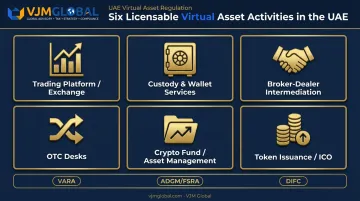
Core licensable activities include:
- Operating a trading platform or exchange
- Custody and wallet services
- Broker-dealer intermediation
- OTC desks
- Crypto fund or asset management
- Token issuance (ICOs/ITOs)
Each activity falls under one of three licensing environments, and each comes with its own rulebook, fee schedule, and activity scope.
| Regulator | Jurisdiction | Scope |
|---|---|---|
| VARA | Dubai mainland and free zones (excluding DIFC) | Governs under Dubai Law No. 4 of 2022 |
| ADGM/FSRA | Abu Dhabi | Regulates virtual asset activities in the Abu Dhabi Global Market |
| DIFC/DFSA | Dubai's separate financial free zone | Operates under its own distinct rulebook |
Picking the wrong one is the single most common early mistake US founders make.
Why US Firms Are Choosing the UAE for Digital Asset Business
A UAE setup makes sense under specific conditions, not as a universal shortcut. It works when your firm needs regulatory recognition, tax efficiency, and access to liquidity that's harder to find domestically.
Regulatory clarity and first-mover credibility. ADGM built one of the world's first comprehensive virtual asset frameworks, and VARA remains the world's first dedicated virtual asset regulator. For US firms used to fighting over whether a token is a security, having a named regulator with a published rulebook is a genuine relief.
Tax efficiency. There's no personal income tax, and most virtual asset transfers and custody services are VAT-exempt. The UAE's Federal Tax Authority confirmed via VATP040 that virtual asset transfers and conversions are VAT-exempt retroactively from January 2018, with custody exemptions applying from November 2024. Free zone entities may also qualify for corporate tax benefits depending on activity.
Market momentum. The region isn't just talk. The UAE received more than $30 billion in on-chain value between July 2023 and June 2024, a 42% year-over-year jump, according to Chainalysis. That kind of growth attracts institutional partners, not just retail traders.
Other strategic advantages:
- Bridge access to Middle East, African, and Asian investor capital
- A time zone that overlaps with both US mornings and Asian evenings
- A licensed entity that supports global banking relationships harder to build directly from the US
Key Considerations Before You Start
Most US firms underestimate how different VARA, ADGM, and DIFC actually are — and how much US compliance stacks on top.
Cost and Timeline Reality
Regulator fees vary sharply by activity, and none of the three publish an all-in setup cost covering incorporation, office space, advisers, and staffing.
| Regime | Application Fee | Annual Fee | Notes |
|---|---|---|---|
| VARA | AED 40,000–100,000 | AED 80,000–200,000 | Per licensed activity |
| ADGM/FSRA | $20,000 add-on | $15,000 add-on | Added to underlying financial service fee |
| DIFC/DFSA | Varies by service | $15,000–$70,000 | Tied to Crypto Token fee schedule |
VARA licensing runs through two stages, initial approval and full VASP licensing. ADGM has five stages, from due diligence through operational-launch testing. Neither publishes a fixed end-to-end timeline, so build in buffer time.
The US Tax Overlay
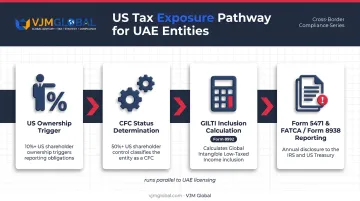
Regulator fees and timelines are only half the picture — the US side adds its own layer of complexity. A UAE entity majority or wholly owned by a US person can become a Controlled Foreign Corporation (CFC). This status applies once US shareholders holding at least 10% each control more than 50% of vote or value, and it triggers:
- GILTI inclusion calculations (Form 8992)
- Form 5471 filing obligations
- Possible FATCA/Form 8938 reporting
None of this replaces UAE licensing requirements. It runs in parallel, and it needs coordination between UAE and US advisors from day one.
Banking Friction
Licensing and tax structuring solve the legal and reporting side, but banking access is a separate battle. Even after licensing approval, opening a corporate bank account for a crypto entity remains one of the toughest practical hurdles. Regulatory certainty helps, but a license alone doesn't guarantee a bank will say yes.
One more warning: there's no single "crypto license" covering everything. Exchanges, custodians, and fund managers each need different permissions and different capital thresholds.
How to Start a Digital Asset Company in the UAE – Step by Step
This section breaks the process into the practical stages a US firm actually goes through, from choosing a jurisdiction to going live.
Common mistakes to avoid before you start:
- Assuming UAE licensing satisfies US regulatory or tax obligations (it doesn't)
- Underestimating how much AML/CFT documentation regulators expect upfront
- Picking a free zone on cost alone without checking if it licenses your specific activity
Step 1 – Choose Your Jurisdiction and License Type
Match your activity to the right regulator. A trading platform, for instance, maps to VARA's Exchange Services license, ADGM's Multilateral Trading Facility authorization, or DIFC's equivalent, but the fees, capital rules, and oversight differ substantially between them.
- VARA: Best fit for Dubai mainland/free zone activity outside DIFC
- ADGM/FSRA: Strong for asset management and fund structures
- DIFC/DFSA: Suited to firms already anchored in traditional finance
Common miss: choosing the cheapest free zone without confirming its regulator actually licenses your specific virtual asset activity.
Step 2 – Define Business Activity and Structure the Entity
Decide on a legal structure: an FZE/FZCO in a free zone, a mainland LLC, or an ADGM/DIFC private company. Then confirm 100% US ownership is permitted for your chosen activity.
You'll also need to appoint:
- A Compliance Officer with relevant experience (VARA requires five years minimum)
- A Money Laundering Reporting Officer (MLRO) with at least two years of AML/CFT experience
A frequent misstep: leaving these governance roles unfilled too late, which delays regulatory review.
Step 3 – Prepare Documentation and Submit the License Application
Core documents typically include a detailed business plan, shareholder and director KYC, an AML/CFT policy manual, technology and security architecture descriptions, and proof of capital.
Capital thresholds vary widely by activity:
- VARA custodians: higher of AED 600,000 or 25% of fixed annual overheads
- VARA exchanges: higher of AED 800,000–1.5M or 15–25%, depending on custody arrangement
- ADGM custodians: higher of $250,000 or six months of audited expenditure
One pitfall: submitting generic AML policies instead of documentation tailored to the specific activity and regulator.
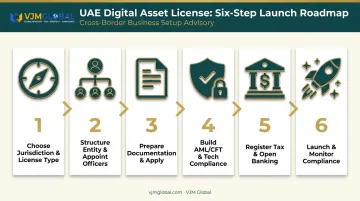
Step 4 – Build AML/CFT, Governance and Technology Compliance
UAE AML law now runs through Federal Decree-Law No. 10 of 2025, which explicitly covers VASPs. You'll need customer due diligence, enhanced due diligence for higher-risk clients, sanctions screening, and suspicious transaction reporting systems.
On the technology side, VARA's Technology and Information Rulebook requires governance over wallet security, access controls, incident response, and periodic technology audits.
Where firms often stumble: treating compliance as a one-time filing rather than a system regulators actively supervise on an ongoing basis.
Step 5 – Register for Tax, Open Banking, and Set Up Accounting
Register for UAE corporate tax at 9% above the AED 375,000 threshold, and confirm your VAT position. Most virtual asset transfer and custody activity is VAT-exempt, while mining services supplied to identifiable customers are generally taxable.
Opening a corporate bank account for a crypto entity is often the slowest part of this step, even with a completed license. Banks will typically want:
- Full licensing documentation
- Ownership and beneficial owner records
- AML policy evidence
This is also where bookkeeping and financial reporting should be set up correctly from day one. Many US founders choose to work with an experienced cross-border accounting partner for this piece.
VJM Global has spent over three decades supporting US businesses with international tax compliance, foreign asset reporting, and cross-border bookkeeping. Firms often turn to partners like this to coordinate the US side of financial reporting while UAE licensing is finalized.
Step 6 – Launch, Monitor, and Maintain Ongoing Compliance
Once licensed, set up real-time transaction monitoring, prepare for periodic regulator audits, and track renewal deadlines closely. Missing one is an easy way to lose a license you worked hard to get.
Establish a reporting cadence that satisfies both the UAE regulator and any US parent-company reporting needs. Common miss: scaling customer onboarding or marketing before AML systems are fully stabilized. Regulators notice, and it rarely ends well.
Ongoing Compliance and Choosing the Right Setup Partner
UAE regulators don't treat licensing as a one-time exercise. VARA, FSRA, and DFSA all expect continuous compliance: annual audits, AML reporting, and capital maintenance sustained throughout the life of the license.
For US firms, this compliance burden doubles. You're managing UAE regulatory obligations while also tracking:
- CFC status and GILTI calculations
- Form 5471 filing requirements
- FATCA and foreign asset disclosure (Form 8938)
Getting UAE licensing right and getting US tax treatment wrong is a common, costly gap. Coordinated advisory support that understands both sides reduces that risk.
VJM Global has spent 30+ years helping US businesses manage cross-border tax planning and foreign asset reporting obligations that come with owning a foreign entity.
UAE-specific licensing work still sits with local regulatory advisors. But a partner who understands the US tax overlay, including CFC exposure, GILTI, and DTAA positioning, means fewer surprises once your UAE entity is operational.

Success in this space comes down to getting jurisdiction, documentation, and compliance right the first time, then adapting as UAE virtual asset regulation continues to evolve.
Frequently Asked Questions
How do I get a crypto license in the UAE?
Select the right regulator (VARA, ADGM/FSRA, or DIFC/DFSA), then submit a detailed application with a business plan plus AML and KYC documentation. Capital requirements vary by activity, so confirm thresholds before applying.
How do I start an asset management company in Dubai?
Crypto fund managers typically apply through ADGM's Venture Capital Fund Manager framework or DIFC, meeting criteria on fund structure and team experience, along with a mandatory compliance officer appointment.
Can a foreigner register a company in the UAE?
Yes. US citizens and companies can fully own UAE free zone entities, and increasingly mainland entities too, subject to activity-specific ownership rules.
Do US-owned UAE digital asset companies need to report to the IRS?
Often, yes. US ownership can trigger CFC status and GILTI inclusions, along with Form 5471 filing requirements, making coordinated US-UAE tax advisory essential from the start.
What's the difference between a VARA license and an ADGM/FSRA license?
VARA governs Dubai (excluding DIFC) under Dubai Law No. 4 of 2022. ADGM/FSRA regulates Abu Dhabi's financial free zone under a separate rulebook, with distinct licensed activities and separate fee and capital requirements.
How long does it take to get a virtual asset license in the UAE?
Typically several months, depending on jurisdiction, activity complexity, and how complete your AML and compliance documentation is at submission.