Introduction
India now leads all countries in foreign direct investment into Dubai, accounting for AED 11.2 billion ($3.05 billion) in 2024—a fivefold surge from the previous year. This growth reflects the strategic appeal of UAE free zones for Indian entrepreneurs: 100% foreign ownership, zero personal income tax, and just a four-hour flight from major Indian cities.
Yet many Indian business owners enter the Dubai free zone market with incomplete cost information. License fees advertised online — often starting at AED 5,000–15,000 — represent only a fraction of the true first-year investment.
Visa processing, Emirates ID, establishment cards, office costs, mandatory health insurance, and minimum bank balance requirements can double or triple your initial budget. Underestimating these costs is the single biggest mistake founders make during setup.
This guide covers what most generic resources leave out:
- Realistic cost ranges in AED with INR equivalents
- Key cost drivers and what inflates your first-year budget
- Budget vs. premium free zone comparisons
- India-specific compliance factors: FEMA regulations, LRS remittance limits, DTAA treaty benefits, and apostille requirements
Key Takeaways
- Dubai free zone license costs range from AED 15,000 to AED 50,000+ (approximately ₹3.5 lakh to ₹12 lakh+) for the first year, all-inclusive
- License type, free zone chosen, visa count, and office plan are the four biggest cost drivers
- Budget zones like IFZA, SHAMS, and RAKEZ suit Indian solopreneurs and SMEs; premium zones like DMCC suit commodity trading
- Indian business owners must also budget for FEMA compliance, bank account minimums, and apostilled documentation costs
- Spending more upfront on the right free zone often costs less in the long run than switching later
How Much Does a Dubai Free Zone License Cost?
There is no single fixed price for a Dubai free zone license. Your total cost depends on which free zone you choose, your business activity type, how many visas you need, and the workspace option you select. Most online quotes show only the license fee—not the all-in first-year cost.
Indian business owners often budget only for the license fee and are caught off-guard by visa fees, establishment card charges, office rent, medical tests, Emirates ID, and banking requirements. This creates early cash flow problems that could have been avoided with accurate planning.
Typical Cost Range (in AED and INR)
Current exchange rate reference: 1 AED ≈ ₹23.50 (rates fluctuate; verify at time of remittance)
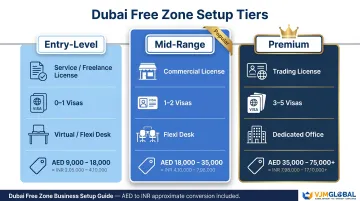
Entry-level setup (service/freelance license, no visa, virtual office or flexi desk):
- AED 9,000–18,000 (approximately ₹2.1 lakh–₹4.2 lakh)
- Best for: Indian freelancers, consultants, and solopreneurs testing the Dubai market or managing the business remotely
Mid-range setup (service or commercial license, 1–2 visas, flexi desk):
- AED 18,000–35,000 (approximately ₹4.2 lakh–₹8.2 lakh)
- Best for: Indian SMEs, startup founders, or service businesses that need UAE residency and a basic operational presence
Premium/trading setup (trading or general trading license, 3+ visas, dedicated office or warehouse):
- AED 35,000–75,000+ (approximately ₹8.2 lakh–₹17.5 lakh+)
- Best for: Indian trading businesses, import/export companies, commodity traders, or those building a team in Dubai
What Each Setup Typically Includes
The cost tiers above cover different combinations of components. Here's what you can expect at each level:
| Component | Entry-Level | Mid-Range | Premium |
|---|---|---|---|
| License type | Service or freelance | Commercial or professional | Trading or general trading |
| Visas included | 0–1 | 1–2 | 3–5 |
| Workspace | Virtual office or flexi desk | Flexi desk or co-working | Dedicated office or warehouse |
| Establishment card | Not always included | Included | Included |
| Emirates ID & medical | Not applicable | Per visa applicant | Per visa applicant |
| Regulatory approvals | Rarely required | Occasionally required | Sometimes required (e.g., gold, food, pharma) |
Note that commodity traders dealing in gold, precious metals, coffee, or spices may face additional regulatory approval costs not reflected in the base premium range.
Key Factors That Affect Dubai Free Zone License Costs
Pricing is shaped by a mix of operational, regulatory, and structural decisions. Getting these right before you apply can save Indian business owners tens of thousands of dirhams, and help you avoid expensive free zone switches down the line.
License and Activity Type
The type of license directly determines the base fee:
- Service licenses (consulting, IT, marketing): Lower cost, typically AED 10,000–20,000
- Professional licenses (accounting, legal, healthcare): Similar to service licenses
- Commercial/trading licenses (import/export, distribution): Higher cost, typically AED 20,000–40,000
- General trading licenses (multiple commodities): Premium pricing, often AED 30,000+
Indian IT consultants, digital marketers, and service exporters typically qualify for lower-cost service or professional licenses. Those importing textiles, electronics, or food products require commercial or trading licenses.
Free Zone Selection
Different free zones have vastly different fee structures:
- Budget zones (SHAMS, RAKEZ, IFZA): AED 6,000–15,000 starting cost
- Mid-tier zones (Meydan, Dubai South): AED 12,000–22,000 starting cost
- Premium zones (DMCC, DIFC): AED 35,000–45,000+ starting cost
Free zone selection also affects credibility, banking ease, and visa quota. Premium zones like DMCC are known for smoother corporate bank account approvals—worth considering, given the enhanced due diligence Indian nationals sometimes face.
Visa Count and Type
Each visa adds costs beyond the base fee. Per visa, budget for:
- Visa fee: AED 3,500–5,000+
- Emirates ID: AED 300 (2-year validity)
- Medical test: AED 250–700
- Health insurance: AED 320+ annually
The number of visas also determines the minimum office size required by free zone rules, which pushes rent costs higher. DMCC, for example, requires larger office space for 3+ visas.
Office or Workspace Type
- Virtual office: AED 2,000–5,000/year (address only, no physical workspace)
- Flexi desk: AED 5,000–15,000/year (shared co-working space)
- Shared office: AED 15,000–25,000/year (dedicated desk in shared suite)
- Dedicated office: AED 20,000–50,000+/year (private office space)
Indian business owners running lean, remote-first operations benefit most from flexi desk or virtual office options. Those needing in-person client meetings should budget for shared or dedicated office space.
External Approvals for Regulated Activities
Some business activities require additional government approvals, adding AED 500–3,000+ to setup costs:
- Food trading or import (Dubai Municipality approval)
- Healthcare services (DHA approval)
- Education/training (KHDA approval)
- Financial services (DFSA or Central Bank approval)
Indian businesses commonly affected include food exporters, pharmaceutical traders, and Ayurvedic/wellness product distributors.
Complete Cost Breakdown for Indian Business Owners
The license fee is just one line item. Your actual first-year cost includes registration charges, visa fees, office space, bank minimums, and India-side document costs. Here is the full picture, broken down by one-time and recurring expenses.
One-Time Setup Costs
| Cost Item | AED Range | Approximate INR | Notes |
|---|---|---|---|
| License registration fee | 1,000–2,500 | ₹23,500–₹58,750 | Application and name reservation |
| Memorandum of Association drafting | 2,000–2,500 | ₹47,000–₹58,750 | Legal incorporation documents |
| Establishment card | 300 | ₹7,050 | Mandatory for all free zone companies |
| Visa application and stamping (per person) | 2,500–3,000 | ₹58,750–₹70,500 | Outside UAE processing |
| Emirates ID (2 years) | 300 | ₹7,050 | Government identity card |
| Medical fitness test (per person) | 250–700 | ₹5,875–₹16,450 | Mandatory for visa issuance |
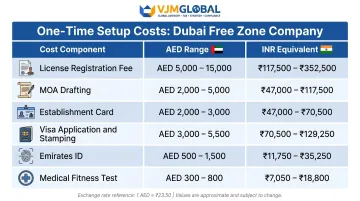
Note: INR conversions based on 1 AED ≈ ₹23.50 (subject to exchange rate fluctuation at time of remittance)
Recurring Annual Costs
Indian entrepreneurs face these costs at license renewal:
- License renewal fee: AED 10,000–40,000/year depending on free zone and license type
- Establishment card renewal: AED 100/year
- Office/flexi desk lease renewal: AED 5,000–50,000/year depending on workspace type
- Visa renewals: Every 2–3 years (AED 2,500–3,000 per person)
- Health insurance: AED 320–1,500/year per visa holder (mandatory)
Renewal costs typically match first-year setup costs — budget for them from day one.
Hidden and Often-Missed Costs
These line items rarely appear in free zone cost summaries, but they affect your actual cash requirement:
- Business bank account minimum balance: AED 10,000–100,000 depending on the bank (RAKBank: AED 25,000; ADCB: AED 100,000)
- Health insurance for visa holders: AED 320+ per person annually (mandatory—penalties up to AED 150,000 for non-compliance)
- Document translation and attestation: AED 500–2,000 for Indian documents
- Apostille fees in India: ₹5,000–₹15,000 per document set (MEA charges plus agent fees)
- Courier and attestation for documents from India: AED 500–1,500
These hidden costs can add AED 5,000–15,000 to your total first-year budget.
Total First-Year Budget Estimate
| Setup Tier | License + Registration | Visa (1 person) | Emirates ID + Medical | Office/Flexi Desk | Bank Minimum Balance | Total Range (AED) | Approximate INR |
|---|---|---|---|---|---|---|---|
| Entry-level | 9,000–12,000 | 0 (no visa) | 0 | 5,000–8,000 | 10,000 | 24,000–30,000 | ₹5.6–7.0 lakh |
| Mid-range | 15,000–20,000 | 3,000 | 1,000 | 8,000–12,000 | 25,000 | 52,000–61,000 | ₹12.2–14.3 lakh |
| Premium | 35,000–45,000 | 9,000 (3 visas) | 3,000 | 20,000–30,000 | 50,000 | 117,000–137,000 | ₹27.5–32.2 lakh |
Use the tier that matches your setup plan as a starting point for remittance planning — then add India-side attestation costs from the hidden costs section above.
Budget vs. Premium Free Zones for Indian Entrepreneurs
Choosing the right free zone shapes your total startup cost more than almost any other decision. The cheapest option does not always deliver the best value for Indian business owners — banking ease, visa flexibility, and setup timelines all factor into the real cost.
Free Zone Comparison Table
| Free Zone | Starting License (AED) | 1-Visa Package (AED) | Flexi Desk (AED/yr) | Best For |
|---|---|---|---|---|
| RAKEZ | 6,000 | 16,500 (all-inclusive) | Included | Budget startups, trading, consulting |
| SHAMS | 5,750–8,050 | 11,000–13,420 | Not published | Media, creative, e-commerce, freelancers |
| Meydan | 12,500 | ~14,350 | Included | IT consulting, general trading, digital businesses |
| IFZA | 12,900 | 14,900 | Included | General trading, consultancy, services |
| Dubai South | 8,500–14,000 | Not published | Not published | Logistics, aviation, e-commerce near airport |
| DMCC | 35,484 (Basic Biz pkg) | 43,780 (Jump Start) | 16,000–19,000 | Commodities, crypto, premium banking, large enterprises |
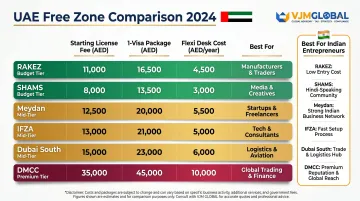
Source notes: RAKEZ, Meydan, and DMCC pricing confirmed from official free zone websites; SHAMS, IFZA, and Dubai South pricing based on secondary sources—verify directly with the free zone before committing.
Key Trade-Offs
The table shows license costs, but the real trade-offs go deeper. Here's what each tier means in practice:
Budget zones (SHAMS, RAKEZ):
- Lowest entry cost across the UAE free zone landscape
- Well-suited for Indian service businesses, freelancers, and e-commerce operators
- Corporate bank account approvals can take longer due to lower brand recognition with UAE banks
- Located outside Dubai (Sharjah, Ras Al Khaimah) — factor in commute and client perception
Premium zones (DMCC):
- Higher upfront cost, but banking relationships are a genuine advantage
- Best fit for Indian commodity traders, precious metals businesses, and companies needing institutional banking
- 26,000+ registered companies make it the world's largest free zone
- Indian entrepreneurs in trading and commodities typically find bank account approvals faster here, given DMCC's established reputation with UAE banks
India-Specific Considerations Before You Set Up in Dubai
FEMA Compliance and LRS Limits
Indian residents who wish to invest in a foreign business must do so under the Liberalised Remittance Scheme (LRS), which allows up to USD 250,000 per financial year (April–March) per resident individual.
Key points:
- The limit is aggregate across all permitted current and capital account transactions
- Tax Collected at Source (TCS): 20% on remittances above ₹7 lakh for investment purposes (refundable against income tax, but creates short-term cash flow impact)
- NRIs and OCIs operate under different, generally simpler rules and are not subject to LRS
- Mandatory PAN for all LRS transactions
Most Dubai free zone setups (AED 6,000–44,000, i.e., USD 1,600–12,000) fall well within this limit. However, budget for TCS if your total remittance—license, visa, office, bank balance—exceeds ₹7 lakh.
VJM Global's FEMA advisory team helps Indian entrepreneurs manage LRS remittances, ODI filings, and annual reporting—late or incorrect filings attract penalties under FEMA Section 42.
India-UAE Double Tax Avoidance Agreement (DTAA)
The India-UAE DTAA (in force since 1993) provides tax relief for Indian business owners operating Dubai free zone companies:
- Business profits: Taxable only in the state of residence unless a permanent establishment exists in the other state
- Dividends: Maximum 10% withholding tax
- Interest: 5% (banks/financial institutions); 12.5% (others)
- Royalties: Maximum 10% withholding tax
Critical requirement: Treaty benefits are not automatic. Article 29 (limitation of benefits) denies benefits if the main purpose of creating the entity was to obtain treaty benefits. You must demonstrate genuine substance in the UAE—employees, office, decision-making—to claim treaty protection.
Residency rules:
- Individual: Present in UAE for at least 183 days in a calendar year
- Company: Incorporated in UAE and managed and controlled wholly in the UAE
Running a "letterbox" company from India without genuine UAE operations risks having treaty benefits denied—resulting in full Indian taxation of worldwide income.
Documentation Requirements Specific to Indian Nationals
Documents required for Dubai free zone company incorporation (based on Meydan Free Zone official guidance):
Core requirements:
- Passport copy (minimum 6 months validity remaining)
- Passport-sized photograph (UAE specification)
- Basic KYC information (personal and contact details)
- Business activity selection
Additional (scenario-specific):
- NOC from current employer (if employed in India or UAE)
- Certificate of Incorporation + MOA/AOA (apostilled)—for branch office of existing Indian company
- Board Resolution and Power of Attorney—for branch office setup
- Proof of address (utility bill, bank statement, tenancy contract)—when specifically requested
Explicitly NOT required (per Meydan Free Zone):
- Aadhaar Card
- PAN Card
- Degree Certificates
- CA-issued Net Worth Certificate
- Company Seal or Authorised Signatory Stamp
Apostille for Indian Documents
India has been a member of the Hague Apostille Convention since 2005. Apostilled Indian documents are accepted in the UAE for authentication purposes, replacing the older full embassy attestation/legalization process.
Apostille services are available through the Ministry of External Affairs (MEA) and its regional offices across India. Budget ₹5,000–₹15,000 per document set (MEA charges plus agent fees) and 10–15 business days for processing.
How to Budget Smartly and Avoid Costly Mistakes
Smart Budgeting Framework
Follow this practical framework to estimate your correct budget:
- Start with license type needed: Service, commercial, or trading
- Add visa count: Owner + family + employees (each visa = AED 3,500–5,000 + ongoing costs)
- Choose the most cost-effective free zone that supports banking and your activity
- Layer in one-time costs: Emirates ID, medical, establishment card, apostille
- Layer in recurring costs: License renewal, office rent, health insurance
- Add bank minimum balance: AED 10,000–100,000 depending on bank
- Budget for FEMA/LRS compliance filings back in India: ₹15,000–50,000 in CA fees annually
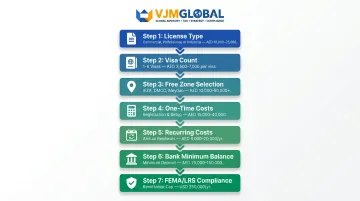
VJM Global offers end-to-end guidance for Indian entrepreneurs setting up in Dubai—from cost planning to FEMA compliance, DTAA structuring, and ongoing APR filing support.
Four Budgeting Mistakes Indian Business Owners Commonly Make
Even with the right framework, these errors catch many first-time Dubai incorporators off guard.
1. Planning only in AED, ignoring INR remittance costs
- Exchange rate fluctuations can add 3–5% to your effective budget
- TCS of 20% on remittances above ₹7 lakh creates short-term cash flow pressure
2. Choosing a free zone based solely on license price
- Budget zones sometimes face longer timelines or stricter scrutiny at corporate bank account opening
- Zones like DMCC tend to deliver faster banking approvals despite higher upfront costs
3. Treating year-one costs as the full picture
- License, visa, and office renewals in year two collectively approach 80% of your first-year setup spend
- Build this into your financial plan before you incorporate, not after
4. Skipping FEMA/LRS compliance back in India
- Required filings include Form A2 per remittance, Form ODI Part I at investment, and APR by December 31 annually
- CA fees run ₹15,000–50,000/year; non-compliance can trigger FEMA penalties
Final Insight
The lowest upfront license cost rarely produces the lowest total cost of ownership. Factor in visa requirements, banking compatibility, renewal cycles, and India-side compliance before you commit to a free zone. That complete picture is what separates a well-structured Dubai setup from one that creates avoidable financial and regulatory headaches in year two.
Frequently Asked Questions
How much does it cost to set up a free zone in Dubai?
The realistic all-in first-year cost ranges from AED 15,000 to AED 50,000+ (approximately ₹3.5 lakh to ₹12 lakh+), depending on the free zone, license type, visa count, and office type. The license fee alone is only part of the total investment—factor in visa fees, Emirates ID, medical tests, office rent, and bank minimums.
How much is a 2-year freelance visa in Dubai?
A Dubai freelance visa typically costs AED 7,000–10,000 for two years (approximately ₹1.6 lakh–₹2.3 lakh), including visa fees, Emirates ID, and medical test. Some free zones like DMCC and SHAMS include visa allocation in their freelance license packages.
What business can I start with 50,000 AED in Dubai?
AED 50,000 is sufficient for a professional service, consultancy, or e-commerce business in a budget-friendly free zone like IFZA, SHAMS, or RAKEZ. This covers the license, one visa, flexi desk, and initial bank balance—and supports businesses in IT consulting, digital marketing, content creation, or general trading.
Can Indian nationals open a business bank account in Dubai with a free zone license?
Yes, Indian nationals can open a corporate bank account in Dubai with a free zone license. Minimum balance requirements vary: RAKBank requires AED 25,000, while ADCB requires AED 100,000. Choosing a premium zone like DMCC often leads to faster bank approval.
Do Indian business owners need to comply with FEMA regulations when investing in Dubai?
Yes, Indian residents must comply with FEMA and the Liberalised Remittance Scheme (LRS), which allows up to USD 250,000 per financial year for foreign investments. NRIs and OCIs operate under different, generally simpler rules. Professional FEMA advisory is strongly recommended before remitting funds—cross-border compliance errors can be costly.
What documents from India are required for a Dubai free zone company setup?
Key documents include a valid passport (minimum 6 months validity), Indian address proof, bank statements, and—if applicable—apostilled incorporation documents from India for branch office setups. Apostillation adds ₹5,000–₹15,000 per document set and 10–15 business days processing time, which should be budgeted in advance.