Introduction
Dubai and Singapore have emerged as the top two overseas business destinations for Indian entrepreneurs. Over 4,543 Indian-owned businesses joined the Dubai Chamber of Commerce in Q1 2025 alone, while Singapore's Indian community represents 9% of the population with deep business networks. The right choice depends heavily on how each jurisdiction interacts with India's regulatory framework — not just tax rates and incorporation fees.
For Indian entrepreneurs, most generic comparisons miss the factors that matter most:
- DTAA treatment — how each country's tax treaty with India prevents double taxation
- FEMA and RBI obligations — compliance requirements that follow you regardless of where you incorporate
- Indian community networks — established business ecosystems that affect deal flow and hiring
- Time zone proximity — operational relevance for teams and clients based in India
- Market access — whether Dubai's Gulf connectivity or Singapore's Southeast Asian reach fits your growth plan
Get the structure wrong, and you risk costly regulatory missteps with both foreign and Indian authorities.
This guide cuts through the noise to give Indian entrepreneurs a clear, India-aware comparison — so you can pick the jurisdiction that fits your business, not just the one with the lowest headline tax rate.
Key Takeaways
- Dubai offers 0% corporate tax in qualifying free zones and 9% for mainland companies, with zero personal income tax — ideal for founders prioritizing personal tax optimization
- Singapore's 17% corporate tax drops to an effective 4.25% for eligible start-ups in the first 3 years, with no capital gains tax
- Both have DTAAs with India preventing double taxation, but Indian tax residents must still report global income
- Dubai suits businesses targeting Middle East, Africa, and Europe; Singapore is stronger for Southeast Asia and Asia-Pacific markets
- Whichever you choose, India-side FEMA and tax obligations don't disappear — cross-border compliance remains essential
Dubai vs Singapore: Quick Comparison at a Glance
| Parameter | Dubai (UAE) | Singapore | |-----------|-------------|-----------|\n| Corporate Tax Rate | 0% (qualifying free zones) / 9% (mainland, above AED 375,000) | 17% headline; ~4.25% effective rate for start-ups (first 3 years) | | Personal Income Tax | 0% | Up to 24% progressive | | GST/VAT | 5% | 9% | | Time to Incorporate | 3-7 working days (free zone) | 1-3 days online | | Foreign Ownership | 100% (free zones and most mainland sectors since 2021) | 100% allowed | | DTAA with India | Yes (1993, amended) | Yes (1994, amended 2017) | | Key Market Access | Middle East, Africa, Europe | Southeast Asia, Asia-Pacific, ASEAN | | Residency/Visa Options | Investor Visa, 10-year Golden Visa (AED 2M+ investment) | EntrePass (strict criteria), Employment Pass | | Annual Compliance Cost | AED 8,000-13,000+ (free zone renewal) | SGD 500-2,000 (filing, registered address, secretary) |
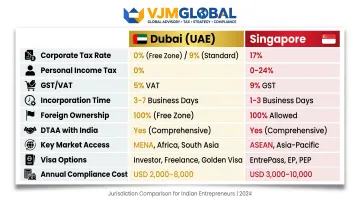
One structural difference matters more than the numbers: Dubai operates through distinct free zones, each with its own regulations, alongside a mainland setup influenced by Islamic commercial law principles. Singapore runs as a single unified jurisdiction under English Common Law — the same framework underpinning Indian corporate law — which means Indian entrepreneurs typically find compliance processes more familiar from day one.
Setting Up in Dubai: What Indian Entrepreneurs Need to Know
Business Structure and Setup Process
Dubai offers three main incorporation routes, each with distinct advantages:
Free Zone Setup (most popular with Indian entrepreneurs):
- Allows 100% foreign ownership with zero restrictions
- No import/export duties on goods
- Simplified licensing and registration process
- Completed in 3-7 working days
- Popular zones: DMCC (attracted 160+ new Indian businesses in 2024), IFZA, DIFC
- Costs: Registration from AED 9,000, license fees AED 10,000-50,000 depending on activity type
- Annual renewal: AED 8,000-13,000+ for most free zones
Mainland (Onshore) Setup:
- Federal Decree-Law 26/2020 (effective 2021) allows 100% foreign ownership in most sectors
- Required for businesses selling directly to UAE domestic market
- Higher licensing and annual renewal fees compared to free zones
- More stringent compliance and local regulations
- Necessary for government contracts and local B2B sales
Offshore Setup:
- Suitable for holding companies, IP ownership, or international trading
- Cannot conduct business within the UAE market
- Lowest compliance requirements but most limited operational scope
Tax Environment for Indian Entrepreneurs
UAE Corporate Tax Structure:
- 0% on taxable income up to AED 375,000
- 9% on income above AED 375,000 (for mainland companies)
- Qualifying Free Zone Persons (QFZP) can maintain 0% tax rate on eligible income if they meet specific conditions
- Zero personal income tax — a major draw for founder-directors taking salary or dividends
India-UAE DTAA Implications:
The India-UAE tax treaty provides relief from double taxation with reduced withholding rates on cross-border income:
- Dividends: 10%
- Interest: 5% (some cases 12.5%)
- Royalties: 10%
Critical for Indian residents: The DTAA prevents double taxation — it doesn't erase Indian tax obligations. If you're still classified as "Resident in India" under the Income Tax Act (generally 182+ days in India), you remain liable for:
- Reporting global income in your Indian ITR, including income from your Dubai entity
- Declaring foreign assets in Schedule FA (failure attracts Black Money Act penalties)
- Complying with FEMA Overseas Direct Investment (ODI) rules when investing through a Dubai entity
- Staying within the Liberalized Remittance Scheme (LRS) limit of USD 250,000 per financial year for outward remittances
Indian Entrepreneur Advantages and Use Cases in Dubai
Community and Cultural Advantage:
Dubai hosts over 3.5 million Indian residents — the largest Indian diaspora community worldwide. This translates to:
- Built-in professional networks and business referrals
- Hindi and regional Indian languages widely spoken
- Cultural familiarity reducing adaptation time
- Indian banking relationships and payment channels
That cultural infrastructure also shapes which business models thrive here. Dubai's regulatory and logistical setup makes the most sense for:
| Business Model | Why Dubai Works |
|---|---|
| Import-Export & Trading | Tax-free zones, Jebel Ali Port infrastructure, strategic position between Asia, Europe, and Africa |
| E-commerce (MENA/Europe) | 2+ billion consumers within a 4-hour flight radius; strong fulfillment and payment gateway ecosystem |
| Crypto & Web3 | VARA licenses across 8 activity categories; zero capital gains tax on crypto trading |
| Consulting & Digital Services | Zero personal income tax; time zone overlap with Europe, India, and East Africa |
| Real Estate & Logistics | Active construction sector; Golden Visa eligibility through property investment (AED 2M+) |

Setting Up in Singapore: What Indian Entrepreneurs Need to Know
Business Structure and Setup Process
The standard structure for foreign entrepreneurs is a Private Limited Company (Pte Ltd), registered through ACRA (Accounting and Corporate Regulatory Authority).
Key Requirements for Indian Founders:
- At least one locally resident director mandatory (nominee director services available initially)
- Company secretary must be appointed within 6 months of incorporation
- Registered local office address required (cannot be residential)
- Minimum paid-up capital: SGD 1 (no minimum requirement)
- Online registration completed in 1-3 days via Bizfile platform
- Incorporation cost: SGD 315 via ACRA
EntrePass Pathway:
Indian entrepreneurs wanting to relocate can apply for EntrePass, which requires:
- Innovative business concept with clear growth potential
- Venture funding of at least SGD 100,000 from recognized investors, OR
- Minimum 30% shareholding in the company
- Relevant business track record or industry experience
- Pass validity tied to business performance milestones
Compliance Environment:
Singapore requires more detailed annual compliance than Dubai free zones, but at significantly lower costs:
- Annual return filing: SGD 60 (due within one month of AGM)
- Audit requirement: Only if revenue exceeds SGD 10 million (for small companies)
- Corporate tax filing: Annual, with start-up exemptions applied automatically
- Total annual compliance cost: SGD 500-2,000 including registered address, company secretary, and filing fees
Tax Environment for Indian Entrepreneurs
Singapore Corporate Tax Structure:
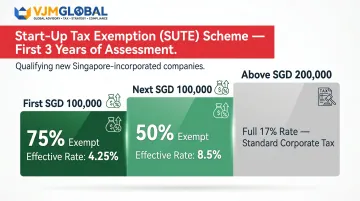
Headline rate: 17%, but the Start-Up Tax Exemption (SUTE) scheme significantly reduces the burden:
- First SGD 100,000 of chargeable income: 75% exempt (effective rate: 4.25%)
- Next SGD 100,000: 50% exempt (effective rate: 8.5%)
- Above SGD 200,000: Full 17% rate
- Exemption applies for the first three consecutive Years of Assessment
Additional Tax Advantages:
- No capital gains tax — critical for startups planning exit or asset sales
- No tax on foreign-sourced income (subject to Section 13(8) conditions: income must be subject to tax in foreign jurisdiction at minimum 15% headline rate and received through beneficial ownership)
- No dividend distribution tax
India-Singapore DTAA Benefits:
The India-Singapore tax treaty provides significant withholding tax relief:
- Dividends: 10% (under 25% shareholding) / 15% (others)
- Interest: 10% / 15% depending on loan type
- Royalties and Fees for Technical Services: 10%
This makes Singapore a preferred holding company jurisdiction for Indian businesses with IP or investment structures — dividend repatriation to India attracts only 10% withholding, compared to 15-20% under treaties with jurisdictions like Mauritius or the Netherlands.
India-Side Compliance Obligations:
Indian tax residents must still comply with FEMA ODI rules when investing into a Singapore entity:
- ODI reporting under the automatic route (up to 400% of net worth)
- Foreign asset disclosure in ITR Schedule FA
- Potential Controlled Foreign Corporation (CFC) scrutiny if the Singapore entity is deemed to be managed from India (i.e., if key decisions are made by India-resident directors)
Indian Entrepreneur Advantages and Use Cases in Singapore
The compliance picture is manageable — and Singapore's structural advantages for Indian founders go well beyond tax.
Community and Legal Familiarity:
Several factors make Singapore unusually accessible for Indian entrepreneurs:
- Substantial Indian-origin professional community (Tamil is one of four official languages)
- English as the business language with minimal translation needs
- Common Law legal system — the same foundation as India's legal framework, reducing the learning curve for contracts, disputes, and corporate governance
Best-Suited Business Models:
SaaS and Technology Companies:
- Strong IP protection framework under Singapore law
- Access to government grants (Startup SG Founder: up to SGD 50,000 with 1:1 co-funding)
- Proximity to Southeast Asian tech talent pools
- Recognized jurisdiction for global B2B SaaS sales
Fintech Startups:
MAS provides one of Asia's clearest regulatory environments for financial services:
- Payment Services Act covers digital payment tokens (DPT), stored payment instruments (SPI), and money-changing
- Regulatory sandbox for testing innovative financial products before full licensing
- Established banking relationships with global financial institutions
Biotech/Pharma and Regional HQ:
- Government R&D incentives alongside world-class research institutions (A*STAR, NUS, NTU)
- Regulatory pathway for FDA/EMA-equivalent approvals, with strong IP protections for life sciences
- Singapore sits at the center of a combined ASEAN consumer market of nearly 600 million people across Indonesia, Vietnam, Thailand, Malaysia, and the Philippines
- ASEAN Free Trade Area (AFTA) tariff advantages and established logistics infrastructure for regional distribution
VC-Backed Startups and Future IPO Pathways:
- Singapore Exchange (SGX) provides exit liquidity for founders planning a public listing
- Venture capital ecosystem with 400+ active VC firms across US, EU, and Asia
- Trusted base for institutional fundraising, with a clear regulatory pathway from seed to Series A
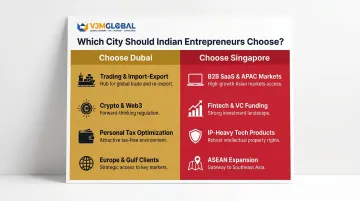
Dubai vs Singapore: Which City Should Indian Entrepreneurs Choose?
| Business Scenario | Recommended City | Rationale |
|---|---|---|
| Import-export or general trading business | Dubai | Tax-free zones, no customs duties, strategic location for re-export |
| B2B SaaS targeting Asia-Pacific clients | Singapore | Tech ecosystem, credibility with APAC enterprises, IP protection |
| Crypto/Web3 venture | Dubai | VARA licensing, zero capital gains tax, progressive regulatory stance |
| Fintech startup seeking VC funding | Singapore | MAS regulatory framework, established VC ecosystem, global credibility |
| Founder prioritizing personal tax savings | Dubai | Zero personal income tax vs. Singapore's 24% top rate |
| Tech product requiring strong IP protection | Singapore | Robust IP laws aligned with international standards, enforcement mechanisms |
| Clients primarily in Europe or the Gulf | Dubai | Time zone overlap, geographic proximity, cultural familiarity with MENA markets |
| ASEAN market expansion (Indonesia, Vietnam, Thailand) | Singapore | ASEAN gateway, regional trade agreements, established distribution networks |
Choosing between the two cities is only half the equation. Whichever location you select, Indian entrepreneurs must also stay compliant on the India side — and the rules here are unforgiving.
India Compliance: The Critical Angle
FEMA Overseas Direct Investment (ODI) Rules:
- Automatic route allows investment up to 400% of net worth without prior RBI approval
- Annual reporting required through designated AD Category-I banks
- Violations attract penalties under FEMA
Income Tax Reporting:
- Schedule FA/AL in ITR must disclose all foreign assets and accounts
- Non-disclosure attracts penalties under the Black Money Act
- Tax residency determined by 182-day rule (Section 6, Income Tax Act)
Controlled Foreign Corporation (CFC) Scrutiny:
- Indian tax authorities can tax overseas entity income in India if they determine the entity is controlled from India
- Substance requirements: local directors, local decision-making, genuine business operations
Getting the structure wrong from the start can trigger double taxation, FEMA penalties, or CFC reclassification. VJM Global works with Indian entrepreneurs to navigate both the foreign jurisdiction setup and India-side reporting obligations — from ODI filings to Schedule FA disclosures — so compliance doesn't become a costly afterthought.
Ongoing Cost of Operations
Dubai Annual Costs (Free Zone Example - DMCC):
- License renewal: AED 10,000-50,000 (activity-dependent)
- Registration renewal: AED 9,000+
- Registered office/flexi-desk: AED 8,000-15,000
- PRO services: AED 3,000-5,000
- Total: AED 30,000-80,000 annually (USD 8,000-22,000)
Singapore Annual Costs:
- ACRA annual return: SGD 60
- Company secretary: SGD 300-1,000
- Registered address: SGD 150-500
- Accounting and tax filing: SGD 1,000-3,000
- Nominee director (if required): SGD 2,000-5,000
- Total: SGD 3,500-9,500 annually (USD 2,600-7,000)
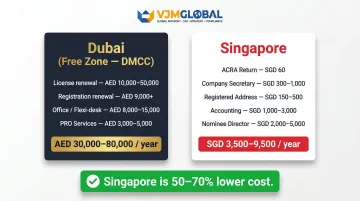
Singapore's compliance costs are 50-70% lower than Dubai free zones, making it the leaner option for startups watching their runway.
Beyond the numbers, where you actually want to live and build your life plays a significant role in the final decision.
Lifestyle and Residency Considerations
Dubai:
- 10-year Golden Visa available (AED 2M+ investment threshold)
- Zero personal income tax maximizes take-home income
- Large Indian social community (3.5M+ residents)
- Dry climate, car-dependent lifestyle
- Arabic and English official languages
- Moderate cost of living (outside luxury segment)
Singapore:
- EntrePass requires meeting performance milestones; no guaranteed long-term residency
- Personal income tax up to 24% reduces net income
- Smaller but highly professional Indian community
- Consistently ranks in top 5 globally for quality of life, safety, and education
- Public transport infrastructure, walkable city
- Higher cost of living, especially for housing and education
For families: Singapore's education system, safety record, and multicultural environment make it attractive for entrepreneurs relocating with children. Dubai offers lower living costs and tax-free income but requires adapting to a more car-dependent, expat-heavy city environment.
Clear Situational Guidance
Choose Dubai if:
- Your business targets the Middle East, Africa, or Europe
- Personal tax optimization is a priority (zero income tax)
- You operate a trading, crypto/Web3, or import-export business that benefits from free zone structures and zero capital gains tax