
This article covers exactly what you need to know: whether Dubai has a minimum wage, the official MoHRE salary benchmarks by worker category, the landmark 2024 update for Emirati nationals, how the Wage Protection System enforces timely pay, and what all of this means practically for expats and employers.
Key Takeaways
- Dubai has no universal minimum wage — expatriate salaries are set by employment contracts
- MoHRE published non-binding salary benchmarks of AED 5,000–12,000/month, varying by qualification level
- Emirati nationals in the private sector now have a mandatory minimum of AED 6,000/month, effective 1 January 2026
- The Wage Protection System (WPS) requires all mainland employers to pay salaries on time or face permit restrictions
- Non-compliance with Emirati wage rules risks work permit suspensions and Emiratisation quota penalties
Does Dubai Have a Minimum Wage?
Unlike most countries, the UAE — including Dubai — does not have a universal, legally mandated minimum wage that applies across all sectors and nationalities. The official UAE government position states that UAE Labour Law does not stipulate a general minimum salary, though wages must be sufficient to meet employees' basic needs.
The legal mechanism to introduce one does exist. Federal Decree-Law No. 33 of 2021, Article 27, grants the Cabinet authority to set a minimum wage — either universally or for specific worker categories. No universal floor has been published under this power yet, but its use for Emirati nationals (covered below) suggests the UAE is moving toward broader wage regulation incrementally.
What This Means for Expatriate Workers
Without a statutory floor, expat compensation is governed almost entirely by individual employment contracts and market conditions — placing the burden on workers to:
- Research industry-standard salary ranges before negotiating
- Ensure all compensation components are clearly documented in the contract
- Understand what is and isn't included (housing allowance, transport, bonuses)
The absence of a universal minimum has been the subject of ongoing policy discussions. The UAE's approach has been to introduce category-based and nationality-specific thresholds rather than a blanket floor — a distinction with real consequences for both workers negotiating offers and employers structuring compensation packages.
Salary Guidelines by Worker Category in Dubai
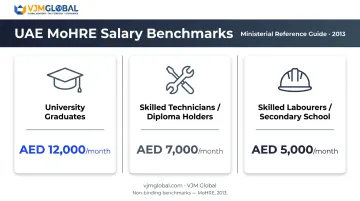
In 2013, the Ministry of Human Resources and Emiratisation (MoHRE) introduced non-binding salary benchmarks for private sector workers. These are not legally enforceable wage floors — but employers reference them widely as administrative guidelines for visa and work permit processing.
The Three MoHRE Benchmark Categories
| Worker Category | Recommended Monthly Minimum |
|---|---|
| University graduates | AED 12,000 |
| Skilled technicians / diploma holders | AED 7,000 |
| Skilled labourers (secondary school certificate) | AED 5,000 |
Important caveats:
- MoHRE has not publicly updated these figures since 2013 — treat them as historical benchmarks, not current policy
- A UAE government skills classification page (updated August 2025) sets AED 4,000/month for skilled workers at professional levels 1–5 with attested qualifications — this is a classification criterion, not a wage floor
- No hourly minimum wage exists in the UAE; salaries are structured on a monthly basis through contracts
- Free zones operate under their own employment rules, separate from mainland MoHRE requirements — employers must verify which jurisdiction applies to their staff
What Actually Drives Salaries
In practice, these benchmarks serve as a floor reference at best. Actual compensation is shaped by several market factors:
- Specialised technical and professional roles routinely earn multiples of the benchmark figures
- Finance, technology, and energy sectors pay considerably more than retail or hospitality
- Multinationals typically offer structured compensation packages; SMEs vary considerably
- High-demand skills — cybersecurity, AI, financial risk — command meaningful premiums in Dubai's current market
Key 2024 Update: The New Minimum Wage for Emirati Workers
The most concrete development in UAE wage regulation is a mandatory minimum salary for Emirati nationals in the private sector, introduced as part of the Emiratisation strategy.
The Phased Threshold
According to MoHRE's announcement, the Emirati private-sector minimum has been raised progressively:
- AED 4,000/month — initial phase
- AED 5,000/month — second phase (applicable through 2024–2025)
- AED 6,000/month — effective 1 January 2026
For the 2024 coverage period, the applicable floor was AED 5,000/month. Verify the applicable threshold against any contract review or new hire offer.
Who This Applies To
- Applies to: Emirati nationals in the private sector — new, renewed, or amended work permits
- Does not apply to: Expatriate workers (who remain without a formal wage floor)
Compliance Timeline and Penalties
Employers with existing Emirati staff must adjust salaries to meet the AED 6,000 threshold by 30 June 2026. Penalties for non-compliance begin from 1 July 2026 and include:
- Underpaid Emiratis excluded from Emiratisation quota calculations
- Suspension of new work permit processing until salaries are corrected
The Emiratisation Context
Emiratisation (also called Tawteen) is the UAE government's initiative to increase Emirati participation in the private sector. Key targets include:
- Employing 75,000 Emiratis in the private sector over five years
- Companies with 50+ employees must raise Emiratisation in skilled roles by 2% annually, reaching 10% by 2026
- Companies with 20–49 employees in specified sectors must hire at least one Emirati by end of 2024, another by end of 2025
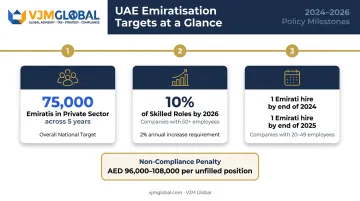
Non-compliance carries financial contributions of AED 96,000–108,000 per unfilled Emirati position. Employers should treat the minimum wage requirement alongside headcount quotas as a single, integrated compliance obligation — penalties can stack across both.
The Wage Protection System (WPS): How Dubai Enforces Timely Pay
The absence of a universal wage floor does not mean Dubai's wage environment is unregulated. The Wage Protection System (WPS) is MoHRE's electronic salary transfer mechanism and the primary enforcement tool for payroll compliance in mainland UAE.
How WPS Works
WPS requires employers to pay wages through MoHRE-approved banks, financial institutions, or exchange houses. This creates a transparent, auditable payment trail that MoHRE monitors in real time.
Key features:
- All private-sector salaries must be processed monthly through WPS
- Deductions are monitored and limited under applicable regulations
- Late or irregular payments are automatically flagged for follow-up
Non-compliance triggers consequences under this framework — and they escalate quickly.
Consequences of Non-Compliance
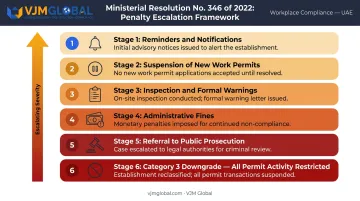
Ministerial Resolution No. 346 of 2022 outlines a tiered penalty framework:
- Reminders and notifications after a missed payment deadline
- Suspension of new work permits for non-compliant establishments
- Inspection and formal warnings for larger establishments
- Administrative fines for repeated violations
- Referral to Public Prosecution for continued non-payment
- Downgrading to Category 3, restricting all further permit activity
Free zone employers: WPS applies to mainland-registered companies. Free zones such as DMCC have adopted equivalent mechanisms, but rules vary — verify your free zone's specific requirements directly with the relevant authority.
What These Changes Mean for Employers and Expats
For Expats: Negotiate With Data
Since no statutory floor protects expatriate salaries, benchmarking is your primary tool. Before signing any contract:
- Research your role and sector using tools like PayScale, Glassdoor, or Bayt
- Verify that housing, transport, and other allowances are clearly specified
- Check whether the salary is processed through WPS (a meaningful signal of employer compliance)
For context, Bayt's current salary data for Dubai shows an average monthly salary of AED 13,451, with a range of AED 6,231 to AED 21,361 — a spread wide enough that "average salary" figures alone are poor benchmarks. Role, sector, and experience matter far more than headline averages.
For Employers: Audit Now, Not Later
Companies hiring Emirati staff should treat the AED 6,000 threshold as an immediate audit trigger:
- Review all existing Emirati employee contracts against current MoHRE thresholds
- Adjust payroll systems before the 30 June 2026 deadline
- Ensure WPS registration is current and all salary transfers go through approved channels
- Document any allowances separately from base salary to avoid misclassification
Businesses with staff across both India and the UAE face an added layer of complexity: payroll rules, compliance timelines, and allowance structures differ significantly between the two jurisdictions. Firms like VJM Global specialize in cross-border payroll compliance for exactly this scenario, helping employers avoid misclassification errors and regulatory gaps.
The Cost-of-Living Dimension
Mercer ranked Dubai 15th globally in its 2024 Cost of Living City Ranking — the costliest city in the Middle East for international employees, up three places from 2023. Dubai housing prices jumped 21% in the same period.
Any salary evaluation should account for:
- Housing costs, which represent the largest single expense for most Dubai residents
- Transportation spend — owning a car costs significantly more than relying on the Nol card public transit network
- School fees, which can run tens of thousands of AED annually for families with children
- The absence of income tax, which meaningfully increases take-home pay compared to the UK, US, or Australia
Frequently Asked Questions
What is the minimum salary in Dubai?
Dubai has no universal minimum wage. MoHRE issued non-binding benchmarks of AED 5,000–12,000/month depending on qualification level, and a mandatory minimum of AED 6,000/month now applies to Emirati nationals in the private sector as of January 2026. No equivalent floor exists for expatriate workers.
Is AED 3,000 a good salary in Dubai?
AED 3,000/month falls below the non-binding MoHRE benchmark for skilled labourers and is difficult to live on in Dubai given high housing costs. Some lower-skilled roles with employer-provided accommodation fall in this range, but it is not a viable standalone income for most residents.
Does Dubai have a minimum wage for expats?
No. There is currently no legally mandated minimum wage for expatriate workers anywhere in the UAE. Expat compensation is set entirely by individual employment contracts and market conditions, making careful salary negotiation essential.
What is the Wage Protection System (WPS) in Dubai?
WPS is the UAE government's electronic salary transfer system, requiring mainland employers to pay wages through approved banks and financial institutions. It gives MoHRE real-time visibility into payroll compliance and flags late or missed payments across the private sector.
What are the penalties for employers who don't comply with Dubai's wage rules?
WPS non-compliance can result in work permit suspensions, administrative fines, and referral to Public Prosecution for persistent non-payment. Employers who fail to meet the Emirati minimum wage requirement face exclusion from Emiratisation quota counts and suspension of new work permit processing from 1 July 2026.
What is the average monthly salary in Dubai?
Bayt reports an average monthly salary of AED 13,451 for Dubai, ranging from AED 6,231 to AED 21,361. PayScale puts the average annual figure at approximately AED 97,000. Both figures vary widely by sector, seniority, and role — treat them as a starting point, not a benchmark for specific positions.