Introduction
Getting UAE employment law wrong isn't a minor compliance slip — it can mean fines of up to AED 1,000,000. For foreign businesses and HR teams managing a workforce where expatriates make up roughly 88% of private-sector employees, the stakes of misunderstanding the rules are high.
The legal framework itself has changed substantially in recent years, and many employers are still catching up.
Federal Decree-Law No. 33 of 2021, effective 2 February 2022, now governs all private sector employment in the UAE. It replaced decades-old labour legislation and introduced sweeping changes to contracts, leave, termination rights, and workplace protections.
This guide is for:
- Foreign businesses establishing UAE operations
- HR professionals managing local workforces
- Expatriate employees who need to understand their rights
We cover employment contracts, working hours, leave entitlements, wage regulations, employee protections, and termination rules — the areas where Article 63 penalties apply.
Key Takeaways
- Federal Decree-Law No. 33 of 2021 (effective February 2022) is the governing UAE private sector labour law
- All private sector contracts must now be fixed-term; unlimited-term contracts no longer exist
- UAE law recognises six flexible work models: full-time, part-time, temporary, flexible, remote, and job sharing
- End-of-service gratuity is payable after one year of service and must be paid within 14 days of termination
- ADGM and DIFC operate under entirely separate employment frameworks — not the mainland law
UAE Labour Law 2026: The Legal Framework at a Glance
Understanding which law applies to your business is the first step before hiring anyone in the UAE. The primary legislation is Federal Decree-Law No. 33 of 2021, supplemented by Cabinet Resolution No. 1 of 2022 (the Executive Regulation, issued 3 February 2022). Together, these instruments cover all private sector employers across the UAE mainland. Domestic workers, federal and local government employees, armed forces, and police fall under separate legislation and are excluded from this framework.
Free Zone Distinctions
The UAE hosts more than 40 free zones. Most of them apply the mainland Labour Law in substance. However, two zones operate under entirely independent legal frameworks:
- DIFC (Dubai International Financial Centre) — governed by DIFC Employment Law No. 2 of 2019
- ADGM (Abu Dhabi Global Market) — governed by ADGM Employment Regulations 2024
Both are common law jurisdictions. Employers in these zones must follow zone-specific rules, not the mainland legislation.
Emiratisation Requirements
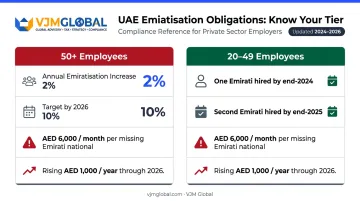
According to MoHRE's July 2025 data, more than 152,000 Emiratis were employed in the private sector by end-June 2025, across 29,000+ companies. The government's Emiratisation programme — administered through NAFIS — requires private sector employers to meet specific hiring targets:
- Companies with 50+ employees: 2% annual increase in Emiratisation for skilled roles, targeting 10% by 2026
- Companies with 20–49 employees: one Emirati required by end-2024, another by end-2025
- Non-compliance penalties start at AED 6,000/month per missing UAE national and increase by AED 1,000 annually through 2026
Employers approaching these thresholds should audit their headcount now — penalties compound quickly and there is no grace period once a deadline passes.
Employment Contracts and Flexible Work Models
Since February 2022, all private sector employment contracts in the UAE must be fixed-term. Under Article 8, the duration is simply a "specified period agreed by the parties" — unlimited-term contracts no longer exist.
If a contract expires without formal renewal, it is automatically renewed on the same terms.
Mandatory Contract Requirements
Every contract must:
- Be in writing, in Arabic and a language the employee understands (Arabic prevails in disputes)
- Contain the start date, job role, wage, duration, and place of work
- Be registered with MoHRE
Failure to provide a written contract creates legal exposure for the employer, not the employee.
Six Recognised Work Models
Cabinet Resolution No. 1 of 2022 recognises six employment models. All carry the same statutory entitlements, though some benefits may be pro-rated:
- Full-time
- Part-time (with one or more employers)
- Temporary
- Flexible
- Remote
- Job sharing
Probationary Periods
- Maximum duration: 6 months
- Employer termination during probation: 14 days' written notice required
- Employee resigning to leave the UAE during probation: 14 days' notice required
- Employee switching to another UAE employer during probation: 1 month's written notice required
- The new employer must reimburse the previous employer's recruitment costs, unless otherwise agreed
Non-Compete Clauses
Non-compete restrictions are permitted for up to two years post-termination and must specify the geographical area, type of work, and duration.
A non-compete clause can be set aside in any of the following ways:
- By written agreement between the parties
- By payment of compensation not exceeding three months' wage
- In specific circumstances, such as termination during probation
Working Hours, Leave, and Public Holidays
Standard Hours and Overtime
Standard working hours are 8 hours per day / 48 hours per week. During Ramadan, hours reduce by two hours per day for all employees. Employees working more than five consecutive hours are entitled to a rest break of up to one hour, which does not count as working time.
Overtime rules:
- Maximum 2 additional hours per day may be required
- Standard overtime: basic hourly rate + 25%
- Overnight overtime (10 pm–4 am): basic hourly rate + 50%
- Work on a rest day: substitute rest day or basic rate + 50%
Shift workers are exempt from these specific overtime provisions.
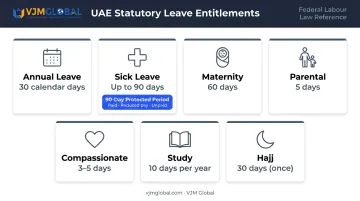
Leave Entitlements Summary
| Leave Type | Entitlement |
|---|---|
| Annual leave | 2 days/month (first year); 30 days/year from second year onward |
| Sick leave | 15 days full pay + 30 days half pay + 45 days unpaid (post-probation) |
| Maternity leave | 60 days (45 full pay + 15 half pay; no minimum service required) |
| Parental leave | 5 paid working days within first 6 months of child's birth |
| Compassionate leave | 5 days (spouse); 3 days (parent, child, sibling, grandparent, grandchild) |
| Study leave | 10 working days/year (after 2 years' service) |
| Hajj leave | Up to 30 unpaid days (once during employment) |
Two rules on annual leave catch employers off guard: carrying forward unused leave or paying it out in lieu both require the employer's written consent. Where termination triggers a payout, the calculation uses basic salary only — not total remuneration.
On the sick leave side, dismissal is prohibited for any employee within the 90-day protected period.
Wages, Salaries, and the Wage Protection System
Minimum Wage Position
There is no universal federal minimum wage for private sector employees in the UAE. Article 27 of the law authorises the Cabinet to set one, but no general amount has been prescribed. The exception is UAE nationals: MoHRE raised the minimum wage for Emiratis in the private sector to AED 6,000/month, effective 1 January 2026. Existing Emirati employees have until 30 June 2026 to comply; from 1 July 2026, non-compliant companies face work permit suspensions and those employees will not count toward Emiratisation targets.
Beyond Emiratis, employers must pay wages that cover employees' basic living needs. Individual free zones may also set their own minimum thresholds above the federal baseline.
The Wage Protection System (WPS)
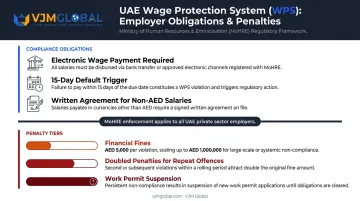
All private sector employers must pay salaries electronically through WPS-approved institutions monitored by MoHRE and the UAE Central Bank. Key rules:
- Wages must be paid on time as specified in the contract, or at least monthly if unspecified
- An employer is in default if wages are unpaid 15 days after the due date
- Salaries can be paid in currencies other than AED only by written agreement
Non-compliance with WPS rules carries serious consequences:
- Fines for general labour law violations range from AED 5,000 to AED 1,000,000
- Repeat offences can result in doubled penalties
- Employers may face suspension of new work permit approvals and court proceedings
Employee Rights and Workplace Protections
Anti-Discrimination and Equal Pay
Article 4 of the law prohibits discrimination on grounds of race, colour, sex, religion, national origin, social origin, or disability. The law mandates equal pay for equal work between men and women — any wage disparity based solely on gender is a legal violation. That said, positive discrimination in favour of UAE nationals is explicitly permitted and exempt from these provisions.
Harassment, Safety, and Grievance Procedures
The law provides protections against sexual harassment, bullying, and physical, verbal, or psychological violence in the workplace. Practical compliance requirements include:
- Employers with 50+ employees must maintain written grievance and disciplinary policies
- All employers must provide a safe working environment compliant with UAE occupational health and safety standards
- MoHRE's annual Midday Break bans outdoor work under direct sunlight from 12:30 pm to 3:00 pm, 15 June to 15 September
Trade unions and collective bargaining are not permitted in the UAE. For dispute resolution, employees with wage complaints or grievances may file a claim directly with MoHRE. The ministry runs a mediation and conciliation process before any case proceeds to the labour courts.
Termination, Notice Periods, and End-of-Service Gratuity
Notice Periods
A fixed-term contract can be terminated by either party with valid reason and notice. The general rule under Article 43 sets notice at not less than 30 days and not more than 90 days, as agreed in the contract. Dismissing an employee in retaliation for filing a complaint is unlawful.
A scaled notice period (30/60/90 days based on length of service) applies specifically to legacy indefinite-term contracts concluded before the law took effect — it is not the general current rule for all contracts.
Summary Dismissal
Article 44 permits dismissal without notice where an employee:
- Provides false identity or forged documents
- Causes material loss through their own fault
- Breaches safety rules or discloses confidential information
- Is convicted of offences involving dishonour or public morals
- Is intoxicated or under the influence of drugs at work
- Commits assault on colleagues or management
- Is absent for more than 20 intermittent days or 7 successive days without lawful excuse
Before dismissing for failure to perform duties, a written investigation and written warning must be issued first.
Employee-Initiated Termination Without Notice
Employees may leave without giving notice if the employer:
- Fails to meet contractual obligations
- Engages in harassment or assault
- Requires the employee to perform fundamentally different work
- Fails to address known health and safety risks after being informed
End-of-Service Gratuity (ESG)
ESG is a mandatory lump sum payable to employees with at least one year of continuous service. Calculation under Article 51:
| Years of Service | Gratuity Rate |
|---|---|
| First 5 years | 21 calendar days' basic pay per year |
| Beyond 5 years | 30 calendar days' basic pay per year |
| Maximum cap | 2 years' total remuneration |
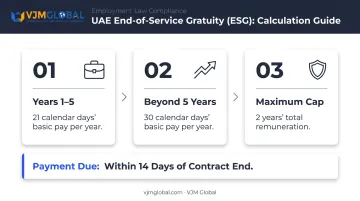
All termination payments, including ESG, must be made within 14 days of the contract end date.
For multinationals managing staff across jurisdictions, meeting that 14-day deadline alongside WPS salary requirements is where compliance typically breaks down. ESG calculations and timely final settlements are two areas where businesses regularly face penalties. VJM Global works with multinational employers to map UAE payroll obligations against their broader international HR frameworks, reducing exposure at the point of contract exit.
Frequently Asked Questions
What is the latest UAE labour law?
Federal Decree-Law No. 33 of 2021 — effective 2 February 2022 — governs private sector employment in the UAE, supplemented by Cabinet Resolution No. 1 of 2022. It introduced changes to contracts, leave entitlements, dismissal rules, and anti-discrimination protections.
What are my rights as an employee in the UAE?
Employees in the UAE private sector are entitled to:
- Written fixed-term employment contract
- 30 days' annual leave per year (after the first year)
- Overtime pay, sick leave, and maternity/parental leave
- Protection from discrimination and harassment
- End-of-service gratuity upon separation
Can I resign after 6 months in the UAE?
Yes. Employees can resign at any point during or after the six-month probation period. Leaving the UAE during probation requires 14 days' notice; switching to another UAE employer requires one month's written notice, and the new employer may need to cover prior recruitment costs.
What are the basic salary rules in UAE labour law?
There is no federal minimum wage for most private sector employees, but salaries must cover basic living needs, be clearly stated in the employment contract, and be paid on time through WPS. The minimum wage for UAE nationals in the private sector is AED 6,000/month from January 2026.
What is the end-of-service gratuity in the UAE?
ESG is a mandatory lump sum for employees with at least one year of service. The rate is 21 days' basic pay per year for the first five years, then 30 days per year after that, capped at two years' total remuneration. Payment is due within 14 days of the termination date.
Does UAE labour law apply in free zones?
Most free zones follow the UAE Labour Law. However, ADGM and DIFC operate under entirely separate employment legislation based on common law. Employers in these two zones must comply with their zone-specific regulations rather than the mainland Labour Law.