Introduction
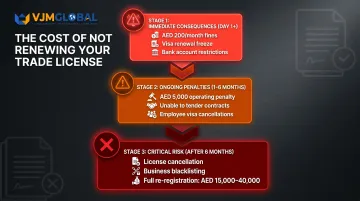
A Dubai trade license must be renewed every 1–3 years — most annually through the Department of Economy and Tourism (DET, formerly DED) or your relevant free zone authority. Letting it lapse triggers a chain reaction: immediate fines from AED 200/month, frozen employee visa renewals, restricted business bank accounts, and license cancellation after 6 months. For Singapore business owners managing Dubai operations remotely, the stakes are high — and the margin for error is slim.
Singapore entrepreneurs face real complexity here. You're navigating unfamiliar regulatory bodies, DET portal processes, and document requirements that vary by license type and jurisdiction (mainland vs. free zone). Currency conversions, time zone gaps, and physical document handling create friction that UAE-based owners simply don't deal with.
This guide covers the full renewal process, the specific obstacles Singapore-based owners encounter, and how to stay on top of deadlines without being in the room.
Key Takeaways
- Dubai trade licenses renew annually (mainland) or up to 5 years (select free zones like DMCC and IFZA)
- Core documents: Ejari certificate, current trade license copy, passport copies, and activity-specific external approvals
- Renewal costs run AED 8,000–15,000 for mainland professional licenses and AED 10,000–25,000 for mainland commercial
- Missing deadlines triggers AED 200/month mainland fines or AED 2,500–AED 5,000 free zone penalties, plus visa blocks
- Remote renewal is fully supported — Singapore owners can use DET e-services or free zone portals, with a Power of Attorney authorizing a local representative to sign on their behalf
What Is Dubai Trade License Renewal?
Trade license renewal is the mandatory annual process of revalidating your company's authorization to conduct business in Dubai. For mainland entities, the Department of Economy and Tourism (DET) — formerly the Department of Economic Development (DED) — oversees this process. Free zone businesses renew through their specific free zone authority (DMCC, IFZA, Meydan, etc.), not the DET.
Renewal is not re-registration — your trade name, business activities, and legal structure all carry forward unchanged. You're simply extending your authorization to operate for another 12 months (or longer, depending on your jurisdiction).
The table below breaks down standard terms and multi-year discount options — worth reviewing before you commit to an annual renewal cycle:
| License Type | Standard Term | Multi-Year Options | Discount Structure |
|--------------|---------------|--------------------|--------------------|
| DET Mainland | 12 months | None verified | N/A |
| DMCC Free Zone | 12 months | 2, 3, 5 years | 5% (2yr), 10% (3yr), 20% (5yr) |
| IFZA Free Zone | 12 months | 2, 3, 5 years | 15% (2yr), 20% (3yr), 30% (5yr) |
Mainland licenses require annual renewal without exception. Free zones, by contrast, offer multi-year terms that meaningfully reduce administrative overhead for Singapore-based owners managing compliance from abroad.
Start the renewal process at least 30 days before your license expiry date. That buffer covers document gathering (Ejari registration in particular), any external approvals required for regulated sectors, and routine processing delays. If you're managing this from Singapore, build in an extra 15 days for time zone coordination and international document handling.
What Happens If You Don't Renew Your Trade License on Time?
Operating without a valid trade license in Dubai is a legal violation that triggers immediate penalties and a chain of operational problems.
Financial penalties:
Mainland late renewal fines start at approximately AED 200 per month according to recent business advisory sources, though this figure is not published on the DET's official portal.
For free zone businesses, DMCC's official Schedule of Charges shows steeper penalties: AED 2,500 for licenses renewed 31-60 days late, escalating to AED 5,000 for 61-90 days late.
Additional mainland penalties can include:
- AED 5,000 for operating with an expired license
- AED 5,000 for unregistered Ejari (office tenancy contract)
- AED 2,000 for branch operations without valid renewal
Operational blocks beyond the fine:
An expired trade license immediately blocks your ability to:
- Renew or apply for new employee residence visas (visa processing ties directly to license validity)
- Conduct official government dealings or tender for contracts
- Maintain unrestricted business bank account access (UAE banks freeze or restrict accounts during compliance reviews)
License cancellation after 6 months:
If your license remains unrenewed for more than 6 months, the DET may initiate cancellation or blacklisting. At that point, you must reapply as a new entity — far more expensive and time-consuming than renewal. The consequences include:
- Full company formation costs again (AED 15,000–AED 40,000+)
- Loss of your existing trade name registration
- Visa cancellations for all sponsored employees
For Singapore-based owners managing operations remotely, the bank account restriction creates a particularly painful loop: a frozen account can block payment of the renewal fees themselves. Resolving that deadlock typically requires physical presence in Dubai or a licensed local representative to intervene on your behalf.
Documents Required for Dubai Trade License Renewal
Core Mainland Documents
The DET requires these documents for mainland trade license renewal:
- Current trade license copy — your existing license being renewed
- Completed BR/1 renewal application form — must be signed by all partners/shareholders
- Ejari-registered tenancy agreement — valid for at least 30 days beyond your license expiry date
- Ejari Registration Certificate — proof of RERA-registered tenancy
- Passport copies of all shareholders, partners, and managers
- UAE residence visa copies (if applicable)
- Emirates ID copies for UAE residents
- Memorandum of Association (MoA) — if company structure changed since last renewal
- External approvals/NOCs — sector-specific clearances from regulatory bodies
Ejari Registration: The Mandatory Prerequisite
Ejari registration — the official certification of your business tenancy contract through Dubai's Real Estate Regulatory Agency (RERA) — is mandatory for mainland renewal. Without a valid Ejari certificate matching your trade license address, your renewal application cannot proceed.
Current Ejari registration costs (2025):
- Online registration: AED 155 base fee + AED 10 Knowledge fee + AED 10 Innovation fee = ~AED 175 total
- In-person registration: ~AED 220 (including VAT and service fees)
Your tenancy contract must remain valid for at least 30 days beyond your renewal application date. If your lease is near expiry, renew your Ejari first — then submit your trade license renewal.
For businesses without dedicated office space, a DET-approved business center Ejari or shared workspace arrangement qualifies as valid office documentation.
External Approvals for Regulated Sectors
Businesses in regulated sectors must obtain clearance from the relevant government authority before submitting renewal applications:
| Sector | Approving Authority | Processing Time |
|---|---|---|
| Healthcare | Dubai Health Authority (DHA) | 3-7 working days |
| Food & Beverage / Restaurants | Dubai Municipality | 5-10 working days |
| Education | Knowledge and Human Development Authority (KHDA) | 5-7 working days |
| Real Estate | Dubai Land Department (DLD) | 3-5 working days |
| Construction | Dubai Civil Defense + Dubai Municipality | 7-10 working days |
| Tourism & Hospitality | Department of Tourism and Commerce Marketing (DTCM) | 5-7 working days |
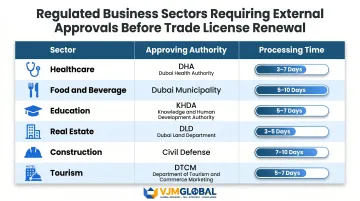
These approvals extend your total renewal timeline by up to 10 business days. Singapore-based owners should start these approvals 45 days before license expiry — a lapsed license triggers daily penalties and can halt business operations until reinstated.
Step-by-Step: How to Renew a Dubai Trade License
The DET mainland renewal process follows five distinct stages. Understanding this sequence helps Singapore owners plan ahead, especially when coordinating across time zones and managing document logistics internationally.
Total processing time: 2-4 working days after document submission (excluding external approvals, which add 3-10 days depending on sector).
Step 1: Certify Your Tenancy Contract (Ejari)
Ensure your business office lease is registered and certified through the Ejari portal. You can complete this:
- Online via dubailand.gov.ae if you have UAE Pass credentials
- Through an authorized typing center if managing remotely
The lease must remain valid for at least one month beyond your license expiry date. Ejari registration typically takes 1-2 working days. Missing or expired Ejari is the most common cause of mainland renewal delays.
For Singapore owners: If you cannot access UAE Pass or visit a typing center, appoint a local representative via Power of Attorney to handle Ejari registration on your behalf. VJM Global assists remote business owners with document coordination and POA drafting for UAE compliance filings.
Step 2: Obtain External Approvals (If Required)
Check with the DET (or your free zone authority) whether your specific business activity requires clearance from a secondary government body. Activities requiring external approvals include:
- Healthcare services (DHA clearance)
- Food & beverage operations (Dubai Municipality health/safety inspection)
- Educational services (KHDA approval)
- Construction or contracting (Civil Defense NOC)
External approvals can extend your timeline by 3-10 business days depending on the authority. Initiate these applications immediately after confirming your Ejari is current.
Step 3: Submit the Renewal Application and Documents
Singapore owners can submit renewal applications through three channels:
Option 1: Online via DET e-Services portal
- Visit investindubai.gov.ae
- Upload required documents digitally
- Track application status through the portal
Option 2: Through a registered business setup consultant
- Engage a local PRO (Public Relations Officer) or business advisory firm
- Provide documents via secure file sharing
- Consultant handles submission and follow-up
Option 3: In-person at DET service centers
- Only practical if you're in Dubai
- Walk-in service with same-day document verification
For Singapore-based owners managing renewal remotely, Option 2 (local consultant/PRO) offers the most reliable outcome. A properly drafted Power of Attorney authorizing your representative to handle license renewal activities ensures the process continues even when you're outside the UAE — which sets you up for the next step: payment.
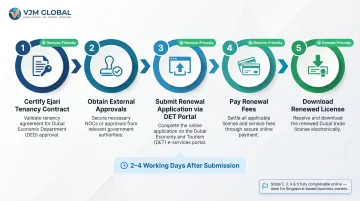
Step 4: Pay the Renewal Fees
Once the DET reviews and approves your application, you'll receive a payment voucher detailing all charges. Payment can be made:
- Online via the DET portal using credit/debit card
- In-person at DET service centers
- Through your authorized representative if paying via UAE bank account
Renewal fees vary by license type and business activity (detailed in the next section). All renewals include mandatory government surcharges:
- Knowledge Dirham Fee: AED 10 (per Dubai Law No. 1 of 2018)
- Innovation Dirham Fee: AED 10 (per Dubai Law No. 2 of 2018)
For Singapore owners without UAE bank accounts: Coordinate payment through your local representative or maintain a UAE business account specifically for compliance fee payments. Late renewal can trigger account restrictions that freeze payment channels, requiring in-person resolution at a DET service center.
Step 5: Receive the Renewed License
After payment, the renewed trade license is typically issued digitally within 1-3 business days. Download it directly from the DET portal; physical copies are available at DET service centers if needed.
Critical post-renewal tasks:
- Update your renewed license number with your UAE bank
- Notify relevant government registrations (labor department, immigration)
- Store digital and physical copies securely
- Schedule next year's renewal reminder 45 days before expiry
Dubai Trade License Renewal Cost Breakdown
Mainland Renewal Fee Structure
The DET does not publish a single, consolidated public fee schedule with line-item detail. However, composite estimates from multiple verified sources provide reliable cost ranges:
Estimated annual renewal costs:
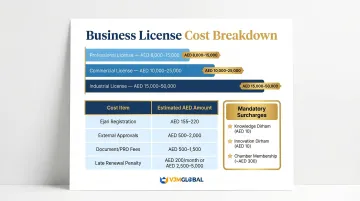
- Mainland Professional License: AED 8,000 – AED 15,000
- Mainland Commercial License: AED 10,000 – AED 25,000
- Industrial License: AED 15,000 – AED 50,000
Key cost drivers include:
- Business activity type and number of activities on the license
- Office size and location (affecting municipality fees)
- Number of employee visa allocations
- Whether external regulatory approvals are required
Mandatory government surcharges (all renewals):
- Knowledge Dirham: AED 10
- Innovation Dirham: AED 10
- Dubai Chamber membership: ~AED 300 (commercial licenses)
Additional costs frequently overlooked by Singapore owners:
| Cost Item | Estimated Amount (AED) |
|---|---|
| Ejari registration | 155 – 220 |
| External approval fees (sector-dependent) | 500 – 2,000 |
| Document typing/clearing charges (if using PRO) | 500 – 1,500 |
| Late renewal penalty (if past expiry) | 200/month (mainland) or 2,500–5,000 (DMCC) |
Budget at the upper range of these estimates and treat savings as contingency. Currency conversion from SGD to AED adds one more variable: fees are AED-denominated, so keep a buffer for exchange rate movement.
Free Zone Renewal Fee Comparison
If mainland costs feel unpredictable, free zone renewals offer a clearer picture. Each authority sets its own fee structure, independent of the DET system:
| Free Zone | 1-Year Renewal | 5-Year Renewal | Annual Equivalent (5yr) |
|---|---|---|---|
| DMCC Trading/Service | AED 20,265 | AED 101,325 (20% discount) | ~AED 20,265/year |
| IFZA 1-visa package | AED 14,900 | AED 52,200 (30% discount) | ~AED 10,440/year |
| Meydan basic | ~AED 12,500+ | Not confirmed | N/A |
DMCC also charges separate annual fees for:
- Operational Fitness Certificate (OFC): AED 1,000
- Establishment Card renewal: AED 1,805
IFZA's 5-year package offers the steepest discount at 30%, bringing the annual equivalent down to AED 10,440 — roughly half the DMCC 1-year rate. For Singapore owners who want to lock in costs and reduce annual renewal work, this is worth factoring into the initial setup decision.
Free zone advantages for remote management:
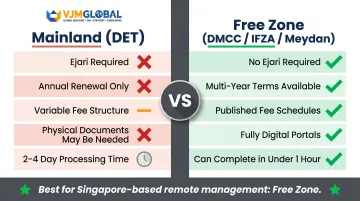
- No Ejari requirement (free zones provide office/flexi-desk as part of license package)
- Fully digital renewal portals (Meydan renews in under 1 hour)
- Publicly listed fee schedules
- Multi-year terms reduce annual compliance tasks
Whichever structure applies to your license, the cost data above gives you a working baseline. The next step is understanding the renewal timeline so fees don't catch you at expiry.
Key Challenges for Singapore-Based Business Owners (and How to Address Them)
Challenge 1: Physical Presence Requirements
Singapore owners managing Dubai businesses remotely cannot easily handle document collection, Ejari updates, or service center visits. Mainland renewal still references physical document submission channels, and typing centers require in-person interaction.
Solution: Appoint a local authorized signatory through a properly drafted Power of Attorney. UAE legal practice recognizes POA for trade license renewal when the POA specifically names license renewal authority, is notarized, and complies with UAE regulations. This allows renewal to be managed entirely remotely.
For Singapore entrepreneurs without existing UAE representation, engaging a cross-border business advisory partner eliminates the physical presence barrier. VJM Global works with international business owners on compliance coordination, including document handling support for remote renewals.
Challenge 2: Free Zone vs. Mainland Complexity
Singapore entrepreneurs are well-represented in Dubai free zones — DMCC reported 13% year-on-year growth in Singaporean companies as of May 2025, when the free zone signed Hawksford Singapore as a local partner. Free zones offer 100% foreign ownership without local sponsor requirements — a structure that suits most Singapore-headquartered businesses operating in Dubai.
The complication: Free zone renewal processes differ completely from DET mainland renewal. Each free zone has its own authority, portal, timeline, and fee structure:
- DMCC manages renewals through its member portal with strict late fee tiers
- IFZA processes renewals through its Professional Partners network
- Meydan runs a fully digital dashboard renewal — typically completed in under an hour
You must track your specific free zone's renewal portal and deadlines separately. A mainland license and a DMCC license follow entirely different renewal paths.
Free zones' digital maturity — fully online portals, no Ejari requirement, transparent pricing — makes remote management significantly easier than mainland renewals. If your business model permits free zone operation, this structure reduces compliance friction considerably for Singapore-based owners.
Challenge 3: Currency and Banking Logistics
Renewal fees are payable in AED. Singapore owners without a UAE bank account face practical payment challenges:
Options for fee payment without a local UAE account:
- Maintain a UAE business bank account (requires an initial UAE visit for account opening)
- Authorize your local representative to pay and reimburse them via international transfer
- Use international wire transfer directly (subject to exchange rate fluctuations and transfer fees)
One risk worth flagging: late renewal can trigger bank account restrictions, which then blocks the very payment needed to clear those restrictions. This compliance catch-22 is particularly difficult to untangle remotely.
The safest approach is to maintain a UAE business bank account with enough AED balance to cover annual renewal fees plus a 20% buffer for unexpected costs or currency shifts — a dedicated compliance reserve that keeps you clear of the catch-22 entirely.
Frequently Asked Questions
How much does it cost to renew an LLC trade license in Dubai?
LLC trade license renewal in Dubai typically costs AED 10,000 – AED 25,000 for mainland commercial licenses, or AED 8,000 – AED 15,000 for professional licenses. The exact amount depends on your business activity, number of license activities, office location, and whether external regulatory approvals are required. Budget an additional AED 500–2,000 for Ejari registration and document processing fees.
How do I renew an LLC trade license in Dubai?
Renew through five steps: (1) certify your Ejari tenancy contract, (2) obtain external approvals if your sector requires them, (3) submit your renewal application via the DET e-Services portal at investindubai.gov.ae, (4) pay renewal fees when the payment voucher is issued, and (5) download your renewed license digitally within 1-3 business days.
What happens if I don't renew my trade license in Dubai?
You face immediate monthly fines (approximately AED 200/month for mainland, AED 2,500–5,000 for DMCC), inability to renew employee visas, potential business bank account freezes, and license cancellation after 6 months of non-renewal. Operating with an expired license is a legal violation that can result in additional AED 5,000 penalties.
How much does initial LLC trade license setup in Dubai cost?
Initial LLC setup in Dubai costs AED 15,000 – AED 40,000+, covering trade name reservation (AED 600–2,000), initial approval (AED 1,000–5,000), license fee (AED 5,000–15,000), and annual office lease/Ejari registration (AED 15,000–50,000). This is a one-time setup cost, separate from the AED 8,000–25,000 annual renewal fee.
What are DED fees in the UAE?
DED fees (now DET fees) are charges levied by Dubai's Department of Economy and Tourism for licensing, renewal, and administrative services. They vary by business activity, license category, and structure — and include the core license fee, processing charges, Knowledge and Innovation Dirhams (AED 10 each), and Dubai Chamber membership (~AED 300 for commercial licenses). For a full fee schedule, visit the DET e-Services portal.
Can I renew my Dubai trade license from Singapore without visiting the UAE?
Yes, remote renewal is possible via the DET e-Services portal or through an authorized representative holding a Power of Attorney. However, physical document handling (Ejari registration, typing center submissions) requires a local agent or PRO. Free zone renewals (DMCC, IFZA, Meydan) offer fully digital processes that are easier to manage remotely without UAE visits.