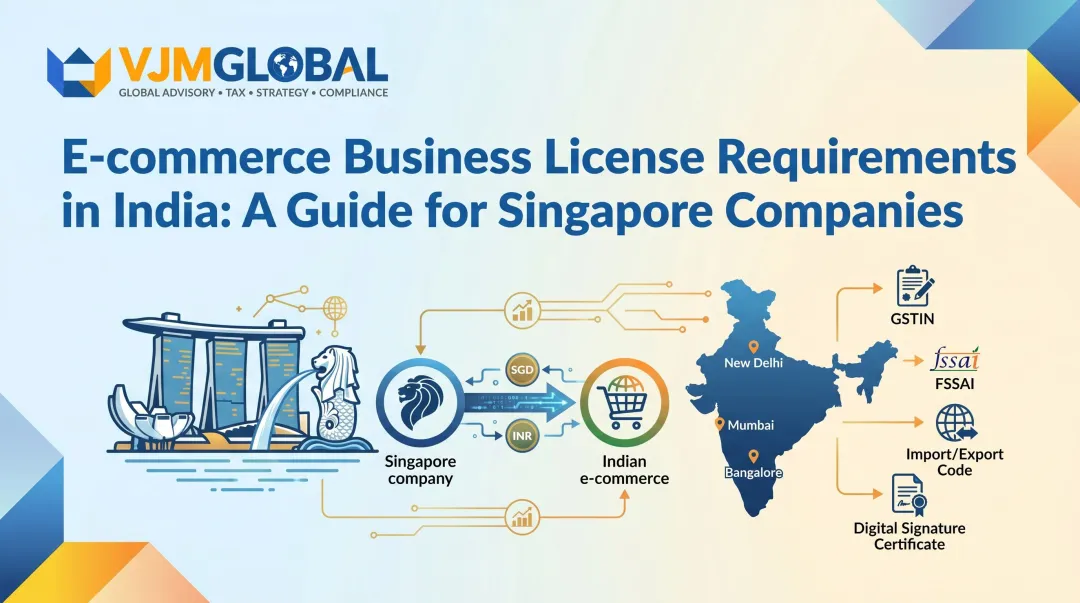
This guide is built for two audiences: Indian entrepreneurs launching their first online store, and foreign investors, NRIs, and overseas businesses from the US, UK, and Australia eyeing India's e-commerce market. Both groups make the same mistake — assuming a website and a bank account are enough.
They're not. Most new sellers underestimate exactly how many registrations sit between "idea" and "first sale." This guide walks through structure selection, the step-by-step registration process, required licenses, and realistic cost and compliance expectations.
Key Takeaways
- Register a business structure first, then obtain GST, MSME, and other required licenses
- GST registration is mandatory for most e-commerce sellers, regardless of turnover, unlike standard businesses
- Choosing a Private Limited, LLP, OPC, or Proprietorship structure affects liability, funding, and FDI eligibility
- Foreign nationals and NRIs can register e-commerce businesses in India, subject to FDI and FEMA compliance
What Is E-commerce Company Registration & Why It Matters in India
E-commerce company registration means legally incorporating your business entity with the Ministry of Corporate Affairs (MCA), then completing the GST and tax registrations needed to sell online. It's a two-part process: incorporation gives you legal existence, and tax registration gives you the right to trade.
The payoff is tangible. Proper registration unlocks:
- Legal recognition as a business entity, not a sole individual
- Marketplace eligibility: Amazon, Flipkart, and Meesho all require a GSTIN and incorporation documents before onboarding sellers
- Payment gateway access: Razorpay, PayU, and similar providers verify business documents before activation
- Tax compliance that keeps you out of penalty territory
Here's where e-commerce differs sharply from a typical brick-and-mortar business:
- Regular businesses: GST required only after turnover crosses ₹20 lakh (₹40 lakh for exclusive goods suppliers in most states)
- E-commerce sellers: GST required from day one, regardless of turnover, under Section 24 of the CGST Act, when selling through an operator that collects tax at source
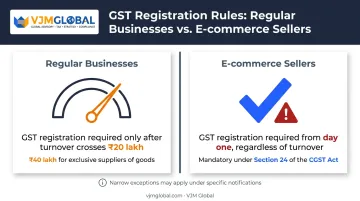
There are narrow exceptions for small service suppliers and single-state goods suppliers meeting specific conditions, but the default assumption for a new online seller should be GST registration from day one.
Skip registration, and the consequences are immediate. No marketplace will list your products. No payment gateway will activate your account. And if you're already trading without required registration, Section 122 of the CGST Act imposes a penalty of ₹10,000 or the tax evaded, whichever is higher.
Step-by-Step Process to Register an E-commerce Company in India
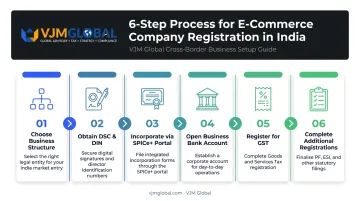
The registration journey follows a logical sequence: pick a structure, secure digital credentials, incorporate through the MCA, open a bank account, then complete tax registrations. Skipping steps or doing them out of order almost always causes delays.
Step 1: Choose the Right Business Structure
Your structure choice shapes everything downstream: liability exposure, ability to raise funds, and whether foreign investment is even possible.
| Structure | Liability | Marketplace/Investor Fit |
|---|---|---|
| Sole Proprietorship | Unlimited personal liability | Weak (rarely accepted by investors) |
| Partnership | Unlimited, shared among partners | Weak |
| LLP | Limited to capital contribution | Moderate |
| One Person Company (OPC) | Limited | Moderate (Indian citizens only) |
| Private Limited Company | Limited to shareholding | Strong — preferred by marketplaces and investors |
Most serious e-commerce founders choose Private Limited or LLP. Marketplaces and investors both favour these structures because they offer clean liability separation and easier equity transfer.
Step 2: Obtain Digital Signature Certificate (DSC) and Director Identification Number (DIN)
Every proposed director needs a DSC to sign incorporation forms electronically, and a DIN before they can be appointed. Foreign directors typically need notarised or apostilled documents depending on their home country, which adds a few extra days to this step.
Step 3: Incorporate the Company via MCA's SPICe+ Portal
Incorporation happens through the SPICe+ (Simplified Proforma for Incorporating Company Electronically) portal in two parts:
- Part A reserves your company name — approval keeps the name valid for 20 days
- Part B captures company details, capital structure, registered office, and subscriber information, and files linked documents including e-MOA and e-AOA
Once the Registrar approves the filing, you receive your Certificate of Incorporation, the official birth certificate of your company.
Step 4: Open a Business Bank Account
With your Certificate of Incorporation, PAN, and registered address proof in hand, open a current account in the company's name. This account is a prerequisite for GST registration and payment gateway applications, so don't delay it.
Step 5: Register for GST
GST registration happens through the GST portal (gst.gov.in) using FORM GST REG-01. Since November 2025, eligible low-risk applications can be approved electronically within 3 working days under the new Rule 9A framework; standard applications still follow the 7-working-day review under Rule 9. Without a GSTIN, no marketplace will onboard you. Full stop.
Step 6: Complete Additional Registrations
Trademark protection, Import Export Code, MSME registration, and sector-specific licenses typically follow once incorporation and GST are locked in. We cover these in detail next.
Licenses & Registrations Required for an E-commerce Business
Beyond incorporation and GST, several other registrations matter depending on your product category and business scale.
GST Registration Mandatory under Section 24 of the CGST Act for most e-commerce sellers regardless of turnover. It functions as the gatekeeper to every marketplace and payment gateway, making it effectively non-negotiable for online sellers.
MSME/Udyam Registration Optional, but worth doing. It's free, entirely online, and self-declared. Benefits include:
- Access to collateral-free credit guarantees (up to ₹10 crore under the CGTMSE scheme from April 2025)
- Eligibility for PMEGP margin-money subsidies ranging from 15% to 35% for qualifying new enterprises
- Priority consideration in government procurement
Trademark Registration Filing early through the IP India portal protects your brand name and logo before competitors or squatters register something similar. Government filing fees run ₹4,500 per mark, per class for individuals, startups, and small enterprises, and ₹9,000 for other applicants.
Import Export Code (IEC) Required if you plan to sell internationally or import inventory. The DGFT issues IEC online through a largely automated process, making this one of the more straightforward registrations on this list.
FSSAI Registration Mandatory for anyone selling food, nutraceutical, or wellness products. Thresholds changed from April 2026: basic registration up to ₹1.5 crore turnover, State license up to ₹50 crore, and Central license above that.
E-commerce food business operators generally need a Central license. Sellers must display their own FSSAI number even when listing through a third-party platform.
Shop & Establishment License Required for your office or warehouse premises and covers employee-related compliance. Rules vary significantly by state — Delhi requires registration within 90 days of commencing operations, while Maharashtra's requirements differ based on whether you employ 10 or more workers.
Business Structure, Cost & FDI Considerations for Foreign Investors
Foreign investors face an additional layer of complexity that Indian founders don't: FDI policy and FEMA compliance sit on top of standard incorporation requirements.
Why Private Limited Wins for Foreign Investors
A Private Limited Company is the clear choice for anyone bringing foreign capital into an Indian e-commerce venture. It accepts equity investment cleanly, supports FC-GPR reporting, and scales toward future funding rounds without structural rework.
By comparison, an OPC is off the table for non-Indian foreign nationals (only Indian citizens, including NRIs who retain citizenship, can form one), and LLP foreign investment comes with conditions attached.
Understanding India's FDI Policy in E-commerce
This is where many foreign founders trip up. India's FDI policy treats e-commerce models differently:
- Marketplace model (B2B): 100% FDI permitted under the automatic route, meaning no prior government approval is needed
- Inventory-based model (B2C): FDI is not permitted, meaning a foreign-backed platform cannot own inventory or control pricing
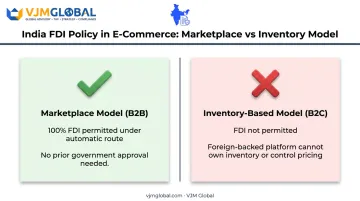
Choosing the wrong model at the structuring stage can force a costly restructure later. Getting this distinction right from day one saves significant time and legal expense.
Realistic Cost Benchmarks
Government fees vary by structure:
- Private Limited/OPC: SPICe+ filing is fee-free for authorised capital up to ₹15 lakh (state stamp duty still applies)
- LLP: Registration fees scale with capital contribution, starting at ₹500 for contributions up to ₹1 lakh and rising to ₹5,000 above ₹10 lakh
- Trademark: ₹4,500–₹9,000 per class depending on applicant type
Professional fees aren't standardised across the industry, so get itemised quotes separating government charges, stamp duty, and advisory fees before committing.
Timeline and RBI Reporting
Name reservation stays valid for 20 days (not a processing guarantee), and GST approval takes 3–7 working days depending on risk classification. Based on comparable LLP incorporation timelines, expect roughly 10–15 working days for core incorporation steps once documents are ready.
Foreign investors face one more obligation Indian founders skip entirely: when an Indian company issues equity to a person resident outside India, it must file Form FC-GPR through the RBI's FIRMS portal within 30 days of the share issue. Missing this deadline triggers late filing penalties under FEMA and can delay future compliance approvals.
This is exactly the terrain where VJM Global operates. With over 30 years of experience and a track record serving 500+ US, 250+ UK, and 250+ Australian businesses, the firm treats incorporation, GST, FDI structuring, and FC-GPR filing as one coordinated process rather than a series of disconnected filings. That approach helps foreign investors and NRIs enter India's e-commerce market in the minimum practical timeframe.
Common Mistakes to Avoid When Registering an E-commerce Business
Even well-prepared founders stumble on a handful of recurring issues:
- Assuming GST has a turnover threshold. Many first-time sellers carry over the ₹20 lakh/₹40 lakh threshold rule from standard businesses. For e-commerce, GST registration under Section 24 typically applies immediately, regardless of revenue.
- Delaying trademark filing. Founders often wait until the brand gains traction before filing a trademark. By then, a competitor or opportunist may have already claimed a similar name, forcing a rebrand at the worst possible time.
- Choosing the wrong structure early. A Proprietorship might feel simpler at launch, but it blocks future fundraising and closes the door to foreign investment. Structure decisions made in week one can limit options years later.
- Underestimating cross-border compliance. For foreign founders specifically, residential-status-based tax rules, FEMA regulations, and MCA e-filing requirements create friction points that domestic founders never encounter. Advisors like VJM Global's business setup team help foreign founders navigate these requirements before they become costly problems.
Frequently Asked Questions
How much does e-commerce company registration cost in India?
Government fees vary by structure: Private Limited/OPC incorporation is fee-free up to ₹15 lakh authorised capital, while LLP fees range from ₹500 to ₹5,000 based on contribution. Professional fees vary by provider, so request an itemised quote.
Do I need a business license to operate an e-commerce company in India?
Requirements depend on your product and location, but most sellers need GST registration and a Shop & Establishment license at minimum. Food, wellness, or health product sellers additionally need FSSAI registration, and international sellers need an IEC.
Is GST compulsory for e-commerce businesses in India?
Yes, for most sellers. Section 24 of the CGST Act requires GST registration for e-commerce sellers regardless of turnover, with narrow exceptions for small service suppliers and single-state goods suppliers meeting specific conditions.
Can NRIs or foreign nationals register an e-commerce company in India?
Yes, subject to FDI policy and FEMA compliance. A Private Limited Company is typically the preferred structure since it accepts foreign equity and supports FC-GPR reporting to the RBI.
Which business structure is best for an e-commerce startup in India?
Private Limited Company or LLP are generally preferred for liability protection, marketplace acceptance, and future funding potential. Proprietorships work for very small, low-risk operations but limit growth options later.
How long does it take to register an e-commerce business in India?
Core incorporation typically takes 10–15 working days once documents are ready, with GST approval adding another 3–7 working days. Foreign investors should budget additional time for FC-GPR filing and FEMA-related compliance.