Introduction
India's e-commerce market reached US$ 125 billion in 2024 and is projected to grow to US$ 345 billion by 2030 at a CAGR of 18.4%, according to the India Brand Equity Foundation. For Singapore companies, this represents a massive growth opportunity—but accessing it means navigating a multi-layered licensing and compliance framework fundamentally different from Singapore's streamlined regulatory environment.
Unlike Singapore, where business registration can be completed in hours and compliance is largely centralized, India requires foreign companies to establish a local legal entity first, obtain multiple registrations from different government departments, and comply with sector-specific licenses that vary by product category.
The regulatory burden spans several authorities: the Ministry of Corporate Affairs, GST authorities, Directorate General of Foreign Trade, state labour departments, and sector regulators like FSSAI and BIS.
If you're a Singapore founder, director, or entrepreneur planning to sell to Indian consumers online, this guide covers what you need to know:
- Entity setup options available to foreign companies
- Mandatory registrations, including GST and PAN
- FDI restrictions that determine your permitted business model
- Sector-specific licenses based on what you sell
- Common pitfalls that delay or derail market entry
Key Takeaways
- Singapore companies must incorporate a local Indian entity (Private Limited Company) before selling on platforms like Amazon.in; direct cross-border selling is not permitted
- GST registration is mandatory for all e-commerce sellers with no minimum turnover threshold — platforms require a valid GSTIN at onboarding
- India permits 100% FDI only in the marketplace model (platform connecting buyers and sellers), not inventory-based sales
- Product-specific licenses — FSSAI for food, IEC for imports, BIS for electronics — are required beyond core registrations
- Full setup from incorporation to operational readiness typically takes 45–90 days depending on documentation and product type
What Makes India's E-Commerce Licensing Framework Unique for Foreign Companies
India's regulatory system treats foreign-owned companies differently from domestic entities under its FDI policy, Consumer Protection Rules, and GST framework. A Singapore company cannot replicate its home-market compliance approach and expect it to work in India.
The India-Singapore Comprehensive Economic Cooperation Agreement (CECA) creates favourable investment conditions, including national treatment guarantees, investment protection, and dispute resolution mechanisms. However, CECA does not exempt Singapore companies from India's domestic licensing, tax, or consumer protection obligations — it provides a protective framework for investments, not a bypass around sector-specific FDI caps or regulatory requirements.
That regulatory reality makes your entry route critical. The type of Indian legal entity you establish determines which licenses and registrations you can apply for — and operating without one first exposes you to serious consequences:
- Inability to register as a seller on Indian e-commerce platforms
- Blocked access to business bank accounts and payment gateways
- Disqualification from obtaining mandatory GSTIN
- Exposure to penalties under FEMA (Foreign Exchange Management Act)
- Platform account suspensions if discovered operating under false pretences
Choosing the Right Business Structure as a Singapore Company
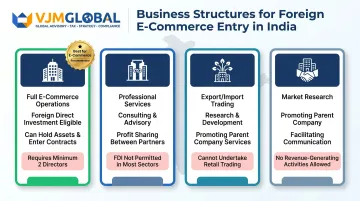
Singapore companies entering India can choose from four incorporation structures. Each carries different operational permissions, FDI eligibility, and compliance requirements — so the choice matters before you register anything.
Private Limited Company (Wholly Owned Subsidiary): The most common choice for e-commerce operations. Qualifies for 100% FDI under the automatic route for eligible sectors, can open business bank accounts, obtain GSTIN, sign vendor agreements, hold inventory, and conduct full commercial operations.
Limited Liability Partnership (LLP): Suitable for professional services and some trading activities. Cannot be used for FDI-restricted sectors and faces limitations on external commercial borrowing.
Branch Office: Restricted to specific approved activities (import/export, research, project execution). Cannot conduct retail e-commerce or sell directly to Indian consumers. Requires Reserve Bank of India approval.
Liaison Office: Cannot generate revenue or conduct commercial operations. Used solely for market research, liaison activities, or communication between parent and Indian parties.
For e-commerce, a Private Limited Company is the recommended structure because it provides maximum operational flexibility and meets platform requirements. Once you've confirmed the structure, the next step is assembling the incorporation documents.
Key Documents Required for Incorporation
To incorporate a Private Limited Company in India, Singapore companies need:
- Certificate of Incorporation from Singapore (apostilled by the Singapore Academy of Law)
- Memorandum and Articles of Association of the parent company (apostilled)
- Passport copies and address proof for all proposed directors
- Registered office address in India (can be a virtual office initially)
- PAN and address proof for foreign shareholders
India acceded to the Hague Apostille Convention in July 2023, simplifying the document authentication process. Singapore documents require notarisation and apostille from SAL before submission to the Registrar of Companies.
VJM Global's India Entry Services
Choosing the right entity structure and completing incorporation within the shortest timeframe requires expertise in Indian corporate law. VJM Global's Business Setup in India service supports Singapore companies across each stage — from FDI advisory and entity selection to incorporation, bank account opening, and post-incorporation compliance. Most incorporations are completed within 13 days when documentation is in order.
FDI Restrictions Singapore Companies Must Understand Before Going Live
India's FDI policy makes a critical distinction between two e-commerce models, and getting this wrong can invalidate your entire business structure.
Marketplace Model: 100% FDI Permitted
According to DPIIT Press Note No. 3 (2016), 100% FDI under the automatic route is permitted in marketplace-based e-commerce. This model means providing an IT platform that acts as a facilitator between buyers and sellers—the entity does not own inventory or influence pricing.
Inventory Model: FDI Prohibited
FDI is not permitted in inventory-based e-commerce, where the entity owns goods and sells them directly to consumers. Singapore companies planning a direct-to-consumer inventory model must restructure their approach before entering India.
Key Marketplace Model Restrictions
Even in the permitted marketplace model, operators face strict rules:
- No single vendor or related group can account for more than 25% of total platform sales
- Platforms cannot influence sale prices through deep discounting, algorithmic manipulation, or exclusive arrangements
- If a vendor sells more than 25% of its goods through the platform or its group companies, regulators presume the platform controls inventory
These restrictions are enforced through FEMA compliance audits and downstream investment reporting. Non-compliance can result in penalties, platform deregistration, and forced divestment.
That said, Singapore companies enter with one structural advantage: because Singapore does not share a land border with India, they qualify for the automatic route for FDI and are exempt from the government approval process imposed by Press Note 3 of 2020.
Mandatory Licenses and Registrations for E-Commerce Operations in India
Business Registration with the Ministry of Corporate Affairs (MCA)
Incorporating your Indian entity with MCA is the first required step. The process includes:
- Digital Signature Certificate (DSC): All directors must obtain DSCs for electronic filing (typically 2 days)
- Director Identification Number (DIN): Unique ID for each director, obtained during incorporation filing
- Name Reservation (RUN): Reserve a unique company name via SPICe+ Part A; must comply with Companies Act naming rules (5 days approval time)
- SPICe+ Filing: Comprehensive incorporation form covering company details, registered office, directors, shareholders, MOA and AOA
- Certificate of Incorporation: Issued upon successful verification along with PAN and TAN allocation
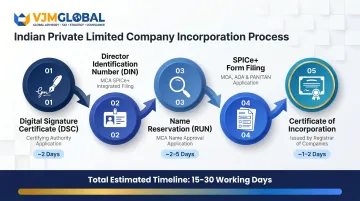
With complete documentation, this process takes 15–30 working days for foreign-promoted companies due to additional document verification requirements.
GST Registration
GST registration is compulsory for all e-commerce sellers in India regardless of turnover. Unlike physical retailers, the standard exemption threshold of ₹20 lakh or ₹40 lakh does not apply.
Section 24(ix) of the CGST Act, 2017 mandates registration for "persons who supply goods or services through an electronic commerce operator who is required to collect tax at source." Platforms like Amazon.in and Flipkart require a valid GSTIN during seller onboarding and will reject applications without it. GST registration typically takes 3–7 working days with complete documentation, though timelines vary by jurisdictional officer.
E-commerce operators (marketplace platforms) carry an additional obligation: they must collect Tax Collected at Source (TCS) at 1% on intra-state supplies (0.5% CGST + 0.5% SGST) and 1% IGST on inter-state supplies, as per CBIC Notification No. 52/2018.
PAN and TAN Registration
Your Indian entity must obtain:
- Permanent Account Number (PAN): Required for all financial transactions, tax filings, and opening business bank accounts. Automatically allocated during MCA incorporation.
- Tax Deduction Account Number (TAN): Required if the company deducts tax at source from employee salaries or vendor payments. Also allocated during incorporation via SPICe+ linked forms.
Both are also required to open a corporate bank account in India.
Import Export Code (IEC)
Beyond tax identifiers, cross-border e-commerce operations require one more clearance. If your Singapore company plans to import goods into India for online sale or export Indian products internationally, an Import Export Code from DGFT is mandatory.
IEC is a one-time, lifetime registration with no renewal requirement. The registration fee is ₹500, and the process is fully online. Post-GST, the IEC number is the same as your entity's PAN.
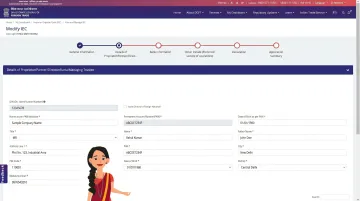
While IEC has lifetime validity, DGFT requires an annual update between April 1 and June 30 each year. Failure to update can result in IEC deactivation.
Shop and Establishment Registration
Any physical premises in India—including registered offices, warehouses, or fulfilment centers—requires Shop and Establishment registration with the relevant state Labour Department within 30 days of commencing operations.
Key points to note:
- Rules, fees, and processes vary significantly by state
- Registration governs working hours, employee records, and leave policies
- Penalties apply for operating unregistered or failing to display the certificate on-site
Consumer Protection (E-Commerce) Rules, 2020 Compliance
The Consumer Protection (E-Commerce) Rules, 2020 impose specific obligations on all e-commerce entities selling to Indian consumers, including foreign-owned entities:
- Appoint a Grievance Officer: Display the officer's name, contact details, and designation publicly on your platform
- 48-hour complaint acknowledgment: Acknowledge consumer complaints within 48 hours and resolve within one month
- Clear product information: Display total price, country of origin (mandatory for imported goods), return/refund terms, warranty details, and importer information
- Prohibited practices: No misleading advertisements, fake reviews, or "dark patterns" (UI designs that trick users into unwanted actions)
Sector-Specific Licenses Based on What You Sell
FSSAI License (Food Products)
Any Singapore company selling food products, packaged snacks, health supplements, or beverages requires an FSSAI license.
Revised thresholds effective from April 1, 2026 (FSSAI Notification dated March 10, 2026):
| License Type | Annual Turnover | Annual Fee |
|---|---|---|
| Basic Registration | Up to ₹1.5 crore | ₹100 |
| State License | ₹1.5 crore to ₹50 crore | ₹2,000–₹5,000 |
| Central License | Above ₹50 crore | ₹7,500 |
Central License is also required for multi-state operations and import/export activities regardless of turnover. Processing time for State and Central licenses typically ranges from 30–60 days.

BIS Certification (Electronics & Appliances)
Products covered under India's mandatory BIS certification standards cannot be sold online without valid BIS registration. Covered categories include:
- Electronics and electrical appliances
- IT equipment and accessories
- Toys and helmets
- Certain packaged goods and chemicals
The Compulsory Registration Scheme (CRS) requires foreign manufacturers to register products before import, sale, or distribution — a step Singapore companies importing consumer electronics or household products frequently miss. Processing time varies by product category but typically takes 4–8 weeks.
Pharmaceutical and Cosmetic Compliance
Prescription and OTC drugs require a Drug License from CDSCO (Central Drugs Standard Control Organisation). Online pharmacy operations face additional Ministry of Health guidelines on top of this.
Imported cosmetics from Singapore fall under the Drugs & Cosmetics Act and require separate import registration per GSR No. 426(E) dated May 19, 2010.
Quick Reference: Product Categories and Required Licenses
| Product Category | Required License/Certification |
|---|---|
| Food & Beverages | FSSAI License (Basic, State, or Central) |
| Electronics & Appliances | BIS Certification under CRS |
| Pharmaceuticals & Drugs | CDSCO Drug License |
| Cosmetics (imported) | CDSCO Import Registration |
| Import/Export Goods | Import Export Code (IEC) |
| Textiles/Apparel | BIS or Quality Control Orders (where mandated) |
Common Mistakes Singapore Companies Make During India E-Commerce Setup
Attempting Platform Registration Without Indian Entity
Amazon.in, Flipkart, and other Indian e-commerce platforms require sellers to have a valid Indian GSTIN, PAN, and Indian bank account during onboarding. Amazon Seller Central and Flipkart's registration process explicitly verify these documents against government databases.
A Singapore foreign entity without an Indian legal presence cannot obtain these credentials. Attempting to register using foreign business credentials results in rejected applications or account suspensions post-launch.
Treating Incorporation as the Finish Line
After entity setup, companies must maintain ongoing compliance including:
- Monthly or quarterly GST return filings (GSTR-1, GSTR-3B)
- Annual ROC filings (AOC-4, MGT-7, Form ADT-1)
- Annual statutory audits (required for companies above specified turnover thresholds)
- Consumer Protection Rule adherence (grievance officer duties, complaint handling)
- TCS/TDS payment and quarterly return filing
- FEMA annual compliance certificate (due by September 30 each year)
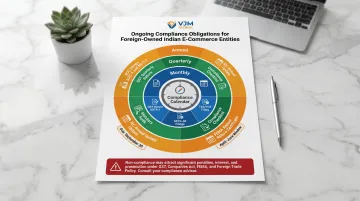
Non-compliance attracts penalties, late fees, and can result in GST registration cancellation or director disqualification.
Underestimating India's Regulatory Complexity
India's e-commerce regulations span multiple central and state-level authorities: MCA, GST Council, FSSAI, DGFT, state Labour Departments, and CDSCO. Unlike Singapore's centralised BizFile system, compliance here means coordinating across disconnected departments — each with its own portal, timeline, and documentation requirements.
Operating without professional coordination typically results in missed deadlines, overlapping obligations, or structuring under the wrong business model (inventory vs. marketplace). Choosing the wrong model can invalidate your FDI compliance entirely — forcing a costly restructuring before you've made a single sale.
Frequently Asked Questions
How to get an e-commerce license in India?
India has no single "e-commerce license." Businesses must obtain a combination of MCA company registration, GST registration, and sector-specific licenses (such as FSSAI for food or IEC for imports). The exact combination depends on your product category and business model (marketplace vs. inventory).
Do I need a business license to sell online in India?
While no single "business license" covers all e-commerce activity, every business selling online must be registered as a legal entity with MCA, hold a valid GSTIN, and comply with Consumer Protection (E-Commerce) Rules 2020. Additional licenses apply based on product category.
Which industries require a license in India?
The most regulated sectors for e-commerce include:
- Food and beverages — FSSAI license required
- Pharmaceuticals and drugs — CDSCO Drug License required
- Electronics and appliances — BIS certification required
- Import/export businesses — IEC from DGFT required
Can a Singapore company sell directly on Indian e-commerce platforms without setting up an Indian entity?
No. A Singapore company cannot register as a seller on platforms like Amazon.in or Flipkart without first incorporating an Indian legal entity, obtaining PAN, and registering for GST. Foreign entities selling directly to Indian consumers through Indian marketplace platforms is not permitted under India's regulatory framework.
How long does the full India e-commerce setup take for a Singapore company?
MCA incorporation takes 15–30 working days, GST registration takes 3–7 working days, and sector-specific licenses (such as FSSAI) take 30–60 days. End-to-end setup typically ranges from 45 to 90 days, depending on product category and documentation readiness.