SMEs, D2C brands, and startups are shifting budgets online faster than agencies can staff up. That's pulling freelancers, IT professionals, and even NRIs into the business of starting their own digital marketing companies.
This guide walks through structure selection, the actual registration process, costs, and what happens after you're incorporated.
Key Takeaways
- No dedicated "digital marketing license" exists in India; standard company and tax registrations cover it
- LLP or Private Limited structures build more credibility with corporate and international clients than sole proprietorships
- Registration typically costs ₹5,000 to ₹20,000 depending on structure, excluding professional fees
- SPICe+ filing bundles incorporation, PAN, and TAN into a single application
- GST registration becomes mandatory once turnover crosses ₹20 lakh, or sooner for interstate billing
What Is a Digital Marketing Company (and Is There a Specific License)?
What Is a Digital Marketing Company (and Is There a Specific License?)
A digital marketing company helps other businesses build and grow their online presence through SEO, social media management, PPC campaigns, content creation, and branding.
Here's where most first-time founders trip up: there is no single "digital marketing license" in India. No specific ministry or department issues a marketing-agency permit. What you actually need is a combination of:
- Standard business registration (proprietorship, LLP, OPC, or Pvt Ltd)
- Tax compliance (GST, once applicable)
- Optional but valuable protections (MSME registration, trademark)
Which structure fits you often comes down to how your business operates day-to-day. Digital marketing businesses in India typically take one of three shapes:
- A solo consultant running everything from a laptop
- A boutique agency with two or three co-founders splitting strategy and execution
- A full-service, team-based agency with account managers, designers, and media buyers
Each shape nudges you toward a different legal structure, which we'll cover next.
Choosing the Right Business Structure for Your Digital Marketing Company
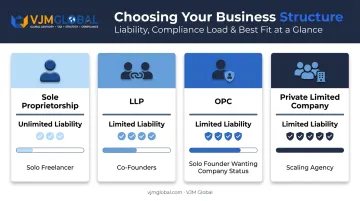
Your entity choice affects three things immediately: personal liability, tax and compliance load, and how seriously corporate or international clients take you. A sole proprietorship might save you paperwork today but cost you a six-figure client contract tomorrow.
Sole Proprietorship / Freelance Setup
This works if you're a one-person consultancy running SEO audits or managing a handful of social accounts. Setup is minimal and cheap. The catch: there's no legal separation between you and the business, so personal assets are on the hook if something goes wrong contractually.
Limited Liability Partnership (LLP)
Ideal when you've got a co-founder, say a marketer paired with a developer or designer. An LLP gives both partners limited liability while keeping compliance lighter than a private company. Startup India guidance notes that audit becomes mandatory once turnover exceeds ₹40 lakh or partner contribution crosses ₹25 lakh.
One Person Company (OPC)
Built for solo founders who want a corporate identity and limited liability without bringing in a partner. The old rule that forced OPCs to convert to a private limited company once turnover crossed ₹2 crore was scrapped by the Companies (Incorporation) Second Amendment Rules, 2021. Conversion is now voluntary, not mandatory.
Private Limited Company
The go-to for agencies planning to scale, hire a team, or land large corporate and international clients. It offers the strongest credibility, supports outside investment, and allows multiple shareholders, though it carries the heaviest compliance load of the four.
| Structure | Liability | Compliance Load | Best For |
|---|---|---|---|
| Sole Proprietorship | Unlimited | Lowest | Solo freelancers, first clients |
| LLP | Limited | Moderate | Two or more co-founders |
| OPC | Limited | Moderate-High | Solo founder wanting company status |
| Private Limited | Limited | Highest | Scaling agencies, investor-ready teams |
For NRIs, OCIs, and foreign nationals: OPC registration generally isn't available to non-residents, since it requires an Indian resident shareholder and nominee. Private Limited Company remains the most practical route, subject to FDI and FEMA reporting.
VJM Global works with foreign founders on entity selection, resident director arrangements, and RBI reporting, ensuring the structure holds up from day one rather than creating compliance gaps later.
How to Register a Digital Marketing Company in India – Step by Step
Once you've settled on a structure, the actual registration follows a predictable sequence. The most common mistakes at this stage:
- Rushing name selection without a trademark check
- Delaying GST registration until a client demands an invoice
- Writing vague MOA business objectives that don't cover the services you actually offer
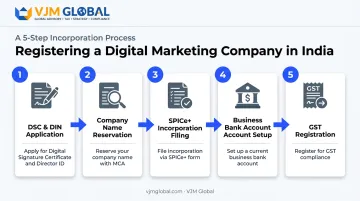
Step 1 – Obtain Digital Signature Certificate (DSC) and Director Identification Number (DIN)
Every proposed director or designated partner needs a DSC to digitally sign incorporation documents. It's issued by a licensed Certifying Authority and typically valid for one to two years.
DIN is a unique identification number applied for through the SPICe+ form itself. Up to three proposed directors can request their DIN in the same filing.
Step 2 – Reserve Your Company Name
Use SPICe+ Part A (RUN service) to check availability and reserve a name for your agency. Two quick tips:
- Avoid names that closely resemble existing trademarks, even outside Class 35
- Check domain availability at the same time so your brand and web presence line up
Step 3 – File SPICe+ for Incorporation
SPICe+ is an integrated form that handles incorporation, PAN, TAN allotment, and MOA/AOA submission in a single filing. You'll need:
- Identity and address proof of all directors/partners
- Registered office proof (rent agreement, utility bill, or NOC)
- MOA outlining your business objectives — be specific about the services you'll offer
- AOA covering internal governance rules
Once documents are filed correctly, the Central Registration Centre examines the application and either approves it or flags resubmission requirements.
Step 4 – Open a Business Bank Account
Your Certificate of Incorporation, PAN, and board resolution are what banks need to open a current account. Do this before you invoice a single client. Mixing personal and business funds creates headaches later.
Step 5 – GST Registration for Digital Marketing Services
GST registration becomes mandatory once your aggregate turnover crosses ₹20 lakh in a financial year (₹10 lakh in Manipur, Mizoram, Nagaland, and Tripura), according to a CBIC GST update from May 2019. It's also triggered immediately if you're billing clients outside your home state, though a specific exemption under Notification No. 10/2017 lets small interstate service suppliers stay unregistered while under the threshold.
Registering voluntarily and early has real upside: it builds credibility with larger clients who expect a GSTIN on invoices, and it lets you claim input tax credit on ad platform subscriptions, design software, and analytics tools. Many founders handle these filings themselves, but firms like VJM Global routinely manage SPICe+ incorporation and GST registration for international founders setting up in India, catching documentation gaps before they cause registrar delays.
Post-Registration Compliance & Additional Registrations to Consider
Incorporation is only the first legal step. A handful of additional registrations deserve priority immediately afterward.
MSME (Udyam) Registration is free and takes minutes online through self-declaration. It unlocks:
- Access to collateral-free credit through CGTMSE-backed lenders
- Eligibility for the government's 25% MSE procurement quota, including free tender sets
- Delayed-payment protection under MSME Samadhaan, capping payment terms at 45 days
Trademark Registration protects your agency's name and logo under Class 35 (advertising and business services). Filing fees run ₹4,500 (e-filing) for individuals, startups, and small enterprises, or ₹9,000 for others, per mark, per class. This registration doesn't grant a license to operate; it simply stops competitors from registering your brand name once you've built recognition.
Startup India (DPIIT) Recognition applies only if your agency demonstrates genuine innovation or a scalable model, not simply being newly incorporated. Alongside that, standard ongoing obligations apply regardless of DPIIT status:
- Filing INC-20A (commencement of business) shortly after incorporation
- Annual ROC filings
- Professional tax where applicable
- Periodic GST returns
Conclusion
Registering a digital marketing company in India isn't complicated once you sequence it correctly:
- Pick the right business structure (Proprietorship, LLP, or Private Limited)
- Complete SPICe+ incorporation with the MCA
- Register for GST once your turnover crosses the threshold
- Layer in MSME and trademark protection as the business grows
Getting this foundation right early saves you from costly delays down the road, especially once bigger corporate or international clients start asking for compliance documentation before signing.
For entrepreneurs, NRIs, or foreign investors who'd rather not navigate FDI rules and RBI reporting alone, VJM Global's business setup team handles incorporation, GST, and ongoing compliance end to end.
Frequently Asked Questions
Is there a specific "digital marketing license" required in India?
No dedicated marketing license exists. Compliance instead revolves around standard business registration, GST (once applicable), and optional trademark protection for your brand.
Which business structure is best for a digital marketing agency, LLP, OPC, or Private Limited?
It depends on team size and growth plans. Private Limited suits agencies scaling toward corporate or international clients, LLP works well for two or more co-founders, and OPC fits solo founders wanting corporate status.
Is GST registration mandatory for digital marketing companies?
It's mandatory once aggregate turnover crosses ₹20 lakh (₹10 lakh in a few special-category states), or sooner if you're billing clients in other states. Voluntary early registration helps with credibility and input tax credit claims.
Can NRIs or foreign nationals register a digital marketing company in India?
Yes, digital marketing services generally fall under the 100% FDI automatic route, subject to FEMA and RBI reporting requirements like Form FC-GPR. Professional guidance helps avoid missteps on resident director and reporting rules.
How long does it take to register a digital marketing company in India?
Most founders complete SPICe+ incorporation in 1 to 3 weeks when documentation is accurate and complete upfront. Delays usually stem from name rejections or incomplete address proof.
What is the total cost to register a digital marketing company in India?
Government fees typically range from a few thousand rupees for LLPs to around ₹15,000-20,000 for private limited companies, excluding professional service fees. Trademark filing adds ₹4,500-9,000 per class if you choose to protect your brand.