Introduction
Singapore companies increasingly source from India, drawn by competitive pricing and manufacturing scale. Bilateral trade reached USD 34.3 billion in FY 2024-25, with Singapore accounting for nearly 28% of India's ASEAN trade. Yet verifying a supplier's real capabilities demands more than a brochure or video call — a factory audit delivers on-the-ground visibility into quality systems, labor practices, production capacity, and compliance standing before you commit to any purchase order.
Singapore buyers face a specific challenge here. India's regulatory framework spans central and state-level laws: the Factories Act, 1948; recently implemented Labour Codes; and environmental regulations under the EPA, 1986. These create compliance layers materially different from Singapore's streamlined approach.
The stakes are concrete. QIMA audit data reveals 29% of Indian factories had critical health and safety violations in 2023 — over twice the rate in mature markets like China (11%). Parliament records show at least 6,500 workers died in industrial accidents over five years, meaning factory audits address documented safety patterns, not hypothetical concerns.
This guide walks Singapore companies through audit types, a practical checklist tailored to Indian conditions, the step-by-step process, key regulations, and common pitfalls to avoid.
Key Takeaways
- Factory audits in India assess quality systems, production capacity, labor compliance, safety standards, and documentation — not just product inspection
- Match audit type (quality, social compliance, environmental, capability) to your sourcing risk and product category
- Cover facility conditions, workforce compliance, production processes, quality management systems, and supply chain controls in your checklist
- India's Factories Act, Labour Codes, and export documentation requirements differ significantly from Singapore's framework
- Working with experienced local partners reduces risks from language gaps, regulatory blind spots, and documentation irregularities
Types of Factory Audits Singapore Companies Should Commission in India
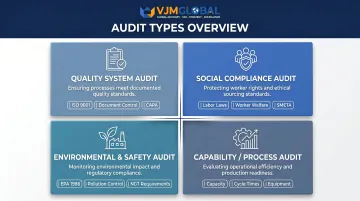
Choosing the wrong audit type leads to incomplete evaluation. Define your primary concern — product quality, worker welfare, environmental risk, or production capacity — then match it to the right format. The four audit types below cover the full range of risks Singapore buyers typically encounter with Indian suppliers.
Quality System Audit
For Singapore buyers sourcing manufactured goods, this is usually the starting point. It evaluates whether the factory's quality management systems genuinely meet standards like ISO 9001 — beyond what marketing materials claim. The audit covers:
- Document control and internal audit processes
- Nonconformance handling and CAPA effectiveness
- Calibration of measurement equipment
- Management review records
Social Compliance Audit
Essential for companies with ESG commitments or brand reputation exposure, this audit verifies adherence to Indian labor laws and global ethical standards through:
- Employment contracts in local language
- Age documentation verification (preventing child labor)
- Working hours and overtime logs (9-hour/day, 48-hour/week limits under Factories Act)
- PPE availability and worker grievance channels
- Confidential worker interviews to surface issues official records may conceal
SMETA audits, the world's most widely used social audit format, logged over 60,000 audits globally in 2023 — making it the benchmark format most Singapore buyers recognize.
Environmental and Safety Audit
This audit covers compliance with the Environment Protection Act, 1986 and National Green Tribunal requirements, reviewing:
- Pollution control systems and Consent to Operate from State PCBs
- Hazardous waste disposal records
- Effluent treatment plant operational status (not just installation)
- Fire safety equipment and emergency exits
- Safety drill documentation
The NGT imposed a ₹1 crore fine on BPCL in April 2026 for environmental violations — a reminder that a supplier's non-compliance can create reputational and supply chain liability for the buyer.
Capability / Process Audit
Before placing a first large order or scaling an existing relationship, Singapore buyers need confidence in actual delivery capacity — not quoted capacity. This audit validates real-world output by observing:
- Cycle times and shift patterns
- Equipment maintenance records
- Work-in-progress buffers
- Bottleneck identification
Most relevant when order volumes are increasing or the supplier relationship is new.
The Factory Audit Checklist: What to Examine in Indian Factories
A thorough factory audit checklist is structured by risk area, with every finding supported by documented evidence linked to a specific clause.
General Facility Conditions and Safety
Key items to verify:
- Structural integrity of buildings
- Fire safety equipment presence, accessibility, and maintenance records
- Clear emergency exit signage and unobstructed pathways
- Adequate lighting and ventilation
- Pest control and 5S housekeeping practices
- Waste disposal systems
Auditors should verify whether safety notices required under the Factories Act are visibly displayed. Under Section 92 of the Factories Act, contraventions carry imprisonment up to 2 years and/or fines up to Rs 1,00,000; where safety violations result in death, the minimum fine is Rs 25,000.
Inadequate facility conditions are frequently cited as root causes of production disruptions. The 2022 Delhi factory fire that killed 27 workers occurred in an electronics unit lacking requisite licenses and fire clearances — a preventable tragedy that highlights the cost of superficial audits.
Workforce and Labor Compliance
Critical verification points:
- Employment contracts in the local language
- Employee records confirming legal working age (14+ years; hazardous work prohibited until 18)
- Attendance and overtime logs complying with 9-hour/day and 48-hour/week limits
- Wages meeting or exceeding Minimum Wages Act requirements (currently Rs 783/day central rate for unskilled workers; Delhi's skilled rate reaches Rs 843/day)
- PPE issuance records and first-aid station stocking
Conduct confidential worker interviews to surface grievances, coercion, or unpaid overtime that official records may conceal. This step is especially important for Singapore companies with global ethical sourcing policies or buyers signatory to international standards like SMETA.
Production Capability and Quality Management Systems
What to check:
- Machinery inventory with calibration status and serial numbers
- Preventive maintenance history
- Process flow from raw materials to finished goods
- Takt time alignment against claimed order capacity
- Statistical process control at critical-to-quality checkpoints
- Golden sample retention practices
Confirm whether key processes are performed in-house or subcontracted, as undisclosed outsourcing is a common risk in Indian manufacturing supply chains.
Quality documentation should include:
- Inspection and test plans with AQL limits
- Nonconforming product segregation and quarantine records
- Management review minutes
- Valid ISO 9001 certification (verify it has not lapsed or been misrepresented)
Supply Chain and Raw Material Controls
Sound quality management at the factory level is only as strong as the inputs feeding into it. Trace raw materials through the full supply chain to confirm controls hold end-to-end:
- Approved vendor list and whether sub-suppliers meet the same compliance criteria
- Incoming quality control inspection records with certificates of analysis
- Lot and batch traceability from raw materials to finished goods
- Quarantine procedures for rejected materials
For Singapore importers in regulated product categories — electronics, food, pharmaceuticals — gaps here can trigger customs holds or product recalls at the point of entry.
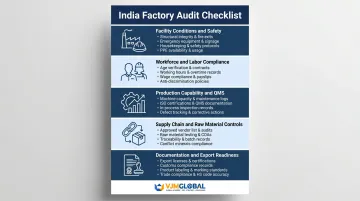
Documentation, Licensing, and Export Readiness
Indian factories must hold valid documentation renewed periodically. Cross-check these against official registries:
Mandatory documents:
- Factory registration and licenses (renewed annually)
- IEC (Importer-Exporter Code) — 10-digit code mandatory for export
- GST registration and filing status
- LUT (Letter of Undertaking) for zero-rated exports filed before each financial year
- RCMC (Registration cum Membership Certificate) for export incentive eligibility
- Product-specific certificates: BIS, FSSAI, or GMP approvals
Verifying these documents requires familiarity with Indian regulatory registries and filing cycles — areas where working with an India-based compliance advisor pays off. VJM Global's GST and export compliance advisory helps Singapore companies validate supplier documentation and flag irregularities before committing to a supplier relationship.
How to Conduct a Factory Audit in India: A Step-by-Step Guide
A structured audit process ensures no critical area is missed and findings are documented in a form Singapore buyers can act on.
Step 1: Define Scope and Prepare the Audit Checklist
Decide the audit type(s) required, applicable standards (ISO 9001, Factories Act, environmental regulations), and coverage areas. Customize the checklist to the product category and factory size before the site visit.
Step 2: Send a Pre-Audit Pack and Schedule the Visit
Request these documents in advance:
- Organizational chart
- Process flow diagrams
- Production capacity data (lines, shifts, units per hour)
- Last 12 months of defect or nonconformance trends
- Factory licenses and training logs
- Recent internal audit reports
Sharing the checklist outline with the factory improves efficiency while still allowing auditors to verify actual practices on-site. Account for India's regional logistics and potential language barriers when scheduling.
Step 3: Conduct the On-Site Audit
The on-site audit begins with an opening meeting to confirm scope and access, followed by a systematic walkthrough covering:
- Production floor
- Incoming materials inspection area
- In-process and outgoing QC stations
- Testing laboratories
- Warehouses and packaging zones
- Worker facilities (for social compliance)
Conduct interviews with both management and workers. Document every finding with time-stamped photographs and record references linked to checklist clauses.
Step 4: Score Findings and Hold a Closing Meeting
Categorize findings by severity — critical, major, or minor — with each nonconformance tied to its compliance risk. The closing meeting should cover:
- Presenting preliminary findings to factory management
- Aligning on containment timelines for each nonconformance
- Clarifying evidence requirements for corrective actions
Step 5: Issue the Audit Report and Track Corrective Actions
The final audit report should include:
- Executive summary
- Overall score or grade
- Evidence-supported findings linked to the checklist
- CAPA plan assigning responsibility, root cause analysis, and deadlines
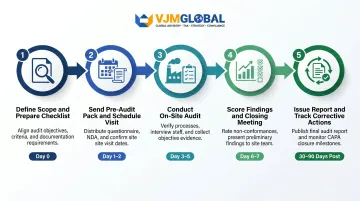
Schedule effectiveness checks 30–90 days post-implementation and plan re-audits for critical or systemic failures. VJM Global supports Singapore companies in interpreting audit findings within India's regulatory context, including tax compliance, labor law documentation, and export readiness, as well as managing ongoing compliance requirements.
Key Indian Regulations Singapore Buyers Must Understand Before Auditing
India's regulatory environment combines central legislation with state-specific rules, creating a compliance landscape significantly different from Singapore's. Understanding this complexity before auditing helps set realistic checklist thresholds. Four regulatory areas deserve particular attention.
The Factories Act, 1948 and OSH Code, 2020
The Factories Act governs worker safety, health, and welfare, applying to factories with 10+ power-assisted workers or 20+ non-power workers. It covers:
- Ventilation and temperature
- Fencing of machinery
- Working hours limits
- Welfare facilities
The Occupational Safety, Health and Working Conditions (OSH) Code, 2020 is progressively subsuming many Factories Act provisions, though full implementation across states remains in transition. Auditors should verify whether the factory's compliance documentation reflects both the legacy Act and the newer Code — particularly in states where the Code has already been notified.
Labor and Social Compliance Laws
Your audit checklist should reference all major labor statutes:
- Payment of Wages Act, 1936
- Minimum Wages Act, 1948
- Employees' Provident Fund Act, 1952
- Maternity Benefits Act, 1961
- Contract Labour (Regulation and Abolition) Act, 1970
- Industrial Relations Code, 2020
Note that some state governments set higher minimum wages or more stringent overtime rules than central standards, affecting how audit findings should be scored.
Environmental Compliance Requirements
Under the Environment Protection Act, 1986, factories must:
- Control air, water, and noise pollution
- Maintain waste disposal records
- Hold valid Consent to Establish and Consent to Operate from State Pollution Control Boards
The National Green Tribunal actively enforces these requirements and can order factory shutdowns for non-compliance. Verify that effluent treatment plants are operational, not just installed for inspection appearances.
GST Compliance and Export Documentation
Singapore buyers sourcing for export should verify:
- GST registration status
- LUT (Letter of Undertaking) for zero-rated export supply filed for the current financial year
- RCMC from Export Promotion Councils
- IEC (Importer-Exporter Code)
Gaps in any of these documents can delay shipments, trigger tax complications, or signal that a factory is not genuinely export-ready. If document verification feels outside your team's scope, working with an India-based compliance advisor — one familiar with both GST regulations and export frameworks — is worth considering before committing to a supplier.
Common Mistakes and Best Practices for Singapore Companies Auditing Indian Suppliers
Common Mistakes to Avoid
Most impactful errors:
- Accepting documentation at face value without triangulating against physical observation and worker interviews — this allows staged shipments or inflated completion claims to go undetected
- Relying on the factory's own translator without independent verification, which can cause misinterpretation of compliance status
- Failing to check whether critical production processes are performed in-house or subcontracted to unvetted third parties
- Applying a generic checklist without adapting to the product category — omitting dyeing effluent checks for textile factories, ESD controls for electronics, or allergen management for food factories
- Treating a one-time audit as sufficient, since production practices and workforce conditions can shift significantly between visits
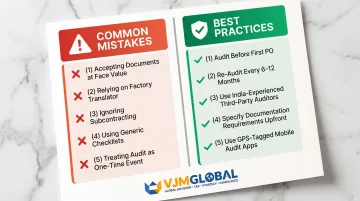
Best Practices for Singapore Buyers
Actionable recommendations:
- Schedule new supplier audits before placing any purchase order
- Plan re-audits at 6–12 month intervals for high-risk suppliers
- Use third-party auditors with proven India experience and local language capability
- Specify exact documentation requirements in the pre-audit pack
- Leverage mobile audit apps that capture GPS-tagged, time-stamped photo evidence
The audit report is most valuable as a supplier development roadmap. Pair findings with structured CAPA timelines and targeted training — then verify progress. That cycle turns compliance gaps into stronger, more reliable supplier relationships.
Frequently Asked Questions
What should be included in an audit checklist?
A factory audit checklist should include facility conditions and safety, workforce and labor compliance, production capability, quality management systems, supply chain and raw material controls, and documentation and licensing. The specific items should be tailored to the product category and applicable regulatory standards.
What are the types of audits in the manufacturing industry?
The main types include quality system audits (ISO 9001 compliance), social compliance audits (labor and worker welfare), environmental audits, capability/process audits, and specialized industry audits (GMP for pharma, FSSAI for food). Each targets a different risk area depending on the buyer's sourcing priorities.
What is the safety audit checklist for a manufacturing company?
A safety audit checklist in India typically covers machinery guarding and fencing per Factories Act Section 21, fire safety equipment and emergency exits, PPE issuance and usage, hazardous materials handling, worker safety training records, and compliance with the OSH Code, 2020.
What is an ISO audit checklist?
An ISO audit checklist (typically ISO 9001) evaluates document control, internal audit processes, management review records, nonconformance and CAPA handling, calibration of measurement equipment, and customer-specific requirements across all production processes.
How often should Singapore companies conduct factory audits in India?
New suppliers should be audited before the first purchase order and again at 6–12 months. High-risk categories (toys, food, pharma) may require quarterly or biannual audits. Mature, low-risk suppliers can move to annual reviews, with targeted mini-audits triggered by significant process changes.
Can factory audits in India be conducted remotely by Singapore companies?
Remote or hybrid audits using video conferencing, live production walkthroughs, and shared document portals are viable for lower-risk scopes. On-site audits remain more reliable, though — physical presence lets auditors detect staged goods, verify actual output, and conduct confidential worker interviews that remote formats cannot replicate.